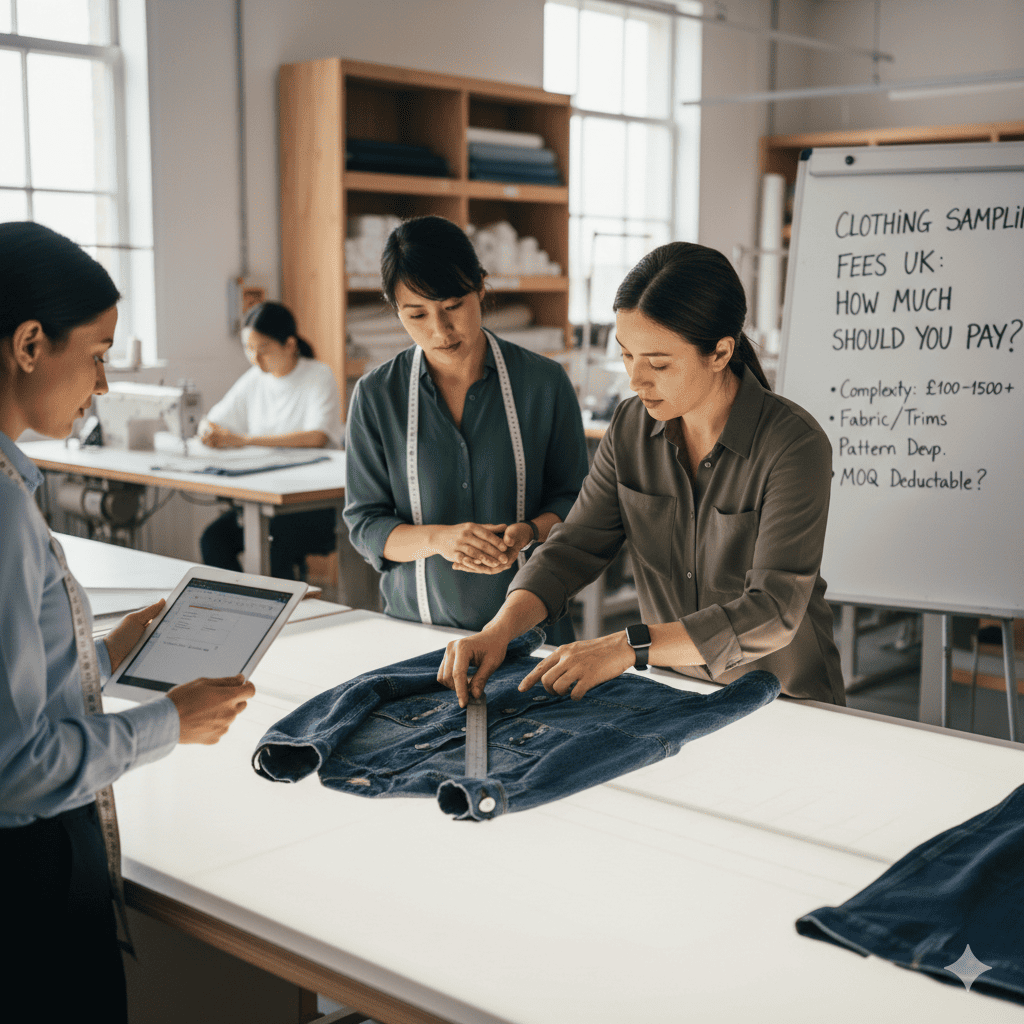
Most brands approach sampling fees as a cost to minimise.
That is the wrong frame entirely.
Sampling is the stage where a manufacturer proves they can build your product to your standard. A manufacturer who charges nothing for samples is either recovering the cost elsewhere — in production margin, in fabric substitution, in reduced pattern cutter time — or they are not running a serious development process. Neither outcome serves your brand.
The right question is not “how do I pay less for samples?” It is “what should I expect to pay for sampling that actually protects my production investment?” Those are different questions. They produce different decisions.
For context on the full production process that follows sampling, see the Complete Guide to Clothing Manufacturers in UK.
Post Summary
- What the three sample types actually cost in the UK in 2026 — proto, SMS, and production sample fees compared with real benchmark figures
- Why paying more for sampling is often the right commercial decision — and the brands that get this backwards
- When sampling fees are refundable — the specific contractual conditions that make recovery possible
- How to negotiate sampling fees without damaging the manufacturer relationship before it starts
- The four mistakes brands make with sampling that cost more than the samples themselves
Contents
- 1. What Are the Different Types of Clothing Samples?
- 2. Prototype (Proto) Sample Costs — UK 2026
- 3. Salesman Sample (SMS) Costs — UK 2026
- 4. Production Sample (PP) Costs — UK 2026
- 5. When Are Sampling Fees Refundable?
- 6. How to Negotiate Sampling Fees
- 7. How Many Sample Rounds Do You Need?
- 8. Four Mistakes Brands Make With Sampling
- 9. Frequently Asked Questions
- 9.1. How Much Should I Pay for a Clothing Sample in the UK in 2026?
- 9.2. Is It Normal to Pay for Samples from a UK Clothing Manufacturer?
- 9.3. How Do I Negotiate Sampling Fees with a UK Garment Manufacturer?
- 9.4. What Is the Difference Between a Proto Sample and a Salesman Sample?
- 9.5. When Are Sampling Fees Refundable in the UK?
What Are the Different Types of Clothing Samples?
Three distinct sample types sit between your brief and your bulk production order. Each serves a different purpose. Each carries a different cost. Conflating them — or skipping one — produces specific, predictable problems downstream.
| Sample Type | Purpose | Who Approves | Typical Stage |
|---|---|---|---|
| Prototype (Proto) | Construction and fit proof — is the pattern correct? | Brand technical team | Pre-SMS |
| Salesman Sample (SMS) | Sales and marketing — represents the final product | Brand commercial team | Pre-bulk order |
| Production Sample (PP) | Confirms bulk production standards before cutting begins | Brand QC sign-off | Pre-production start |
Each stage answers a different question. The proto answers: can the factory build this garment? The SMS answers: does this garment represent what we are selling? The production sample answers: is the factory ready to produce at bulk standard?
Skipping the proto produces an SMS that does not fit. Skipping the SMS produces a production sample the sales team has never approved. Skipping the production sample produces a bulk run that may differ materially from what the brand signed off.
Prototype (Proto) Sample Costs — UK 2026
UK sampling fees reflect the actual labour cost of skilled pattern cutters and sample machinists. The National Living Wage of £12.71/hour from April 2026 sets a floor. Senior pattern cutters and sample room specialists command significantly more (Source: GOV.UK / Low Pay Commission).
| Garment Complexity | Proto Sample Fee (UK, 2026) | What Is Included |
|---|---|---|
| Basic jersey (t-shirt, vest) | £80–£180 | Pattern, cut, make — fabric supplied by brand |
| Casual woven (shirt, trouser) | £150–£280 | Pattern development, toile if required, sample make |
| Mid-complexity (unlined jacket, dress) | £250–£450 | Full pattern development, fit allowances, sample make |
| Complex structured (lined jacket, tailoring) | £400–£900 | Senior pattern cutter time, toile, fit session, sample |
| Technical / performance | £350–£800 | Specialist construction, bonding or seam sealing included |
Proto fees cover pattern development time — the largest variable. A t-shirt pattern from an existing block takes 2–4 hours. A tailored jacket pattern built from scratch takes 12–20 hours. At UK senior pattern cutter rates of £25–£45/hr, the fee range reflects real labour (Source: UKFT, 2024).
Salesman Sample (SMS) Costs — UK 2026
SMS fees are typically lower than proto fees because the pattern exists. The sample machinist is working from an approved pattern, not developing one.
| Garment Type | SMS Fee (UK, 2026) | vs Proto Fee |
|---|---|---|
| Basic jersey | £45–£120 | 40–60% of proto |
| Casual woven | £90–£200 | 50–70% of proto |
| Mid-complexity | £160–£320 | 55–75% of proto |
| Complex structured | £250–£550 | 55–65% of proto |
| Technical / performance | £200–£500 | 55–65% of proto |
“The SMS fee is not a second proto fee. The pattern work is done. You are paying for skilled sample room time — a specialist machinist making one garment at a level of finish that represents what you are selling. That time has a real cost regardless of volume.” — Silk Routes Manufacturing Team
Production Sample (PP) Costs — UK 2026
Production samples are made from the actual bulk production fabric, with the actual bulk trims, on the production floor. They are the final quality gate before cutting begins.
| Garment Type | PP Sample Fee (UK, 2026) |
|---|---|
| Basic jersey | £35–£90 |
| Casual woven | £70–£160 |
| Mid-complexity | £130–£280 |
| Complex structured | £200–£450 |
| Technical / performance | £180–£420 |
PP samples are less expensive than proto or SMS because they are made by production operators rather than specialist sample machinists. The cost difference reflects the operator rate differential — production machinists earn less per hour than sample room specialists.
Some manufacturers include one PP sample in their production quote. Many charge separately. Clarify before the order is placed.
When Are Sampling Fees Refundable?
The standard industry position in UK clothing manufacturing is that sampling fees are non-refundable — the labour has been performed and cannot be recovered regardless of whether the brand proceeds to production.
However, refundable — or production-offset — arrangements do exist under specific conditions.
Production offset (most common). The sampling fee is credited against the first production order when the brand places bulk with the same manufacturer. This is not a refund — the fee is paid upfront and deducted from the production invoice. Standard credit terms: 50–100% of sampling cost offset against the first order above a minimum quantity threshold (typically 200–300 units per style).
The brand must proceed to production with that manufacturer. If production goes elsewhere, the offset is forfeited. This is the manufacturer’s protection against brands using their sample room as a development resource and producing elsewhere.
Partial refund on manufacturer fault. If a sample is materially wrong due to the manufacturer’s error — not the brief, not the spec, not the pattern — a responsible manufacturer will remake at no charge or offer a partial credit. The error must be clearly documented and attributable to the factory.
Full refund conditions — rare. Typically only when the manufacturer cannot source the agreed fabric or materials and cannot fulfil the sample at all. Secure this in writing before any money transfers.
If you want to understand how Silk Routes handles sampling costs and what our production offset terms look like, our clothing manufacturing services page covers our development process.
How to Negotiate Sampling Fees
Negotiate the offset, not the fee. The fee reflects real labour cost. The offset — the proportion credited against production — is commercially negotiable. A manufacturer who will not reduce the upfront fee may agree to offset 75% rather than 50% against the first production order. That is the same economic outcome as a partial fee reduction, with less resistance.
Lead with your production plan. A brand that opens a sampling conversation with “here is our 12-month production plan — we expect to place three orders per year at 400 units per style” is a different commercial prospect than a brand asking for cheap samples with no context. The first brand is worth investing sampling resource in. The second is an unknown risk.
Offer to supply fabric for the proto. Manufacturers price proto samples on the assumption they are sourcing or holding sample fabric. A brand that supplies the proto fabric removes that cost from the manufacturer and has a legitimate basis to request a reduced fee.
Ask about multi-style sampling rates. Brands sampling three or four styles simultaneously have more negotiating leverage than brands sampling one. The manufacturer is more efficient running multiple samples in parallel — some of that efficiency is available as a fee concession.
Do not negotiate proto fees below the point of quality. A pattern cutter paid below their market rate to rush a pattern will produce a pattern that requires correction. The correction costs another sample round. The cost of the underpaid sample plus the correction almost always exceeds the fee you were trying to avoid.
How Many Sample Rounds Do You Need?
| Scenario | Typical Sample Rounds | Budget Indication |
|---|---|---|
| Clear brief, simple garment, experienced manufacturer | 1 proto + 1 PP | Proto + PP fees only |
| Clear brief, complex garment | 1–2 proto + 1 SMS + 1 PP | Proto (×1–2) + SMS + PP |
| Unclear brief, any garment | 2–4 proto rounds | Multiple proto fees — brief-dependent |
| Bespoke / pattern from scratch | 2–3 proto + fit sessions + SMS + PP | Full development cost |
| First-time brand, new manufacturer | 1–2 proto + 1 SMS + 1 PP | Budget for two proto rounds minimum |
The most expensive sampling scenario is an unclear brief. Arriving at the sampling stage with a complete tech pack, a clear fabric specification, and a physical reference garment is the single most effective cost-reduction measure in the sampling process — more effective than fee negotiation.
Four Mistakes Brands Make With Sampling
Choosing a manufacturer on sampling fee rather than sampling capability. A manufacturer charging £120 for a proto on a lined jacket is not offering a discount — they are either not running a full pattern development process or recovering the cost in the production quote. Assess sampling fees against what the fee includes, not against the lowest number available.
Not getting the offset terms in writing before paying. A verbal agreement that “the sampling cost comes off your first order” is not enforceable. Specify the percentage, the minimum order quantity that triggers it, and the time limit in a written agreement before any fee is transferred.
Approving a sample remotely without a fit session. A sample approved from photographs is not an approved sample — it is a photograph of a sample. Garments approved without a live fit session on an appropriate model or fit form routinely produce fit corrections in production.
Treating the SMS as the production standard. The SMS is made in the sample room to a show standard. The PP sample — made on the production floor from actual bulk fabric — is the production standard. Brands that approve the SMS and skip the PP sample discover the production standard at the point of bulk delivery, not before.
Frequently Asked Questions
How Much Should I Pay for a Clothing Sample in the UK in 2026?
For a proto sample, budget £80–£180 for basic jersey garments, £150–£280 for casual wovens, and £400–£900 for complex structured garments such as lined jackets. SMS fees run at 50–70% of proto fees on the same garment. PP samples are typically 40–60% of proto fees. These ranges reflect actual UK pattern cutter and sample machinist labour costs at 2026 National Living Wage rates with skilled worker premiums applied (Source: UKFT, 2024; GOV.UK).
Is It Normal to Pay for Samples from a UK Clothing Manufacturer?
Yes — paying for samples is standard practice in UK clothing manufacturing. A manufacturer who offers free samples on a first engagement is recovering that cost somewhere — typically in production margin, fabric substitution, or reduced pattern development time. The exception is brands with a long-term production relationship where the manufacturer absorbs sample costs as a relationship investment. For new clients, expect to pay.
How Do I Negotiate Sampling Fees with a UK Garment Manufacturer?
Negotiate the production offset rather than the upfront fee — ask for 75–100% of sampling cost credited against the first production order rather than attempting to reduce the fee directly. Lead with your production plan to establish commercial context. Offer to supply the proto fabric to remove the fabric sourcing cost from the manufacturer’s calculation. Do not push fees below the point where the quality of the process is affected.
What Is the Difference Between a Proto Sample and a Salesman Sample?
A proto (prototype) sample proves the pattern and construction — it answers whether the manufacturer can build the garment correctly, and may not use the final fabric or trims. A salesman sample (SMS) is made from the final or representative fabric and trims, finished to show standard, and represents what will be sold. The proto is the technical gate. The SMS is the commercial gate. Both are required for any garment above basic jersey construction.
When Are Sampling Fees Refundable in the UK?
Standard UK sampling fees are non-refundable — the labour has been performed regardless of whether production proceeds. Production offsets — where the sampling fee is credited against the first bulk order — are available from most manufacturers under written agreement, typically covering 50–100% of sampling cost against a minimum order threshold. Full refunds apply only when the manufacturer cannot fulfil the sample due to their own inability to source agreed materials. Always secure refund and offset conditions in a written agreement before paying any sampling fee.