Contents
- 1.
- 2. Is This Childrenswear Design Safety-Ready?
- 2.1. Interactive Safety-Ready Checker
- 2.2. Four Safety Review Zones
- 2.3. Safety Area Decision Table
- 2.4. Childrenswear Safety Checkpoint Flow
- 2.5. Pre-Production Timeline
- 2.6. Authoritative Reference Links
- 2.7. Labelling Requirements for UK Childrenswear
- 2.8. UK Children’s Clothing Manufacturers — What to Look For
- 2.9. MOQ and Lead Times for Childrenswear UK
- 2.10. Cost of UK Children’s Clothing Manufacturing
- 2.11. Organic Children’s Clothing UK
- 2.12. How to Brief a UK Children’s Clothing Manufacturer
- 2.13. Common Childrenswear Compliance Mistakes
- 2.13.1. 1. Designing First and Checking Safety Later
- 2.13.2. 2. Using Adult Garment Details on Children’s Clothing
- 2.13.3. 3. Treating Small Parts as Decoration Only
- 2.13.4. 4. Assuming Supplier Documentation Is Enough
- 2.13.5. 5. Using One Safety Approach for Every Age
- 2.13.6. 6. Leaving Labels Until the End
- 2.14. How Silk Routes Supports Childrenswear Brands
- 2.15. FAQ
- 2.15.1. What safety standard applies to cords and drawstrings in children’s clothing?
- 2.15.2. Are small parts allowed on children’s clothing?
- 2.15.3. Does UK REACH apply to children’s clothing?
- 2.15.4. Does all children’s clothing need the same flammability testing?
- 2.15.5. What should I ask a children’s clothing manufacturer before ordering?
- 2.16. Build Safety Into the Product Before Production
A children’s hoodie can look completely normal and still contain a design problem.
A drawcord may be too long. A decorative component may detach. A finish may not be suitable for the intended age group. A garment may be labelled incorrectly.
That is why choosing children’s clothing manufacturers UK is not only about price, fabric and MOQ.
Childrenswear needs tighter control over design, components, testing, documentation and age suitability.
For founders entering this category, the manufacturer should understand those risks before sampling starts.
Post Summary
Childrenswear carries stricter safety expectations than adult fashion
BS EN 14682 is a key reference for cords and drawstrings
UK REACH affects restricted chemical substances in textile products
Small parts, trims and fastenings need age-appropriate assessment
Flammability requirements depend on the product category
Labelling needs to be accurate and complete
Manufacturer selection should include compliance experience, not only sewing capability
MOQ and cost depend heavily on testing, trims, age range and fabric choice
Safety checks should be built into the brief before production
Why Childrenswear Has Stricter Manufacturing Requirements Than Adultwear
Children interact with clothing differently from adults.
They pull, chew, climb, run and sleep in garments.
That changes the risk profile.
A component that is harmless on an adult jacket may become a hazard on a child’s garment.
Key areas include:
Cords and drawstrings
Small detachable parts
Buttons and snaps
Zips
Decorative trims
Chemical finishes
Flammability
Age suitability
Labelling
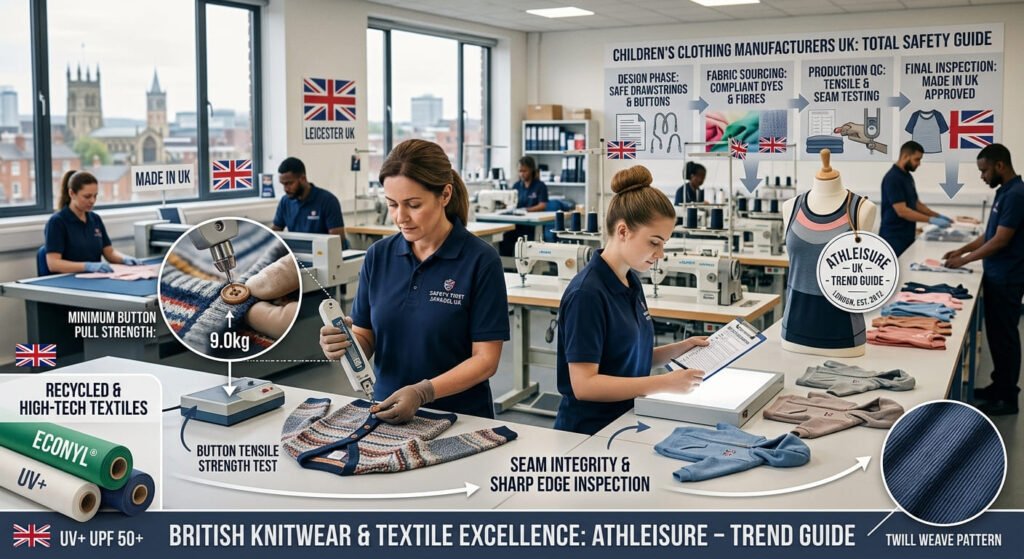
The supplied brief specifically identifies BS EN 14682, UK REACH, flammability, small parts and age grading as the core safety areas for this post.
Key Safety Standards for UK Children’s Clothing
| Safety Area | Main Risk | Manufacturer Check |
|---|---|---|
| Cords and drawstrings | Entrapment | Design against BS EN 14682 |
| Chemical substances | Restricted chemicals | Supplier/testing documentation |
| Flammability | Rapid ignition/spread | Product-specific requirements |
| Small parts | Detachment / choking | Attachment strength + age suitability |
| Fastenings | Injury / failure | Component and pull testing |
| Labels | Incorrect information | Fibre/content accuracy |
BS EN 14682 — Cords and Drawstrings
BS EN 14682 addresses cords and drawstrings on children’s clothing.
This matters because loose or long cords can create entrapment risks.
The standard considers areas such as:
Hood and neck cords
Waist cords
Hem cords
Sleeve cords
Free ends
Loops
Age group
A manufacturer making children’s hoodies, coats or trousers should understand those restrictions during design development.
The safer route is to remove unnecessary cords rather than try to fix them late in production.
Silk Routes Manufacturing Team: If a cord is not functionally necessary, question whether it should be there at all.
UK REACH Chemicals Regulations
Textiles placed on the UK market may also be affected by UK REACH restrictions.
The issue is not simply the fibre.
Chemicals may enter through:
Dyeing
Printing
Coatings
Finishes
Adhesives
Metal components
Plastics
That means the buyer should request appropriate material documentation from suppliers.
Where a risk exists, testing may be needed.
A manufacturer should be able to explain where fabrics and trims are sourced and what supporting documentation is available.
Flammability Requirements
Flammability requirements in childrenswear depend on the product.
Nightwear is particularly important because it is used close to the body during sleep.
Do not assume one flammability rule applies to every children’s garment.
The correct requirement depends on:
Product type
Age group
Fibre content
Construction
Intended use
The manufacturer should identify the applicable requirement before production.
Small Parts and Age Grading
Small components create another risk.
Examples include:
Buttons
Beads
Sequins
Decorative charms
Press studs
Zip pulls
A component should not detach easily.
That is especially important for baby and toddler clothing.
Age grading matters because the same trim may be acceptable for an older child but unsuitable for an infant.
The product brief should therefore include the intended age range.
Is This Childrenswear Design Safety-Ready?
Interactive pre-sampling safety review for cords, small parts, materials, flammability and labelling.
Interactive Safety-Ready Checker
Review your design before sampling
Four Safety Review Zones
Safety Area Decision Table
| Area | Typical Trigger | What to Review |
|---|---|---|
| Cords & drawstrings | Hoodies, jackets, trousers | Placement, loops, free ends and age suitability |
| Small parts | Buttons, beads, snaps, charms | Attachment strength and age suitability |
| Chemical / material controls | Dyed, printed, coated or treated fabric | Supplier documentation and applicable restricted-substance checks |
| Flammability | Especially sleepwear / nightwear | Identify product-specific requirement before production |
| Labels | All finished garments | Fibre, size, care, warnings and product information where applicable |
Childrenswear Safety Checkpoint Flow
Pre-Production Timeline
Authoritative Reference Links
- GOV.UK — UK REACH guidance
- BSI — British Standards information
- GOV.UK — Find your local Trading Standards office
- OEKO-TEX — textile testing and certification systems
Labelling Requirements for UK Childrenswear
Labelling is part of product control.
At minimum, brands should ensure that required information is accurate and consistent with the garment being sold.
Common label elements include:
| Label Element | Why It Matters |
|---|---|
| Fibre composition | Consumer information |
| Size | Correct fit and age selection |
| Care instructions | Garment maintenance |
| Brand / supplier information | Product identification |
| Country of origin where applicable | Supply-chain information |
| Safety wording where relevant | Product-specific warning |
The manufacturer should not guess label information.
The final label copy should be approved before bulk production.
For baby and children’s products, wording and placement also need practical consideration.
A label that is technically correct but causes irritation is still poor product design.
UK Children’s Clothing Manufacturers — What to Look For
Not every general clothing factory is suitable for childrenswear.
Look for evidence of relevant experience.
| Capability | Why It Matters |
|---|---|
| Childrenswear samples | Shows category experience |
| Cord/drawstring knowledge | Reduces design risk |
| Trim control | Important for small parts |
| Fabric traceability | Supports compliance |
| Testing process | Supports safety checks |
| Age grading | Helps product suitability |
| Label control | Reduces information errors |
| Quality documentation | Improves production consistency |
Ask the manufacturer:
What children’s products have you made?
Which age groups?
How are small parts checked?
How are cords and drawstrings reviewed?
What documentation is retained?
What testing can be arranged?
Who approves final trims?
Those questions are more useful than asking only for price.
MOQ and Lead Times for Childrenswear UK
There is no single meaningful MOQ for children’s clothing.
It depends on the product and production route.
MOQ pressure increases with:
More age groups
More sizes
More colours
Custom-dyed fabric
Custom trims
Special testing
Multiple styles
| Order Structure | Relative MOQ Pressure |
|---|---|
| One style, one colour | Lower |
| One style, several sizes | Moderate |
| Several colours | Higher |
| Custom fabric | Higher |
| Multiple age groups | Higher |
| Complex trims | Higher |
Lead time should also include compliance-related steps.
Those may include:
Fabric approval
Trim approval
Safety review
Sampling
Fit testing
Testing
Label approval
The brief requests MOQ and lead-time statistics, but there is no verified live 2026 source available here, so fixed figures are not included.
Cost of UK Children’s Clothing Manufacturing
Childrenswear cost depends on more than sewing time.
Important cost drivers include:
| Cost Driver | Lower-Cost Direction | Higher-Cost Direction |
|---|---|---|
| Fabric | Stock fabric | Custom fabric |
| Trim count | Few trims | Many trims |
| Size range | Narrow | Wide |
| Age range | One group | Multiple groups |
| Testing | Basic | More extensive |
| Construction | Simple | Complex |
| Labels | Standard | Multiple warnings / labels |
| Sampling | Fewer rounds | Multiple revisions |
Testing can add cost.
So can rejected trims or late design changes.
That is why safety decisions should be made early.
A low initial unit price is not useful if the design has to be rebuilt after testing.
Organic Children’s Clothing UK
Organic fibres can be part of a children’s collection.
But “organic” does not automatically mean “safe.”
The garment still needs appropriate control over:
Dyeing
Printing
Finishes
Trims
Fastenings
Construction
If a brand makes an organic claim, supporting certification or traceability should be available.
The Textile Exchange publishes standards and guidance relating to preferred fibres.
For textile testing and certification systems, OEKO-TEX is another established reference.
How to Brief a UK Children’s Clothing Manufacturer
A good brief should start with age.
Include:
Product type
Intended age group
Size range
Fabric composition
Fabric weight
Colour
Prints
Trims
Buttons
Snaps
Zips
Cords
Drawstrings
Labels
Care instructions
Quantity
Packaging
Testing requirements
For babywear, also flag:
Small detachable parts
Neck openings
Rough seams
Hard trims
Loose embellishments
For hoodies and outerwear, check:
Hood cords
Waist cords
Hem cords
Zip pulls
Toggles
If a design contains a questionable trim, raise it during sampling.
Do not wait for bulk production.
Brands developing children’s collections can review our clothing manufacturing services before preparing samples.
Common Childrenswear Compliance Mistakes
1. Designing First and Checking Safety Later
Why it happens: The product starts from appearance.
Why it fails: Safety changes may force redesign.
Fix: Review age and hazard points before sampling.
2. Using Adult Garment Details on Children’s Clothing
Why it happens: The same style is scaled down.
Why it fails: Adult trims and cords may be unsuitable.
Fix: Reassess every component for the child age group.
3. Treating Small Parts as Decoration Only
Why it happens: Beads and charms look harmless.
Why it fails: Detachment may create a hazard.
Fix: Review attachment strength and age suitability.
4. Assuming Supplier Documentation Is Enough
Why it happens: A fabric certificate is provided.
Why it fails: Other components may still introduce risk.
Fix: Review the full garment, not only the main fabric.
5. Using One Safety Approach for Every Age
Why it happens: The collection shares a design.
Why it fails: Infant and older-child risk profiles differ.
Fix: Define age groups clearly.
6. Leaving Labels Until the End
Why it happens: Labels feel administrative.
Why it fails: Fibre, care or warning information may be incorrect.
Fix: Approve label content before production.
How Silk Routes Supports Childrenswear Brands
Children’s clothing needs disciplined product development.
The process should connect design, fabric, trims, age range and testing.
Silk Routes can help organise:
Fabric requirements
Trim selection
Size and age range
Sampling
Labels
Production specifications
Quality-control checkpoints
For children’s collections, simplifying trims and avoiding unnecessary cords can also reduce risk.
You can learn more about our manufacturing background on the About Silk Routes page.
FAQ
No Google People Also Ask results were available for this keyword, so the questions below are buyer FAQs and are not presented as Google PAA data.
What safety standard applies to cords and drawstrings in children’s clothing?
BS EN 14682 is the key reference for cords and drawstrings in children’s clothing.
Check at least 3 areas during design: cord location, free-end length and age group.
Are small parts allowed on children’s clothing?
Some small components may be used, but they need appropriate attachment and age suitability.
Review at least 3 factors: component size, attachment strength and intended age group.
Does UK REACH apply to children’s clothing?
UK REACH can affect textile chemicals and restricted substances used in fabrics, finishes and components.
Check at least 4 material areas: fabric, print, coating and trims.
Does all children’s clothing need the same flammability testing?
No.
Requirements depend on the garment type and intended use, so the correct test should be identified before production.
What should I ask a children’s clothing manufacturer before ordering?
Ask about relevant childrenswear experience, testing, trims, age grading and documentation.
Compare at least 5 areas before choosing a supplier: product history, safety knowledge, testing, quality control and traceability.
Build Safety Into the Product Before Production
Childrenswear safety is easiest to manage when it is designed in from the beginning.
Age group, trims, cords, fabric, labels and testing should be treated as part of the same product-development process.
The manufacturer should not simply sew what is provided.
A suitable childrenswear supplier should be able to question risky details before they reach bulk production.
For wider specialist manufacturing guidance, see our Specialist Clothing Manufacturers UK guide.