
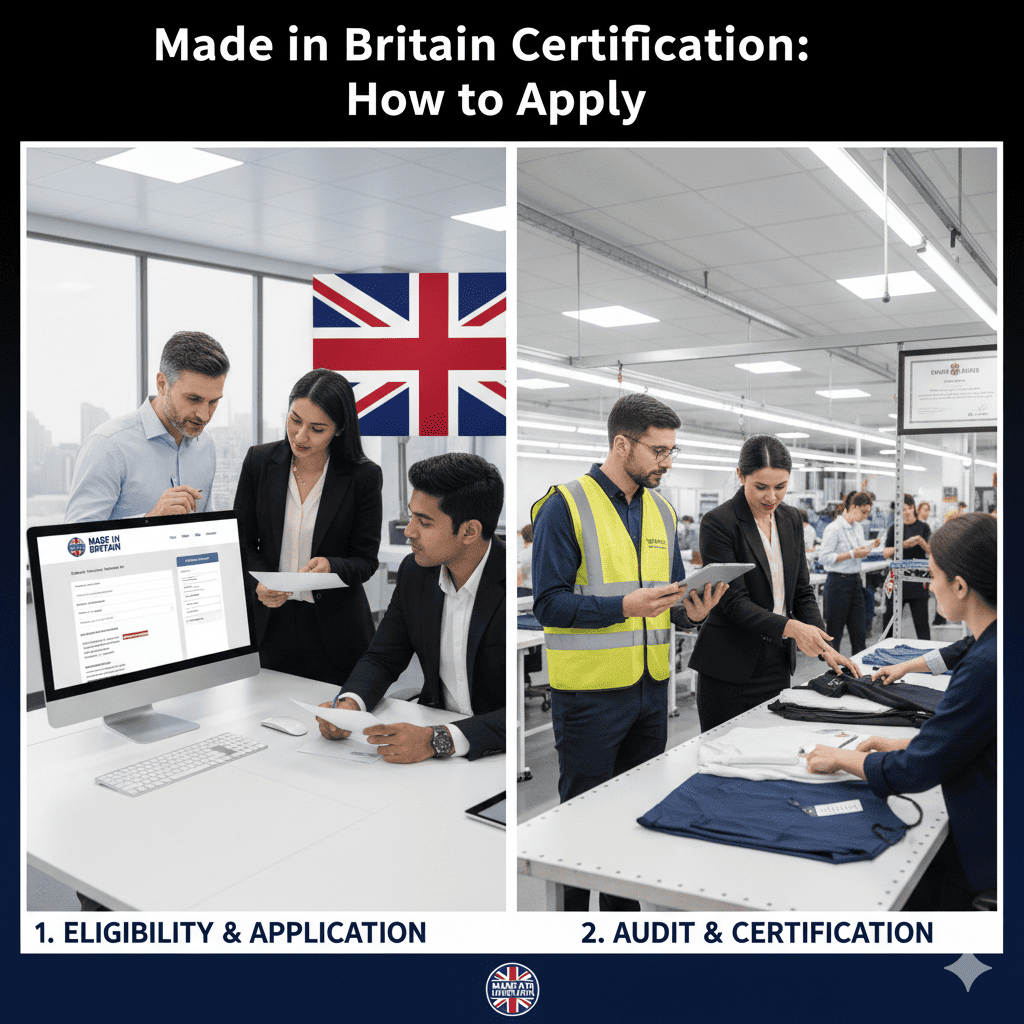
Sam had been manufacturing in the UK for two years before she realised the Made in Britain marque existed. When she applied, she assumed it would be complicated. It wasn’t.
But she also assumed all her products would qualify automatically because they were made in a UK factory. Two styles didn’t. Understanding why took her a week of back-and-forth with the Made in Britain team, time that a clear eligibility check upfront would have saved entirely.
This guide gives you the eligibility rules, the application steps, the cost reality, and the common mistakes Sam and brands like her make along the way. For context on how UK manufacturing fits your broader sourcing strategy, see our Complete Guide to Clothing Manufacturers in UK.
Post Summary
- The Made in Britain marque is a registered collective trademark, not a government standard, issued by a not-for-profit organisation to qualifying manufacturers
- Eligibility requires that 100% of the labour producing the finished product was carried out in Great Britain or Northern Ireland, and that any imported components underwent a substantial and transformative change there
- Membership fees are tiered by company turnover and reviewed periodically; always check the current published fee schedule before applying rather than relying on figures from an old guide
- The application process is straightforward but requires written evidence; verbal assurances from your UK factory aren’t sufficient
- Two styles in a range can have different eligibility outcomes if they use different fabric sourcing or production routes
- The commercial return on the marque, in wholesale relationships, press coverage, and customer trust, can be meaningful for brands that communicate it actively, though it’s worth knowing the scheme has also faced some public criticism over verification rigour
Contents
- 1. What Is the Made in Britain Certification?
- 2. Eligibility Criteria: Does Your Clothing Qualify?
- 3. Step-by-Step Application Process
- 4. Costs: Membership Fees and What’s Included
- 5. How to Use the Made in Britain Marque Correctly
- 6. Common Rejection Reasons: What to Avoid
- 7. Is It Worth It? Commercial Benefits of the Mark
- 8. Made in Britain: Questions Brands Ask Us
- 8.1. How long does the Made in Britain application take?
- 8.2. Can I use the Made in Britain marque if I manufacture some products offshore?
- 8.3. What is the difference between Made in Britain and Made in UK?
- 8.4. Does imported fabric disqualify my clothing from the Made in Britain mark?
- 8.5. How much does Made in Britain membership cost?
- 9. The Application Is the Easy Part: Getting Production Right Is the Foundation
What Is the Made in Britain Certification?
The Made in Britain marque is a registered collective trademark issued by Made in Britain, a not-for-profit organisation. It’s one of the better-known marks for British-manufactured goods, registered with the UK Intellectual Property Office.
It isn’t a government quality standard. It isn’t a legal requirement for describing products as British-made. What it provides is third-party association with a recognised mark, structured as a collective trademark registered with the UK Intellectual Property Office, indicating that goods bearing it originate from members of the organisation rather than just one trader, and members agree to a published Code of Conduct covering manufacturing location, ethical standards, and product safety as a condition of membership.
For clothing brands, it’s one of the more commercially recognisable credentials available. The Made in Britain directory is used by some buyers, press, and procurement professionals looking for UK-made suppliers. Membership creates a public-facing record of your manufacturing claim that self-declaration alone doesn’t provide.
Sam’s original question, whether she could just write “Made in UK” on her labels without applying, is a common one. The answer is that factual origin labelling is a separate matter governed by trading standards. The Made in Britain marque is an additional commercial credential, not a replacement for correct labelling.
Eligibility Criteria: Does Your Clothing Qualify?
The Origin Rules Explained Simply
To qualify for the Made in Britain marque, your product must meet two conditions simultaneously, based on the organisation’s published eligibility criteria:
Condition 1: 100% of the labour or human resource that makes the finished product carrying the trademark is based in Great Britain or Northern Ireland.
Condition 2: Raw materials or components have undergone a substantial and transformative change as a result of manufacturing processes that take place in Great Britain or Northern Ireland.
Both conditions must be met. A garment cut and sewn in Britain from British fabric meets both easily. A garment cut and sewn in Britain from imported fabric also meets both, because cutting and sewing constitutes a substantial and transformative change.
What “Substantially Made in Britain” Means in Practice
For clothing, the substantial transformation test is generally satisfied by garment construction, the cut, make, and trim process. Fabric weaving or knitting in another country doesn’t disqualify a garment if the construction happens in Britain.
However, the rule has limits. Garments where the only British involvement is finishing, for example labelling, pressing, or packing a completed garment made offshore, don’t meet the criteria. The transformation must be genuinely substantial, not cosmetic.
Practical examples for clothing brands: a jersey T-shirt cut and sewn in a UK factory from Turkish fabric qualifies. A structured jacket constructed in a UK factory from Italian woven fabric qualifies. A completed garment made in Bangladesh, imported, and labelled in a UK warehouse does not qualify.
This is why Sam’s two styles failed, they were constructed offshore and imported for finishing only. Her other styles, where UK factories performed the cut and make, qualified without issue.
Step-by-Step Application Process
Made in Britain’s application process runs through an online eligibility check followed by a full application. The time investment is typically a few hours for a well-prepared brand.
Step 1: Check eligibility. Before applying, confirm that your products meet both origin conditions above. Made in Britain provides an online eligibility test that walks through the key questions, whether your products are manufactured or assembled in Great Britain or Northern Ireland, how you manufacture (in-house or via a partner), and who owns the brand and intellectual property. If you manufacture through a UK factory partner like Silk Routes, request written confirmation that the garments are cut and made in Britain. This confirmation will be required during the full application.
Step 2: Complete the online application. Apply through the Made in Britain website. The application requests basic business details, product category, and a written description of your manufacturing process, specifically where the goods are made and what transformation occurs in Britain.
Step 3: Submit evidence. You’ll need to provide written evidence that your products are manufactured in Britain. This typically means a signed statement from your UK manufacturer confirming cut-and-make location, photographs of production in your UK factory, or, for established businesses, a history of invoices from a UK manufacturer.
Step 4: Agree to the Code of Conduct. Membership requires agreement to the Made in Britain Code of Conduct, a published set of commitments covering control of a UK factory or workshop, correct use of the mark only on qualifying products, fair working conditions, health and safety compliance, and adherence to modern slavery, anti-bribery, and product safety legislation.
Step 5: Pay your membership fee. Fees are charged annually based on company turnover, with the requirement to declare any change in turnover at renewal so you’re placed in the correct tier. Always check the current fee schedule directly on the Made in Britain website before applying, since published rates are reviewed and updated periodically.
Step 6: Receive your approval and member listing. On approval, your business is listed in the Made in Britain public directory, a searchable database used by buyers, press, and procurement teams seeking UK-made suppliers.
“The application itself is not the hard part. The hard part is having the documentation ready, a written statement from your UK factory, confirmation of where cut-and-make happens, and ideally a photograph of production. Brands that apply without this documentation add weeks to their approval timeline unnecessarily.” — Silk Routes Manufacturing Team
If you want to understand how Silk Routes structures manufacturing documentation for clients pursuing Made in Britain certification, our clothing manufacturing services page covers our process.
Costs: Membership Fees and What’s Included
Made in Britain membership fees are tiered by annual company turnover, with the organisation publishing and periodically updating its current fee schedule. Rather than quote specific figures here that may already be out of date by the time you read this, check the live fee tiers on the Made in Britain website directly before budgeting, since rates have changed before and will likely change again.
Membership typically includes a licence to use the Made in Britain marque on qualifying products and marketing materials, a public directory listing, a company profile page, access to export and international trade guidance, and eligibility for the organisation’s Environmental and Social Value (ESV) certification programme, a separate assessment of a company’s environmental and social practices.
The marque licence applies to qualifying products only. If a brand has both UK-made and offshore-made products in its range, the marque may only be used on the qualifying UK-made items.
Worth knowing before you commit: some independent reviews of Made in Britain have raised concerns about how rigorously membership claims are verified, including reports of no site visits being conducted and dissatisfaction with how disputed products were handled. This doesn’t mean the credential has no value, the Code of Conduct and eligibility criteria are genuinely published and specific, but it’s a reasonable reason to keep your own documentation rigorous regardless of what the organisation itself checks, and not to assume membership alone substitutes for accurate labelling under trading standards law.
For Sam, the annual fee was recoverable within her first trade show season, two wholesale buyers specifically mentioned the Made in Britain listing as the reason they made contact. That’s the commercial return brands sometimes underestimate, when they actively use the mark rather than just acquire it.
How to Use the Made in Britain Marque Correctly
The Made in Britain marque is a registered trademark. Using it correctly is both a legal obligation and a commercial best practice.
Where you can use it: on garment labels and hangtags, on your website product pages, on marketing materials, catalogues, and social media, on business stationery and packaging, at trade shows and wholesale presentations.
Where you cannot use it: on products that don’t meet the eligibility criteria, in a way that implies broader business certification when only specific products qualify, on products manufactured offshore, even if they’re sold alongside qualifying UK-made products.
Logo use: Made in Britain provides approved logo formats to suit different label layouts. The logo must be used in its approved form without modification of colours, proportions, or wording.
Annual renewal: Membership and the marque licence must be renewed annually, with turnover declared at each renewal. Brands that allow their membership to lapse must remove the marque from all active product labelling and marketing until renewal is confirmed.
Common Rejection Reasons: What to Avoid
Mistake 1 — Applying without written evidence from your UK manufacturer. Brands assume their invoices from a UK factory are sufficient. The application requires a specific written confirmation that cut-and-make occurs in Britain, not just that a UK company is involved in the supply chain. Fix: before applying, obtain a signed letter or statement from your UK manufacturer confirming the specific production location and that cut-and-make is performed in Britain.
Mistake 2 — Applying for products where only finishing occurs in the UK. Brands with offshore production that use UK labelling or packing services assume the UK involvement qualifies. Fix: the substantial transformation must be the construction of the garment, cut and make. Labelling, pressing, packing, or quality inspection of a completed offshore garment doesn’t qualify.
Mistake 3 — Applying across an entire range without checking each style individually. Brands with mixed UK and offshore production apply for blanket certification without reviewing each style against the eligibility criteria. Fix: assess every style individually. A range can have both qualifying and non-qualifying products. Apply only for styles that meet both conditions, and don’t apply the marque to non-qualifying styles.
Mistake 4 — Not maintaining documentation after approval. Brands apply, get approved, and then assume the certification is permanent. Fix: retain your manufacturing evidence, factory statements, production invoices, photographs, for the full period of your membership. If your manufacturer changes or production moves, reassess eligibility before continuing to use the marque.
Mistake 5 — Using the marque on marketing before the application is approved. Brands are confident of approval and begin using the logo in advance. Fix: the marque licence only becomes active on approval and payment. Don’t use the logo, including on social media or trade show materials, before receiving your official approval.
Is It Worth It? Commercial Benefits of the Mark
The commercial case for Made in Britain certification is strongest for brands actively selling through wholesale channels and building a premium positioning.
Wholesale buyers at some independent retailers actively use the Made in Britain directory as a sourcing tool. Membership creates discoverability with buyers who specifically prioritise UK-made product, a buyer segment that doesn’t respond to generic “Made in UK” label claims alone.
Press and editorial coverage of British manufacturing stories sometimes references Made in Britain membership as a credibility signal. For brands seeking coverage in trade press, regional media, or consumer titles with sustainability and provenance angles, the marque can strengthen the narrative, particularly when paired with your own evidence of genuine production.
The honest caveat: the marque’s value is proportional to how actively you use it. Brands that apply and then don’t feature the mark prominently on labels, website, and marketing materials see limited commercial return. Brands that build their origin story around it, labelling, wholesale presentations, social content, PR, more consistently report meaningful returns within their first membership year.
Sam’s first full year with the marque saw her directory listing generate several wholesale enquiries she wouldn’t otherwise have received. A number converted. That covered her membership fee and her application time several times over.
Made in Britain: Questions Brands Ask Us
How long does the Made in Britain application take?
For a well-prepared brand with documentation ready, the online application itself can be completed in a few hours. Approval timelines depend on the volume of applications the Made in Britain team is processing at the time. Delays almost always occur when documentation is incomplete, have your manufacturer’s written confirmation ready before you begin.
Can I use the Made in Britain marque if I manufacture some products offshore?
Yes, but only on the products that meet the eligibility criteria. A brand with both UK-made and offshore-made products can use the marque exclusively on its qualifying UK-made styles. Using the marque on offshore-produced products, even inadvertently, constitutes a misuse of a registered trademark and can result in suspension under the organisation’s Code of Conduct.
What is the difference between Made in Britain and Made in UK?
Made in Britain is a registered collective trademark issued by the Made in Britain organisation, with a published Code of Conduct and eligibility criteria members must agree to. “Made in UK” is a factual origin description governed by UK trading standards law, any manufacturer or brand can use it on products genuinely made in the UK without joining any organisation. The Made in Britain marque adds an organisational layer of association and a published standard, though it’s worth doing your own due diligence on production claims regardless.
Does imported fabric disqualify my clothing from the Made in Britain mark?
No. Fabric from overseas doesn’t disqualify your product if the garment is cut and made in Britain or Northern Ireland. The substantial transformation test is satisfied by the construction process, cutting, assembly, and finishing. The origin of the raw material doesn’t determine eligibility provided the transformation in Britain is genuine and substantial.
How much does Made in Britain membership cost?
Fees are tiered by annual company turnover and reviewed periodically by the organisation. Because published rates change over time, check the current fee schedule directly on the Made in Britain website before applying rather than relying on figures quoted in older guides, including this one.
The Application Is the Easy Part: Getting Production Right Is the Foundation
The Made in Britain marque is a recognisable, commercially useful credential for a UK clothing brand willing to use it actively. The application process is genuinely straightforward, and the eligibility criteria are clearly published.
What the marque can’t do is certify production that doesn’t genuinely happen in Britain, and the responsibility for that ultimately sits with you, not the organisation issuing the mark. Before applying, the most important question is whether your UK manufacturer is performing the cut-and-make in Britain, and whether you have the documentation to prove it independently of the certification process itself.
Sam’s two non-qualifying styles weren’t a setback. They were a signal to review whether those styles belonged in offshore production at all. The review led her to move both styles to UK production within six months. Her entire range now qualifies.
For how UK domestic manufacturing fits your broader sourcing and brand strategy, our Complete Guide to Clothing Manufacturers in UK covers the full picture.
