
International consumers are willing to pay an average gross premium of just under 10% for British-made clothing, putting fashion fourth among the product categories Barclays Corporate Banking tested, behind food and drink, alcoholic beverages, and homeware. India, the UAE, and the USA showed the strongest willingness to pay among the ten markets surveyed.
That premium isn’t an accident. It’s the product of a well-documented psychological mechanism, the country-of-origin effect, that operates across consumer goods categories generally and shows up clearly in how international consumers respond to British manufacturing. Understanding how it works, what sustains it, and how to activate it commercially is the analytical foundation of British craftsmanship pricing.
For the full manufacturing and sourcing context behind premium British positioning, see our Complete Guide to Clothing Manufacturers in UK.
Post Summary
- The country-of-origin effect is empirically well established in marketing research, brands with favourable origin associations can charge premiums beyond what quality differences alone would justify
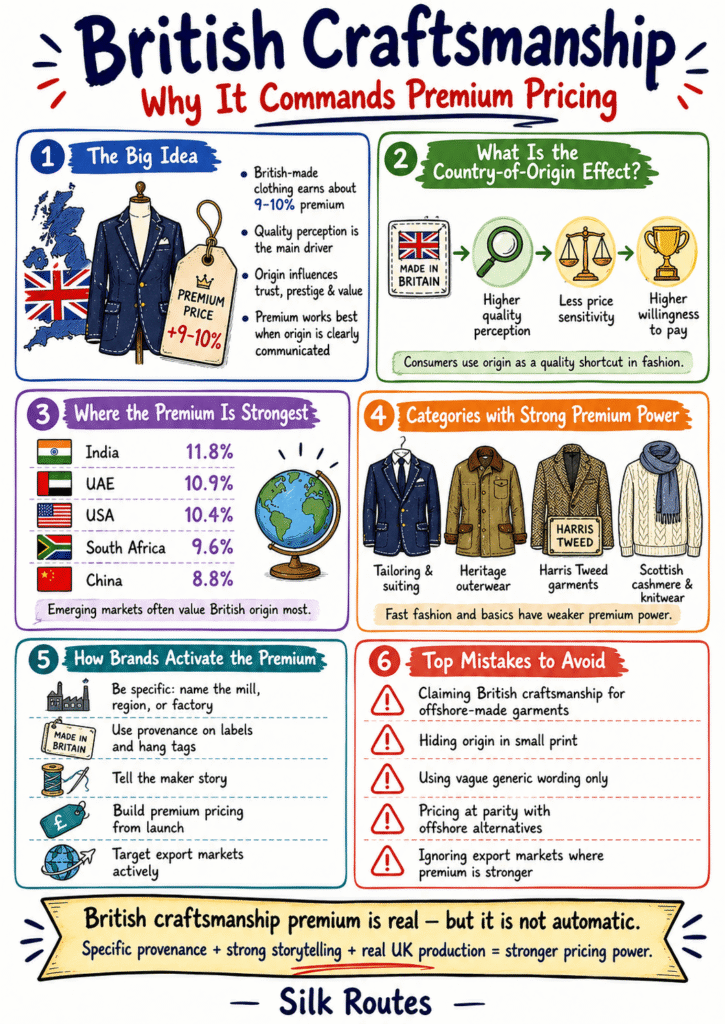
- International consumers are willing to pay an average gross premium of just under 10% for British-made clothing; India (11.8%), UAE (10.9%), USA (10.4%), South Africa (9.6%), and China (8.8%) show the strongest premiums
- Barclays Corporate Banking research identifies a £3.5 billion annual revenue opportunity for British exporters from origin premiums across ten surveyed markets
- The premium is strongest in emerging markets; 63% of Chinese consumers and 60% of Indian consumers say they’ve already knowingly paid more for British-made goods
- The country-of-origin premium isn’t automatic, it’s activated by explicit, specific provenance communication; brands that don’t actively surface their British origin capture significantly less of the available premium
Contents
- 1. What Is the Country-of-Origin Effect in Fashion?
- 2. British Craftsmanship: What Consumers Actually Believe
- 3. The Premium Pricing Evidence: Research Findings
- 4. Product Categories Where British Craftsmanship Commands the Highest Premium
- 5. How to Build a British Craftsmanship Brand Narrative
- 6. Mistakes Brands Make When Claiming British Craftsmanship
- 7. British Craftsmanship: Questions Brands Ask Us
- 7.1. Does British-made clothing genuinely command a price premium?
- 7.2. Why do consumers associate British-made clothing with quality?
- 7.3. Is the British craftsmanship premium stronger for some categories than others?
- 7.4. How do international markets compare for British craftsmanship premiums?
- 7.5. Can a new brand build a British craftsmanship premium, or is it reserved for heritage labels?
What Is the Country-of-Origin Effect in Fashion?
The country-of-origin (COO) effect is the influence a product’s country of manufacture has on consumer perceptions of quality, value, and prestige, and consequently on willingness to pay a price premium.
The effect is academically well established. A 2024 review of 67 studies on the topic, published as an unreviewed preprint, found that country of origin significantly impacts how consumers perceive product quality, value, and prestige, though the ultimate effect on actual purchase choice is less consistent once other factors like brand familiarity and price enter the decision. The review is worth treating as a synthesis of existing academic literature rather than new primary research, and it hasn’t yet been peer-reviewed, though its conclusions align with decades of prior published work in the field.
The literature identifies three routes through which COO affects fashion pricing.
Quality inference. Consumers infer product quality from the known reputation of the manufacturing country, even without direct product inspection. A garment labelled Made in Britain is assumed by many consumers to be better made than an equivalent labelled Made in Bangladesh, regardless of whether the actual construction quality differs.
Prestige and status signalling. For luxury categories in particular, origin carries status implications independent of functional quality. Interestingly, the academic literature on this point most often cites France and Italy as the classic prestige-origin examples specifically for fashion, given their strong cultural association with craftsmanship and refinement; Britain’s strongest documented prestige association in the research base sits more with categories like automotive and food and drink. This doesn’t mean Britain lacks a fashion prestige story, the Barclays survey data below shows real willingness to pay for British clothing, but it’s worth being precise that the academic fashion-prestige literature centres elsewhere by default, and British fashion brands need to work harder to establish that specific association rather than assume it’s automatically conferred.
Price sensitivity reduction. Consumers are demonstrably less price-sensitive for products made in developed economies with strong quality reputations than for equivalents from developing-economy producers. This is the mechanism through which British origin can directly enable higher retail pricing.
The COO effect has limitations relevant to commercial application. It’s strongest when origin information is explicitly communicated at the point of sale or in brand marketing, and it weakens significantly when consumers have no exposure to origin information or when other product cues (price, brand, styling) dominate the decision. The implication is direct: British craftsmanship premium pricing is only commercially realised when origin is actively surfaced.
British Craftsmanship: What Consumers Actually Believe
The most comprehensive research specifically on British-made product perceptions across international markets is the Barclays Corporate Banking Brand Britain research programme, an international study of over 10,000 consumers across ten markets, including the USA, Ireland, France, Netherlands, Germany, South Africa, UAE, India, China, and South Korea.
Quality as the primary driver in emerging markets. Two-thirds (66%) of consumers in China and India said they’d be inclined to pay more for British goods because they believe them to be of higher quality, well ahead of the ten-market survey average of 39%.
Fashion’s place in the ranking. Among the product categories Barclays tested, food products commanded the highest gross premium at 11.7%, followed by alcoholic beverages at 11.2%, homeware at 10.4%, and UK fashion just under 10%, making clothing the fourth-highest category rather than the third. British automotive products also performed strongly, with 15% of respondents describing British cars as “the best in the world” and an average 10.2% premium attached to them.
A meaningful share have already paid the premium. Among consumers who said they’d already paid more for British products, China led at 63%, followed by India at 60% and the UAE at 56%.
Growing demand year on year. 69% of Indian consumers, 64% of Chinese consumers, and 64% of UAE consumers said they were buying more British-made products than they were five years earlier.
Domestic consumer context. Among UK consumers specifically, the Made in Britain Buying British Survey 2024 found that 50% prefer British-made products overall, 56% now recognise the Made in Britain trademark, and 51% of those who prefer British-made goods say they’re willing to pay more even when prices exceed imported alternatives. Domestic UK demand and international demand for British goods are measured by entirely different research programmes, and the figures aren’t directly comparable, but both point in the same direction.
The Premium Pricing Evidence: Research Findings
| Origin / Category | Premium vs Non-British Equivalent | Source | Market |
|---|---|---|---|
| British clothing (international average) | Just under 10% gross | Barclays Brand Britain Research | 10 markets |
| British clothing (India) | 11.8% gross | Barclays Brand Britain Research | India |
| British clothing (UAE) | 10.9% gross | Barclays Brand Britain Research | UAE |
| British clothing (USA) | 10.4% gross | Barclays Brand Britain Research | USA |
| British clothing (South Africa) | 9.6% gross | Barclays Brand Britain Research | South Africa |
| British clothing (China) | 8.8% gross | Barclays Brand Britain Research | China |
| Sustainably/locally produced goods (general, not British-specific) | 9.7% stated | PwC Voice of the Consumer Survey 2024 | 31 countries |
| Harris Tweed fabrics | Premium over generic tweed equivalent; specific multiple not independently verified | Harris Tweed Authority | UK / global |
The Barclays figures are gross price premium, meaning before any cost difference between British and offshore production is accounted for. The net commercial premium, what the brand actually captures after its higher cost base, will be lower. A roughly 10% gross premium doesn’t imply a 10% profit improvement; it implies consumer willingness to pay that level above a non-British equivalent, from which the brand must still cover the additional cost of UK production. For comparison, PwC’s 2024 global consumer survey found a similar roughly 9.7% willingness-to-pay ceiling for sustainably sourced goods generally, not British-specific, suggesting premiums in this range are broadly where consumer tolerance sits across multiple origin and sustainability claims. Our UK manufacturing cost breakdown sets out what that additional production cost typically looks like by garment type.
The practical implication: British origin premium is most commercially powerful when UK production costs are managed efficiently. The premium is real and documented. Whether it covers the manufacturing cost differential depends on the specific product, production method, and market.
Product Categories Where British Craftsmanship Commands the Highest Premium
British craftsmanship commands measurably different premiums across clothing categories. The premium isn’t uniform.
Tailoring and suiting. The strongest premium narrative in British clothing sits in formal and tailored garments. The Savile Row association, a globally recognised reference for hand-tailoring, gives British tailored clothing a quality narrative that few other countries fully replicate. Brands producing UK-made structured jackets, trousers, and formal wear can reference this tradition directly in positioning and premium justification.
Heritage outerwear. Waxed jackets, country-style outerwear, tweed coats, and wool overcoats carry strong British provenance associations, particularly in international markets. The combination of British climate heritage (garments designed for British weather) and material heritage (Harris Tweed, Yorkshire wool) creates a layered origin story with genuine premium justification.
Harris Tweed garments. Harris Tweed fabric is protected by the Harris Tweed Act 1993 and certified by the Harris Tweed Authority, the only fabric in the world with its own Act of Parliament. Garments made from certified Harris Tweed carry a legal provenance impossible to replicate, which retailers consistently translate into premium pricing over comparable-weight alternatives in other fabrics. Our heritage textile mills guide covers Harris Tweed and other active UK fabric sources in detail.
Knitwear: Scottish cashmere and heritage knit. Scottish cashmere, particularly from mills such as Johnstons of Elgin, commands premium positioning in global luxury markets. The mills supply major international luxury houses and carry genuine heritage credibility. For brands that can access Scottish cashmere yarn or finished knitwear, the provenance story supports meaningful price premiums above cashmere processed elsewhere.
Workwear and functional garments. British functional clothing, military heritage styling, technical outerwear, and workwear-derived design, carries strong quality and durability associations, with established British heritage brands having demonstrated the durability of this positioning internationally over decades.
Fast fashion and basics. This is where British origin premium is weakest. Consumers don’t apply meaningful quality inferences to commodity garments (T-shirts, basic knitwear, everyday casualwear) based on origin alone. British craftsmanship premium requires a product where construction quality, material selection, or heritage narrative is plausibly relevant to the buying decision.
How to Build a British Craftsmanship Brand Narrative
The COO effect only activates when origin is explicitly communicated. The commercial premium doesn’t arise from origin alone, it arises from origin communicated specifically and credibly.
Be specific, not generic. “Made in Britain” is a start, but it doesn’t activate the full premium. “Woven from Yorkshire wool in our Guiseley mill” is the level of specificity that actually triggers quality inferences. Name the mill, the fabric, the region. Consumers can’t infer quality from vague country labelling; they can infer it from specific, verifiable details.
Integrate origin into product naming and labelling. The most effective British craftsmanship brands embed provenance in the product itself, on the label, the hang tag, the dust bag. A label that names the specific certified fabric and its origin is more commercially powerful than a hang tag that says “Made in UK” in small print.
Use the maker’s story. Consumers respond to human-scale craftsmanship narratives: the name of the weaver, the number of generations the mill has operated, the town where the factory is located. These details aren’t marketing embellishment; they’re the substance of the quality signal. A brand that introduces its UK production team by name, role, and location is communicating something qualitatively different from one that prints a postcode.
Price with the premium built in from launch. The most common strategic mistake is launching at a price point calibrated to offshore alternatives and then trying to add a premium later. British craftsmanship premium pricing has to be set from the beginning. Consumer anchoring makes price increases difficult; pricing correctly at launch is far more effective.
Target international markets actively. The Barclays research shows the British craftsmanship premium is significantly stronger in India, the UAE, China, and the USA than in domestic or European markets. Brands that restrict British origin storytelling to the UK market are leaving the most commercially significant premium on the table.
“The brands that convert British origin into real sales are the ones that treat it as a product feature, not a footnote. They put the mill name on the label, photograph the factory, name the maker. They don’t assume the customer will notice, they make it impossible to miss.” — Silk Routes Manufacturing Team
For more on how Silk Routes supports brands in communicating their UK manufacturing credentials, our clothing manufacturing services page covers what we provide.
Mistakes Brands Make When Claiming British Craftsmanship
Mistake 1 — Claiming “British craftsmanship” for offshore-produced garments. Brands with some UK design or brand identity assume that qualifies as British craftsmanship. Fix: British craftsmanship claims must be grounded in UK-based production. Design in London, manufacture offshore, that isn’t British craftsmanship. The COO effect only applies where production is genuinely British. Claims without production foundation are both commercially weak (they don’t trigger quality inferences) and risky under UK trading standards.
Mistake 2 — Leaving origin off labelling and marketing. Brands know they’re UK-made but treat it as a given rather than a feature. Fix: origin must be actively communicated at every relevant touchpoint, product label, hang tag, website, wholesale presentations, social content. The COO premium is only activated through explicit communication. Assuming consumers will notice or infer UK origin without it being stated is commercially self-defeating.
Mistake 3 — Using generic country language without product-level specifics. Brands describe themselves as “Made in Britain” without providing any detail about where, by whom, or with what materials. Fix: specificity is the premium driver. Name the factory location, the fabric mill, the weaver, the technique. The more specific and verifiable the craftsmanship claim, the more powerfully it triggers quality inferences. Generic claims add little to willingness to pay.
Mistake 4 — Pricing at parity with offshore alternatives. Brands fear that British-made premium pricing will reduce volume. Fix: the research evidence consistently shows that consumers who respond to British craftsmanship origin signals aren’t the same consumers making volume-driven decisions. Pricing British-made garments at parity with offshore alternatives signals that British origin isn’t genuinely differentiated, and eliminates the premium margin that makes UK production commercially viable.
Mistake 5 — Not targeting export markets where the premium is strongest. UK fashion brands often focus almost exclusively on the domestic market for British origin storytelling. Fix: the Barclays research shows the British craftsmanship premium is materially stronger in India, the UAE, the USA, and China than in the UK or EU. A brand that communicates its UK origin actively in these markets captures a premium that domestic-focused origin marketing largely misses.
British Craftsmanship: Questions Brands Ask Us
Does British-made clothing genuinely command a price premium?
Yes, both academically and commercially. The country-of-origin effect on quality perception and willingness to pay is one of the most consistently studied findings in consumer marketing research. Specifically for British clothing, Barclays Corporate Banking’s 2021 research found that international consumers are willing to pay just under a 10% gross premium for British-made clothing, with India, the UAE, and the USA showing the highest premiums.
Why do consumers associate British-made clothing with quality?
The quality association is built on a combination of historical reality and accumulated reputation. Britain has genuine heritage in high-quality textile production, Yorkshire wool milling, Scottish cashmere, Savile Row tailoring, that created the underlying quality reality. That reality has been communicated and reinforced internationally through British fashion exports and cultural exports over decades, creating a quality stereotype that now operates even for brands without direct heritage credentials of their own.
Is the British craftsmanship premium stronger for some categories than others?
Significantly so. The premium is strongest in tailoring, heritage outerwear, knitwear, and fabric-focused products where construction and material quality are relevant and visible. It’s weakest in commodity basics, casualwear, and fast fashion categories where consumers don’t apply quality inferences based on origin. A Harris Tweed coat, a Savile Row-influenced structured jacket, or a Scottish cashmere sweater carries far more premium power from British origin than a standard white T-shirt.
How do international markets compare for British craftsmanship premiums?
India, the UAE, and the USA show the highest premiums, gross premiums of 11.8%, 10.9%, and 10.4% respectively, according to Barclays’ 2021 research. Emerging market consumers generally show the strongest quality associations with British manufacturing, making international marketing of British origin particularly commercially important rather than something to treat as a domestic-only story.
Can a new brand build a British craftsmanship premium, or is it reserved for heritage labels?
New brands can build it, but it requires investment in origin storytelling. The COO effect is triggered by explicit origin communication, not by brand heritage alone. A new brand that names its UK factory, photographs its production, labels its garments specifically, and integrates its manufacturing story into every touchpoint can activate similar quality inferences to an established heritage brand, though the heritage dimension itself takes genuine time to develop and can’t be manufactured through messaging alone.