
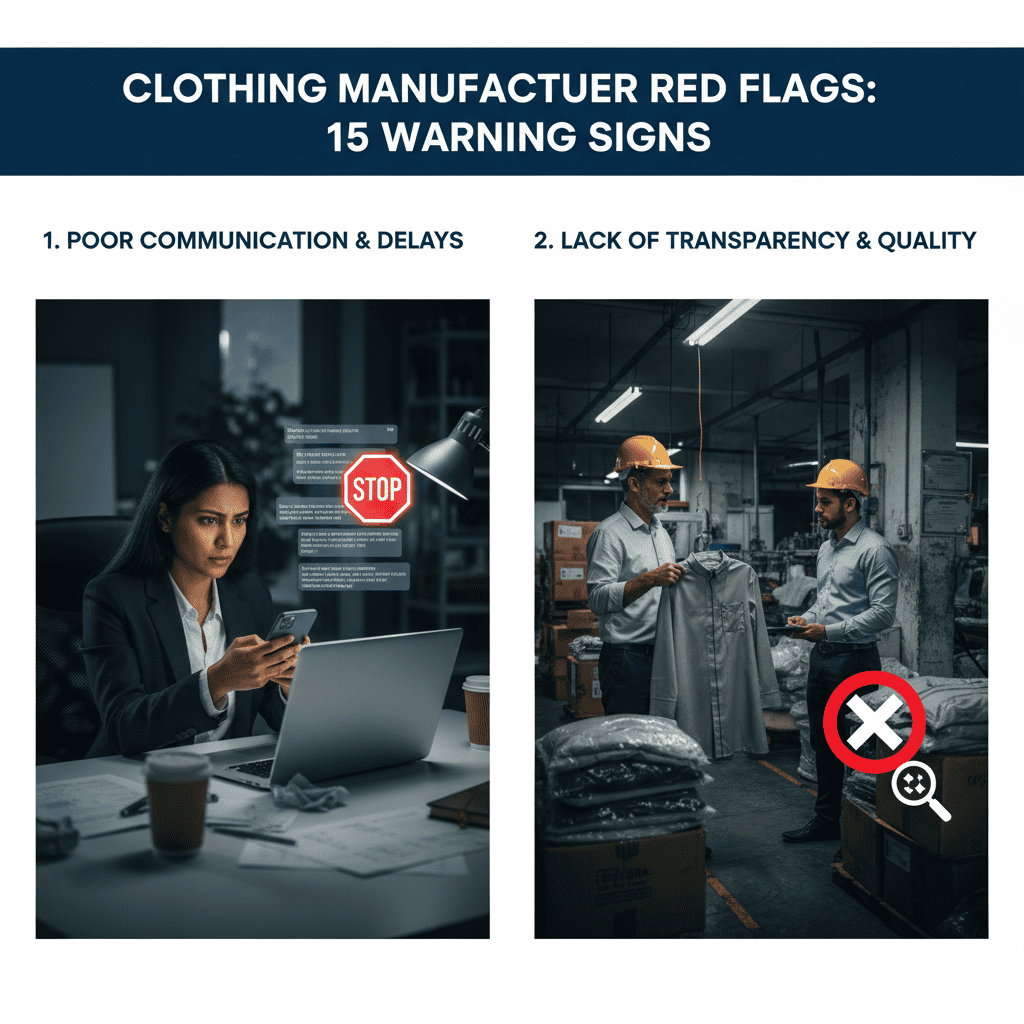
Brands that lose a deposit to a bad UK clothing manufacturer typically hand over between 30% and 50% of the total order value before anything goes wrong. We’ve seen the same pattern on every failed relationship we’ve been asked to untangle: at least one visible clothing manufacturer red flag was there from the first few emails, and it got explained away.
This is the full list. Fifteen signs, none of them requiring specialist knowledge. Every one is visible before you commit a penny.
Post Summary
- The five most costly red flags — upfront payment demands, no Companies House registration, an unverifiable factory, refused references, and resistance to a written contract — are each individually sufficient reason to stop
- Red flags don’t always mean fraud; some point to a factory that’s disorganised or wrong for your product, but the financial outcome for your order is the same either way
- A manufacturer who clears all 15 checks isn’t guaranteed to perform, but one who fails any of them is a known, avoidable risk
- Response time, communication channel, and pricing tell you more about a factory than its portfolio does
- What you do in the first 30 days of contact matters more than what the sample looks like
Contents
- 1. Why This List Exists
- 2. Red Flags 1–5: Communication and Responsiveness Issues
- 3. Red Flags 6–10: Pricing, MOQ, and Contract Warning Signs
- 4. Red Flags 11–15: Operational and Legal Red Flags
- 5. What Brands Get Wrong After Spotting a Flag
- 6. If You’ve Already Spotted a Red Flag
- 7. How to Protect Yourself Before Any Order
- 8. Vetting Doesn’t Stop at This List
- 9. Frequently Asked Questions
Why This List Exists
A red flag doesn’t confirm something will go wrong. It tells you the odds of it going wrong are meaningfully higher than with a factory that doesn’t show that signal.
The stakes are real. A failed first-order relationship costs more than the deposit — it costs the re-sourcing time, the missed season, and sometimes the wholesale commitments you can no longer fill. For a small brand, one bad manufacturer relationship can be the whole business.
We’ve watched every pattern below play out with real clients, more than once. None of it is theoretical.
Red Flags 1–5: Communication and Responsiveness Issues
| # | Red Flag | What It Signals | What to Do |
|---|---|---|---|
| 1 | Only reachable by mobile — no landline, business email, or fixed address | No permanent business premises | Request a full business address and email domain, then verify it independently |
| 2 | Takes over 48 hours to answer a technical query | No internal capacity to manage a client relationship | Set a response-time expectation on day one; a factory that’s slow before your money lands won’t speed up after |
| 3 | Can’t name a specific point of contact | No account management structure | Ask directly who owns your account; a vague answer means the role doesn’t exist |
| 4 | Refuses written communication, insists on phone-only | Avoiding a record of what was agreed | Confirm every substantive term — dates, specs, price — in writing, no exceptions |
| 5 | Pushes urgency to speed up your commitment | A sales tactic dressed as scarcity | Ignore any pressure that isn’t tied to a specific, verifiable production slot |
We turn away enquiries that show flags 1–5 within the first week. It’s not harsh — it’s just that a factory that can’t manage a pre-sale conversation won’t manage a production run.
Red Flags 6–10: Pricing, MOQ, and Contract Warning Signs
| # | Red Flag | What It Signals | What to Do |
|---|---|---|---|
| 6 | Prices 40–60% below the going market rate | The quote won’t survive contact with your actual order | Ask for a cost breakdown; if they can’t explain the number, the number isn’t real |
| 7 | 100% payment demanded before any sample | The signature pattern of garment-sector deposit fraud | Never pay in full before a sample is made and approved — decline and move on |
| 8 | MOQ rises after the first conversation | Either disorganised, or the low figure was bait | Get MOQ confirmed in writing at first contact, then written into the agreement |
| 9 | No written contract, or one that skips key terms | No intention of being held to any of it | Treat a full written agreement as non-negotiable before production starts |
| 10 | Subcontracting not disclosed | Your order goes to a factory you never vetted | Require a subcontracting clause with mandatory notice and equal compliance standards |
This is where UK CMT pricing gets tested against reality. At the current National Living Wage, a machinist producing a moderately complex garment at four units an hour generates a minimum labour cost well above what a 40–60%-below-market quote can cover once overheads are added — the manufacturing services page explains how we actually structure CMT pricing if you want a working comparison.
Red Flags 11–15: Operational and Legal Red Flags
| # | Red Flag | What It Signals | What to Do |
|---|---|---|---|
| 11 | Not registered at Companies House | Sole trader without structure, or worse | Check every UK-manufacturer claim at Companies House — no registration, no engagement |
| 12 | Factory visit refused or endlessly deferred | Nothing to show, because there’s no active production | Treat a visit (or a video walkthrough for offshore factories) as non-negotiable before any bulk order |
| 13 | Sample quality outstrips the factory’s stated capacity | The sample may have been produced elsewhere | Visit after the sample, not before — confirm the same equipment made both |
| 14 | No written IP policy on patterns and tech packs | They can hold your patterns to ransom if the relationship ends | Confirm IP ownership in writing before sharing a single design file |
| 15 | References are unverifiable or oddly uniform | Fabricated or arranged | Contact references directly, not via the manufacturer, and confirm the reference company actually exists |
What Brands Get Wrong After Spotting a Flag
Ignoring the first flag because everything else looked good. It happens because a brand has already invested days into vetting and doesn’t want to start over. The fix: agree in advance that any Category-A flag — payment, registration, contract, visit, references — ends the conversation the same day, no exceptions.
Increasing the deposit to “lock in” a factory using pressure tactics. This happens out of fear the price will disappear. The fix: a cost breakdown request always comes before a bigger payment, never after.
Accepting a WhatsApp-only relationship because the sample looked right. A good sample earns trust it hasn’t paid for yet. The fix: written confirmation of specs, dates, and pricing before a single unit goes into bulk.
Sending tech packs before checking the business exists. This one happens simply because brands want a quote fast. The fix: a Companies House check and a signed NDA before any file leaves your inbox — your designs have value before a stitch is cut.
If You’ve Already Spotted a Red Flag
“Nothing here is retrospective advice — every rule below is one we’d apply to our own supplier relationships.” — Silk Routes Manufacturing Team
“The sample charge is the cheapest lesson in this whole list. If a red flag shows up after that payment, losing it is the right outcome — not a setback.” — Silk Routes Manufacturing Team
Nothing paid yet: stop the engagement. You’ve lost time, not money.
Sample charge paid: assess whether the flag is a communication issue (1–5) or something structural (6–15). Communication issues can sometimes be isolated; pricing, contract, or legal flags rarely are.
Deposit paid: don’t pay the balance. Enforce any written contract, and contact Citizens Advice for guidance on deposit recovery if the manufacturer stops responding.
Paid in full, nothing delivered: put your position in writing, citing the contract, with a formal deadline. A County Court claim doesn’t require legal representation for disputes up to £10,000.
How to Protect Yourself Before Any Order
- Complete a full vetting pass before committing — legal status, premises, references, contract — before a manufacturer clears all of it, treat them as unverified.
- Never pay more than 50% before sample approval. Deposit on confirmation, balance after PP sample sign-off.
- Use a written manufacturing agreement for every order — verbal terms are worth nothing in a dispute.
- Keep every substantive conversation in writing, even ones that started on a call.
- Verify before you brief: Companies House check, confirmed address, signed NDA — before any tech pack goes out.
Vetting Doesn’t Stop at This List
Fifteen flags cover the visible risks. They don’t replace a structured, end-to-end check before you commit to a factory — that’s what the Complete Guide to Clothing Manufacturers in UK walks through in full.
If you’re vetting a UK manufacturer right now and want a second opinion on what you’re seeing, find out more about how we work before you sign anything.
Frequently Asked Questions
What Are Some Problems in the Clothing Industry?
Late deliveries, quality inconsistency, and deposit disputes are the three most common operational problems brands report with UK manufacturers. Roughly a third to half of the deposit value is lost on average when a manufacturer relationship fails outright. Most of these problems trace back to a vetting step that was skipped, not bad luck.
How Do I Know If a Company Is a Red Flag?
A manufacturer is a red flag when it fails any one of the 15 checks above — no Companies House registration, no written contract, or a demand for 100% payment before a sample being the three most serious. Any single one of these is sufficient reason to stop, not a point to negotiate on.
What Are the Challenges in the Clothing Business?
For brands sourcing UK manufacturing, the core challenges are pricing transparency, MOQ reliability, and finding a factory whose actual production capacity matches its sample quality. A cost floor set by the National Living Wage means quotes 40–60% below market rate almost always signal a problem, not a bargain.
What Are Red Flags for a Company?
For a clothing manufacturer specifically, the clearest red flags are financial (upfront payment demands), legal (no business registration), and evidential (refused factory visits or unverifiable references). A factory that fails even one of these categories carries a documented, avoidable level of risk.