
Most beginner guides to wholesale clothing manufacturing start with supplier directories and platform lists. That’s the wrong place to start, and it’s why most first-time buyers end up with the wrong factory, the wrong terms, and stock they can’t move.
Wholesale clothing manufacturing isn’t a sourcing problem — it’s a commercial structure problem. Get the structure right first — what you’re buying, from whom, on what terms, at what volume — and the sourcing becomes straightforward.
Summary
- Wholesale manufacturing means commissioning bulk production at a per-unit cost that allows profitable resale — a different model from private label or dropshipping
- UK wholesale manufacturers typically require 50–300 units per style; offshore starts from 100–500
- Landed cost — unit cost plus duty, freight, and fulfilment — determines profitability, not factory price alone
- Payment terms, lead times, and reorder minimums must be confirmed in writing before the first order
- The biggest beginner mistakes are buying on price alone, ignoring landed cost, and ordering too many SKUs on the first run
Contents
- 1. Wholesale Clothing ManufacturingBeginner's Cost & MOQ Dashboard
- 1.1. What Each Manufacturer Type Actually Requires
- 1.2. UK vs Turkey/Portugal vs Asia — 100-Unit Jersey Run
- 1.3. Where Your Real Margin Comes From
- 1.4. The 5-Stage Wholesale Manufacturing Structure
- 1.5. Typical First-Order Deposit Split
- 1.6. Five Mistakes That Cost the Most
- 1.7. How Wholesale Manufacturing Is Structured
- 1.8. UK vs Offshore Manufacturing: What Beginners Get Wrong
- 1.9. Understanding MOQ in Wholesale Manufacturing
- 1.10. Calculating Your Cost Structure
- 1.11. Payment Terms and Contracts
- 1.12. Five Beginner Mistakes in Wholesale Manufacturing
- 1.13. FAQ
- 1.13.1. What’s the difference between wholesale manufacturing and buying wholesale?
- 1.13.2. How much does wholesale clothing manufacturing cost for a beginner?
- 1.13.3. Can I start with 50 units?
- 1.13.4. How do I find wholesale clothing manufacturers in the UK?
- 1.13.5. What payment terms should I expect?
- 1.14. The Commercial Foundation That Makes This Work
What Wholesale Clothing Manufacturing Actually Means
Most beginner resources conflate wholesale manufacturing with wholesale buying. They’re not the same thing.
Wholesale buying means purchasing finished, pre-designed stock from a supplier at trade price and reselling it — no production involvement, no design input. Wholesale manufacturing means commissioning a factory to produce garments, either to your spec (private label) or from their range (white label), at a per-unit cost that leaves you a margin.
| Model | Design Input | MOQ | Margin Potential |
|---|---|---|---|
| Wholesale buying (trade) | None | Low | Low — competitive |
| White label manufacturing | Label only | 10–100 units | Moderate |
| Private label manufacturing | Full spec | 30–300 units | High |
| OEM manufacturing | Full spec + tooling | 100–500 units | Highest |
What guides get wrong: beginners are told wholesale manufacturing means “buying in bulk from a factory.” That framing skips the important question — bulk on what terms, to whose specification. The answer determines your cost structure and your margin for the next three years.
Wholesale Clothing Manufacturing
Beginner's Cost & MOQ Dashboard
The real numbers behind UK, Turkish, and Asian production — minimum order quantities, landed cost, and what actually drives your margin.
What Each Manufacturer Type Actually Requires
MOQ ranges by manufacturer type, per style per colourway. Bar length shows the relative ceiling of each range.
UK vs Turkey/Portugal vs Asia — 100-Unit Jersey Run
Factory price is only the starting point. Duty and freight change the picture significantly by region.
- Import duty0%
- Freight (100u)£50–£150
- Lead time6–10 wks
- QC accessDirect
- Import duty0%*
- Freight (100u)£200–£600
- Lead time8–14 wks
- QC accessManageable
- Import duty12%
- Freight (100u)£400–£1,200
- Lead time12–20 wks
- QC accessRequires agent
*Turkey qualifies for 0% duty under the UK–Turkey Free Trade Agreement; Portugal under the UK–EU Trade and Cooperation Agreement, both subject to rules-of-origin compliance.
Where Your Real Margin Comes From
Landed cost = factory price + freight + duty + fulfilment. Jersey tee, 100 units, £45 retail price.
The 5-Stage Wholesale Manufacturing Structure
The same sequence applies whether you're sourcing UK or offshore.
Spec agreement
Design or stock range confirmed. Factory quotes per-unit price.
Sampling
Sealed sample or pre-production sample confirmed before bulk.
Payment terms
30–50% deposit on confirmation, balance on QC approval.
Production & QC
Mid-run and completion checks against the sealed sample.
Delivery
To warehouse or 3PL — plus customs clearance if offshore.
Typical First-Order Deposit Split
Standard terms for first-time wholesale buyers in UK manufacturing.
Five Mistakes That Cost the Most
Each one is avoidable with preparation before your first call to a factory.
Pricing on factory cost, not landed cost
Ordering too many SKUs on the first run
No confirmed reorder lead time
Skipping the sealed sample
Ignoring labelling compliance
Sources
- UKFT — UK Fashion & Textile Industry Overview: ukft.org/who-we-are/our-industry
- McKinsey & Company — The State of Fashion 2024: mckinsey.com
- UK Government — Consumer Rights Act 2015: legislation.gov.uk
- UK Government — Textile Products (Labelling and Fibre Composition) Regulations 2012: legislation.gov.uk
Figures are illustrative ranges based on the sources above and Silk Routes production data. Always confirm current duty rates, freight costs, and factory pricing directly before committing to a volume.
How Wholesale Manufacturing Is Structured
Wholesale manufacturing works on a volume-for-price exchange. The more you commit to, the lower your per-unit cost, and the higher your margin at retail.
“We’re seeing more small-batch wholesale enquiries at 50–150 units than we did a few years ago — direct-to-consumer brands increasingly want smaller, more frequent production cycles rather than one large annual run.” — Silk Routes Manufacturing Team
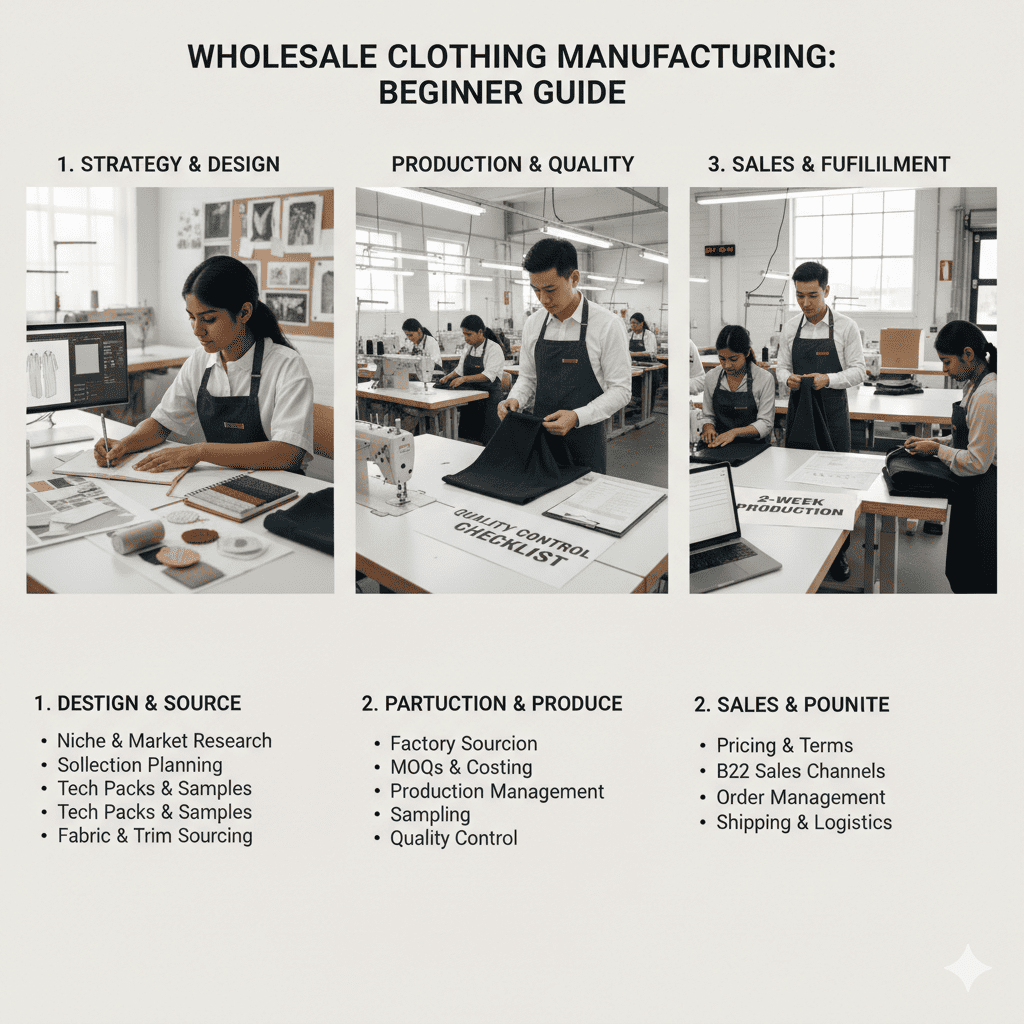
The basic structure runs in five stages: specification agreement, sampling, payment terms (typically 30–50% deposit, balance on completion), production and QC, and delivery. Offshore production adds freight, customs clearance, and duty calculation on top of that sequence.
For a full breakdown of structuring your first manufacturing relationship, our guide to low MOQ and private label clothing manufacturers UK covers what to expect at each stage.
UK vs Offshore Manufacturing: What Beginners Get Wrong
The most common beginner decision is choosing UK vs offshore on unit price alone. That’s the wrong comparison.
What guides get wrong: offshore unit costs look significantly lower on a factory quote. They look less lower once freight, minimum fabric quantities, extended lead times, and quality-failure risk at a distance are added.
| Factor | UK | Turkey / Portugal | Asia |
|---|---|---|---|
| Unit cost (jersey, 100 units) | £10–£14 | £6–£10 | £3–£7 |
| Import duty | None | 0%* | ~12% (standard MFN) |
| Freight cost | £50–£150 | £200–£600 | £400–£1,200 |
| Lead time | 6–10 weeks | 8–14 weeks | 12–20 weeks |
| Landed cost per unit (100 units) | £10–£14 | £7–£12 | £6–£11 |
*Turkey and Portugal-origin goods qualify for 0% duty under the UK-Turkey FTA and UK-EU TCA respectively, provided rules-of-origin documentation is in place — this isn’t automatic and needs to be confirmed with your supplier.
The landed cost gap between UK and near-shore is narrower than the factory price gap suggests, especially at low volume. For a beginner buying 50–150 units, UK or near-shore (Turkey, Portugal) manufacturing is the honest recommendation — the unit cost premium is real, but so is the risk premium on offshore quality and lead time, and the offshore risk is harder to quantify until it goes wrong.
Understanding MOQ in Wholesale Manufacturing
MOQ isn’t a price negotiation — it’s an economics statement. Every run carries fixed costs that can’t be spread thinly enough below a certain volume.
What guides get wrong: beginners are told MOQ is always negotiable. Pushing a factory below its economic floor produces one of two outcomes — they decline, or they accept and cut corners to cover the gap. Neither is useful.
Three approaches that genuinely work to bring MOQ down:
Arrive with a complete tech pack. A brief needing no factory input reduces onboarding cost, which buys flexibility on volume.
Offer faster payment. A 70% deposit reduces the factory’s working capital exposure on a small run.
Commit to a written reorder. A confirmed second order at 90 days turns a one-off small run into a relationship — factories price those differently from transactions.
Calculating Your Cost Structure
The number that determines profitability isn’t the factory price — it’s the margin between your landed cost and your selling price.
Landed cost = factory unit price + freight per unit + import duty per unit + fulfilment cost per unit
Example — 100 units, jersey tee, UK manufacture:
| Cost Item | Amount |
|---|---|
| Factory unit price | £12.00 |
| Freight (domestic) | £0.80 |
| Import duty | £0.00 |
| Fulfilment | £3.50 |
| Landed cost per unit | £16.30 |
| Retail price | £45.00 |
| Gross margin | 63.8% |
Same product, Turkey, 100 units (0% duty under the UK-Turkey FTA):
| Cost Item | Amount |
|---|---|
| Factory unit price | £8.00 |
| Freight per unit | £4.50 |
| Import duty (0%) | £0.00 |
| Fulfilment | £3.50 |
| Landed cost per unit | £16.00 |
| Retail price | £45.00 |
| Gross margin | 64.4% |
At 100 units, UK and Turkish manufacture land within a point of each other on margin. The cost is nearly identical — the risk profile isn’t.
If you want to model this for your specific product, speak to the Silk Routes team about realistic unit costs at your target MOQ.
Payment Terms and Contracts
What guides get wrong: beginners treat the factory quote as the agreement. It isn’t — the purchase order is the contract, and what’s in it determines your leverage when something goes wrong.
Every purchase order needs: confirmed unit price and total value, payment schedule, production lead time and delivery date, sealed sample reference number, QC standards, and cancellation provisions.
Under the UK Consumer Rights Act 2015, verbal commitments are enforceable in principle but practically difficult to prove — a signed purchase order is the document that actually protects you.
“We insist on a signed purchase order for every run, not because we expect problems, but because clarity protects both sides. A factory confident in its own quality welcomes a written spec.” — Silk Routes Manufacturing Team
Always tie balance payment to QC approval, not to despatch.
Five Beginner Mistakes in Wholesale Manufacturing
Buying on factory price rather than landed cost. Freight, duty, and fulfilment all add to the real per-unit cost. Fix: build a landed cost model before requesting any quote.
Ordering too many SKUs on the first run. Three styles at 100 units each spreads risk across untested products. Fix: start with one style, prove 60% sell-through in 90 days, then commission the next.
Not confirming reorder lead times upfront. A product selling out in week three with a 12-week reorder loses all momentum. Fix: confirm reorder lead time and minimum at the same time as your first order.
Skipping the sealed pre-production sample. No reference standard means no contractual basis to reject finished goods that differ from expectations. Fix: insist on a sealed sample, countersigned, referenced in the PO by approval number.
Ignoring labelling compliance. The Textile Products (Labelling and Fibre Composition) Regulations 2012 require fibre content, care instructions, and country of manufacture on every garment sold in the UK — and that responsibility sits with the brand, not the factory. Fix: submit your label spec as part of the brief and confirm compliance before production, not on delivery.
FAQ
What’s the difference between wholesale manufacturing and buying wholesale?
Wholesale buying means purchasing pre-made stock at trade price with no production involvement. Wholesale manufacturing means commissioning a factory to produce garments to your spec or from their range, backed by a formal purchase order.
How much does wholesale clothing manufacturing cost for a beginner?
For a single jersey style at 100 units from a UK CMT manufacturer, total cost to delivery runs roughly £1,500–£2,500. A more complex woven style at 150 units from a full-service manufacturer typically runs £4,000–£8,000.
Can I start with 50 units?
Yes, at UK CMT manufacturers for simple jersey construction with fabric supplied by the brand. Below 50 units, fixed costs generally can’t be spread thinly enough for the factory to run at a commercial margin.
How do I find wholesale clothing manufacturers in the UK?
Start with the UKFT member directory, the British Fashion Council, and direct referrals from other brand founders. Avoid generic overseas directories listing “UK wholesale manufacturers” — many are overseas suppliers with UK-facing websites, not UK manufacturers.
What payment terms should I expect?
First-time buyers typically pay 50% deposit on order confirmation with the balance due on QC approval before despatch. Net 30 or Net 60 terms are rare for small brands at this stage — most manufacturers require payment before goods leave the factory.
The Commercial Foundation That Makes This Work
Wholesale clothing manufacturing is straightforward when the structure is right, and it fails — consistently and expensively — when beginners treat it as a sourcing exercise rather than a commercial model.
The structure that works: one style, clear spec, complete tech pack, confirmed landed cost, purchase order in writing, sealed sample before production, QC before payment. That sequence is the difference between a run that delivers what you planned and one that delivers what the factory assumed you wanted.
The British Fashion Council’s Commercialising Creativity research points to preparation, not capital, as the recurring barrier for UK brands trying to scale production — a pattern that matches what we see with first-time wholesale buyers at Silk Routes.
Get the structure right on your first run and every subsequent one becomes faster, cheaper, and lower risk. Ready to structure your first wholesale order properly? Find out how Silk Routes works with first-time wholesale buyers.