
Marcus had been running his menswear brand for two years when he finally understood why his first offshore manufacturer kept misquoting him. He was asking for FOB prices. The factory was giving him CMT rates. His freight forwarder was calculating landed costs assuming full-package delivery.
Nobody in the conversation was using the same definition — and Marcus was building a cost model on a foundation where three different people meant three different things by the same words.
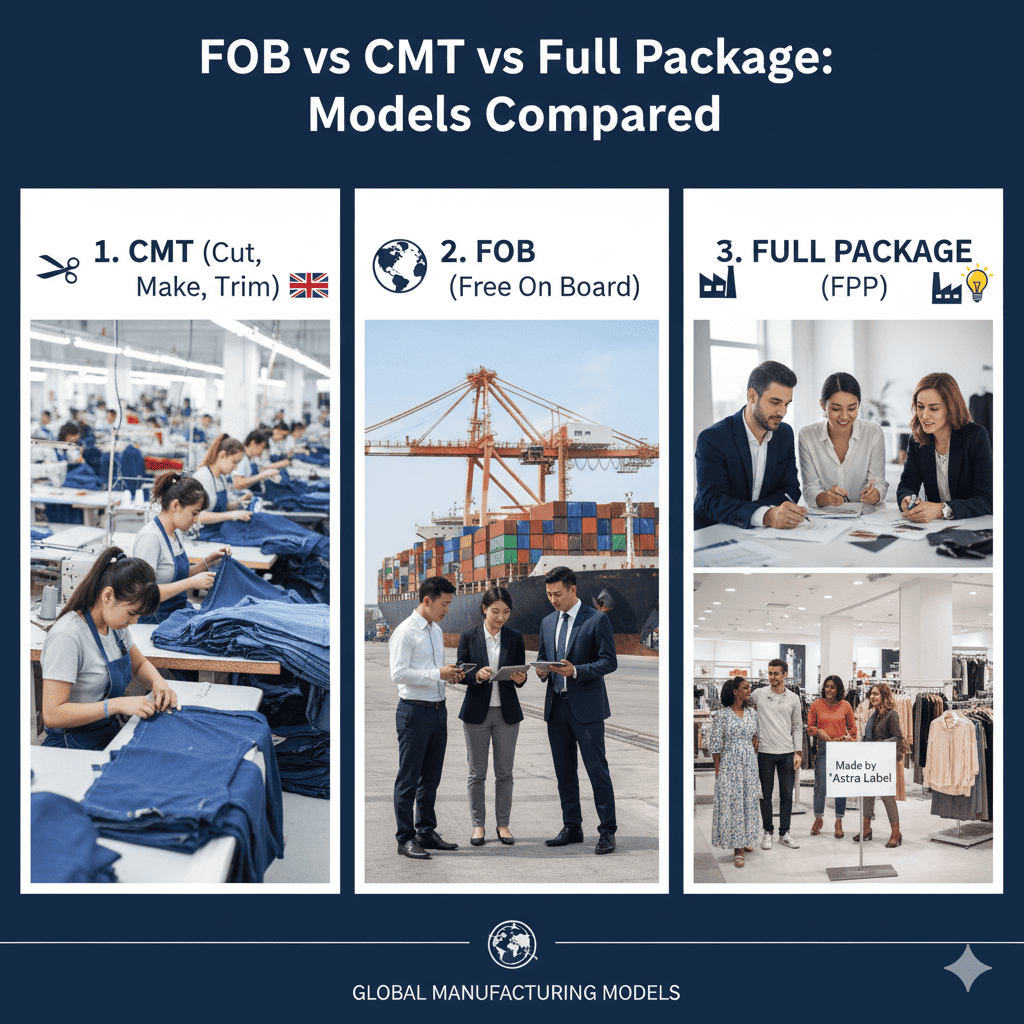
This is not unusual. FOB, CMT, and full-package are the three most frequently confused terms in clothing manufacturing. The confusion has real commercial consequences: undercosted production runs, unexpected materials charges, freight liability errors, and margin models that don’t survive contact with a real order.
This article defines all three precisely, compares them across every operationally relevant dimension, and explains which model is appropriate at each stage of a brand’s development.
For the CMT deep-dive, see What Is CMT Manufacturing? For the full sourcing context, see the Complete Guide to Clothing Manufacturers in UK.
Post Summary
- CMT (Cut, Make, Trim) is a production model defining what the factory does — the brand supplies all materials, the factory provides only labour
- FOB (Free On Board) is an Incoterm — a shipping and pricing term defining the point at which responsibility and risk transfer from seller to buyer. It says nothing about whether the factory sourced the materials
- Full Package (also called full-service or OEM) is a production model — the factory sources all materials, manages the supply chain, and delivers finished garments
- The most common confusion: brands conflate FOB with a production model. FOB is a price and logistics term that can apply equally to CMT and full-package production
- Choosing the wrong model for the brand’s stage of development determines operational burden, capital requirement, quality control, and total cost
Contents
- 1. The Critical Distinction: Production Model vs Incoterm
- 2. CMT Manufacturing Defined
- 3. Full Package Manufacturing Defined
- 4. FOB Explained: The Incoterm
- 5. The Three Compared: Full Operational Analysis
- 6. Building a Landed Cost Model
- 7. Which Model Is Right at Each Brand Stage?
- 8. Five Common Mistakes Across All Three
- 9. Frequently Asked Questions
The Critical Distinction: Production Model vs Incoterm
Before comparing the three, one distinction must be established clearly — because conflating it produces the Marcus problem.
CMT and Full Package are production models. They define the division of responsibility between brand and factory in sourcing materials and producing the garment — what the brand must supply, what the factory supplies, and what each party’s operational role is.
FOB is an Incoterm (International Commercial Term). Published by the International Chamber of Commerce (ICC) under Incoterms 2020, it defines the point at which risk and cost transfer from the seller to the buyer. Under FOB, the seller delivers and loads the goods on the vessel at the named port of shipment, and risk transfers to the buyer at that point. It is a logistics and pricing term — not a production scope definition.
A garment can be priced FOB under either CMT or full-package production. “FOB £12.50” on a factory quotation means the price quoted covers production to the point of vessel loading at the origin port — it says nothing about whether the factory sourced the fabric.
CMT Manufacturing Defined
Cut, Make, Trim. The factory provides the labour to cut the fabric, assemble the garment, and apply all trims and finishing. The brand supplies all material inputs.
Brand supplies: tech pack, patterns (graded), all fabric, all lining, all trims, all labels, all packaging.
Factory supplies: premises, machinery, skilled operatives, production management, in-line and end-of-line quality inspection.
Factory charges: a CMT rate per unit covering labour only. Materials are not included in the CMT price.
Risk profile: the brand bears all materials risk — fabric quality, dye lot consistency, delivery timing, and specification compliance of every input. The factory bears only production execution risk.
Pricing example: CMT rate of £18/unit for a structured woven shirt. The brand additionally pays: £8.50/metre fabric × 1.4 metres consumption = £11.90 fabric cost + £3.20 trims and labels = £33.10 total production cost per unit before factory transport or warehouse receipt.
Full Package Manufacturing Defined
Full Package (also called full-service, or OEM — Original Equipment Manufacturer) is a production model in which the factory sources all materials, manages the supply chain, and delivers a finished garment to the brand’s specification.
Brand supplies: design, tech pack (or design brief), size specifications, approved colour references, quality standards, and final approval at sample stage.
Factory supplies: fabric sourcing and procurement, trim sourcing, pattern development (sometimes), grading, production management, all material inputs, finished garment.
Factory charges: a per-unit price covering labour, materials, factory overhead, and factory margin on materials. The brand sees a single quoted unit price — not a breakdown of CMT plus materials separately.
Risk profile: the factory bears materials sourcing risk. The brand bears the risk of the factory’s sourcing decisions — if the factory substitutes fabric or uses a different dye lot, the brand may not discover this until the goods arrive.
Pricing example: full-package price of £38/unit for the same structured woven shirt. This includes fabric (£11.90 equivalent), trims (£3.20), factory labour (£18.00 CMT equivalent), and factory materials margin (£4.90) — arriving at approximately the same total cost as CMT but with different risk and operational structure.
FOB Explained: The Incoterm
Free On Board (Incoterms 2020, International Chamber of Commerce). Under FOB terms, the seller is responsible for delivering and loading the goods on the vessel at the named port of shipment. Risk transfers to the buyer at the point of loading.
FOB pricing includes: production cost, inland haulage to port, export customs clearance, port handling, and loading charges.
FOB pricing excludes: ocean freight, marine insurance, destination port handling, import customs clearance, import duty, and inland haulage to the buyer’s warehouse.
Note on containers: ICC Incoterms 2020 specifies FOB for non-containerised sea and inland waterway freight. For containerised shipments, FCA (Free Carrier) is the technically correct term — risk transfers when the container is handed to the carrier. In practice, FOB is still widely used for containerised garment shipments, which is why it appears on most factory quotations.
| Term | Seller’s responsibility ends at | Buyer pays from |
|---|---|---|
| EXW (Ex Works) | Factory gate | Everything from factory onwards |
| FOB (Free On Board) | Loaded on vessel at origin port | Ocean freight, insurance, destination costs |
| CIF (Cost, Insurance, Freight) | Destination port | Destination port handling, customs, inland haulage |
| DDP (Delivered Duty Paid) | Buyer’s named location | Nothing — all costs included |
Source: ICC Incoterms 2020 (iccwbo.org)
FOB applied to CMT: “FOB £12.50 per unit CMT” means the factory charges £12.50 for its labour, the brand-supplied materials are produced, and the finished garments are delivered loaded on the vessel at origin port. The brand pays freight and all destination costs from that point.
FOB applied to full package: “FOB £38 per unit” means the factory has sourced all materials, produced the garments, and delivered them loaded on the vessel — the brand pays freight and destination costs from that point.
The Three Compared: Full Operational Analysis
| Dimension | CMT | Full Package | FOB (as pricing term) |
|---|---|---|---|
| What it is | Production model | Production model | Incoterm / pricing term |
| Factory scope | Labour only | Labour + materials | Pricing to port of loading |
| Brand sources fabric | Yes | No | N/A — applies to either |
| Brand sources trims | Yes | No | N/A |
| Brand provides patterns | Yes (required) | Sometimes shared | N/A |
| Factory applies materials margin | No | Yes (10–30% typically) | N/A |
| Brand’s operational burden | High | Lower | N/A |
| Brand’s capital requirement | Higher (materials upfront) | Lower | N/A |
| Total cost vs factory price | Factory price + all materials | Factory price includes materials | Excludes freight, duty, destination |
| Typical UK MOQ | 50–300 units | 200–500 units | N/A |
| Best for | Established brands with sourcing infrastructure | Early-stage brands, offshore production | Offshore pricing basis |
Building a Landed Cost Model
Understanding all three terms together is most useful when building a landed cost model — the total cost of getting a finished garment to your warehouse.
CMT landed cost model (UK domestic):
| Cost element | Per unit |
|---|---|
| CMT rate (labour) | £18.00 |
| Fabric (£8.50/m × 1.4m) | £11.90 |
| Lining | £1.80 |
| Trims (zip, thread, labels) | £2.40 |
| Packaging | £0.80 |
| Delivery to warehouse | £0.40 |
| Total landed cost | £35.30 |
Full-package FOB landed cost model (offshore, MFN origin — e.g. China):
| Cost element | Per unit |
|---|---|
| FOB price (factory, full package, to port) | £14.50 |
| UK import duty (12% MFN on FOB value) | £1.74 |
| Ocean freight (per unit allocation) | £1.20 |
| Marine insurance | £0.15 |
| UK port handling and customs | £0.40 |
| Inland haulage to warehouse | £0.35 |
| Total landed cost (DDP equivalent) | £18.34 |
Note: the 12% duty rate applies to garments from countries without a UK Free Trade Agreement (UK Global Tariff MFN rate, verified via UK Trade Tariff). Garments from Turkey qualifying under the UK-Turkey FTA attract 0% duty; garments from Bangladesh qualify at 0% under DCTS (Developing Countries Trading Scheme). Always verify using your commodity code at trade-tariff.service.gov.uk.
The offshore full-package route in the example produces a landed cost of £18.34 versus UK CMT at £35.30 — a difference of £16.96 per unit. At 500 units, that is £8,480. The brand must decide whether UK production advantages — shorter lead time, no import duty on domestic production, British craftsmanship positioning, quality control proximity — justify the per-unit cost premium.
Which Model Is Right at Each Brand Stage?
Early-stage brand (pre-revenue, first production run). Full-package production is almost always more appropriate. The operational infrastructure required for CMT — tech packs, graded patterns, fabric supply chains — takes time and money to build. Full-package reduces the moving parts in a first production run. The factory materials margin is the cost of that operational simplicity. Typical entry route: full-package offshore for core volume, with small UK CMT runs for hero pieces.
Growing brand (established product range, growing volume). CMT becomes progressively more attractive as the brand builds sourcing infrastructure. A brand with fabric supplier relationships and a pattern cutter in place can use CMT to remove the factory materials margin and gain complete control over fabric quality. The transition point is typically when annual fabric spend is large enough that direct procurement is meaningfully cheaper — usually from approximately 500 units per season per fabric per style.
Established brand (significant volume, multiple categories). Most established brands operate both models simultaneously — CMT for categories where material quality control is paramount or where UK production is commercially justified, and full-package for commodity volume at offshore facilities. FOB pricing is standard for offshore production at this stage.
Five Common Mistakes Across All Three
Mistake 1: Treating FOB as a production model. Factory quotations often say “FOB £X” without clarifying whether it’s CMT or full-package. Always confirm separately whether a quoted price is CMT (brand supplies materials) or full-package (factory supplies materials).
Mistake 2: Comparing CMT rates to full-package prices without adding materials. A CMT rate of £18 is not cheaper than a full-package price of £38 until the £17 materials cost is added, making the CMT total £35. Always compare total landed costs.
Mistake 3: Using FOB pricing without modelling the full landed cost. Build a complete DDP equivalent cost for every offshore supplier quote before comparing to a domestic CMT alternative. FOB is not the landed cost.
Mistake 4: Approaching CMT before patterns exist. CMT factories work from brand-supplied graded patterns. Pattern development is a pre-CMT activity.
Mistake 5: Accepting a full-package quote without scrutinising factory materials sourcing. Require fabric and trim specification sheets from the factory before sample production begins. The fabric in the approved sample must match the bulk fabric.
To understand how Silk Routes operates as a CMT manufacturer — what we need from brands, how production is structured, and what the process looks like — our manufacturing services page covers our approach in full. Find out more about Silk Routes.
Frequently Asked Questions
What Is the Difference Between CMT and FOB in Clothing Manufacturing?
CMT is a production model — it defines what the factory does (cuts, sews, trims) and what the brand supplies (all materials). FOB is an Incoterm defined by the International Chamber of Commerce under Incoterms 2020 — it defines the point at which pricing and risk transfer from seller to buyer (at the point of loading on the vessel at origin port). A factory can quote a CMT service on FOB terms simultaneously — the brand supplies materials, the factory produces the garment, and the price quoted covers production to vessel loading.
What Does FOB, C&F, and CIF Mean?
FOB (Free On Board) means the seller is responsible for delivering and loading the goods on the vessel at origin — the buyer pays ocean freight and all destination costs. C&F (also written CFR — Cost and Freight) means the seller pays ocean freight to the destination port but risk transfers to the buyer at loading. CIF (Cost, Insurance, Freight) means the seller pays ocean freight and marine insurance to the destination port — the buyer pays destination handling, import duty, and inland haulage. All three are Incoterms 2020 terms published by the International Chamber of Commerce.
Which Is Better, CFR or FOB?
FOB gives the buyer more control over the freight leg — the buyer selects and pays their freight forwarder directly, which often produces better freight rates for experienced importers. CFR is more convenient for buyers who do not have established freight relationships, as the seller arranges and pays ocean freight — but the buyer loses control over carrier choice and timing. For experienced UK clothing brands importing regularly, FOB is generally preferable as it allows direct management of the freight leg and typically produces a more transparent total landed cost. For first-time importers, CFR or CIF reduces one layer of logistics management at the cost of slightly less control.
What Is Full-Package Manufacturing in Clothing?
Full-package manufacturing (also called full-service or OEM) is a production model in which the factory sources all materials, manages the supply chain, and delivers finished garments to the brand’s specification. The brand provides design, tech pack, and quality standards — the factory handles everything else, including fabric procurement, pattern development, and production management.
How Do I Calculate the Total Cost of CMT Production?
Add the CMT rate to all materials costs: fabric (price per metre × consumption in metres per garment), lining (if applicable), all trims itemised per BOM, all labels, packaging, and delivery to warehouse. The sum of CMT rate plus all materials is the total production cost per unit. Compare this total figure — not the CMT rate alone — against a full-package price to make a meaningful cost comparison.