Most brands that lose quality during a manufacturer switch blame the new factory.
The real problem was the transition — specifically, what they failed to document, transfer, and verify before they walked out the door of the old one.
A new manufacturer cannot replicate a standard they have never been shown. Switching clothing manufacturers without losing quality is not about finding a better factory. It is about transferring your quality standard with the same precision you would transfer any other business asset.
For context on how to vet a new manufacturer as part of that transfer, see the Complete Guide to Clothing Manufacturers in UK.
Post Summary
- Switching manufacturers is a process failure, not a supplier selection problem — most quality drops happen because brands switch without documenting their own standards first
- Parallel sampling is the one step that prevents catastrophic quality loss — running both manufacturers simultaneously before cutting ties with the old one
- Your tech pack belongs to you, not your manufacturer — how to extract it cleanly before giving notice
- A 5-step transition timeline with a checklist covering every critical gate
- The four mistakes that cost brands an entire production season
Contents
- 1. When Is It Time to Switch Your Clothing Manufacturer?
- 2. Step 1 — Document Your Quality Standards Before You Start
- 3. Step 2 — Find and Vet Your New Manufacturer Before Leaving the Old One
- 4. Step 3 — Run Parallel Sampling
- 5. Step 4 — Manage the Transition Timeline
- 6. Step 5 — Formal Handover and Contract Ending
- 7. Four Mistakes That Cost Brands a Season
- 8. Manufacturer Switch Checklist
- 9. Frequently Asked Questions
- 9.1. How Long Does a Proper Manufacturer Transition Take?
- 9.2. Who Owns My Tech Packs When I Leave a Manufacturer?
- 9.3. Can I Run Parallel Production with Two Manufacturers at the Same Time?
- 9.4. What Happens to My Deposits If I Leave a Manufacturer Mid-Order?
- 9.5. Do I Need an NDA with My New Manufacturer Before Sharing Designs?
When Is It Time to Switch Your Clothing Manufacturer?
Not every difficult production run is a reason to switch. The question worth asking first is whether the problem is the factory or the brief.
Persistent defects across two or more consecutive runs — after written corrections have been submitted and acknowledged — are a legitimate signal. Capacity issues that consistently push lead times past your agreed window, with no credible explanation, are another.
“We tell clients to document every quality correction formally. A pattern of unresolved issues across three or more runs is the clearest operational signal that the relationship has structurally failed.” — Silk Routes Manufacturing Team
Pricing that escalates without transparent justification, or communication that has become unresponsive, rarely self-corrects. Once the working relationship deteriorates, production quality follows within two to three seasons.
One counterintuitive point most guides miss: a manufacturer who is honest about not being able to meet your volume or timeline requirements is doing you a favour. That conversation, handled professionally, gives you time to plan a proper transition rather than react to a crisis.
Step 1 — Document Your Quality Standards Before You Start
This is the step brands skip. It is also why quality drops after a switch.
Your existing manufacturer holds institutional knowledge about your product that does not live in any document — the specific pressing method on your jacket collar, the seam allowance adjustment an operator made on your third sample run, the finishing sequence that has never been written down. Before you give notice, extract all of it.
Tech pack audit. Pull every tech pack for every active product. Check that seam allowances, grading, trim specifications, fabric composition, and finishing instructions are complete. If your manufacturer produced the original patterns, request them in writing before any transition conversation begins.
Sealed reference samples. Create a physically signed-off sample for every product your new manufacturer will need to produce. Photograph every critical detail at close range — label placement, hem finishing, zip orientation, topstitching tension. Visual references transfer information that spec sheets cannot.
QC benchmarks in writing. Document your AQL level, defect category definitions, and pass/fail criteria formally. If these only exist as tacit agreements with your current manufacturer, they need to become written standards before you transition them.
The single most productive thing you can do before approaching any new manufacturer is conduct this audit yourself. What you discover will also tell you whether your existing quality problems originate in the factory or in the brief.
Step 2 — Find and Vet Your New Manufacturer Before Leaving the Old One
Give notice only after your new manufacturer has been identified and qualified — not shortlisted. Qualified.
UKFT membership and the Made in Britain mark provide a basic credibility signal for UK manufacturers — neither guarantees quality, but both indicate a level of accountability that unlisted manufacturers do not carry. For offshore options, WRAP certification and independently verified audit reports serve the equivalent function.
| Criteria | What to Verify | Acceptable Standard |
|---|---|---|
| QC process | Inline inspection and end-of-line check in place | Written QC procedure, not just verbal |
| Machinery condition | Relevant to your product category | Recent maintenance records available |
| Staff stability | Operator turnover rate | Below 25% annually where disclosed |
| Capacity | Can they absorb your volume without queue pressure | Confirmed in writing, not estimated |
| Certifications | Match your product and market requirements | Current certificates, not expired |
A site visit is not optional for any manufacturer handling significant volume. A virtual audit tells you how a factory presents itself. A site visit tells you how it operates.
Step 3 — Run Parallel Sampling
This is the step that prevents catastrophic quality loss. It is also the step most brands cut to save money — and the reason they spend the following season recovering from a preventable quality drop.
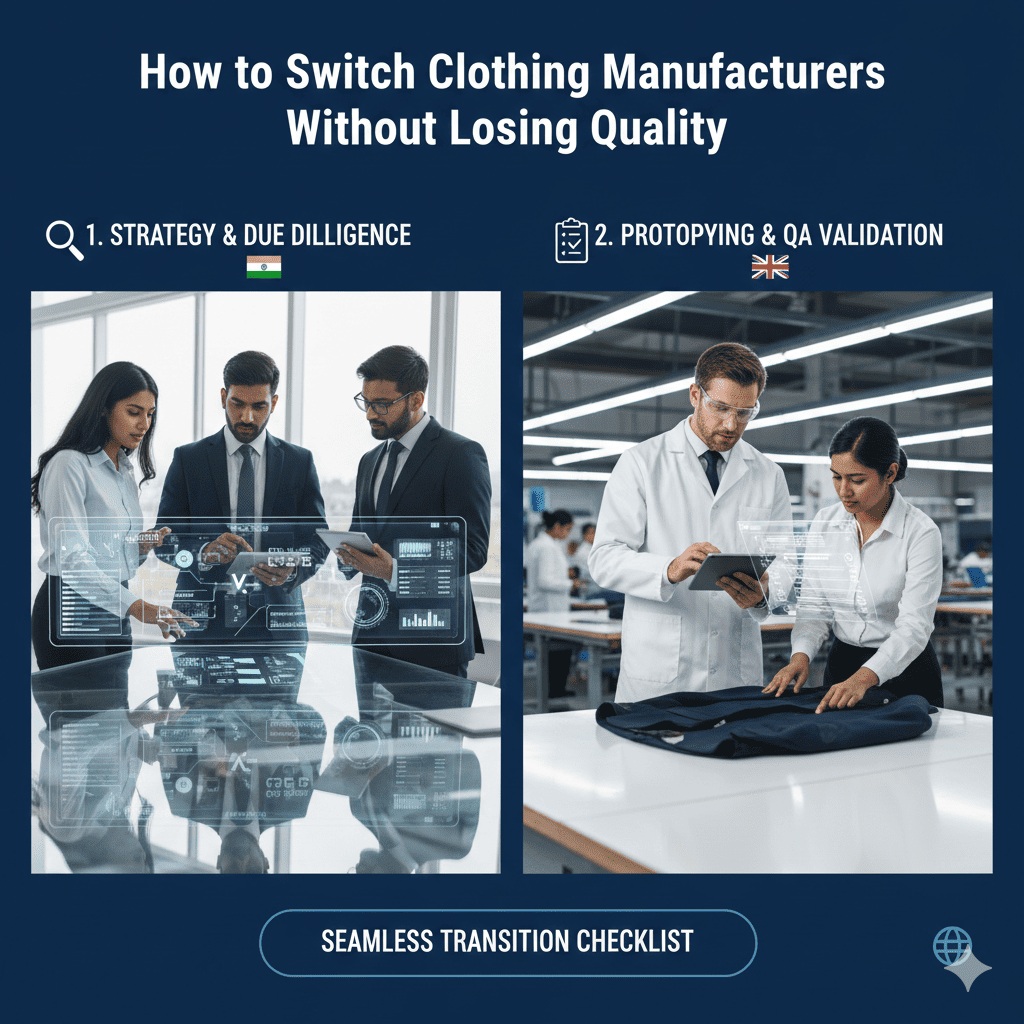
Parallel sampling means running the same product through both your existing and new manufacturer simultaneously, against the same tech pack and sealed reference sample. The output from the new manufacturer is measured against your QC benchmarks — not against the new factory’s own standards.
“Send your most technically demanding product for parallel sampling, not your simplest. If a manufacturer can match your quality on a complex garment under sample conditions, they can do it in production. The reverse is not always true.” — Silk Routes Manufacturing Team
What parallel sampling reveals that nothing else does:
- Whether the new manufacturer’s interpretation of your tech pack matches your expectations
- Where undocumented standards from your current factory need to be explicitly written into the brief for the new one
- Which defect categories the new factory tends towards, so you can build monitoring into production QC
Parallel sampling costs more in the short term. It costs far less than a failed first production run with a new manufacturer, which typically sets a brand back one full season.
If you are ready to discuss production requirements with a new manufacturer, our clothing manufacturing services page covers what Silk Routes offers and how the onboarding process works.
Step 4 — Manage the Transition Timeline
Most transition timelines are too optimistic by 8–10 weeks. Build in time for the steps that routinely overrun.
| Phase | Action | Realistic Duration |
|---|---|---|
| Tech pack audit and documentation | Extract, review, fill gaps | 2–4 weeks |
| New manufacturer qualification | Vetting, site visit, shortlist to selection | 3–6 weeks |
| Parallel sampling | Sample production and QC review | 4–6 weeks |
| Parallel production run | First real order with both factories active | 6–8 weeks |
| Old manufacturer wind-down | Notice period, outstanding order completion | Per contract terms |
| Post-transition review | QC comparison, process documentation update | 2 weeks |
The parallel production run — not just sampling, a real order at production volume — is the final gate before you give notice. Brands that phase out the old manufacturer before this gate is cleared are making a commercial decision on incomplete information.
Parallel sampling and parallel production are not the same thing. Sample conditions differ from production floor conditions in ways that matter: operator consistency, batch fabric performance, production pace. A passed sample does not guarantee a passed production run. Both stages are required.
Step 5 — Formal Handover and Contract Ending
Issue your notice in writing, in accordance with the terms of your manufacturing contract. Most UK manufacturer agreements require 30–90 days’ written notice. Read your contract before you begin any transition conversation — exit clauses, outstanding order obligations, and deposit terms vary significantly.
Collect the following before the relationship ends, in writing, with confirmed receipt:
- All patterns, graded size sets, and digital production files
- All approved reference samples held at the factory
- Written confirmation that the manufacturer holds no IP or tooling on your behalf post-termination
Settle all outstanding invoices promptly. The UK garment manufacturing sector is smaller than it appears, and how you handle an exit affects your standing with future manufacturers, subcontractors, and fabric suppliers who operate in the same networks.
Four Mistakes That Cost Brands a Season
Skipping parallel production to save time or money. This is the single most common cause of post-switch quality failure. The new factory needs at least one real production run under formal QC review before they handle your primary volume.
Giving notice before the new manufacturer has passed sampling. Pressure to leave a difficult relationship leads brands to trigger the exit before the replacement is confirmed. This leaves no fallback if the new factory underperforms.
Failing to extract tech packs and patterns before notice is given. Once a manufacturer relationship is formally in exit, the willingness to cooperate on documentation handover often drops sharply. Extract everything before the conversation begins.
Briefing the new manufacturer with incomplete specs. A brand that gives its new factory the same brief that produced problems at the old one will produce the same problems. The transition is the opportunity to close every documentation gap.
Manufacturer Switch Checklist
| Stage | Action | Done |
|---|---|---|
| Pre-transition | Tech pack audit complete | ☐ |
| Pre-transition | Sealed reference samples created for all active products | ☐ |
| Pre-transition | QC benchmarks documented in writing | ☐ |
| Pre-transition | Patterns and production files requested from current manufacturer | ☐ |
| Vetting | New manufacturer site visit completed | ☐ |
| Vetting | Capacity confirmed in writing | ☐ |
| Sampling | Parallel samples run against sealed reference | ☐ |
| Sampling | Sample QC review passed formal benchmark | ☐ |
| Production | Parallel production run completed | ☐ |
| Production | Production QC review passed formal benchmark | ☐ |
| Exit | Written notice issued per contract terms | ☐ |
| Exit | All IP, patterns, and samples collected | ☐ |
| Exit | All outstanding invoices settled | ☐ |
| Post-switch | First solo run reviewed against benchmarks | ☐ |
Frequently Asked Questions
How Long Does a Proper Manufacturer Transition Take?
A well-managed transition runs 16–24 weeks from opening qualification conversations to your first solo production run with the new manufacturer. Brands that try to complete it in 8–10 weeks almost always skip parallel production, which is the step that prevents quality loss. Build the full timeline in from the start.
Who Owns My Tech Packs When I Leave a Manufacturer?
You do. Tech packs document your product and are your intellectual property regardless of who created the original patterns. Request all pattern files, graded size sets, and production reference materials formally and in writing before giving notice — and confirm receipt before the relationship ends. If a manufacturer refuses to release your files, the UK Intellectual Property Office provides guidance on design rights and ownership.
Can I Run Parallel Production with Two Manufacturers at the Same Time?
Yes — and for any brand with an established range, this is the recommended approach rather than a nice-to-have. Place a real production order with your new manufacturer while the existing one handles your primary volume. Use identical specs and sealed reference samples on both. Only proceed to exit after the new factory’s output passes your formal QC review.
What Happens to My Deposits If I Leave a Manufacturer Mid-Order?
This depends entirely on your contract. Deposits on orders already in production are typically non-recoverable. Deposits on future runs not yet started may be recoverable if your contract allows early termination with notice. Assume deposits are non-refundable unless your contract states otherwise, and factor that into your transition budget before triggering the exit.
Do I Need an NDA with My New Manufacturer Before Sharing Designs?
Yes. Share a signed NDA before any design files, tech packs, or reference samples are transferred to a new manufacturer. This applies to UK-based manufacturers as well as overseas factories. Have it signed before the first sample brief is issued. The Manufacturer NDA Template post provides a free, ready-to-use template built specifically for clothing brands.