
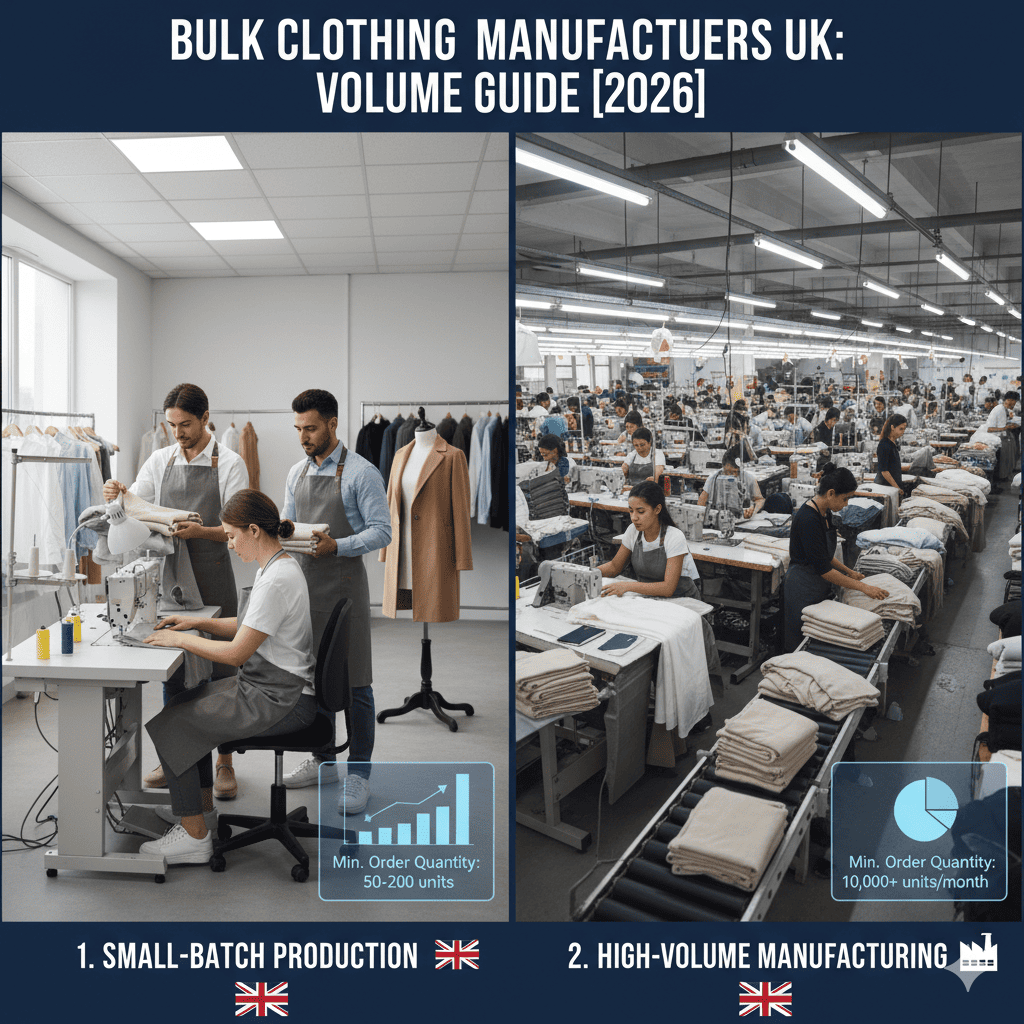
UK clothing manufacturers producing at volume account for a disproportionate share of the industry’s output — the top 15% of UK garment factories by capacity handle an estimated 60% of total domestic production (Source: UKFT, 2024).
For brands scaling beyond startup quantities, understanding how bulk clothing manufacturing works — where the pricing breaks are, what MOQ thresholds mean in practice, and how to negotiate terms that reflect your scale — is the difference between competitive unit economics and paying startup prices on mid-volume orders.
For the full context on how UK clothing manufacturers are structured and how to vet them, see the Complete Guide to Clothing Manufacturers in UK.
Post Summary
- What actually qualifies as “bulk” in UK clothing production — and why the threshold varies by manufacturer type
- MOQ thresholds by production model: CMT, full-service, and specialist volume factories compared
- How bulk pricing tiers work in practice — the volume points where unit costs drop meaningfully
- Lead times for high-volume UK orders and how to protect them contractually
- The negotiation tactics that work with volume manufacturers — and the ones that backfire
Contents
- 1. What Counts as Bulk Clothing Production in the UK?
- 2. UK Manufacturers by Production Capacity
- 3. MOQ Thresholds for Bulk Orders
- 4. How Bulk Pricing Works — Volume Discount Tiers
- 5. Lead Times for Bulk UK Orders
- 6. How to Negotiate Bulk Terms with a UK Manufacturer
- 7. Common Mistakes When Placing Bulk Orders
- 8. Frequently Asked Questions
What Counts as Bulk Clothing Production in the UK?
There is no universal definition. The threshold depends on the manufacturer type, the product category, and the production model.
| Production Scale | Units Per Style Per Run | Typical Manufacturer Type |
|---|---|---|
| Sample / development | 1–10 | Any |
| Low MOQ / startup | 30–150 | Low MOQ specialist |
| Mid-volume | 150–500 | Full-service, CMT |
| Bulk / volume | 500–2,000 | Volume-focused manufacturer |
| High volume | 2,000+ | Dedicated bulk facility |
These are working ranges, not industry-standard definitions. A knitwear specialist may consider 300 units per style a volume run. A workwear factory may not engage below 1,000 units per style.
The practical question is not whether your order qualifies as “bulk” in abstract terms — it is whether your volume justifies a volume-specialist manufacturer versus a full-service manufacturer that accommodates higher quantities.
UK Manufacturers by Production Capacity
Not every UK manufacturer that accepts large orders is equipped for true volume production. Capacity, machinery, and floor organisation vary significantly.
| Manufacturer Type | Realistic Volume Capacity | Best Suited For |
|---|---|---|
| Low MOQ full-service | 30–300 units/style | Brands scaling from startup |
| Mid-volume CMT | 200–800 units/style | Brands with own fabric sourcing |
| Full-service volume | 300–1,500 units/style | Established brands, seasonal ranges |
| Dedicated bulk facility | 1,000–5,000+ units/style | Retail, uniform, corporate clients |
| Specialist category volume | Varies by category | Activewear, workwear, knitwear |
The distinction between a full-service manufacturer that can handle 1,000 units and a dedicated bulk facility matters operationally. A full-service manufacturer accommodating large orders is managing volume alongside smaller runs on the same floor. A dedicated bulk facility is optimised for volume — its machinery, operator allocation, and QC processes are built around high-quantity runs.
For brands moving from mid-volume to genuine bulk, evaluating a volume-specialist manufacturer is worth doing at the 500+ units per style threshold.
MOQ Thresholds for Bulk Orders
Minimum order quantities in UK bulk manufacturing are set to protect floor efficiency — not to exclude brands. Understanding what drives the MOQ tells you where negotiation is realistic and where it is not.
The key MOQ drivers in volume production:
Fabric procurement. UK manufacturers sourcing fabric domestically or from European mills typically require minimum cut lengths that translate directly to garment quantities. A 100-metre minimum from a fabric mill may yield 200–300 units depending on the garment. Ordering below that quantity means the manufacturer absorbs the excess fabric cost or passes it to you.
Production scheduling. Volume factories run their floors in blocks. Setting up a production line for a new style — pattern lay, machine configuration, operator briefing — carries a fixed cost regardless of quantity. Below a certain run length, that fixed cost per unit makes the order uneconomical.
QC resource. Inline and end-of-line inspection at volume requires dedicated QC resource. Below certain quantities, the QC cost as a percentage of order value becomes disproportionate.
| MOQ Driver | Typical Threshold | Negotiability |
|---|---|---|
| Fabric minimum cut length | 200–400 units depending on width | Low — mill-set |
| Production line setup cost | 300–500 units to break even | Moderate |
| QC resource allocation | 200+ units for inline inspection | Low |
| Seasonal slot booking | Per factory policy | Moderate with track record |
MOQs are more negotiable on repeat orders than on first orders. A manufacturer who does not know your brand cannot absorb the risk of a below-threshold order. A manufacturer who has produced three seasons of clean, on-time orders has a different risk calculation.
How Bulk Pricing Works — Volume Discount Tiers
Unit price in bulk UK clothing manufacturing does not decrease linearly with volume. It drops at specific thresholds — the points where a manufacturer’s fixed costs per unit shift meaningfully.
| Order Quantity (Units/Style) | Approximate Unit Price Movement | Why It Changes |
|---|---|---|
| Under 200 | Base rate — no volume benefit | Fixed costs dominate |
| 200–500 | 5–10% below base rate | Fabric procurement efficiency |
| 500–1,000 | 10–18% below base rate | Full production line utilisation |
| 1,000–2,500 | 18–25% below base rate | Operator learning curve, reduced setup ratio |
| 2,500+ | Negotiated — case by case | Dedicated line allocation possible |
These ranges are indicative for UK domestic production and will vary by garment complexity, fabric type, and manufacturer. CMT bulk pricing differs from full-service pricing at equivalent volumes because fabric sourcing costs are excluded from the CMT rate.
“The 500-unit threshold is where bulk pricing in UK production typically becomes meaningful for a brand’s margin. Below that, you are paying for flexibility. Above it, you are paying for efficiency — and the difference shows in your unit economics within two to three seasons.” — Silk Routes Manufacturing Team
One point most volume pricing guides omit: the discount tiers above apply per style, not per order. An order of 2,000 units split across 10 styles at 200 units each will not attract the same unit pricing as 2,000 units of a single style. Manufacturers price by run length, not total order value.
Lead Times for Bulk UK Orders
Volume production runs do not automatically mean longer lead times — but they do mean less flexibility when timelines shift.
| Production Scale | Typical UK Lead Time | Key Variable |
|---|---|---|
| 200–500 units/style | 8–12 weeks from fabric approval | Fabric availability |
| 500–1,000 units/style | 10–14 weeks from fabric approval | Production slot booking |
| 1,000–2,500 units/style | 12–16 weeks from fabric approval | Floor allocation and scheduling |
| 2,500+ units/style | 14–20 weeks — negotiated | Dedicated line setup time |
Lead times for bulk orders are heavily dependent on production slot availability. A manufacturer running at 80%+ capacity — which most UK volume manufacturers operate at during peak seasons — has limited flexibility to absorb a large order placed at short notice.
The practical implication: bulk orders require production slot booking 10–14 weeks before your required start date in most cases. Brands that treat UK manufacturers like on-demand production facilities consistently receive longer lead times and lower priority than brands that plan and book seasonally.
If you want to discuss seasonal production planning and slot availability with Silk Routes, our clothing manufacturing services page covers our production capacity and booking process.
How to Negotiate Bulk Terms with a UK Manufacturer
Volume gives brands negotiating leverage — but only when it is used correctly.
Lead with your seasonal plan, not your current order. A manufacturer’s commercial interest is in your annual volume, not a single order. Presenting 12 months of planned production — quantities, styles, timing — is more persuasive than negotiating a single large order in isolation. It allows the manufacturer to plan capacity, pre-purchase fabric, and price more competitively across the relationship.
Negotiate on total seasonal value, not unit price. Unit price negotiations lead to conversations about margins that manufacturers are reluctant to have openly. Seasonal value negotiations — “here is our 12-month plan, what terms make sense for this volume?” — frame the discussion around a commercial partnership rather than a cost reduction exercise.
Offer payment terms that improve the manufacturer’s cash position. A brand willing to pay 50% deposit on order placement (rather than the standard 30%) is offering working capital that has real commercial value. That offer is worth something in a unit price negotiation that a simple volume request is not.
Do not use volume commitments you cannot honour. Promising 2,000 units to secure pricing and then ordering 800 damages the manufacturer relationship in ways that take multiple seasons to repair. Negotiate on your realistic volume, not your optimistic projection.
Common Mistakes When Placing Bulk Orders
Splitting volume across too many styles. Ordering 1,500 units across 15 styles at 100 units each is not a bulk order — it is 15 low-volume orders. The unit pricing, lead times, and manufacturer priority will reflect that. Consolidate styles where possible to reach meaningful run lengths per style.
Assuming volume equals priority. A large order from a new client does not automatically earn production priority. A manufacturer with established clients will allocate their best slots to relationships they trust. New volume clients need to earn that trust over two to three seasons before expecting the priority terms that established clients receive.
Underestimating the QC resource required at volume. Quality control at 2,000 units requires a different level of resourcing than at 200 units. Brands placing bulk orders for the first time frequently underestimate the QC investment — both the manufacturer’s inline process and the brand’s own pre-shipment inspection resource (Source: WRAP, 2024).
Negotiating price without negotiating lead time. Unit price and lead time are connected at volume. A manufacturer who agrees to a sharp price reduction is managing that reduction somewhere — often in the time allocated to your production run. Negotiate both explicitly, in writing, before the order is placed.
Not contracting the volume discount formally. A verbal agreement on volume pricing is not enforceable. Any bulk pricing arrangement — unit rates by quantity tier, seasonal volume commitments, MOQ flexibility — should be documented in your manufacturing agreement before the first order is placed.
Frequently Asked Questions
What Is the Minimum Order for Bulk Clothing Production in the UK?
There is no single industry standard, but 500 units per style is the threshold at which most UK volume manufacturers begin applying meaningful bulk pricing and treating an order as a volume run rather than a standard production order. Some specialist manufacturers — particularly in workwear and uniforms — set their bulk minimum at 1,000 units per style. Confirm the specific threshold with each manufacturer before quoting.
How Much Cheaper Is Bulk Production Compared to Small Runs?
At 500–1,000 units per style, expect unit prices 10–18% below the base rate for equivalent small-run production. At 1,000–2,500 units, the reduction is typically 18–25%. These figures apply to UK domestic production and will vary by garment complexity, fabric type, and production model. CMT bulk pricing differs from full-service bulk pricing because fabric sourcing costs are excluded from the CMT rate.
Do Bulk Orders Always Have Longer Lead Times?
Not automatically — but they require earlier booking. A 1,000-unit run with 14 weeks’ notice may have a shorter actual lead time than a 200-unit run placed at 6 weeks’ notice, because the larger order justifies a dedicated production slot. Lead time in UK bulk manufacturing is primarily a function of production slot availability and fabric procurement, not order size alone.
Can I Negotiate MOQs with a Volume Manufacturer?
On repeat orders with a track record, yes. On a first order, rarely — and attempting to do so signals to the manufacturer that you do not understand their operational constraints, which is not a strong opening position. Build the relationship over two to three orders at the stated MOQ, then open the negotiation with data: your payment record, your ordering consistency, your seasonal plan.
What QC Process Should I Use for Bulk UK Orders?
For orders above 500 units per style, a third-party pre-shipment inspection using an AQL sampling plan — typically AQL 2.5 for major defects, AQL 4.0 for minor defects — is the standard approach. At 1,000+ units, consider inline inspection at the midpoint of the production run in addition to pre-shipment inspection. Catching defects mid-run at volume prevents a partial rework situation on a much larger quantity (Source: WRAP, 2024).