A clothing brand sells 800 units of a children’s jacket. A drawstring fails. A child is injured.
The brand holds public liability insurance but not product liability. The claim reaches £340,000. The public liability policy does not respond — it covers injury on premises, not injury caused by a product in use.
The brand pays out of pocket. It does not survive.
Clothing manufacturing insurance is not a compliance exercise. It is the difference between a claim being an operational problem and a claim ending the business. Most UK clothing brands are underinsured in at least one material category. Many do not discover it until after an incident.
For context on the full range of UK manufacturer relationships and commercial arrangements, see the Complete Guide to Clothing Manufacturers in UK.
Post Summary
- The five insurance types every UK clothing brand and manufacturer needs in 2026 — and the one that is legally mandatory
- Product liability insurance — why a single defective garment claim can exceed £1 million and what cover level to hold
- Employers liability: the only insurance UK law requires you to hold — the fine for non-compliance is £2,500 per day
- Goods in transit cover — the gap most brands discover only after a lost shipment
- Common insurance gaps that leave fashion brands exposed — and how to close them before a claim occurs
Contents
- 1. What Insurance Does a UK Clothing Brand or Manufacturer Need?
- 2. Product Liability Insurance — Why It Is Non-Negotiable
- 3. Public Liability Insurance for Garment Manufacturers
- 4. Employers Liability — UK Legal Requirement
- 5. Goods in Transit Insurance for Clothing Production
- 6. IP and Design Infringement Insurance
- 7. Common Gaps in Fashion Brand Insurance Cover
- 8. Frequently Asked Questions
- 8.1. What Kind of Insurance Do I Need for a Clothing Business?
- 8.2. What Do Clothing Manufacturers Need in Terms of Insurance?
- 8.3. How Much Does It Cost to Manufacture Clothes in the UK?
- 8.4. Is Product Liability Insurance Legally Required for UK Clothing Brands?
- 8.5. What Is the Fine for Operating Without Employers Liability Insurance?
What Insurance Does a UK Clothing Brand or Manufacturer Need?
Five categories. One is legally mandatory. The rest are commercially non-negotiable for any brand selling physical garments.
| Insurance Type | Who Needs It | Legally Required | Minimum Cover |
|---|---|---|---|
| Employers liability | Any business with employees or labour-only contractors | Yes — UK law | £5 million (statutory minimum) |
| Product liability | Any brand selling physical garments | No — but essential | £1–5 million recommended |
| Public liability | Manufacturers, brands with premises or trade shows | No — but standard | £1–2 million minimum |
| Goods in transit | Brands receiving or shipping stock | No — but critical | Per shipment value |
| IP and design infringement | Brands with original designs | No | £100,000–£500,000 |
A sole trader selling handmade garments at a market needs product liability and public liability. A brand with a UK manufacturer and a warehouse needs all five. The cover required scales with operational complexity — not with revenue.
Product Liability Insurance — Why It Is Non-Negotiable
Product liability covers claims arising from injury, illness, or property damage caused by a physical product you have designed, manufactured, or sold.
For clothing brands, the specific risk categories are:
Physical injury — drawstring strangulation risk (children’s garments), choking hazards from loose components, allergic reactions to fabric treatments, skin irritation from chemical finishes, fire risk from non-compliant fabrics.
Property damage — a garment that bleeds dye onto a customer’s furniture, a waterproof jacket that fails and causes damage to electronics.
Consequential loss — in commercial supply, a defective uniform batch that forces a client to halt operations.
UK product safety law — the General Product Safety Regulations 2005 — places strict liability on clothing brands selling in the UK market (Source: gov.uk). Strict liability means a claimant does not need to prove negligence. They need to prove the product was defective and caused the harm.
Average product liability claims in UK manufacturing have settled in the range of £85,000–£340,000 for physical injury in published cases. Claims involving children’s products or hospitalisation can exceed £1 million (Source: British Fashion Council, 2024).
Recommended cover: £1 million minimum for most brands. £5 million for brands selling children’s garments, performance wear, or products with technical safety specifications.
“Every brand we work with that sells children’s garments gets the same advice on their first order: product liability cover at £2 million minimum before the first unit ships. The premium is small. The exposure without it is not.” — Silk Routes Manufacturing Team
Public Liability Insurance for Garment Manufacturers
Public liability covers bodily injury or property damage to third parties occurring as a result of your business activities — on your premises, at trade events, during client visits, or on location.
Relevant scenarios for clothing manufacturers and brands:
- A buyer visiting your factory or showroom slips and is injured
- A pop-up event or trade show stand causes property damage
- A fitting session results in an injury to the client
- A contractor visiting your warehouse is injured
Public liability does not cover product-related claims. That is product liability. The two policies are distinct and both are required by any brand with physical premises or client-facing activity.
Standard cover: £1 million minimum, £2 million recommended for brands attending trade shows, operating showrooms, or running production facilities with third-party visitors (Source: UKFT, 2024).
If you sell on online marketplaces — Amazon UK, ASOS Marketplace, Not On The High Street — check the platform’s seller requirements. Several now mandate minimum public liability cover levels as a condition of trading.
Employers Liability — UK Legal Requirement
Employers liability insurance is the only insurance UK law requires you to hold if you employ anyone.
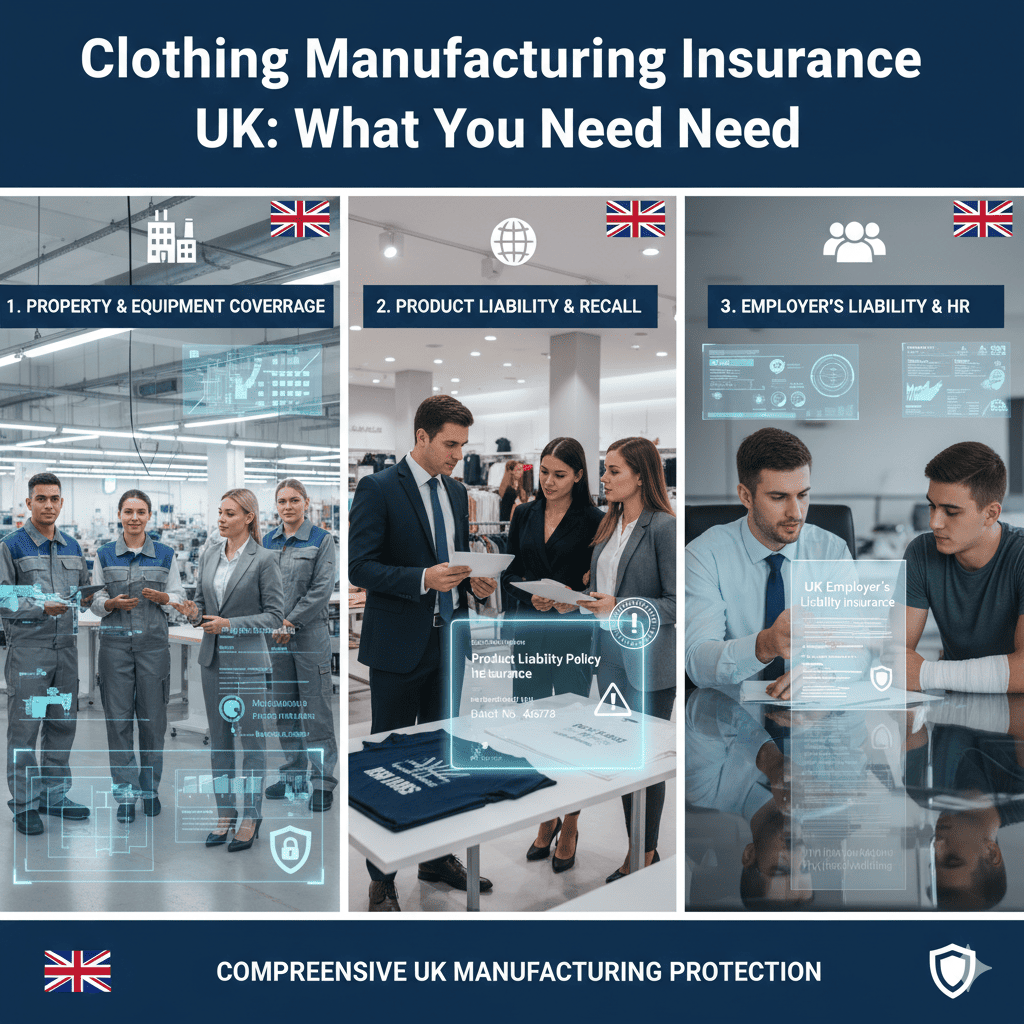
The Employers’ Liability (Compulsory Insurance) Act 1969 requires UK businesses with employees to hold a minimum of £5 million employers liability cover from an authorised insurer.
The fine for non-compliance: £2,500 per day for each day you operate without valid cover. The fine for failing to display your certificate: £1,000.
Who counts as an employee for this purpose extends further than most brands expect (Source: HSE):
- Full-time and part-time employees on PAYE
- Workers on zero-hours contracts
- Labour-only contractors who work primarily for you
- Apprentices and trainees
- Temporary and agency workers in some circumstances
Freelance pattern cutters, sample machinists, or production assistants engaged regularly — even without a formal employment contract — may trigger the requirement. The HSE’s definition of employment for this purpose is broader than HMRC’s definition for tax.
If you use a UK CMT manufacturer, their employees are covered by the manufacturer’s own employers liability policy. Your obligation applies to anyone working directly for your brand.
If you are ready to discuss production arrangements with a UK manufacturer, our clothing manufacturing services page covers how Silk Routes operates and what compliance standards we hold.
Goods in Transit Insurance for Clothing Production
Goods in transit insurance covers stock against loss, theft, or damage while being transported — between your manufacturer and warehouse, between warehouse and fulfilment centre, or during international shipment.
The gap most brands discover after a loss: standard courier and freight carrier liability is limited by default to figures that bear no relationship to garment values.
| Carrier Type | Default Liability Limit | What This Means in Practice |
|---|---|---|
| Standard UK parcel courier | £20–£100 per consignment | A £4,000 sample shipment is covered for £50 |
| Road freight (CMR Convention) | 8.33 SDR per kg (≈£9/kg) | A 20kg garment shipment ≈ £180 maximum |
| Air freight (Montreal Convention) | 22 SDR per kg (≈£23/kg) | A 20kg shipment ≈ £460 maximum |
| Sea freight (Hague-Visby Rules) | 2 SDR per kg or 666.67 SDR per package | Typically far below garment value |
SDR (Special Drawing Rights) values as of 2024. Source: IMF, 2024.
A production run of 500 garments at £28 per unit represents £14,000 in transit. Standard road freight liability covers approximately £180 of that. The gap is not the carrier’s problem — it is yours, unless you hold goods in transit cover.
Set cover at the full replacement value of your highest-value single shipment, not an average or a percentage. Under-insuring for the sake of a lower premium is commercially counterproductive — the premium difference on a garment shipment is small relative to the exposure.
IP and Design Infringement Insurance
IP infringement insurance covers legal costs and damages arising from claims that your brand has infringed a third party’s intellectual property — and, in some policies, covers the cost of defending your own IP against infringement by others.
For clothing brands with original designs, both directions of exposure are real:
Infringement claims against you — a competitor alleges your design copies their registered design or trade mark. Even a groundless claim costs £10,000–£50,000 to defend to resolution.
Defending your IP — enforcing your own design rights or trade mark against a copyist requires legal action. Without insurance, the cost is prohibitive for most brands at £15,000–£80,000 per case.
The UK Intellectual Property Office estimates that 26% of UK fashion businesses experience IP disputes within their first five years of trading (Source: IPO, 2024).
Cover levels: £100,000–£500,000 for most independent brands. High-volume or high-profile brands should seek specific advice on appropriate limits.
Common Gaps in Fashion Brand Insurance Cover
Holding public liability but not product liability. The two policies cover different risks. Holding only one creates a gap that a specific claim will fall directly into.
Under-insuring goods in transit. Setting transit cover at average shipment value rather than maximum shipment value means your worst-case loss is underinsured by definition.
Not covering trade shows and pop-up events. Standard public liability policies may exclude temporary trading locations unless specifically declared. Confirm your policy covers third-party claims at trade show locations before you attend.
Assuming the manufacturer’s insurance covers your product. A UK manufacturer’s product liability policy covers claims arising from their manufacturing process. It does not cover claims arising from your product design, your specification decisions, or your selling activity. You need your own policy regardless of your manufacturer’s cover.
Not reviewing cover annually as the business grows. A policy adequate for a brand turning over £80,000 is materially inadequate at £400,000 turnover. Review cover levels every 12 months and at any significant change in product range, revenue, or distribution channel.
Frequently Asked Questions
What Kind of Insurance Do I Need for a Clothing Business?
At minimum: product liability (for any garment you sell — essential but not legally mandated), public liability (for any premises, events, or client-facing activity), and employers liability (legally required at £5 million minimum if you have any employees or regular contractors). Add goods in transit cover for any shipments above nominal value, and IP infringement cover if you have original designs worth protecting. Most commercial insurers offer combined fashion business policies covering multiple categories at lower combined premiums than individual policies.
What Do Clothing Manufacturers Need in Terms of Insurance?
UK clothing manufacturers need employers liability (legally required, £5 million minimum), public liability for third-party visitors and premises, and product liability for any manufacturing defects that cause injury or damage. Manufacturers operating as CMT factories — where the brand supplies the design and materials — typically hold product liability covering their manufacturing process, but this does not extend to the brand’s design decisions. Both parties need their own policies.
How Much Does It Cost to Manufacture Clothes in the UK?
UK CMT (Cut, Make, Trim) rates in 2026 range from approximately £8–£15 per unit for basic jersey garments to £50–£90 per unit for fully lined tailored jackets, reflecting the National Living Wage of £12.71/hour from April 2026. Full production cost (CMT plus fabric, trims, labels, and packaging) is typically two to three times the CMT rate alone. Insurance is a small additional overhead — combined product and public liability premiums for a startup brand typically run £350–£900 per year — and should be factored into production planning from the first order.
Is Product Liability Insurance Legally Required for UK Clothing Brands?
No — product liability insurance is not legally mandated. Employers liability is the only legally required insurance for businesses with employees. However, product liability is commercially essential for any brand selling physical garments. Strict liability under UK product safety law means you can face a valid claim without any negligence — cover at £1 million minimum is the standard recommendation for adult garment brands, £2–5 million for children’s wear.
What Is the Fine for Operating Without Employers Liability Insurance?
£2,500 per day for each day you operate a UK business with employees without valid employers liability cover from an authorised insurer. Additionally, £1,000 for failing to display your certificate or make it available to HSE inspectors on request. Both are fixed penalties under the Employers’ Liability (Compulsory Insurance) Act 1969 and associated regulations. Source: HSE / gov.uk.