
UK businesses generated roughly 2.5 million tonnes of plastic packaging waste in 2022 (Source: WRAP, 2023). Clothing packaging accounts for a measurable share of that figure.
For UK clothing manufacturers, eco-friendly packaging for clothing manufacturers UK has moved from a marketing choice to a compliance requirement in 2026.
The Extended Producer Responsibility scheme now places direct financial obligations on larger producers. The Plastic Packaging Tax penalises low-recycled-content plastic at the point of manufacture or import.
This guide covers which options are genuinely verifiable, what they cost against standard packaging, and where UK brands most often get the switch wrong.
- Plastic Packaging Tax now sits at £228.82 per tonne from 1 April 2026, applying once a business manufactures or imports 10+ tonnes of sub-30%-recycled plastic packaging a year
- EPR reporting starts at 25 tonnes and £1m turnover; financial obligations only bite above 50 tonnes and £2m turnover
- Recycled polybags at 50% PCR content cost 10–25% more than standard and are the easiest upgrade to make
- Home compostable packaging needs EN 13432 home certification plus genuine consumer composting access — industrial-only claims break the Green Claims Code
- FSC-certified paper and card is the most straightforward sustainable claim to verify, via the public certificate database
- Switching packaging without testing the full supply chain journey costs brands more than the eco premium itself
Contents
- 1. Types of Eco-Friendly Packaging for Clothing Manufacturers UK Brands Use
- 2. UK Packaging Regulations Affecting Clothing Brands in 2026
- 3. Cost Comparison: Standard vs Eco Packaging
- 4. UK Eco Packaging Suppliers for Clothing Manufacturers
- 5. How to Communicate Your Packaging Credentials to Consumers
- 6. Common Mistakes When Switching to Sustainable Packaging
- 7. FAQ
- 7.1. Does the UK Plastic Packaging Tax apply to small clothing brands?
- 7.2. What’s the difference between home and industrially compostable packaging?
- 7.3. What is the best eco friendly packaging for clothing manufacturers UK brands should start with?
- 7.4. Is FSC certification reliable for paper garment packaging?
- 7.5. What packaging claims are safe under the Green Claims Code?
- 8. Matching Packaging to Your Product’s Sustainability Story
Types of Eco-Friendly Packaging for Clothing Manufacturers UK Brands Use
Recycled polybags with at least 50% post-consumer content carry a 10–25% cost premium over virgin plastic at standard order volumes (Source: WRAP, 2024).
That’s the smallest jump of any eco packaging switch available right now.
Our opinion: most brands overthink this decision and should just start with recycled polybags before touching anything else on this list.
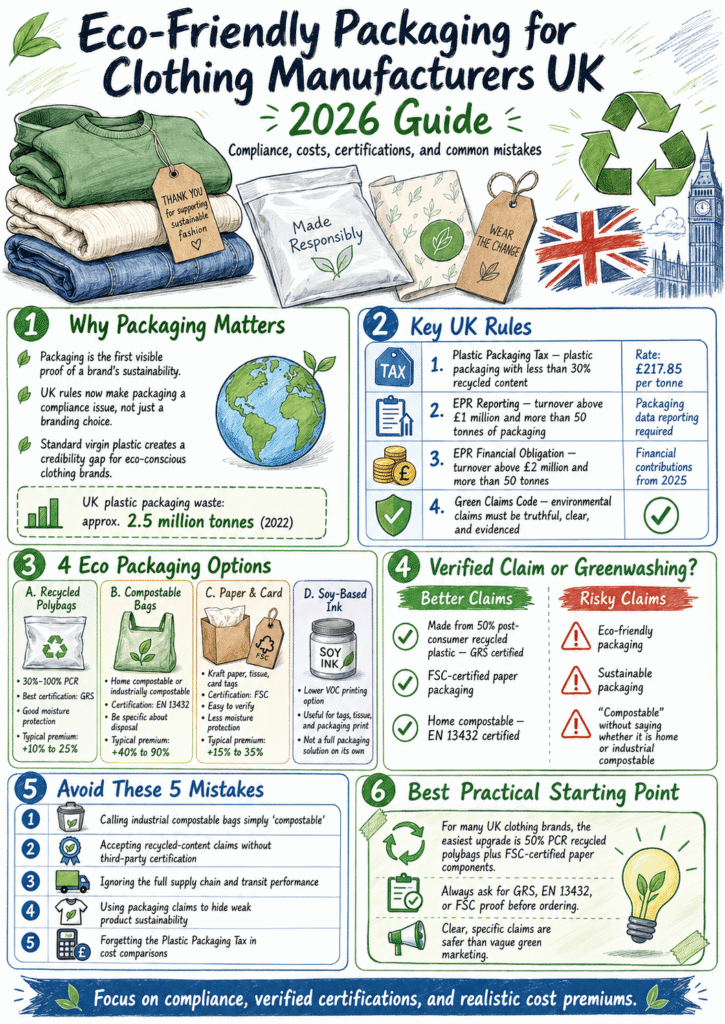
Recycled Polybags
Recycled polybags use post-consumer recycled (PCR) or post-industrial recycled (PIR) plastic in place of virgin polyethylene.
Clarity, strength, and moisture resistance are comparable to standard polybags at equivalent recycled content levels.
Look for suppliers who can show third-party verification of recycled content. Global Recycled Standard certification is the recognised benchmark, with stricter chain-of-custody and processing requirements than a basic recycled-content claim.
At 100% PCR content, polybags may show a slight drop in clarity and tensile strength. For most garment protection needs, 50–75% PCR performs the same as virgin plastic.
Compostable Garment Bags
Compostable garment bags use plant-based materials — typically PLA derived from corn starch, or PBAT blends.
The distinction that matters: home compostable breaks down in a standard compost bin within 12 weeks under EN 13432 home conditions. Industrially compostable needs a commercial facility above 55°C to break down in the same period.
Most UK kerbside collection doesn’t include industrial composting access.
Marking a bag “compostable” without saying which kind is the single most common packaging claim we see brands get wrong. If the customer can’t actually compost it, the claim is doing more harm than the plastic bag it replaced. — Silk Routes Manufacturing Team
That distinction also applies directly to compostable mailing bags used for direct-to-consumer shipments — the same home-vs-industrial split determines whether the claim on the mailer is compliant.
Paper and Card Alternatives
Paper and card garment packaging — kraft bags, tissue paper, card hang tags — is the most straightforwardly verifiable sustainable option when it carries FSC certified packaging documentation.
Every FSC chain of custody certificate can be checked against the FSC’s public certificate database before you commit to an order.
Paper provides less moisture protection than polybags, so bulk freight still needs carton protection or moisture-resistant lining underneath it. Paper suits retail presentation and direct shipment; it doesn’t suit unprotected bulk transit on its own.
Soy-Based Ink Printing
Soy-based ink is a lower-VOC alternative to petroleum-based inks for hang tags, care labels, and branded tissue.
It’s a component-level credential, not a packaging format — a virgin plastic polybag printed with soy ink is still a virgin plastic polybag, and still liable for the Plastic Packaging Tax.
If you’re reviewing packaging as part of a wider UK production run, our clothing manufacturing services page covers how we handle packaging specification alongside garment production.
UK Packaging Regulations Affecting Clothing Brands in 2026
The Plastic Packaging Tax has risen every April since it launched at £200 per tonne in 2022, and now stands at £228.82 per tonne from 1 April 2026 (Source: HMRC, 2026).
That’s a 14% increase since 2022, and it applies before you’ve made a single sustainability claim — it’s a straight cost on low-recycled plastic.
The practical implication: budget for the tax to keep rising annually, and price recycled alternatives against next year’s rate, not this year’s.
| Regulatory Trigger | Threshold | Obligation |
|---|---|---|
| UK Plastic Packaging Tax | 10+ tonnes of plastic packaging manufactured or imported in 12 months, under 30% recycled content | £228.82 per tonne from 1 April 2026 |
| EPR — small organisation | Turnover £1m–£2m and 25+ tonnes, or turnover above £1m with 25–50 tonnes | Data reporting only, no current fee |
| EPR — large organisation | Turnover £2m or more and more than 50 tonnes | Waste disposal fee, scheme administrator costs, registration charge |
| Plastic carrier bag charge | Any retailer selling goods in single-use plastic bags | 10p minimum per bag (England) |
The Extended Producer Responsibility scheme is administered by PackUK, and fees are now modulated by recyclability rather than flat-rate — harder-to-recycle packaging costs more from year two onward (Source: Defra, 2026).
Most brands we work with sit below the large-organisation threshold and only need to report, not pay. That’s worth confirming with an accountant before assuming a fee applies.
Cost Comparison: Standard vs Eco Packaging
What Eco-Friendly Packaging for Clothing Manufacturers UK Actually Costs
A jacket costing £42 to manufacture, shipped in a recycled polybag costing £0.08 instead of £0.06, adds £0.02 to unit cost (Source: WRAP, 2024).
That’s roughly 0.05% of manufacturing cost — the eco premium disappears against production cost at almost any garment price point.
Our opinion: brands that hesitate over packaging cost while accepting far larger margins elsewhere in the supply chain are usually solving the wrong problem.
| Packaging Type | Standard Cost | Eco Alternative | Premium |
|---|---|---|---|
| Polybag (30×40cm) | £0.04–£0.07/unit | 50% PCR recycled: £0.05–£0.09/unit | 10–25% |
| Polybag (30×40cm) | £0.04–£0.07/unit | Home compostable PLA: £0.09–£0.14/unit | 60–90% |
| Paper garment bag | £0.08–£0.15/unit | FSC-certified kraft: £0.10–£0.18/unit | 15–25% |
| Mailer bag | £0.12–£0.22/unit | 50% PCR mailer: £0.14–£0.26/unit | 12–20% |
Premiums compress at higher order volumes, so the cost gap that matters most is at the 1,000–5,000 unit range most independent brands order at.
UK Eco Packaging Suppliers for Clothing Manufacturers
Suppliers offering eco friendly packaging for clothing manufacturers UK wholesale fall into four broad categories, and the certification you should ask for changes by category.
| Supplier Type | What They Offer | Certification to Request |
|---|---|---|
| Specialist sustainable packaging suppliers | PCR polybags, compostable bags, FSC paper | GRS, EN 13432, FSC chain of custody |
| WRAP-accredited suppliers | Packaging meeting UK recycling standards | WRAP certification |
| GRS-accredited suppliers | Recycled content packaging for fashion brands | GRS, RCS (Recycled Claim Standard) |
| FSC-certified paper mills | Certified paper and card packaging | FSC chain of custody certificate |
Ask every supplier for documentation covering the specific product ordered, not their general company certification — a certificate for one product line doesn’t cover another.
How to Communicate Your Packaging Credentials to Consumers
The Green Claims Code requires packaging sustainability claims to be specific, accurate, and substantiated (Source: CMA, 2024).
That single requirement rules out most of the packaging copy currently printed on UK garment bags.
“Eco-friendly packaging” on its own is not a claim, it’s a placeholder — regulators and customers now both expect the number behind it. — Silk Routes Manufacturing Team
Compliant: “This bag is made from 50% post-consumer recycled plastic, certified to Global Recycled Standard.”
Compliant: “This packaging is FSC-certified, produced from responsibly managed forests. Certificate: [number].”
Non-compliant: “Sustainable packaging” — a relative claim with no stated comparison.
Non-compliant: “This bag is compostable,” printed on an industrially compostable bag with no facility guidance for the customer.
Common Mistakes When Switching to Sustainable Packaging
Marking industrially compostable bags as simply “compostable.” This happens because brands copy supplier marketing language without checking the underlying certificate. Fix: state “industrially compostable” explicitly and add a line on where UK customers can access that facility, or switch to home compostable if you can’t answer that.
Accepting recycled content claims without third-party certification. This happens because supplier self-declarations are cheaper and faster than requesting a certificate. Fix: require a GRS or RCS certificate for the specific product ordered before confirming the order.
Testing new packaging only at the showroom stage. This happens because paper alternatives perform well in a controlled retail environment and brands assume that carries through to freight. Fix: run a full bulk-freight test shipment before committing to volume, not just a sample unit.
Treating packaging as a substitute for product sustainability. This happens because packaging is a faster, cheaper story to tell than reformulating the garment itself. Fix: match packaging claims to product claims — a home compostable bag around a non-certified garment invites more scrutiny than credit.
Leaving the Plastic Packaging Tax out of the cost comparison. This happens because the tax is charged upstream and rarely appears as a line item on a packaging quote. Fix: add the tax liability to the standard-plastic cost before comparing it against the recycled option, once you’re above the 10-tonne threshold.
FAQ
Does the UK Plastic Packaging Tax apply to small clothing brands?
Only once you’ve manufactured or imported 10 or more tonnes of plastic packaging in 12 months. Most independent brands sit well under that, so the cost is usually built into the supplier’s price rather than reported directly.
What’s the difference between home and industrially compostable packaging?
Home compostable breaks down in a garden compost bin at ambient temperature; industrially compostable needs a facility running above 55°C. A bag that only says “compostable” without specifying which type risks a Green Claims Code breach.
What is the best eco friendly packaging for clothing manufacturers UK brands should start with?
Start with 50% PCR recycled polybags — a 10–25% premium, GRS-certifiable, and performance-equivalent to virgin plastic for most garments. Save home compostable packaging for direct-to-consumer mailers where you can confirm the customer has genuine composting access.
Is FSC certification reliable for paper garment packaging?
Yes, when checked. Every certificate carries a unique number verifiable on FSC’s public database, so an unverified FSC logo with no checkable number is the actual red flag, not the certification scheme itself.
What packaging claims are safe under the Green Claims Code?
Any claim with a specific figure and a named certification — “50% recycled, GRS-certified” or “home compostable, EN 13432” — holds up. Anything reading “eco-friendly” or “sustainable” on its own doesn’t meet the substantiation bar the CMA enforces.
Matching Packaging to Your Product’s Sustainability Story
The packaging premium is rarely the obstacle — misjudging which certification actually matches the claim you want to make is.
Get that match right and the packaging becomes part of the product’s credibility rather than a line item competing against it.
For the full picture of production decisions this sits inside, see our Complete Guide to Clothing Manufacturers in UK, or talk to Silk Routes directly about specifying packaging alongside your next production run.