Contents
- 1.
- 1.1. Post Summary
- 1.2. Sock Manufacturing in the UK — What Is Still Produced Domestically
- 1.3. Sock Manufacturing Is Different From Cut-and-Sew Clothing
- 1.4. Types of Socks UK Manufacturers Produce
- 1.5. Cushioning
- 1.6. Arch Support
- 1.7. Mesh and Ventilation Zones
- 1.8. Reinforced Heel and Toe
- 1.9. Dress and Formal Socks
- 1.10. Cuff Performance Matters
- 1.11. Seam Bulk Matters Too
- 1.12. Fashion and Lifestyle Socks
- 1.13. Knit-In Logos
- 1.14. Colour Changes
- 1.15. Compression Socks
- 1.16. Athletic vs Dress vs Fashion vs Compression
- 2. Which Sock Manufacturing Route Fits Your Brand?
- 2.1. Three Common Sock Production Routes
- 2.2. Interactive Sock Manufacturer Fit Finder
- 2.3. Sock Type & Manufacturer Fit
- 2.4. Four Sock Production Risk Zones
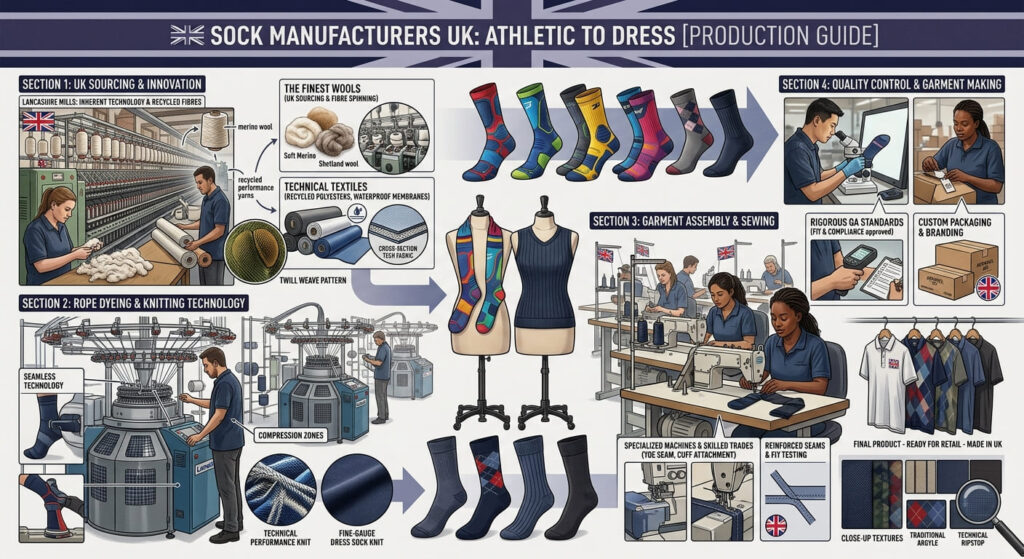
- 2.5. How a Custom Sock Is Manufactured
- 2.6. Fabric Options for UK Socks
- 2.7. Cotton Socks
- 2.8. Combed Cotton
- 2.9. Merino Wool
- 2.10. Polyester
- 2.11. Nylon
- 2.12. Elastane
- 2.13. Bamboo Socks
- 2.14. Recycled Sock Yarns
- 2.15. Yarn Blend Matters More Than Fibre Name Alone
- 2.16. Sock Gauge and Machine Capability
- 2.17. Fine-Gauge Socks
- 2.18. Heavy-Gauge Socks
- 2.19. Custom Branding on Socks — Knit-In vs Applied
- 2.20. Knit-In Branding
- 2.21. Embroidery on Socks
- 2.22. Applied Transfers
- 2.23. Branding on the Sole
- 2.24. Sock Sizing
- 2.25. Heel Placement
- 2.26. Cuff Height
- 2.27. Sock Sampling — What Should Be Approved
- 2.28. Wear Testing for Athletic Socks
- 2.29. MOQ and Lead Times for UK Sock Manufacturing
- 2.30. Why Sock MOQ Can Be Machine-Led
- 2.31. Yarn Minimums Matter Too
- 2.32. Lead Time Depends on Development Readiness
- 2.33. Cost of UK Sock Production
- 2.34. Why Athletic Socks Can Cost More
- 2.35. Why Dress Socks Can Still Be Premium
- 2.36. Why Fashion Socks Become Expensive
- 2.37. How to Brief a UK Sock Manufacturer
- 2.38. Give Artwork in a Sock-Friendly Format
- 2.39. Specify Sock Height
- 2.40. Specify Cushion Zones
- 2.41. Specify Compression Carefully
- 2.42. Common Mistakes When Ordering Custom Socks
- 2.42.1. 1. Treating Socks Like Printed T-Shirts
- 2.42.2. 2. Using Too Much Logo Detail
- 2.42.3. 3. Ignoring Stretch When Designing Logos
- 2.42.4. 4. Choosing Cotton Alone for Performance Socks
- 2.42.5. 5. Making the Cuff Too Tight
- 2.42.6. 6. Ignoring Toe Construction
- 2.42.7. 7. Skipping Wear Testing
- 2.42.8. 8. Ordering Too Many Colourways at Launch
- 2.43. How Silk Routes Supports Accessories and Sock Brands
- 2.44. FAQ
- 2.45. The Best Sock Manufacturer Depends on What the Sock Has to Do
Socks look simple because they are small.
Manufacturing them well is not simple.
A sock has to stretch, recover, stay in position, survive repeated washing and still feel comfortable after hours of wear.
Athletic socks need support and moisture management.
Dress socks need refinement and low bulk.
Fashion socks need visual impact.
Compression socks need controlled pressure and specialist production capability.
That is why choosing the right sock manufacturers UK depends first on what the sock is meant to do.
The supplied brief covers athletic, dress, fashion and compression socks, material options, knit-in versus applied branding, MOQ, lead times, costs and how to brief a UK sock manufacturer.
Post Summary
Sock manufacturing is a knitting process, not standard cut-and-sew garment production
Different sock categories need different yarns, structures and machine capability
Athletic socks usually prioritise cushioning, support and moisture management
Dress socks prioritise thinness, refinement and comfort inside formal shoes
Fashion socks often prioritise colour and knit-in branding
Compression socks require specialist technical capability
Yarn blend affects comfort, durability, stretch and recovery
Branding can be knitted into the sock or added after production
MOQ depends on machine setup, yarn colours, sizes, design complexity and packaging
Cost should be compared against the same yarn, construction, branding and packaging specification
Sock Manufacturing in the UK — What Is Still Produced Domestically
The brief targets brand owners looking for UK production across branded, athletic and fashion sock collections.
UK sock production can include:
Athletic socks
Running socks
Training socks
Dress socks
Fashion socks
Branded promotional socks
Ankle socks
Crew socks
Boot socks
Lifestyle socks
Compression products
But not every sock manufacturer UK will cover every category.
Sock factories differ according to:
Knitting machinery
Needle gauge
Yarn capability
Toe-closing method
Cushioning capability
Compression capability
Design software
Finishing equipment
That is why “Can you make socks?” is not enough.
The better question is:
Can you make this type of sock, in this yarn, at this gauge, with this performance requirement?
Sock Manufacturing Is Different From Cut-and-Sew Clothing
Most socks are knitted into tubular or shaped constructions.
That means the design depends heavily on:
Machine gauge
Needle count
Yarn
Stitch structure
Elastic zones
Heel formation
Toe formation
Artwork cannot simply be printed across the sock as if it were a T-shirt.
The design often has to work within the knitting structure.
Types of Socks UK Manufacturers Produce
| Sock Type | Main Priority | Typical Construction Features | Main Production Risk |
|---|---|---|---|
| Athletic | Performance | Cushioning, arch support | Poor fit / heat |
| Running | Moisture + friction control | Mesh zones, cushioning | Blisters |
| Dress | Thinness + refinement | Fine gauge | Bulk / slipping |
| Fashion | Branding + colour | Jacquard / knit-in design | Distorted artwork |
| Lifestyle | Comfort | Cotton blends | Recovery |
| Boot | Warmth + durability | Heavy knit | Excess bulk |
| Compression | Controlled support | Graduated compression | Incorrect pressure |
Athletic and Performance Socks
Athletic socks are designed around movement.
They may need:
Cushioning
Arch support
Ventilation
Moisture management
Reinforced heel
Reinforced toe
Secure cuff
Zoned stretch
The correct construction depends on activity.
A running sock is not the same as:
Football sock
Gym sock
Hiking sock
Tennis sock
The foot moves differently.
Cushioning
Cushioning can be added in zones such as:
Heel
Forefoot
Toe
More cushioning is not always better.
Too much bulk can make the shoe feel tight.
The manufacturer should balance protection with fit.
Arch Support
Some athletic socks use elastic or tighter knit zones around the arch.
The goal is often to help the sock stay in position.
It should not feel excessively restrictive.
Mesh and Ventilation Zones
Lighter knitted areas can improve airflow.
These are often positioned on the top of the foot.
But ventilation zones also need enough durability for repeated wear.
Reinforced Heel and Toe
Heel and toe areas experience high abrasion.
Reinforcement can improve durability through:
Denser knitting
Stronger yarn
Additional yarn
Dress and Formal Socks
Dress socks have different priorities.
They usually need to feel:
Thin
Smooth
Refined
Comfortable inside formal footwear
Common design features include:
Fine rib
Subtle patterns
Fine-gauge knitting
Low-bulk toe
Controlled cuff
A thick sports construction usually makes little sense in a formal shoe.
Cuff Performance Matters
A dress sock should stay up.
But the cuff should not feel excessively tight.
This balance depends on:
Elastic yarn
Cuff structure
Fit
Size grading
Seam Bulk Matters Too
Toe construction can affect comfort.
A bulky toe seam may be noticeable in:
Dress shoes
Tight footwear
Running footwear
Ask the manufacturer how the toe is closed and finished.
Fashion and Lifestyle Socks
Fashion socks often prioritise branding.
Design options may include:
Logos
Stripes
Repeating graphics
Colour blocking
Geometric patterns
Typography
The design has to work with the knitting machine.
This can require artwork simplification.
Knit-In Logos
A logo can be knitted directly into the sock.
This can create a durable, integrated result.
But very fine details may not reproduce cleanly.
Colour Changes
Every additional yarn colour can increase complexity.
The machine has to manage colour transitions while keeping the design clean.
Too many colours can make the construction heavier or visually messy.
Compression Socks
Compression is a specialist category.
It should not be treated as simply “a tight sock”.
Compression products may require controlled pressure distribution and more technical development.
If the product is intended for medical or therapeutic claims, appropriate regulatory and product-specific requirements may also apply.
A general fashion-sock factory should not automatically be assumed capable.
Athletic vs Dress vs Fashion vs Compression
| Requirement | Athletic | Dress | Fashion | Compression |
|---|---|---|---|---|
| Cushioning | High | Low | Optional | Low |
| Fine gauge | Medium | High | Variable | Variable |
| Ventilation | Often | Less critical | Optional | Depends |
| Branding | Moderate | Subtle | High | Limited |
| Recovery | High | High | High | Critical |
| Performance zoning | High | Low | Optional | High |
| Specialist testing | Moderate | Lower | Lower | High |
Which Sock Manufacturing Route Fits Your Brand?
Interactive guide for matching sock function, yarn, branding and performance needs to the right production capability.
Three Common Sock Production Routes
Best for running, gym, sports and technical socks with cushioning, ventilation and reinforcement.
Best for dress socks, lifestyle socks, knit-in logos and refined branded collections.
Best for controlled-support products requiring specialist knitting capability and tighter technical control.
Interactive Sock Manufacturer Fit Finder
Build your sock brief
Sock Type & Manufacturer Fit
| Production Route | Best Fit | Capability Needed | Main Risk |
|---|---|---|---|
| Performance specialist | Running, gym, sports | Zoned knit + reinforcement + technical yarns | Heat / slipping / friction |
| Fine-gauge dress specialist | Formal / premium socks | Fine-gauge machines + refined toe finish | Bulk / cuff comfort |
| Fashion / jacquard specialist | Logos, colour patterns | Design programming + multi-colour knitting | Artwork distortion |
| Outdoor / merino specialist | Hiking / winter | Wool blends + cushioning | Bulk / care |
| Compression specialist | Controlled-support socks | Specialist pressure control | Incorrect technical performance |
Four Sock Production Risk Zones
How a Custom Sock Is Manufactured
Recommendations are qualitative sourcing guidance. Physical sampling and wear testing remain the strongest basis for bulk approval.
Fabric Options for UK Socks
The brief specifically asks for sock fabric options.
In sock production, “fabric” usually means the yarn blend and knitted structure.
| Yarn / Fibre | Typical Use | Main Strength | Main Watch-Out |
|---|---|---|---|
| Cotton | Casual, dress | Soft familiar feel | Moisture retention |
| Combed cotton | Premium casual | Smoothness | Cost |
| Merino wool | Outdoor / premium | Warmth + moisture management | Care |
| Polyester | Athletic | Durability + moisture movement | Hand feel varies |
| Nylon | Performance | Strength | Usually blended |
| Elastane | Stretch zones | Recovery | Used in controlled amounts |
| Bamboo-derived viscose | Lifestyle | Soft hand feel | Claims need care |
| Recycled synthetics | Sustainability-led | Recycled input | Performance still needs testing |
Cotton Socks
Cotton is widely used for:
Casual socks
Dress socks
Lifestyle socks
It feels familiar and soft.
But cotton can retain moisture.
That may make it less suitable as the sole fibre for demanding athletic use.
Combed Cotton
Combed cotton removes more short fibres.
This can produce a:
Smoother
Cleaner
More refined
yarn.
It is often attractive for premium lifestyle socks.
Merino Wool
Merino can work well in:
Hiking
Outdoor socks
Premium winter socks
It can provide:
Warmth
Moisture management
Softness
The exact yarn and blend matter.
Polyester
Performance polyester can be used where:
Moisture movement
Durability
Quick drying
are priorities.
It is often blended with other fibres.
Nylon
Nylon is commonly used for strength.
It can support durability in high-wear zones.
Elastane
Elastane helps with stretch and recovery.
It may be used around:
Cuff
Arch
Leg
Foot
Too little recovery creates slipping.
Too much tension creates discomfort.
Bamboo Socks
“Bamboo sock” is commonly used as a marketing description.
But the actual fibre may be bamboo-derived viscose rather than raw bamboo fibre.
Brands should describe materials accurately.
Recycled Sock Yarns
Recycled polyester or nylon may be suitable for sustainability-led collections.
But recycled content alone does not guarantee a better product.
The sock still has to meet:
Durability
Comfort
Recovery
Wash performance
Yarn Blend Matters More Than Fibre Name Alone
A sock labelled “cotton sock” may still contain:
Polyester
Nylon
Elastane
The blend determines:
Stretch
Recovery
Drying
Abrasion resistance
Always request the actual composition.
Sock Gauge and Machine Capability
Sock knitting machines are available in different gauges.
The gauge affects:
Thickness
Detail
Yarn compatibility
Feel
Fine dress socks generally need different machine capability from thick boot socks.
Fine-Gauge Socks
Fine gauge can suit:
Dress socks
Refined fashion socks
Lightweight lifestyle products
The design needs to respect the finer structure.
Heavy-Gauge Socks
Heavier construction can suit:
Boot socks
Hiking
Winter products
But bulk has to be controlled.
Custom Branding on Socks — Knit-In vs Applied
| Branding Method | Best Use | Durability | Main Limitation |
|---|---|---|---|
| Knit-in logo | Fashion, sports | High | Detail limits |
| Knit-in pattern | Fashion collections | High | Machine constraints |
| Embroidery | Small external branding | High | Adds bulk |
| Heat transfer | Specific decorative use | Variable | Surface application |
| Printed packaging | Brand presentation | N/A | Not part of sock |
| Custom woven label packaging | Premium sets | N/A | Extra component |
Knit-In Branding
This is often the strongest route for branded socks.
The design becomes part of the knitted structure.
Advantages include:
Durability
Integrated appearance
Repeatable branding
But fine artwork may need simplifying.
Embroidery on Socks
Embroidery is possible in certain applications.
But socks stretch.
Embroidery does not stretch in the same way.
Large embroidered areas can feel stiff.
Keep embroidery small and intentional.
Applied Transfers
Transfers can add:
Logos
Numbers
Small graphics
But the application must tolerate:
Stretch
Washing
Flexing
Test physically.
Branding on the Sole
Some brands place logos under the foot.
That may work visually for:
Packaging
Lifestyle presentation
But heavy decoration on the sole should not compromise comfort.
Sock Sizing
Sock sizing often combines several shoe sizes into one sock size.
But the actual range depends on:
Yarn stretch
Machine
Construction
Product type
Compression or technical products may need more precise sizing.
Heel Placement
The heel should sit correctly on the foot.
If the sock is too short or too long, heel placement moves.
This affects comfort and appearance.
Cuff Height
Define cuff height clearly.
Do not rely only on terms like:
Ankle
Crew
Mid-calf
Give a physical measurement.
Sock Sampling — What Should Be Approved
Check:
Overall size
Heel position
Toe fit
Cuff height
Cuff tension
Arch tension
Cushion placement
Yarn feel
Logo clarity
Colour
Stretch
Recovery
Toe finish
Wash performance
For athletic products, also wear-test.
Wear Testing for Athletic Socks
A useful wear test should consider:
Slipping
Bunching
Friction
Heat
Cushion position
Cuff movement
A sock can look perfect on a flat table and fail inside a shoe.
MOQ and Lead Times for UK Sock Manufacturing
The brief asks for MOQ and lead-time information.
There is no useful universal MOQ across all UK sock manufacturers.
MOQ can depend on:
Machine setup
Yarn
Colours
Sock size
Design
Packaging
Number of styles
| Specification | Relative Production Pressure |
|---|---|
| Simple single-colour sock | Lower |
| Multi-colour knit-in pattern | Higher |
| Multiple sizes | Higher |
| Custom yarn colour | Higher |
| Athletic zoning | Higher complexity |
| Compression | Specialist |
| Custom retail packaging | Higher |
Why Sock MOQ Can Be Machine-Led
Sock manufacturing relies heavily on machine setup.
A factory may need to:
Load yarn
Program design
Adjust gauge
Test tension
Small runs can carry more setup pressure per pair.
Yarn Minimums Matter Too
Even if the knitting factory accepts a smaller run, the yarn supplier may impose its own minimum.
That can apply to:
Custom dyed yarn
Special blends
Branded colour matching
Ask separately about:
production MOQ and yarn MOQ.
Lead Time Depends on Development Readiness
A simple repeat sock differs from a new athletic design.
Development can involve:
Artwork → Knit Program → Yarn → Sample → Wear Test → Revision → Approval → Bulk Knitting → Toe Closing → Boarding → QC → Packaging
Do not confuse knitting time with total project lead time.
Cost of UK Sock Production
The brief requests cost benchmarks.
Without verified live supplier quotes, fixed 2026 unit prices would be misleading.
The more useful comparison is by cost driver.
| Cost Driver | Lower Pressure | Higher Pressure |
|---|---|---|
| Yarn | Standard | Premium / specialist |
| Colours | Few | Many |
| Design | Simple | Complex knit-in |
| Cushioning | Minimal | Zoned |
| Sizes | Few | Many |
| Compression | None | Specialist |
| Packaging | Bulk | Retail-ready |
| Quantity | Larger repeat | Very small run |
Why Athletic Socks Can Cost More
Athletic socks may use:
Multiple yarns
Mesh zones
Cushioning
Reinforcement
Arch support
More technical structure means more machine programming and production complexity.
Why Dress Socks Can Still Be Premium
Dress socks may be visually simpler.
But premium cost can come from:
Fine yarn
Fine gauge
Merino
Refined finishing
Low-bulk toe construction
Simple appearance does not mean basic production.
Why Fashion Socks Become Expensive
Fashion socks can increase complexity through:
Many colours
Frequent yarn changes
Complex artwork
Multiple sizes
The number of knitted colours and design complexity matter.
How to Brief a UK Sock Manufacturer
Send a complete brief.
Include:
Sock type
Intended use
Sock height
Shoe-size range
Yarn composition
Colour references
Logo/artwork
Knit-in pattern
Cushion zones
Ventilation zones
Reinforcement
Cuff specification
Toe finish
Quantity
Packaging
Labelling
Brands developing socks alongside wider clothing collections can review our clothing manufacturing services before production.
Give Artwork in a Sock-Friendly Format
Do not assume a detailed vector logo can be knitted exactly.
The supplier may need to convert artwork into a grid or knitting programme.
Ask for a visual proof before sampling.
Specify Sock Height
State the finished height.
For example, measure from:
Heel reference
Foot base
according to the supplier’s method.
Do not rely only on “crew sock”.
Specify Cushion Zones
If the sock needs cushioning, show exactly where.
For example:
Full sole
Heel only
Toe only
Heel + forefoot
Specify Compression Carefully
Do not use the word “compression” loosely.
If the product is truly intended to deliver controlled compression, use a manufacturer with relevant specialist capability.
Common Mistakes When Ordering Custom Socks
1. Treating Socks Like Printed T-Shirts
Why it happens: Buyers focus on artwork.
Why it fails: Knit structure limits detail.
Fix: Design for the machine.
2. Using Too Much Logo Detail
Why it happens: The full brand mark is copied directly.
Why it fails: Fine detail can disappear.
Fix: Simplify the knit-in version.
3. Ignoring Stretch When Designing Logos
Why it happens: Artwork is reviewed flat.
Why it fails: The logo distorts on the foot.
Fix: Review it while worn.
4. Choosing Cotton Alone for Performance Socks
Why it happens: Cotton feels natural.
Why it fails: It may retain moisture.
Fix: Select the yarn blend around actual performance.
5. Making the Cuff Too Tight
Why it happens: Buyers want the sock to stay up.
Why it fails: The wearer may find it uncomfortable.
Fix: Test cuff tension physically.
6. Ignoring Toe Construction
Why it happens: The seam is hidden.
Why it fails: Bulk can cause discomfort.
Fix: Review the toe finish inside footwear.
7. Skipping Wear Testing
Why it happens: The sample looks correct.
Why it fails: Slippage and friction appear only in use.
Fix: Test in the intended footwear.
8. Ordering Too Many Colourways at Launch
Why it happens: Brands want variety.
Why it fails: Yarn and machine setup multiply.
Fix: Start with a controlled colour range.
How Silk Routes Supports Accessories and Sock Brands
Sock production is highly dependent on the relationship between:
Machine
Yarn
Structure
Performance
Branding
Silk Routes can help coordinate:
Product specification
Yarn selection
Branding
Sampling
Packaging
Sizing
Performance requirements
Production planning
Quality-control requirements
The aim is to match the product to the right manufacturing capability rather than treating every sock supplier as interchangeable.
You can learn more about our manufacturing approach on the About Silk Routes page.
FAQ
No Google People Also Ask questions were supplied for this article, so these are practical buyer FAQs rather than claimed Google PAA data.
What types of socks can UK manufacturers produce?
Depending on factory capability, UK manufacturers can produce athletic, dress, fashion, lifestyle and specialist sock categories.
Before selecting a supplier, check at least 4 capabilities: machine gauge, yarn range, branding method and finishing.
Can UK sock manufacturers make branded socks?
Yes, branding can often be knitted into the sock or added through another suitable method.
For knit-in branding, review at least 3 things: logo detail, colour count and distortion when stretched.
What materials are best for athletic socks?
There is no single best fibre.
Assess at least 4 performance needs: moisture management, cushioning, durability and recovery.
What should I send to a custom sock manufacturer?
Send a proper specification rather than only artwork.
Include at least 6 essentials: sock type, size range, yarn, colours, branding and quantity.
Should custom socks be wear-tested?
Yes, particularly for performance products.
A basic wear test should check at least 4 issues: slipping, friction, cuff movement and cushion placement.
The Best Sock Manufacturer Depends on What the Sock Has to Do
An athletic sock.
A fine dress sock.
A bold fashion sock.
A compression sock.
They are all socks.
But they are not the same manufacturing job.
The right sock manufacturers UK should have machine capability that matches the product.
For athletic socks, ask about performance knitting.
For dress socks, ask about fine gauge and low bulk.
For fashion socks, ask how much artwork detail can actually be knitted.
For compression products, ask about specialist capability.
Start with function.
Then choose the yarn.
Then choose the machine.
Then choose the manufacturer.
For broader specialist clothing-production guidance, see our Specialist Clothing Manufacturers UK guide.
