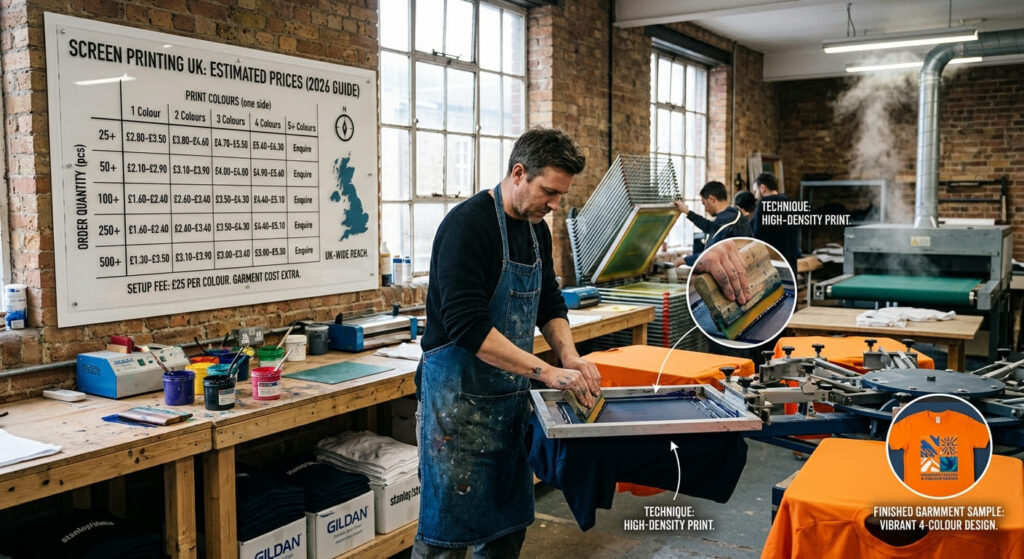
Screen printing can be one of the most economical ways to decorate clothing — but only when the artwork, quantity and garment suit the process. See our guide: embroidery vs screen print vs DTG compared.
A one-colour logo printed across 500 T-shirts is a very different production job from a five-colour illustration printed on 30 hoodies. See our guide: embroidery or screen printing for corporate uniforms.
That is why comparing screen printing services UK prices using only a “price per garment” can be misleading.
Screen printing cost is usually shaped by setup, number of colours, print positions, garment type, ink choice and order volume.
The supplied brief specifically targets UK buyers comparing garment screen-printing cost, setup fees, MOQ, ink types and different printing methods.
Contents
- 1. Post Summary
- 2. How Does Screen Printing Work on Clothing?
- 3. Screen Printing Is a Production Process, Not a Desktop Printer
- 4. What Drives Your Screen Printing Price?
- 5. The Biggest Price Drivers
- 6. Interactive Screen Printing Cost-Pressure Estimator
- 7. How Specification Changes Cost Pressure
- 8. Where Screen Printing Cost Comes From
- 9. UK Screen Printing Prices in 2026 — What Actually Changes the Quote
- 10. Price Per Garment by Quantity
- 11. Setup and Screen Fees
- 12. Multi-Colour Print Premium
- 13. Print Positions Matter Too
- 14. Spot Colour Screen Printing
- 15. CMYK and Process Screen Printing
- 16. Ink Types and Their Impact on Price and Finish
- 17. Plastisol Ink
- 18. Water-Based Ink
- 19. Discharge Ink
- 20. Specialty Inks
- 21. Screen Print vs DTG — When to Use Each
- 22. When Screen Printing Usually Makes Sense
- 23. When DTG May Make More Sense
- 24. Screen Printing on T-Shirts
- 25. Screen Printing on Hoodies
- 26. Screen Printing on Workwear
- 27. Screen Print MOQ for UK Services
- 28. How to Get the Best Screen Printing Quote
- 29. Send Quantity Breakdowns, Not Just Total Quantity
- 30. File and Artwork Requirements for Screen Printing
- 31. Separate Colours Clearly
- 32. Convert Text Correctly
- 33. Check Transparency and Effects
- 34. Oversized Screen Printing
- 35. Why Curing Matters
- 36. Why a Wash Test Is Useful
- 37. Common Screen Printing Mistakes
- 37.1. 1. Comparing Quotes Only by Price Per Garment
- 37.2. 2. Adding Colours Without Considering Cost
- 37.3. 3. Choosing Screen Printing for Tiny Variable Orders
- 37.4. 4. Sending Low-Resolution Artwork
- 37.5. 5. Designing Across Seams and Zips
- 37.6. 6. Ignoring Fabric Type
- 37.7. 7. Approving Colour Only on Screen
- 37.8. 8. Skipping Production Testing
- 38. How Silk Routes Manages Screen Printing for Clothing Orders
- 39. FAQ
- 40. Screen Printing Value Comes From the Right Production Match
Post Summary
Screen printing uses a separate screen or stencil for individual print elements or colours
Setup cost matters more on small orders because it is spread across fewer garments
Higher quantities usually improve production efficiency
More print colours generally mean more setup and machine operations
Water-based and plastisol inks create different finishes and production requirements
Spot-colour printing is well suited to solid brand colours
CMYK/process printing can reproduce more complex imagery but requires greater control
Hoodies, T-shirts and workwear can need different ink and curing decisions
Artwork preparation directly affects print quality
The cheapest quote is not necessarily the best production route
How Does Screen Printing Work on Clothing?
Screen printing transfers ink through a prepared mesh screen onto the garment.
Areas that should not print are blocked.
The open parts of the screen allow ink through.
For a basic one-colour print, the process broadly looks like this:
Artwork → Screen Preparation → Registration → Ink → Print → Cure → Inspect
For multiple colours, the printer must align the colours accurately.
That alignment is called registration.
Each additional colour can increase:
Setup
Screen requirements
Registration work
Print operations
Production time
This is why the number of colours matters when requesting a screen-printing quotation.
Screen Printing Is a Production Process, Not a Desktop Printer
A common mistake is treating screen printing as if the printer simply opens a JPEG and presses “print”.
There is more preparation involved.
The printer may need to:
Separate colours
Prepare artwork
Output films or equivalent production files
Coat and expose screens
Register screens
Mix ink colours
Test-print
Cure
Quality-check the garments
For repeat jobs, some of that setup may already exist depending on the printer’s workflow.
Related reading: clothing embroidery techniques · custom T-shirt manufacturing
What Drives Your Screen Printing Price?
Interactive estimator for understanding relative cost pressure — without inventing live price figures.
The Biggest Price Drivers
Artwork preparation, screens, registration and colour setup matter most when quantities are small.
More colours, positions, oversized prints and specialist inks increase production work.
Higher repeat quantities spread fixed setup across more garments and usually improve production efficiency.
Interactive Screen Printing Cost-Pressure Estimator
Build your print specification
How Specification Changes Cost Pressure
| Specification | Relative Pressure | Why |
|---|---|---|
| One-colour repeat print | Lower | Fewer screens and simpler registration |
| Multi-colour artwork | Higher | More screens and print operations |
| Front + back + sleeve | Higher | More garment handling and setups |
| Oversized print | Higher | May require specialist screens or equipment |
| Large identical run | Lower relative setup pressure | Fixed setup is spread over more units |
| Many unique designs | Higher / consider alternatives | Screen printing loses repeat-production efficiency |
Where Screen Printing Cost Comes From
Relative scoring is educational guidance only. A real quote requires the printer to inspect the actual garment, artwork, quantity, positions, colours and finishing requirements.
UK Screen Printing Prices in 2026 — What Actually Changes the Quote
The brief calls for current UK screen-printing price-per-garment figures, setup fees and quantity comparisons.
I have not inserted fixed 2026 prices because live market verification is unavailable here.
Instead, the table below shows what genuinely drives the quotation.
| Cost Factor | Lower Cost Pressure | Higher Cost Pressure |
|---|---|---|
| Order quantity | Larger repeat run | Very small run |
| Print colours | One colour | Multiple colours |
| Print positions | One position | Front + back + sleeve |
| Artwork | Print-ready | Requires rebuilding |
| Print size | Standard | Oversized |
| Garment | Easy flat T-shirt | Difficult seams/pockets |
| Ink | Standard production route | Specialist ink/process |
| Colour matching | Standard colours | Precise custom matching |
| Packaging | Bulk packed | Individual finishing |
Price Per Garment by Quantity
Screen printing has fixed preparation work.
That preparation does not disappear simply because only a few garments are being printed.
Suppose the printer has to prepare:
Artwork
Screen
Ink
Registration
for a one-colour design.
If the job contains only a small number of garments, those setup operations are distributed across a small order.
With a larger order, the same initial setup is spread across more units.
This is why screen printing often becomes more commercially attractive as volume rises.
That does not mean every large order is automatically cheap.
A large order with:
Six colours
Three print positions
Oversized artwork
Difficult garments
can still involve substantial production time.
Setup and Screen Fees
A screen-printing quote may include setup as:
A separate charge
A charge per colour
A charge per screen
Included within the unit rate
Partially waived above a certain order size
Do not compare two quotations until you know what each one includes.
A supplier quoting a lower garment-print price may charge separately for:
Screens
Artwork preparation
Colour matching
Samples
Folding
Packaging
The final project cost matters more than one isolated line item.
Multi-Colour Print Premium
A multi-colour design generally involves more production stages than a single-colour design.
For example:
One colour:
Screen 1 → Print → Cure
Four colours:
Screen 1 → Screen 2 → Screen 3 → Screen 4 → Registration → Print sequence → Cure
The exact method varies by equipment and ink system.
But the principle remains: more colours usually mean more setup and more print operations.
Print Positions Matter Too
A front-and-back print is not simply the same job twice.
The garment has to be repositioned.
Each print position requires its own production setup.
Common positions include:
Left chest
Centre chest
Full front
Upper back
Full back
Sleeve
Leg
Pocket area
When requesting a quote, specify each position separately.
Spot Colour Screen Printing
Spot-colour printing uses defined individual colours.
It is especially suitable for:
Logos
Typography
Bold illustrations
Corporate colours
Simple brand artwork
A three-colour logo would normally require the printer to manage those colours separately.
Spot printing is often the most straightforward route for strong solid branding.
CMYK and Process Screen Printing
Process printing uses combinations of colours to create a wider visual range.
CMYK refers to:
Cyan
Magenta
Yellow
Black
It can be used for complex images where colours visually combine.
However, process printing needs careful control over:
Halftones
Registration
Screen preparation
Colour behaviour
Garment colour
It is a more technical brief than a simple one-colour logo.
Ink Types and Their Impact on Price and Finish
Ink choice changes the feel, appearance and production requirements.
| Ink Type | Typical Appearance | Hand Feel | Main Consideration |
|---|---|---|---|
| Plastisol | Strong, opaque | More noticeable | Reliable coverage |
| Water-based | Softer | Softer on suitable fabric | Fabric/process dependent |
| Discharge | Very soft | Integrated feel | Garment dye compatibility |
| High-density | Raised | Textured | Specialist setup |
| Metallic/specialty | Decorative | Varies | Additional process control |
Plastisol Ink
Plastisol is widely used in garment screen printing.
It is valued because it can provide:
Strong colour
Good opacity
Consistent production
It sits more on the garment surface than some water-based systems.
The final feel depends on:
Ink deposit
Artwork
Mesh
curing
Garment
A very heavy plastisol print can feel noticeably different from a carefully controlled one.
Water-Based Ink
Water-based inks can create a softer print feel on suitable garments.
They are often attractive to fashion brands wanting the print to feel less like a layer sitting on top of the fabric.
But water-based printing is not automatically the right choice for every fabric or artwork.
The printer needs to consider:
Fibre composition
Garment colour
Opacity
Drying behaviour
Production setup
Discharge Ink
Discharge printing works differently.
Instead of simply depositing an opaque layer over the garment, the process can alter the existing garment dye and replace or modify the colour in the printed area.
That can produce a very soft finish.
But the garment has to be suitable.
Results can vary depending on:
Dye chemistry
Fabric
garment colour
A discharge result should be tested rather than assumed.
Specialty Inks
Special finishes may include:
Puff
High-density
Metallic
Reflective
Glow-effect
Other specialist formulations
These can create a distinctive product.
They may also add:
Setup complexity
Testing
Production time
Print limitations
Special ink should be chosen because it improves the product, not just because it sounds unusual.
Screen Print vs DTG — When to Use Each
Screen printing and direct-to-garment printing solve different problems.
| Requirement | Screen Printing | DTG |
|---|---|---|
| High-volume simple logo | Strong fit | Possible |
| One or two colours | Excellent | Possible |
| Small personalised run | Less efficient | Often suitable |
| Photographic artwork | Possible with advanced process | Strong fit |
| Repeat corporate order | Strong fit | Depends on job |
| Large production run | Strong fit | Depends on equipment |
| Many unique designs | Less practical | Better suited |
| Specialty inks | Strong capability | More limited |
When Screen Printing Usually Makes Sense
Screen printing is especially strong when:
The artwork repeats
The quantity is meaningful
Colours are controlled
The garment surface is suitable
A clothing brand ordering the same front logo across hundreds of garments is very different from a customer requesting twenty completely different prints.
When DTG May Make More Sense
DTG can be useful for:
Small batches
Detailed artwork
Many colours
Photographic images
Short-run design testing
It removes the need for individual screens in the same way as traditional screen printing.
But DTG has its own:
Pretreatment requirements
Garment compatibility
Print behaviour
production economics
Neither method is universally better.
Screen Printing on T-Shirts
T-shirts are one of the most common screen-printing garments.
Important variables include:
Cotton content
Fabric weight
Surface smoothness
Garment colour
Print size
Ink
Lightweight fabric needs care with heavy ink deposits.
A large, dense print can change the hand feel significantly.
Screen Printing on Hoodies
Hoodies create additional challenges.
The printer may need to manage:
Thick fabric
Fleece backing
Pockets
Seams
Zips
Rib areas
A large front print across a kangaroo pocket is not the same production job as printing a flat T-shirt.
For zip hoodies, printing across the centre zip creates another complication.
Screen Printing on Workwear
Workwear may use:
Cotton
Polyester
Poly-cotton
Technical fabrics
Some garments also include:
Pockets
Reinforcement
Reflective components
Coatings
The print method must suit the garment.
For compliance-critical clothing, decoration should not interfere with relevant functional areas.
Screen Print MOQ for UK Services
There is no universal UK screen-print MOQ.
A supplier may structure its minimum around:
Number of garments
Minimum order value
Number of garments per design
Number of garments per colourway
| Order Type | Relative Suitability for Screen Print |
|---|---|
| Very small one-off order | Lower |
| Small simple one-colour batch | Possible |
| Medium repeat order | Strong |
| Large branded clothing run | Very strong |
| Many different individual designs | Lower |
| Repeat corporate uniform order | Strong |
The correct question is not only:
“What is your MOQ?”
Also ask:
“What quantity makes this job commercially sensible for this artwork?”
How to Get the Best Screen Printing Quote
A useful quotation request should include:
Garment type
Garment colour
Fabric composition if known
Quantity
Size breakdown
Artwork
Number of print colours
Finished print dimensions
Print positions
Ink preference
Colour-matching requirement
Packaging
Delivery requirement
That information lets the printer quote the actual production job rather than guess.
Brands planning decorated garments can review our clothing manufacturing services before arranging production.
Send Quantity Breakdowns, Not Just Total Quantity
“500 T-shirts” is incomplete.
A more useful breakdown looks like:
Small
Medium
Large
XL
XXL
If several garment colours are involved, split those too.
The printer needs to know whether the job is:
500 identical black garments
or
500 garments spread across five colours and several designs.
Those are different workflows.
File and Artwork Requirements for Screen Printing
Good artwork saves production time.
The printer may request vector artwork for suitable designs.
Useful formats can include properly prepared:
AI
EPS
PDF
SVG
depending on the supplier’s workflow.
For raster artwork, resolution and actual print dimensions matter.
Do not send a small low-resolution image pulled from social media and expect a clean large-format print.
Separate Colours Clearly
For spot-colour artwork, each intended print colour should be identifiable.
Do not rely on:
Screen appearance
Vague colour descriptions
If brand colour matters, provide an agreed colour reference.
Convert Text Correctly
If artwork contains typography, the printer needs access to the correct lettering.
Depending on workflow, this may mean:
Outlining fonts
Supplying font files where permitted
Converting artwork appropriately
Missing fonts can change the design.
Check Transparency and Effects
Graphic effects designed for screens do not always translate directly into screen printing.
Examples include:
Soft transparency
Fine gradients
Drop shadows
Glow effects
These may require:
Halftones
Artwork adaptation
Another printing method
The artwork should be designed for the production process.
Oversized Screen Printing
Large prints can look strong on:
Streetwear
Oversized T-shirts
Hoodies
Fashion garments
But oversized printing can require:
Larger screens
Larger print beds
Different handling
Special equipment
Before designing the artwork, ask the printer for the maximum practical print area.
Why Curing Matters
Printing the ink is only part of the process.
The print has to be cured according to the ink system.
Poor curing can lead to problems such as:
Cracking
Poor adhesion
Premature wash failure
The printer should control the curing process as part of production.
Why a Wash Test Is Useful
For important branded clothing, test the finished print under realistic laundering.
Check:
Adhesion
Cracking
Colour
Distortion
Garment behaviour
A visually perfect first print is not enough if it performs badly after washing.
Common Screen Printing Mistakes
1. Comparing Quotes Only by Price Per Garment
Why it happens: Unit price is easy to compare.
Why it fails: Setup, garments, print colours and packaging may be different.
Fix: Compare the complete specification.
2. Adding Colours Without Considering Cost
Why it happens: Digital artwork makes extra colours feel free.
Why it fails: Each screen-print colour can add production work.
Fix: Simplify artwork where it does not harm the design.
3. Choosing Screen Printing for Tiny Variable Orders
Why it happens: The method is familiar.
Why it fails: Setup becomes inefficient across many different designs.
Fix: Compare DTG or another short-run method.
4. Sending Low-Resolution Artwork
Why it happens: The image looks acceptable on a monitor.
Why it fails: Enlarging poor artwork reveals rough edges.
Fix: Supply print-ready artwork at the correct dimensions.
5. Designing Across Seams and Zips
Why it happens: Mock-ups make every surface look flat.
Why it fails: Physical garment construction affects printing.
Fix: Confirm printable area before finalising artwork.
6. Ignoring Fabric Type
Why it happens: Buyers focus on design.
Why it fails: Ink behaves differently on different garments.
Fix: Specify the exact production garment before approving the process.
7. Approving Colour Only on Screen
Why it happens: Digital approval is convenient.
Why it fails: Monitor colour is not physical ink colour.
Fix: Use an agreed physical colour reference where accuracy matters.
8. Skipping Production Testing
Why it happens: The first print looks good.
Why it fails: Problems may appear after curing or washing.
Fix: Approve a production-equivalent sample and wash performance where appropriate.
How Silk Routes Manages Screen Printing for Clothing Orders
Screen printing should be planned as part of the garment specification.
Silk Routes can help coordinate:
Garment selection
Artwork requirements
Print position
Print dimensions
Ink choice
Colour specification
Sampling
Bulk production
Packaging
Quality-control requirements
This makes it easier to judge whether screen printing is genuinely the right method before production begins.
You can learn more about our manufacturing approach on the About Silk Routes page.
FAQ
No Google People Also Ask questions were supplied for this article, so these are practical buyer FAQs rather than claimed Google PAA results.
How much does screen printing cost per garment in the UK?
There is no single reliable price without a full specification.
At minimum, the quote depends on 5 variables: quantity, garment, number of colours, print positions and artwork complexity.
Does adding more colours increase screen printing cost?
Usually, yes.
Each additional colour can require another screen, registration and print operation, so a four-colour job normally involves more setup than a one-colour job.
Is screen printing cheaper than DTG?
It depends on the order.
Screen printing often becomes more efficient as the number of identical garments rises, while DTG can suit small or highly detailed runs better.
What is a screen printing setup fee?
A setup fee covers production preparation such as artwork processing, screens and registration.
A buyer should check at least 3 things: whether setup is charged per design, per colour or per repeat order.
What artwork is best for screen printing?
Clean production artwork is best.
For simple spot-colour work, vector artwork with clearly defined colours usually gives the printer better control than a low-resolution raster image.
Screen Printing Value Comes From the Right Production Match
The lowest screen-printing quotation is not always the cheapest route.
What matters is how efficiently the artwork, quantity and garment fit the process.
A simple repeat logo across a substantial garment run can be a strong screen-printing job.
A tiny order containing dozens of different photographic designs probably is not.
Before comparing screen printing services UK prices, standardise:
Garment
Quantity
Artwork
Number of colours
Print size
Print positions
Ink
Packaging
Then compare like with like.
That produces a much more useful buying decision than choosing whichever supplier advertises the lowest headline print price.
For broader specialist clothing-production guidance, see our Specialist Clothing Manufacturers UK guide.
