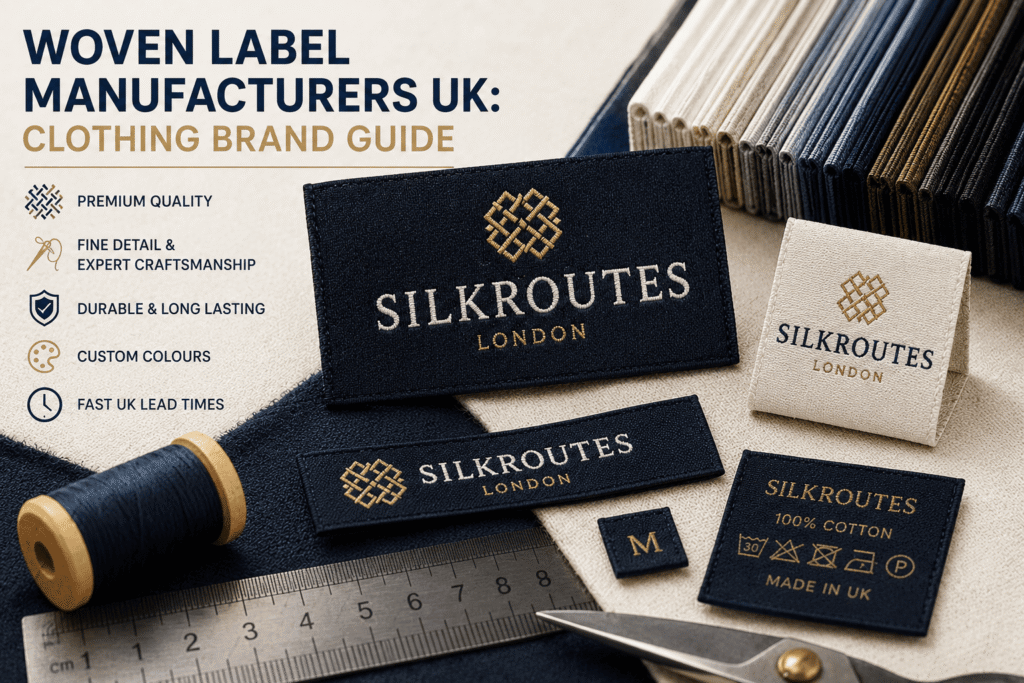
A woven label is one of the smallest parts of a garment — and one of the easiest places to make a brand look cheap. See our guide: UK care label legal requirements.
The fabric can be premium. The stitching can be clean. The fit can be excellent. See our guide: clothing packaging and swing tag requirements.
But if the neck label is scratchy, the logo is unreadable or the edges fray, the customer notices.
That is why choosing woven label manufacturers UK should involve more than asking who offers the lowest price.
The label has to suit the garment, the branding and the way it will be attached.
The supplied brief specifically covers damask, satin and taffeta woven labels, branding design, MOQ, lead time, pricing and sourcing for clothing brands.
Contents
- 1. Post Summary
- 2. Why Woven Labels Are the Premium Choice for Clothing Brand Identity
- 3. Types of Woven Labels for Clothing
- 4. Damask vs Satin vs Taffeta
- 5. Which Woven Label Type Fits Your Clothing Brand?
- 6. Three Main Woven Label Routes
- 7. Interactive Woven Label Type Finder
- 8. Label Type & Use Fit
- 9. From Brand Artwork to Finished Garment Label
- 10. Woven Label vs Printed Label — Key Differences
- 11. When Woven Labels Make More Sense
- 12. When Printed Labels May Be Better
- 13. Woven Label Design Starts With the Final Size
- 14. Logo Simplification for Woven Labels
- 15. Woven Label Thread Count and Detail
- 16. Colour Selection for Woven Labels
- 17. Contrast Matters More Than Colour Quantity
- 18. Label Fold Types
- 19. Centre-Fold Labels
- 20. End-Fold Labels
- 21. Straight-Cut Labels
- 22. Flag Labels
- 23. Label Placement Options
- 24. Comfort Matters
- 25. Sewing Method Matters Too
- 26. Design Considerations for Woven Brand Labels
- 27. Main Brand Label vs Care Label
- 28. MOQ and Lead Times for UK Woven Labels
- 29. Why MOQ Can Be Higher Than Expected
- 30. Lead Time Starts After Approval
- 31. Cost of UK Woven Labels — What Changes the Quote
- 32. How to Compare Woven Label Quotes
- 33. Ask Whether Sampling Is Included
- 34. How to Brief a UK Woven Label Manufacturer
- 35. Approve a Physical Sample
- 36. Common Woven Label Mistakes
- 36.1. 1. Making the Logo Too Detailed
- 36.2. 2. Choosing the Label Before the Garment
- 36.3. 3. Ignoring Fold Allowance
- 36.4. 4. Using Poor Colour Contrast
- 36.5. 5. Putting Too Much Information on One Label
- 36.6. 6. Approving Only a Digital Proof
- 36.7. 7. Ignoring Skin Contact
- 36.8. 8. Treating Labels as a Last-Minute Purchase
- 37. How Silk Routes Sources Woven Labels for Client Brands
- 38. FAQ
- 39. A Good Label Should Look Like It Belongs to the Garment
Post Summary
Damask is usually the most versatile woven-label option for detailed branding
Satin gives a smoother, shinier appearance
Taffeta offers a more basic woven construction and different hand feel
Woven labels are not automatically better than printed labels
Fine artwork must be simplified for weaving
Fold type affects both appearance and sewing
Thread colour should be approved physically, not only on screen
Label size should be chosen around real garment placement
MOQ depends on supplier, construction, size, colours and finishing
Final approval should include both the label and how it is attached to the garment
Why Woven Labels Are the Premium Choice for Clothing Brand Identity
A woven label becomes part of the garment construction.
Unlike a printed transfer or surface decoration, it can remain present throughout the product’s life.
Brands commonly use woven labels for:
Main brand labels
Neck labels
Size labels
Hem labels
Sleeve labels
Flag labels
Care-label combinations
Limited-edition branding
The appeal comes from texture.
The logo is created through woven threads rather than simply printed onto the surface.
That can create a more integrated and premium appearance.
But woven labels also have limitations.
Tiny type, gradients and photographic detail can become difficult or impossible to reproduce cleanly.
Silk Routes Manufacturing Team: Design the label for weaving. Do not shrink a full website logo into a 20 mm rectangle and expect the loom to reproduce every detail.
Types of Woven Labels for Clothing
| Label Type | Appearance | Best Use | Main Limitation |
|---|---|---|---|
| Damask | Fine, detailed, smooth | Fashion brands, neck labels | More detail still has limits |
| Satin | Smooth and glossy | Premium, lingerie, occasionwear | Different visual character |
| Taffeta | More basic woven texture | Utility/basic branding | Less refined than fine damask |
| High-density woven | Detailed | Small premium logos | Depends on supplier capability |
| Woven flag label | Small side-seam branding | External identity | Limited space |
Damask Woven Labels
Damask is often the first option considered for premium clothing labels.
It can produce relatively fine woven detail and a smooth finish.
It works well for:
Brand names
Small logos
Neck labels
Hem labels
Premium fashion garments
Damask can also support multiple thread colours.
The design still needs to respect the physical limits of weaving.
Very thin lines may disappear.
Tiny lettering can close up.
Satin Woven Labels
Satin labels have a smoother, shinier appearance.
They can suit:
Lingerie
Occasionwear
Premium accessories
Garments where softness matters
The visual effect is different from damask.
Satin can look elegant, but not every brand identity suits a shiny label surface.
The choice should match the garment.
Taffeta Labels
Taffeta woven labels generally have a more basic woven appearance.
They may be suitable where the priority is:
Simpler branding
Functional garment identification
Cost control
Utility applications
They are not necessarily the right answer for a luxury garment where label feel and visual refinement are important.
Damask vs Satin vs Taffeta
| Requirement | Damask | Satin | Taffeta |
|---|---|---|---|
| Fine detail | Strong | Moderate | Lower |
| Smooth feel | Strong | Very strong | Moderate |
| Glossy appearance | Low | High | Low |
| Premium fashion branding | Strong | Strong | Moderate |
| Small logos | Strong | Depends on design | More limited |
| Utility/basic labels | Possible | Less typical | Strong |
There is no universal “best” label.
The correct choice depends on the garment and the brand identity.
Which Woven Label Type Fits Your Clothing Brand?
Interactive selector for choosing damask, satin, taffeta or an alternative label route.
Three Main Woven Label Routes
Best all-round option for detailed fashion branding, neck labels and premium identity.
Best where softness, smooth feel and a refined or glossy finish matter.
Best for simpler branding, utility applications and more basic woven construction.
Interactive Woven Label Type Finder
Build your label brief
Label Type & Use Fit
| Label Route | Best Fit | Main Strength | Main Watch-Out |
|---|---|---|---|
| Damask | Fashion, premium brand labels | Detail + versatility | Tiny detail still has limits |
| Satin | Lingerie, occasionwear, soft garments | Smooth feel | Glossy look may not suit every brand |
| Taffeta | Utility/basic clothing | Functional simplicity | Less refined finish |
| Printed label | Care, legal, fine text | Information density | Less woven texture |
| Flag label | Hem, side seam, sleeve | Small external branding | Very limited artwork space |
From Brand Artwork to Finished Garment Label
Final approval should be based on the physical label and, where relevant, the label sewn into the actual garment.
Woven Label vs Printed Label — Key Differences
Woven and printed labels solve different problems.
| Requirement | Woven Label | Printed Label |
|---|---|---|
| Premium texture | Strong | Lower |
| Fine photographic detail | Limited | Strong |
| Small text | Depends on weave | Often stronger |
| Many colour effects | Limited by weaving | More flexible |
| Long-term branding | Strong | Depends on print |
| Soft lightweight care label | Possible | Often suitable |
| Luxury brand identity | Strong | Possible |
| Detailed legal/care information | Less efficient | Strong |
When Woven Labels Make More Sense
Use woven labels when the priority is:
Brand identity
Tactile quality
Durability
Premium garment presentation
External small-branding details
When Printed Labels May Be Better
Printed labels can make more sense when you need:
Lots of text
Complex symbols
Fine legal information
Washing instructions
Multiple languages
Very small lettering
A garment can use both.
For example:
Woven main brand label + printed care label
is often more practical than trying to weave every care instruction.
Woven Label Design Starts With the Final Size
A label should be designed in real physical dimensions.
Not just pixels.
Specify:
Width
Height
Fold allowance
Sewing allowance
A label that looks spacious on a monitor may become crowded once reduced to actual garment size.
Logo Simplification for Woven Labels
The woven version of a logo does not always need every detail from the master artwork.
Elements that may need simplification include:
Thin strokes
Small gaps
Tiny symbols
Fine serif detail
Gradients
Shadows
Very small taglines
A simplified woven logo can look cleaner than a technically faithful but unreadable one.
Woven Label Thread Count and Detail
The ability to reproduce detail depends on the weave construction and supplier capability.
More detail is not automatically better.
A highly detailed label can still fail if:
Lettering is too small
Colour contrast is poor
Thread boundaries blur
Fold lines interfere with artwork
The physical sample should decide approval.
Colour Selection for Woven Labels
Thread colours should support the brand identity.
But colour on screen is not the same as thread.
For colour-critical branding:
Use physical thread references where available
Compare the sample under normal light
Check the label against the actual garment fabric
A white logo may look very different on:
Black cotton
Cream knitwear
Navy workwear
Bright activewear
The surrounding garment colour matters.
Contrast Matters More Than Colour Quantity
Adding more colours does not automatically make the label more premium.
A simple two-colour design can be stronger than a four-colour label with poor contrast.
Ask:
Can the brand name be read quickly?
Does the background help or hurt?
Are important details being lost?
Label Fold Types
Fold construction affects how the label is sewn.
Common options include:
Straight cut
Centre fold
End fold
Manhattan fold
Loop fold
Mitre fold
Book fold
Flag fold
Each changes how much artwork space is actually visible.
Centre-Fold Labels
A centre-fold label is folded in half.
It can suit:
Neck seams
Side seams
Care-label combinations
Only part of the total woven area may be visible after sewing.
Artwork must account for the fold.
End-Fold Labels
End-fold labels have folded edges on the left and right.
They can create a clean finish.
They are commonly used where the label is sewn down at both ends.
Straight-Cut Labels
Straight-cut labels are simple flat pieces.
They can be:
Sewn on all sides
Sewn at selected edges
Used as patches or external branding
Edge finishing matters because the cut edges need to remain stable.
Flag Labels
Flag labels are usually small and inserted into a seam.
They work well for:
Side-seam logos
Sleeve branding
Hem branding
Space is limited.
The artwork should therefore be extremely simple.
Label Placement Options
| Placement | Typical Label | Main Consideration |
|---|---|---|
| Back neck | Main brand | Comfort + size |
| Side seam | Care/brand | Bulk |
| Hem | External branding | Visibility |
| Sleeve seam | Flag label | Small dimensions |
| Waistband | Trousers/skirts | Comfort |
| Inside pocket | Premium detail | Sewing access |
Comfort Matters
A label that scratches the neck can damage the perception of the entire garment.
Comfort depends on:
Material
Edge finish
Fold
Placement
Sewing
For sensitive garment categories such as:
Lingerie
Children’s clothing
Lightweight tops
label comfort deserves particular attention.
Sewing Method Matters Too
A perfect woven label can still look poor if attached badly.
Check:
Stitch line
Thread colour
Alignment
Edge visibility
Distortion
Puckering
The approval should include the label sewn into the actual garment, not just the loose label.
Design Considerations for Woven Brand Labels
Before ordering, define:
Label purpose
Finished visible dimensions
Full production dimensions
Fold type
Background colour
Logo colours
Text
Artwork
Placement
Attachment method
Garment type
Quantity
That is a stronger brief than:
“Please make us a premium woven label.”
Main Brand Label vs Care Label
Do not confuse these functions.
Main Brand Label
Usually communicates:
Brand name
Logo
Identity
Care Label
May need to communicate:
Fibre composition
Washing instructions
Care symbols
Country-of-origin information where relevant
Other required product information
A woven main label and printed care label can therefore work together.
MOQ and Lead Times for UK Woven Labels
There is no reliable universal MOQ across all woven label manufacturers UK.
MOQ may depend on:
Label dimensions
Weave type
Number of colours
Fold
Edge finishing
Backing
Packaging
Supplier setup
| Specification | Relative Production Pressure |
|---|---|
| Simple small damask label | Lower |
| Multiple colours | Higher |
| Very detailed artwork | Higher |
| Special fold | Higher |
| Multiple label sizes | Higher |
| Separate labels for each colourway | Higher |
| Custom packaging | Higher |
The brief requests current MOQ and lead-time benchmarks.
I have not inserted fixed 2026 figures without live supplier verification.
Why MOQ Can Be Higher Than Expected
Woven labels are not individually created one by one in the same way as a home printer.
The manufacturer has setup and loom-production requirements.
This is why a small number of labels can sometimes be disproportionately expensive.
If you need several garment sizes, consider whether the size should be:
Woven into the main label
Added as a separate size tab
A separate size tab can sometimes make inventory easier to manage.
Lead Time Starts After Approval
Do not treat a quotation date as the production start.
The process may include:
Artwork → Digital Proof → Sample → Revision → Approval → Bulk Weaving → Cutting/Folding → QC → Delivery
Every revision adds another approval cycle.
Finalising artwork early helps.
Cost of UK Woven Labels — What Changes the Quote
The brief also requests a UK woven-label price guide.
Without live supplier verification, fixed 2026 unit prices would be misleading.
The useful approach is to understand cost drivers.
| Cost Driver | Lower Pressure | Higher Pressure |
|---|---|---|
| Size | Small/standard | Large |
| Colours | Few | Many |
| Detail | Simple | Very detailed |
| Fold | Standard | Specialist |
| Quantity | Larger repeat order | Very small run |
| Variants | One version | Many versions |
| Finishing | Standard | Special backing/cutting |
| Packaging | Bulk | Individually packed |
How to Compare Woven Label Quotes
Standardise the specification.
Give every supplier the same:
Label dimensions
Artwork
Weave type
Colours
Fold
Quantity
Packaging
Delivery destination
Otherwise you are not comparing like with like.
Ask Whether Sampling Is Included
Some suppliers may quote separately for:
Setup
Prototype
Sampling
Courier
Artwork adjustment
Clarify before ordering.
How to Brief a UK Woven Label Manufacturer
Send:
Vector artwork if available
Exact finished dimensions
Fold type
Colour references
Weave preference
Placement
Quantity
Garment type
Attachment method
Packaging requirement
Brands sourcing labels alongside garment production can review our clothing manufacturing services before placing orders.
Approve a Physical Sample
A digital proof can confirm:
Layout
Colour intention
Text
Size
But it cannot fully show:
Texture
Edge feel
Actual thread
Fold behaviour
Comfort
Approve the physical label where brand presentation matters.
Better still, approve it attached to a garment.
Common Woven Label Mistakes
1. Making the Logo Too Detailed
Why it happens: The brand wants exact reproduction.
Why it fails: Fine details can disappear when woven.
Fix: Simplify the embroidery/weave version of the logo.
2. Choosing the Label Before the Garment
Why it happens: Branding is developed separately.
Why it fails: Size, colour and feel may not suit the final fabric.
Fix: Assess the label with the garment.
3. Ignoring Fold Allowance
Why it happens: Buyers specify only visible size.
Why it fails: Artwork can fall into fold or stitch areas.
Fix: Specify finished and total dimensions.
4. Using Poor Colour Contrast
Why it happens: Brand colours are copied exactly.
Why it fails: Two approved brand colours may still be difficult to read when woven together.
Fix: Prioritise legibility.
5. Putting Too Much Information on One Label
Why it happens: Brands want to reduce component count.
Why it fails: The main label becomes crowded.
Fix: Separate branding from detailed care information where appropriate.
6. Approving Only a Digital Proof
Why it happens: It saves time.
Why it fails: A screen cannot show physical texture.
Fix: Approve the actual woven sample.
7. Ignoring Skin Contact
Why it happens: The label looks excellent off the garment.
Why it fails: Stiff or rough edges may irritate the wearer.
Fix: Wear-test neck and skin-contact positions.
8. Treating Labels as a Last-Minute Purchase
Why it happens: They look simple.
Why it fails: Label delays can hold up final garment production.
Fix: Develop and approve trims early.
How Silk Routes Sources Woven Labels for Client Brands
Labels work best when treated as part of garment development rather than a separate afterthought.
Silk Routes can help coordinate:
Label specification
Artwork preparation
Weave choice
Fold type
Thread colour
Sampling
Garment placement
Attachment method
Bulk sourcing
Quality-control checks
This allows the label to be judged alongside the garment it will actually appear on.
You can learn more about our manufacturing approach on the About Silk Routes page.
FAQ
No Google People Also Ask questions were supplied for this article, so these are practical buyer FAQs rather than claimed Google PAA results.
What is the best woven label for a clothing brand?
Damask is often the strongest general-purpose option for detailed fashion branding.
Before selecting it, compare at least 4 factors: artwork detail, garment type, comfort and intended placement.
What is the difference between damask, satin and taffeta labels?
Damask typically prioritises detail, satin gives a smoother shinier finish, and taffeta provides a more basic woven character.
They represent 3 distinct label constructions, not simply three quality grades.
Are woven labels better than printed labels?
Not always.
Woven labels are strong for branding and texture, while printed labels can be better for small text, care information and complex detail.
How should I prepare artwork for a woven label?
Start with clean artwork at the intended physical dimensions.
Review at least 4 elements before approval: lettering size, thin lines, colour contrast and fold area.
Should I approve a woven label before garment production?
Yes, where possible.
Approval should cover at least 3 stages: artwork, physical woven sample and the label attached to the actual garment.
A Good Label Should Look Like It Belongs to the Garment
A woven label should not feel like something added at the end.
Its:
Material
Size
Colour
Fold
Position
Stitching
should work with the garment.
The strongest brand labels often look simple.
But that simplicity is deliberate.
They are readable.
They feel comfortable.
They are correctly proportioned.
And they survive the garment’s intended use.
When comparing woven label manufacturers UK, ask to see the physical result.
Ask how fine detail will reproduce.
Ask how the label will be folded.
Ask how it should be sewn into the garment.
Those questions tell you far more than the unit price alone.
For broader specialist clothing-production guidance, see our Specialist Clothing Manufacturers UK guide.
