Contents
- 1.
- 1.1. Post Summary
- 1.2. Headwear Manufacturing in the UK — Overview
- 1.3. Types of Headwear UK Manufacturers Produce
- 1.4. Baseball Caps and 5-Panel Caps
- 1.5. Structured vs Unstructured Caps
- 1.6. Six-Panel Caps
- 1.7. 5-Panel Caps
- 1.8. Cap Crown Height
- 1.9. Peak Construction
- 1.10. Snapbacks and Trucker Caps
- 1.11. Snapback Closures
- 1.12. Trucker Caps
- 1.13. Trucker Cap Branding
- 1.14. Dad Hats
- 1.15. Knitted Beanies and Bobble Hats
- 1.16. Cuffed Beanies
- 1.17. Uncuffed Beanies
- 1.18. Ribbed Beanies
- 1.19. Bobble Hats
- 1.20. Caps vs Beanies — Different Manufacturing Routes
- 2. Which Headwear Manufacturing Route Fits Your Brand?
- 2.1. Three Common Headwear Production Routes
- 2.2. Interactive Headwear Manufacturer Fit Finder
- 2.3. Headwear Type & Manufacturer Fit
- 2.4. Four Headwear Production Risk Zones
- 2.5. How Custom Headwear Is Made
- 2.6. Fabric Options for Caps
- 2.7. Cotton Twill
- 2.8. Canvas
- 2.9. Polyester
- 2.10. Ripstop
- 2.11. Yarn Options for Beanies
- 2.12. Acrylic Beanies
- 2.13. Wool Beanies
- 2.14. Merino Beanies
- 2.15. Recycled Yarn Beanies
- 2.16. Decoration Options for Branded Headwear
- 2.17. Flat Embroidery
- 2.18. 3D Puff Embroidery
- 2.19. Woven Patches
- 2.20. Embroidered Patches
- 2.21. Knit-In Beanie Branding
- 2.22. Headwear Embroidery Placement
- 2.23. Logo Size Matters
- 2.24. Embroidery Digitising
- 2.25. Headwear Sampling — What Should Be Approved
- 2.26. Fit Testing Caps
- 2.27. Fit Testing Beanies
- 2.28. MOQ and Lead Times for UK Headwear
- 2.29. Stock Blank vs Fully Custom Headwear
- 2.30. Blank Headwear Decoration
- 2.31. Fully Custom Headwear
- 2.32. Lead Time Depends on Development
- 2.33. Cost Benchmarks for UK Headwear Manufacturing
- 2.34. Why Custom Caps Cost More Than Decorated Blanks
- 2.35. Why Beanie Costs Vary
- 2.36. How to Brief a UK Headwear Manufacturer
- 2.37. Specify Whether You Need Blank Decoration or Custom Manufacture
- 2.38. Give Exact Logo Dimensions
- 2.39. Provide Colour References
- 2.40. Define Peak Shape
- 2.41. Specify Closure
- 2.42. Common Mistakes When Ordering Branded Headwear
- 2.42.1. 1. Treating Caps and Beanies as the Same Product
- 2.42.2. 2. Using an Oversized Embroidery Design
- 2.42.3. 3. Ignoring Cap Depth
- 2.42.4. 4. Approving Embroidery Only on Flat Fabric
- 2.42.5. 5. Choosing 3D Puff for Fine Artwork
- 2.42.6. 6. Ignoring Beanie Recovery
- 2.42.7. 7. Failing to Specify Peak Stiffness
- 2.42.8. 8. Comparing Blank Decoration With Full Custom Quotes
- 2.43. How Silk Routes Supports Headwear and Accessories Brands
- 2.44. FAQ
- 2.45. The Right Headwear Manufacturer Depends on How the Product Is Built
Headwear looks simple until you start manufacturing it.
A cap has crown shape, panel structure, peak construction, closures, sweatbands and embroidery zones. A beanie has knit gauge, yarn, cuff depth, stretch, recovery and branding limitations.
That is why choosing the right headwear manufacturers UK matters.
The supplied brief covers baseball caps, 5-panel caps, snapbacks, trucker caps, knitted beanies and bobble hats, plus decoration, MOQ, lead times, costs and manufacturer briefing.
Post Summary
Cap manufacturing and knitted beanie manufacturing are different production disciplines
Structured caps need accurate panel, peak and crown construction
5-panel caps suit cleaner fashion-led silhouettes
Snapbacks need shape, closure and peak consistency
Trucker caps combine fabric front panels with mesh construction
Beanies depend heavily on yarn, gauge and recovery
Embroidery is one of the strongest branding methods for headwear
Large or highly detailed logos can distort around curved surfaces
MOQ depends on headwear type, materials, decoration and supplier setup
Cost should be compared against the same construction and decoration specification
Headwear Manufacturing in the UK — Overview
The brief is aimed at brands and buyers looking for UK manufacturers producing caps, beanies and branded headwear for fashion and corporate collections.
UK headwear production can include:
Baseball caps
5-panel caps
Snapbacks
Trucker caps
Dad hats
Embroidered caps
Knitted beanies
Ribbed beanies
Cuffed beanies
Bobble hats
Corporate headwear
But not every headwear manufacturer UK will produce every style.
A sewn-cap manufacturer may not knit beanies.
A knitwear specialist may produce excellent beanies but have no structured-cap capability.
That distinction should be made before sampling.
Types of Headwear UK Manufacturers Produce
| Headwear Type | Main Construction | Typical Branding | Main Production Priority |
|---|---|---|---|
| Baseball cap | Multi-panel sewn crown | Embroidery | Shape consistency |
| 5-panel cap | Five-panel construction | Embroidery / patch | Panel alignment |
| Snapback | Structured crown + closure | Embroidery | Crown + peak |
| Trucker cap | Front panels + mesh | Embroidery / patch | Material combination |
| Dad hat | Soft crown | Embroidery | Relaxed shape |
| Cuffed beanie | Knitted | Embroidery / patch / knit-in | Stretch + recovery |
| Bobble hat | Knitted + pom-pom | Knit-in / patch | Knit consistency |
Baseball Caps and 5-Panel Caps
Baseball Caps
A traditional baseball cap may use:
Five or six panels
Curved peak
Eyelets
Sweatband
Adjustable closure
Top button
The crown can be:
Structured
Semi-structured
Unstructured
That affects fit and appearance.
Structured vs Unstructured Caps
Structured caps usually contain reinforcement behind the front panels.
This helps the crown maintain shape.
Unstructured caps sit more softly on the head.
Neither is automatically better.
The choice depends on the brand aesthetic.
Six-Panel Caps
Six-panel caps often create a rounded crown.
The centre-front seam can affect embroidery placement.
If a logo crosses that seam, digitising and embroidery quality become more important.
5-Panel Caps
A 5-panel cap usually has a flatter front section.
This can make it attractive for:
Streetwear
Outdoor brands
Fashion collections
It often gives branding a cleaner uninterrupted surface.
But panel proportion still matters.
A badly shaped 5-panel cap can look too tall, too shallow or too wide.
Cap Crown Height
Crown height influences the entire silhouette.
A high crown can look:
Structured
Streetwear-led
A low crown can look:
Relaxed
Lifestyle-led
Do not leave crown height undefined.
Peak Construction
The peak may be:
Flat
Pre-curved
Slightly curved
Construction can include:
Internal insert
Multiple rows of stitching
Fabric covering
The stiffness should match the intended style.
Snapbacks and Trucker Caps
Snapbacks
Snapbacks typically combine:
Structured crown
Flat or flatter peak
Plastic snap closure
They are common in:
Streetwear
Sports branding
Promotional collections
Consistency matters.
The crown should not collapse unevenly between units.
Snapback Closures
The closure needs to be:
Secure
Comfortable
Consistent in colour
Low-quality closure components can undermine an otherwise good cap.
Trucker Caps
Trucker caps typically combine:
Foam or structured front panels
Mesh back
Adjustable closure
That means the manufacturer is joining materials with different behaviour.
The front panel needs to hold shape.
The mesh needs to remain comfortable.
Trucker Cap Branding
Common methods include:
Embroidery
Woven patch
Printed patch
Large embroidery may be difficult if the front panel is very soft or foam-backed.
Dad Hats
Dad hats generally have:
Softer crown
Curved peak
Relaxed fit
They often use:
Cotton twill
Washed cotton
The visual appeal comes from softness rather than strong structure.
Knitted Beanies and Bobble Hats
Beanies are a different manufacturing category from sewn caps.
They depend on:
Yarn
Knit structure
Gauge
Stretch
Recovery
Cuff construction
A beanie manufacturer UK needs knitting capability, not simply sewing capability.
Cuffed Beanies
A cuffed beanie folds at the lower edge.
This gives:
Extra warmth
A clear branding area
Strong retail familiarity
The cuff depth should be defined.
Uncuffed Beanies
Uncuffed beanies create a cleaner silhouette.
Fit depends more heavily on:
Overall length
Stretch
Crown shaping
Ribbed Beanies
Rib structures help create stretch and recovery.
The rib can also affect:
Thickness
Texture
Branding
Bobble Hats
Bobble hats add another component:
Pom-pom / bobble
This may be:
Yarn-based
Faux-fur
Attachment strength matters.
Caps vs Beanies — Different Manufacturing Routes
| Requirement | Caps | Beanies |
|---|---|---|
| Main process | Cut + sew | Knitting |
| Shape | Panel engineering | Knit shaping |
| Structure | Interfacing / peak | Yarn / gauge |
| Stretch | Limited | High |
| Branding surface | Curved | Stretching |
| Main fit risk | Crown depth | Tightness / recovery |
| Typical decoration | Embroidery | Patch / embroidery / knit-in |
Which Headwear Manufacturing Route Fits Your Brand?
Interactive guide for matching cap or beanie style, structure, material and branding to the right production capability.
Three Common Headwear Production Routes
Best for baseball caps, 5-panel caps, dad hats and fully custom sewn headwear.
Best for higher-crown caps, firm peaks, structured fronts and 3D puff embroidery.
Best for cuffed beanies, ribbed beanies, bobble hats and knit-in branding.
Interactive Headwear Manufacturer Fit Finder
Build your headwear brief
Headwear Type & Manufacturer Fit
| Production Route | Best Fit | Capability Needed | Main Risk |
|---|---|---|---|
| Cap cut-and-sew specialist | Baseball, 5-panel, dad hat | Panel construction + peak + closures | Crown/peak inconsistency |
| Structured cap specialist | Snapback, sports caps | Structured fronts + embroidery | Distortion / peak mismatch |
| Trucker-cap specialist | Mesh-back caps | Mixed-material construction | Front/mesh balance |
| Beanie knit specialist | Ribbed, cuffed, bobble hats | Yarn + gauge + recovery | Loose fit / poor recovery |
| Blank decoration route | Corporate / test runs | Embroidery / patch application | Limited construction control |
Four Headwear Production Risk Zones
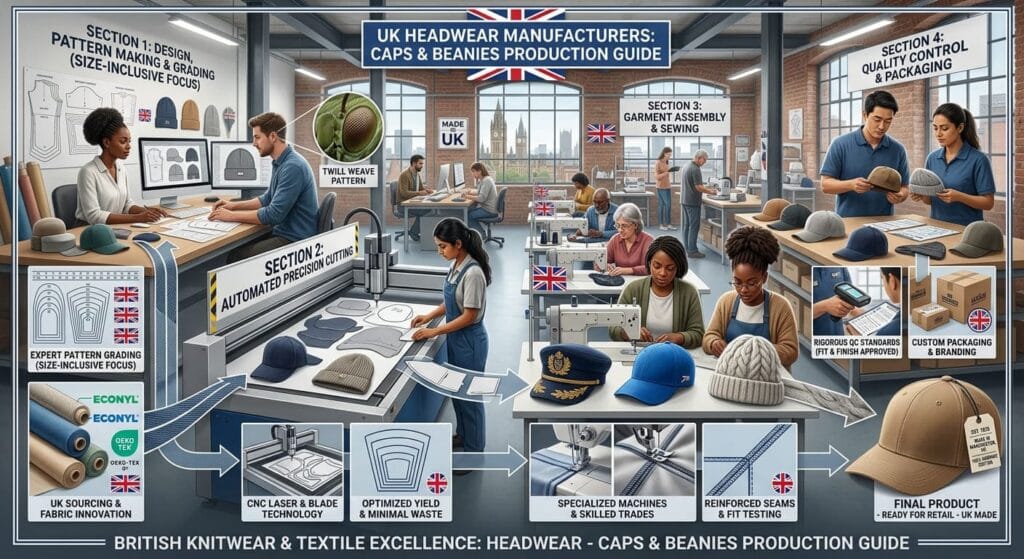
How Custom Headwear Is Made
Recommendations are qualitative sourcing guidance. Physical fit and decoration approval on the final headwear sample remain the strongest basis for bulk production.
Fabric Options for Caps
Common cap fabrics include:
Cotton twill
Brushed cotton
Canvas
Polyester
Ripstop
Performance synthetics
Cotton Twill
Cotton twill is widely used for:
Baseball caps
Dad hats
Casual branded caps
It offers a familiar surface for embroidery.
Canvas
Canvas gives more structure.
It can suit:
Workwear-inspired caps
Outdoor collections
But heavy material increases seam bulk.
Polyester
Polyester can suit:
Sports caps
Uniform headwear
Performance styles
It may offer faster drying than cotton.
Ripstop
Ripstop can suit:
Outdoor caps
Utility styling
It creates a more technical appearance.
Yarn Options for Beanies
Common yarn directions include:
Acrylic
Wool
Wool blends
Merino
Cotton blends
Recycled synthetic yarns
The choice changes:
Warmth
Feel
Price pressure
Recovery
Care
Acrylic Beanies
Acrylic is widely used because it can provide:
Warmth
Colour consistency
Easy care
Quality varies considerably.
Wool Beanies
Wool gives a more natural premium feel.
It may require more careful:
Washing
Finishing
Care labelling
Merino Beanies
Merino can support premium positioning.
But yarn quality and actual fibre composition should be specified clearly.
Recycled Yarn Beanies
Recycled synthetic yarns can support sustainability-led collections.
But recycled content alone should not replace checks for:
Softness
Recovery
Durability
Decoration Options for Branded Headwear
The supplied brief specifically calls for decoration options.
| Decoration Method | Best Use | Main Strength | Main Limitation |
|---|---|---|---|
| Flat embroidery | Caps / beanies | Durable | Detail limits |
| 3D puff embroidery | Structured caps | Strong visual depth | Needs suitable artwork |
| Woven patch | Caps / beanies | Fine detail | Extra attachment |
| Embroidered patch | Lifestyle headwear | Premium texture | Adds thickness |
| Leather-style patch | Beanies / caps | Heritage look | Material suitability |
| Knit-in branding | Beanies | Integrated | Limited detail |
| Screen/transfer print | Selected caps | Graphic flexibility | Surface dependent |
Flat Embroidery
Flat embroidery is one of the safest branding methods for headwear.
It works well for:
Logos
Text
Small icons
But curved cap surfaces can distort designs.
3D Puff Embroidery
3D puff uses foam underneath embroidery.
It creates a raised result.
It is especially common on:
Snapbacks
Structured caps
The artwork usually needs:
Bold shapes
Strong stitch coverage
Very fine detail is unsuitable.
Woven Patches
Woven patches can reproduce finer detail than direct embroidery.
They can be attached to:
Cap front
Side panel
Beanie cuff
Embroidered Patches
Embroidered patches give more texture.
They suit:
Outdoor brands
Heritage styling
Workwear-inspired headwear
Knit-In Beanie Branding
Branding can sometimes be knitted into the structure.
This can work for:
Stripes
Repeating graphics
Simple logos
But detail is limited by machine gauge and yarn.
Headwear Embroidery Placement
Common cap locations include:
Front centre
Side
Rear
Beanie placement often includes:
Cuff centre
Side cuff
Placement must be specified.
“Logo on front” is not enough.
Logo Size Matters
A logo that is too large can:
Distort the cap front
Cause puckering
Become uncomfortable
The decoration should match the available stable area.
Embroidery Digitising
Embroidery requires digitised stitch files.
Good digitising controls:
Stitch direction
Density
Underlay
Compensation
The same logo may need different digitising for:
Cap
Beanie
Flat garment
Headwear Sampling — What Should Be Approved
Check:
Crown height
Head circumference
Peak shape
Peak stiffness
Closure
Sweatband
Panel alignment
Embroidery
Logo position
Thread colour
Beanie stretch
Beanie recovery
Cuff depth
Yarn feel
For caps, test the product while worn.
For beanies, test both stretched and relaxed.
Fit Testing Caps
A cap should be tested for:
Depth
Pressure
Peak position
Closure comfort
A cap can match circumference and still feel wrong if the crown is too shallow.
Fit Testing Beanies
Beanies should be checked for:
Tightness
Slippage
Length
Recovery
A beanie that stretches easily but does not recover may become loose after wear.
MOQ and Lead Times for UK Headwear
The brief requests MOQ and lead-time information.
There is no useful universal MOQ across all UK headwear suppliers.
MOQ depends on:
Cap or beanie type
Fabric or yarn
Colour
Decoration
Number of sizes
Custom components
Packaging
Factory setup
| Specification | Relative Production Pressure |
|---|---|
| Stock cap + embroidery | Lower |
| Custom sewn cap | Higher |
| Multi-colour custom panels | Higher |
| Standard beanie yarn | Lower |
| Custom-dyed yarn | Higher |
| 3D puff embroidery | Moderate |
| Multiple patches | Higher |
| Custom packaging | Higher |
Stock Blank vs Fully Custom Headwear
This is an important distinction.
A brand can either:
Decorate an existing blank cap/beanie
Manufacture custom headwear from scratch
These are not the same service.
Blank Headwear Decoration
This route can be useful for:
Corporate orders
Small runs
Event merchandise
Early brand testing
The garment already exists.
Only decoration is added.
Fully Custom Headwear
Custom manufacture gives control over:
Fabric
Panel shape
Peak
Closure
Colour
Labels
Internal taping
Branding
It also creates more development work.
Lead Time Depends on Development
A repeat embroidery job is very different from a new custom cap.
Custom development may involve:
Design → Material → Pattern → Sample → Fit → Embroidery Sample → Revision → Approval → Bulk → QC
Beanies may follow:
Design → Yarn → Knit Programme → Sample → Fit → Branding → Approval → Bulk
Cost Benchmarks for UK Headwear Manufacturing
The brief requests cost benchmarks.
Without verified live quotes, fixed 2026 prices would be misleading.
The useful comparison is by cost driver.
| Cost Driver | Lower Pressure | Higher Pressure |
|---|---|---|
| Product | Stock blank | Fully custom |
| Fabric/yarn | Standard | Premium/specialist |
| Panels | Standard | Custom |
| Decoration | Simple embroidery | 3D/patch/multiple |
| Colours | Few | Many |
| Closures | Standard | Custom |
| Quantity | Larger repeat | Small custom run |
| Packaging | Bulk | Retail-ready |
Why Custom Caps Cost More Than Decorated Blanks
With a blank cap, the base product already exists.
With a custom cap, the supplier may need to develop:
Pattern
Panels
Peak
Closure
Internal components
That increases development pressure.
Why Beanie Costs Vary
Beanie price pressure can increase through:
Premium yarn
Custom dyeing
Complex knit
Jacquard branding
Bobbles
Patches
How to Brief a UK Headwear Manufacturer
A strong brief should include:
Headwear type
Reference silhouette
Crown height
Panel construction
Fabric or yarn
Colour
Peak shape
Closure
Logo artwork
Decoration method
Logo dimensions
Placement
Label requirements
Quantity
Packaging
Brands planning caps, beanies or wider accessory collections can review our clothing manufacturing services before sampling.
Specify Whether You Need Blank Decoration or Custom Manufacture
Do this first.
Otherwise you may receive quotes for two completely different services.
Give Exact Logo Dimensions
Do not say:
“Medium logo.”
Specify:
Width
Height
Position
Provide Colour References
Provide appropriate colour references for:
Fabric
Yarn
Thread
Patch
Screens are not reliable enough for final production approval.
Define Peak Shape
For caps, state whether you want:
Flat
Slightly curved
Pre-curved
Specify Closure
Options can include:
Plastic snap
Metal buckle
Strapback
Hook-and-loop
Common Mistakes When Ordering Branded Headwear
1. Treating Caps and Beanies as the Same Product
Why it happens: Both are headwear.
Why it fails: One is normally sewn; the other is knitted.
Fix: Select capability by product type.
2. Using an Oversized Embroidery Design
Why it happens: Brands want maximum visibility.
Why it fails: Large dense embroidery can distort the crown.
Fix: Match logo size to stable decoration area.
3. Ignoring Cap Depth
Why it happens: Buyers focus on circumference.
Why it fails: The cap can still sit too high or too low.
Fix: Approve crown depth on a wearer.
4. Approving Embroidery Only on Flat Fabric
Why it happens: It is easier to inspect.
Why it fails: The logo behaves differently on a curved cap.
Fix: Approve embroidery on the final headwear sample.
5. Choosing 3D Puff for Fine Artwork
Why it happens: Puff looks premium.
Why it fails: Fine text and small detail do not reproduce well.
Fix: Simplify the artwork.
6. Ignoring Beanie Recovery
Why it happens: The sample feels stretchy.
Why it fails: Stretch without recovery leads to a loose fit.
Fix: Test after repeated wear.
7. Failing to Specify Peak Stiffness
Why it happens: “Baseball cap” seems descriptive enough.
Why it fails: Peak construction varies.
Fix: Approve physical peak feel.
8. Comparing Blank Decoration With Full Custom Quotes
Why it happens: Both suppliers quote “custom cap”.
Why it fails: One may be decorating stock while the other is manufacturing from scratch.
Fix: Compare like with like.
How Silk Routes Supports Headwear and Accessories Brands
Headwear sourcing depends on matching:
Product
Construction
Material
Fit
Decoration
Silk Routes can help coordinate:
Fabric or yarn sourcing
Headwear specification
Sampling
Embroidery
Patches
Labels
Packaging
Production planning
Quality-control requirements
The aim is to find the right production route rather than treating every headwear supplier as interchangeable.
You can learn more about our manufacturing approach on the About Silk Routes page.
FAQ
No Google People Also Ask questions were supplied for this article, so these are practical buyer FAQs rather than claimed Google PAA data.
What types of headwear can UK manufacturers produce?
Depending on capability, UK suppliers can produce or customise baseball caps, 5-panel caps, snapbacks, trucker caps, dad hats and knitted beanies.
Check at least 4 areas: construction method, material, fit and decoration.
Can UK manufacturers make fully custom caps?
Some suppliers can manufacture fully custom headwear, while others mainly decorate existing blanks.
Ask about at least 3 stages: pattern/construction, sampling and bulk production.
Is embroidery good for caps and beanies?
Yes, embroidery works well for many headwear applications.
Before bulk, check at least 3 factors: logo size, stitch density and distortion on the final product.
What should I send to a headwear manufacturer?
Send a complete specification rather than only a logo.
Include at least 6 essentials: style, material, dimensions, colour, decoration and quantity.
Should caps and beanies be fit-tested?
Yes.
Check at least 4 areas: depth or length, pressure, movement and recovery.
The Right Headwear Manufacturer Depends on How the Product Is Built
A baseball cap.
A 5-panel cap.
A snapback.
A trucker cap.
A knitted beanie.
They may all sit in the same accessories category, but they do not require the same manufacturing capability.
A good cap supplier should understand:
Crown shape
Peak construction
Panel alignment
Embroidery
A good beanie supplier should understand:
Yarn
Gauge
Stretch
Recovery
The best headwear manufacturers UK are the ones whose real capability matches the product you intend to make.
Start with the construction.
Then choose the material.
Then choose the decoration.
Then choose the manufacturer.
For broader specialist clothing-production guidance, see our Specialist Clothing Manufacturers UK guide.
