
![Specialist Clothing Manufacturers UK: The Complete Product Guide [2026]](https://silkroutes.co.uk/wp-content/uploads/2026/04/Specialist-Clothing-Manufacturers-UK.png)
Most brands get this wrong before they send a single email.
They find a UK clothing manufacturer, check the website, see a broad capability list, and assume the factory can handle their specific product.
Three weeks and two failed sample rounds later, they discover the factory’s real speciality is printed T-shirts — not the structured workwear jacket they needed.
That mistake costs money. It costs time. It happens constantly.
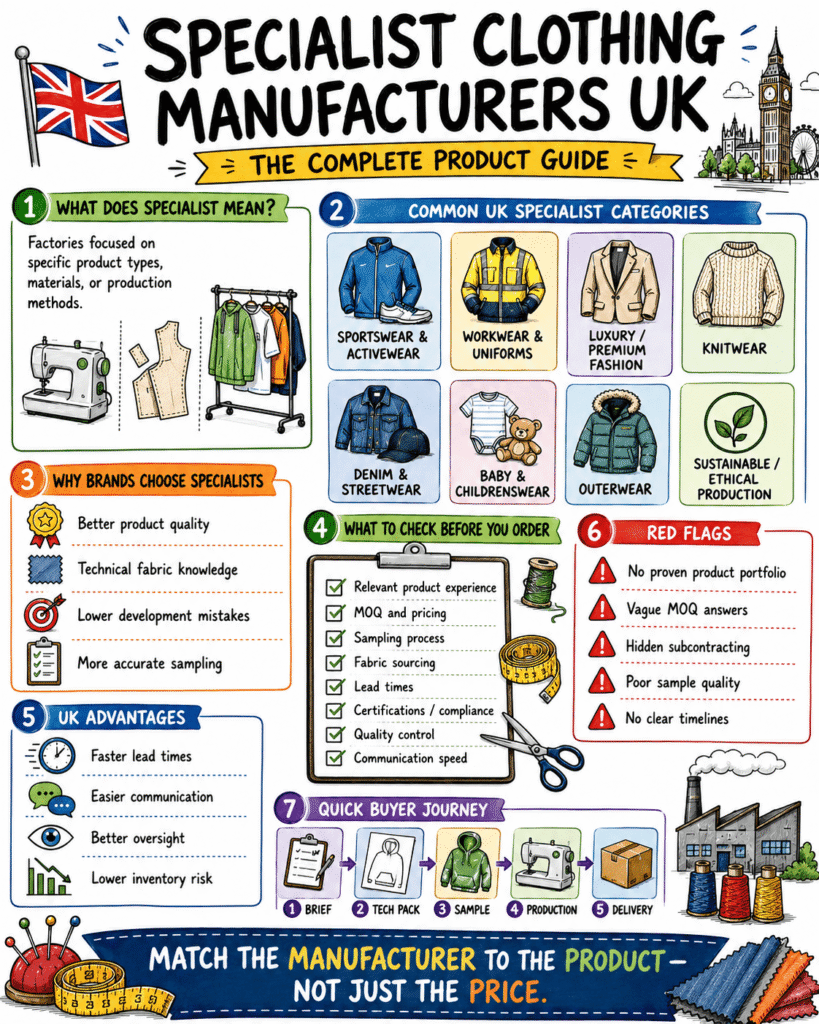
The UK has over 200 specialist clothing manufacturers operating across distinct product categories — workwear, activewear, knitwear, denim, swimwear, childrenswear, and bespoke/luxury (Source: Make It British, UK Clothing Manufacturers Directory, 2025). The problem is not a shortage of specialists. The problem is that most brands do not know how to identify one.
This guide breaks down every major product category in UK specialist clothing manufacturing — what to look for, what MOQs to expect, what compliance applies, and what it costs when you get the match wrong.
Contents
- 0.1. Post Summary
- 0.2. Quick Answer
- 0.3. Why the “Any Manufacturer Can Make Anything” Myth Is Costing UK Brands
- 0.4. Workwear & Uniforms: The Commercial Reality
- 0.5. Activewear & Sportswear: Performance Fabric Handling Is a Specialist Skill
- 0.6. Swimwear & Lingerie: The Most Technically Demanding Category
- 0.7. Childrenswear: The Category With Legal Safety Requirements
- 0.8. Knitwear & Sweaters: Fully-Fashioned vs Cut-and-Sew
- 0.9. Specialty Garments: Denim, Leather & T-Shirt Specialists
- 0.10. Luxury & Bespoke Clothing Manufacturers
- 0.11. Product-Specific MOQs: What to Realistically Expect
- 0.12. Case Study: The Wrong Specialist Match
- 0.13. Common Mistakes When Choosing a Specialist
- 0.14. Case Study: The Generalist-to-Specialist Pivot
- 1. Specialist Clothing Manufacturers UK: Data & Visual Guide 2026
- 1.1. The Silk Routes Approach to Specialist Manufacturing
- 1.2. Frequently Asked Questions
- 1.2.1. What is the difference between a specialist and a generalist clothing manufacturer UK?
- 1.2.2. How many UK specialist clothing manufacturers are there?
- 1.2.3. What MOQ should I expect from a UK knitwear specialist?
- 1.2.4. How do I verify that a UK manufacturer genuinely specialises in my product category?
- 1.2.5. Are there specific safety standards for childrenswear manufacturers in the UK?
- 1.2.6. Is it cost-effective to use multiple specialists for different product types in my range?
- 1.2.7. How do I find luxury clothing manufacturers in the UK?
- 1.3. Citations and Sources
Post Summary
- The UK has 200+ specialist clothing manufacturers across workwear, activewear, knitwear, denim, swimwear, childrenswear, and luxury/bespoke categories.
- Specialism is about machinery, machinists, and supply chain — not willingness. A factory rarely says no to a new enquiry.
- MOQs range from 30 units for fully-fashioned knitwear to 500+ for corporate uniform programmes.
- The flatseam machine is the single clearest tell for genuine activewear capability — ask to see the machine list before sampling.
- Denim quality is made in finishing, not construction — confirm in-house or audited laundry partnership before committing.
- Childrenswear carries specific legal safety standards (cords, flammability, component attachment) that most general factories do not test for.
- True bespoke, made-to-order, and custom manufacturing are three different things — most “bespoke” UK manufacturing is actually custom.
- Mismatched specialism is the most expensive mistake in UK clothing sourcing — one case in this guide cost a brand £2,200 and 11 weeks before they corrected it.
Quick Answer
Specialist clothing manufacturers in the UK are factories with dedicated machinery, trained machinists, and established supply chains for a specific product category. The UK has 200+ operating across workwear, activewear, knitwear, denim, swimwear, childrenswear, and bespoke/luxury garments. MOQs range from 30 units for knitwear to 500+ for corporate uniform programmes. Matching your product to the right specialist — rather than the nearest generalist — reduces sampling rounds, cuts lead time, and significantly lowers defect rates on first bulk runs.
Why the “Any Manufacturer Can Make Anything” Myth Is Costing UK Brands
Here is the assumption that needs challenging: a clothing manufacturer is a clothing manufacturer.
It is not true. It has never been true.
A workwear factory is optimised for durability, compliance standards, and repeat corporate programmes. Its machinists are trained in reinforced stitching and high-stress seam construction.
Put an activewear brief in front of that same factory and you get a garment that technically holds together — but flatseam bonding and compression knit handling are different disciplines entirely.
A knitwear specialist running domestic fully-fashioned machines cannot replicate the tight tolerances a denim factory achieves with rigid woven fabrics. A luxury bespoke atelier cannot absorb a 2,000-unit corporate order without destroying the craftsmanship that justifies their premium.
Specialism in clothing manufacturing is about machinery, machinists, and supply chain — not willingness.
The common mistake is treating a manufacturer’s capability list as a menu. A factory will rarely say no to a new enquiry. That does not mean they are the right fit.
Your job as a brand is to verify specialism before you commit to sampling — and this guide gives you the framework to do it.
Workwear & Uniforms: The Commercial Reality
The global workwear and uniforms market was valued at approximately $65 billion in 2024, with the UK contributing a meaningful share of that demand and continued annual growth projected through 2031 (Source: Cognitive Market Research, Workwear/Uniforms Market Report, 2024).
That scale supports a distinct tier of UK specialists built for volume, compliance, and repeat ordering — not trend-driven fashion cycles.
Workwear is the most procurement-driven category in UK clothing manufacturing. Buyers need EN ISO standards compliance, consistent colourways across thousands of units, and a manufacturer that can handle annual contract renewals without starting from zero.
What a Genuine Workwear Specialist Looks Like
A real workwear specialist holds or can evidence compliance with relevant British Standards Institute and EN ISO standards for the garment types they produce.
For high-visibility workwear, that means EN ISO 20471 certification. For flame-resistant garments, EN ISO 11612. For general occupational clothing, EN ISO 13688.
A generalist factory will not have these standards embedded into their QC process. A specialist will.
Beyond compliance, look for dedicated pattern blocks for occupational silhouettes, in-house embroidery capability, and relationships with performance fabric suppliers rather than general merchants.
Corporate Uniforms vs Workwear: Different Briefs
These two categories overlap but are not identical.
Corporate uniforms — hospitality, retail, aviation, financial services — prioritise aesthetic consistency and brand identity. The brief centres on colourway matching, logo application, and a professional finish across mixed garment types.
Occupational workwear — construction, manufacturing, healthcare — prioritises durability, safety compliance, and ease of industrial laundering. The brief centres on fabric specification and regulatory signoff.
Some UK specialists handle both. Many do not. Knowing which category your brief falls into narrows the shortlist immediately.
Scrubs and Healthcare Workwear
Medical scrubs sit at the intersection of workwear and product-type specialism. UK demand accelerated post-pandemic, and a small number of manufacturers now focus exclusively on NHS-approved scrub production.
NHS Supply Chain operates a national Healthcare Uniform framework that runs from June 2024 for 60 months, setting the procurement standard most NHS-facing scrub manufacturers now work to (Source: NHS Supply Chain, NHS Healthcare Uniform Contract Launch Brief, 2024).
Key specification requirements include OEKO-TEX Standard 100 certified fabric for skin-contact garments worn for long shifts, fluid-resistant finish options, and colour-coding systems that match departmental standards.
Any manufacturer claiming scrubs capability without demonstrable experience in healthcare fabric specifications is a risk.
Ready to discuss a workwear or uniform brief? View our clothing manufacturing services to see how Silk Routes approaches volume uniform production.
Activewear & Sportswear: Performance Fabric Handling Is a Specialist Skill
| Fabric Type | Key Properties | Specialist Machinery Required | Common Application |
|---|---|---|---|
| Four-way stretch knit | Compression, recovery | Flatlock/flatseam machine | Leggings, base layers |
| Moisture-wicking polyester | Sweat management | Standard + bonding equipment | Running tops, training tees |
| Neoprene | Insulation, water resistance | Heavy-duty industrial machines | Wetsuits, structured panels |
| Mesh | Ventilation | Specialist needle configuration | Panel inserts, sports bras |
| Recycled rPET knit | Sustainability + performance | Standard knit + GRS documentation | Eco activewear |
| Bonded technical fabric | Waterproofing | Heat bonding press | Outerwear, trail running |
| Compression knit | Graduated pressure | Flatseam essential | Recovery wear, cycling shorts |
Activewear is where the gap between a generalist and a specialist becomes most visible — and most expensive.
The flatseam machine is the tell. It eliminates raised seams that cause chafing under compression garments.
A factory without flatseam capability is not an activewear manufacturer, regardless of what their website says. Ask to see their machine list before you discuss sampling.
The Athleisure Complication
Athleisure sits between fashion knitwear and performance activewear — and it creates genuine sourcing confusion.
A hoodie worn as leisurewear does not require flatseam construction. A yoga set worn in an actual yoga studio does.
If your brief is fashion-forward athleisure with no performance claims, a knitwear or general CMT manufacturer may serve you better — and at a lower MOQ.
UK Activewear Manufacturing: The Honest Picture
UK-based activewear manufacturing is growing, but it remains a smaller category than workwear or knitwear in domestic specialist count.
Most mid-volume activewear is still produced offshore — Portugal and Turkey are the most common nearshore options for UK brands.
If your activewear programme exceeds 1,000 units per style, you will likely need a hybrid model: UK-based development and sampling with offshore production. A UK specialist can manage that process and should be honest about it.
Swimwear & Lingerie: The Most Technically Demanding Category
Swimwear and lingerie sit in their own specialist tier — and most general clothing manufacturers, including many activewear specialists, do not have the machinery for either.
Swimwear production requires flatlock and coverstitch machines as standard, plus pattern cutters with specific stretch-fabric experience. Different swimwear fabrics stretch differently — some in one direction, some in both — meaning patterns cannot simply be transferred between fabric types.
Lingerie manufacturing adds a further layer of complexity: working with elastics, lace, underwiring, and bonded seams that must sit comfortably against skin for extended wear. Specialist UK lingerie and swimwear manufacturers commonly use automated cutting equipment, CAD/CAM software, and dedicated bonding machines for seamless or near-seamless finishes.
This is genuinely good news for low-volume brands. UK swimwear specialists frequently offer MOQs from 50–100 units per style — lower than many activewear categories — because the production runs are inherently smaller-batch by nature of the category.
The trade-off is sampling cost and rounds. Swimwear and lingerie tech packs typically run £100–£500, and brands should expect more sampling iterations than a basic T-shirt or jersey product, given the fit-critical nature of both categories.
If your product involves underwiring, confirm specifically whether your chosen manufacturer handles wired construction in-house or sources it through a specialist partner — wired and non-wired swimwear are frequently treated as separate production lines even within the same factory.
Childrenswear: The Category With Legal Safety Requirements
Childrenswear is unlike every other category in this guide in one critical respect: specific UK safety standards are written into product safety law, not just industry best practice.
BS EN 14682 governs cords and drawstrings on children’s clothing up to age 14, prohibiting drawstrings entirely in the hood, neck, or upper chest area for younger children and restricting free cord length elsewhere to 7.5cm with no knots or toggles (Source: GOV.UK, PRISM Risk Assessment — Non-Compliant Cords and Drawstrings, 2026).
This is not a voluntary guideline a factory can choose to follow. Garments that fail this standard fall under the UK General Product Safety Regulations, and non-compliant stock has been the subject of formal product safety enforcement action.
BS EN 14878 governs burning behaviour of children’s nightwear specifically — a separate, mandatory consideration if your product range includes pyjamas, dressing gowns, or sleepwear.
A further standard set — the EN 17394 series — covers security of attachment for buttons, snap fasteners, and other components on children’s clothing, addressing choking and small-parts risk directly (Source: BSI Group, Clothing and Textiles Regulations and Standards in the UK).
A genuine childrenswear specialist tests against these standards as a matter of routine production, not as a special request. A generalist factory producing a children’s range alongside adult product lines may not have this testing built into their QC process at all.
Ask any prospective childrenswear manufacturer directly: which of these standards do you test against as standard practice, and can you show me a recent test certificate for a comparable garment? A factory that has not heard of BS EN 14682 should not be making drawstring hoodies for a five-year-old.
Knitwear & Sweaters: Fully-Fashioned vs Cut-and-Sew
Most brands do not know this distinction exists until it affects their production cost by a significant margin.
Fully-fashioned knitwear is knitted to shape on the machine — each panel is formed to the garment’s dimensions before assembly. Construction quality is superior. It is more expensive to produce.
Cut-and-sew knitwear is knitted as flat fabric, then cut and assembled like a woven garment. Faster, lower cost, more suitable for high-volume runs.
A genuine knitwear specialist offers both and advises which suits your brief. A generalist offers cut-and-sew only and calls it knitwear manufacturing.
Cashmere, Merino and Luxury Fibres
UK knitwear manufacturing has a heritage advantage — Scottish knitwear production, Yorkshire wool mills, and the Midlands knitting industry create a genuine domestic ecosystem.
Scottish cashmere remains the benchmark for luxury knitwear internationally. Manufacturers in the Scottish Borders access fibre grades that offshore factories rarely reach through the same supply chains.
Global fibre production data shows continued growth in certified wool programmes — certified wool rose from 4.2% to 4.8% of the global wool market between 2022 and 2023, reflecting growing buyer demand for traceable animal fibre sourcing (Source: Textile Exchange, Materials Market Report, 2024).
If your brief involves luxury natural fibres, do not assume any knitwear manufacturer can source them. Fibre access defines a specialist in this category.
MOQ Reality for Knitwear
Knitwear carries the lowest MOQs of any UK specialist category.
Fully-fashioned domestic production can be viable from 30–50 units per style. Cut-and-sew knitwear MOQs typically start at 50–100 units.
This makes UK knitwear specialists genuinely accessible for startup brands — a real advantage over categories where domestic MOQs start at 200–500 units.
The trade-off is lead time: fully-fashioned production runs 8–12 weeks from approved sample, cut-and-sew 6–10 weeks. Build this into your seasonal calendar from day one.
Specialty Garments: Denim, Leather & T-Shirt Specialists
| Specification | What to Check | Why It Matters |
|---|---|---|
| Selvedge capability | Selvedge looms or fabric access | Premium denim brands require this construction |
| Wash & finishing | In-house laundry or established partner | Denim aesthetics are achieved in finishing |
| Pattern grading for rigid fabric | Accounts for denim shrinkage | Fit consistency across size range |
| Hardware sourcing | Branded rivets, buttons, zips | Brand identity in the detail |
| MOQ minimums | Most start at 100–200 units | Lower volume = premium pricing per unit |
| Fabric origin | UK, Italian, Japanese, Turkish tiers | Informs retail price positioning |
| Sustainability credentials | GOTS organic, recycled, OEKO-TEX | Increasingly required by retail buyers |
Denim is a sub-category that attracts the most misrepresentation in UK manufacturing.
The finishing process — stone washing, enzyme washing, overdyeing — is where denim aesthetics are made.
A factory that constructs denim garments but sends them to an unaudited third-party laundry is not a denim specialist. It is a CMT operation with a laundry account.
Ask specifically: do you have in-house finishing or an established, audited laundry partner? The answer tells you immediately whether you are talking to a denim specialist or a generalist.
Leather Clothing Manufacturers
UK leather garment manufacturing is a niche within a niche, and the domestic specialist count is small.
Genuine specialists concentrate in the Midlands and London’s East End. What distinguishes them: pattern cutting expertise in leather, in-house finishing, and tannery relationships.
Vegan leather and PU alternatives have created a secondary category. Confirm clearly whether a “leather specialist” works with genuine hides, alternatives, or both — the production processes differ significantly.
T-Shirt Specialists: Blank vs Branded vs Cut-and-Sew
The T-shirt category has three distinct production models, and confusing them wastes months.
Blank garment sourcing — buying wholesale blanks from Gildan, Stanley/Stella, Continental Clothing — is product sourcing, not manufacturing. No UK clothing manufacturer is involved.
Decorated blanks — sourcing blanks and adding embroidery or print — is a decoration service. It is not the same as CMT or full-package manufacturing.
Cut-and-sew T-shirt manufacturing — producing from fabric to finished garment — is genuine manufacturing, typically with MOQs from 100–200 units per style.
Know which model you need before you approach a supplier.
Luxury & Bespoke Clothing Manufacturers
What “Bespoke” Actually Means in a Manufacturing Context
The word bespoke is used loosely. It needs unpacking.
True bespoke means a garment made to individual measurements, developed through multiple fittings, with hand-finishing that cannot be replicated on a production line. It is the territory of Savile Row tailors and a small number of luxury ateliers.
Made-to-order — what most brands mean when they say bespoke — means producing garments to a brand’s specifications, with some customisation, at quantities from one to several hundred units.
Custom manufacturing — producing a brand’s designed garments in specified fabric and construction — is what most specialists actually offer.
Ask the manufacturer to define their terms back to you.
The Premium Manufacturing Ecosystem
Luxury clothing manufacturing in the UK clusters around specific geographies.
London’s East End and pockets of Soho hold a density of small luxury manufacturers suited to designer-level production.
Scotland’s Borders region anchors luxury knitwear and outerwear. Yorkshire mills support a tier of luxury tailoring manufacturers.
The skills base — pattern cutting, hand-finishing, luxury fabric handling — is genuinely concentrated domestically in ways difficult to replicate offshore at equivalent quality (Source: Make It British, Benefits of Manufacturing in the UK).
The Trade-Off: Quality vs Commercial Scale
A genuine luxury specialist working at 50–200 units per style per season is optimised for quality, not throughput.
If your brand grows to require 500+ units per style, you will likely outgrow that manufacturer’s capacity, or their pricing will no longer be competitive at that volume.
Build a scaling plan into your manufacturer relationship from the start. The right luxury specialist will tell you honestly where their ceiling is.
Product-Specific MOQs: What to Realistically Expect
| Product Category | UK MOQ Range | Notes |
|---|---|---|
| Corporate workwear (repeat programme) | 100–500 units per style | Lower per-style MOQ at higher total programme value |
| Occupational workwear (EN ISO compliant) | 200–500 units | Compliance testing adds cost at low volume |
| Medical scrubs | 100–300 units | NHS-approved fabric minimums apply |
| Technical activewear (flatseam) | 100–300 units | Sampling adds 8–12 weeks |
| Swimwear / lingerie | 50–100 units | Lower MOQ than most technical categories |
| Childrenswear | 100–300 units | Compliance testing required regardless of run size |
| Fashion athleisure (cut-and-sew) | 50–150 units | Lower MOQ than technical performance |
| Fully-fashioned knitwear | 30–100 units | Lowest UK specialist MOQ category |
| Denim (cut-and-sew, washed) | 100–200 units | Finishing adds 2–3 weeks to lead time |
| Leather garments (genuine hide) | 50–150 units | High unit cost; sampling complex |
| Luxury/bespoke (made-to-order) | 1–100 units | Price per unit increases sharply below 30 |
These figures reflect typical UK market conditions in 2026. Individual manufacturers vary — use as a starting benchmark, not a fixed industry rule.
Case Study: The Wrong Specialist Match
A London-based activewear startup — three SKUs, compression leggings and a sports bra set — approached a UK CMT manufacturer in the East Midlands.
The factory had a credible website and confirmed they could work from a tech pack. What they did not disclose clearly: no flatseam machinery.
Their production floor was set up for cut-and-sew jersey — fine for T-shirts, not suitable for compression activewear.
The first sample round came back with raised internal seams on the leggings — unwearable for the intended use. The second round addressed the leggings, but the sports bra showed puckering at bonded panels.
By the time the brand moved to an activewear specialist, they had spent £2,200 on sampling and lost 11 weeks of development time.
The activewear specialist produced an approved sample on the first round — 3 weeks from tech pack submission.
The fix is simple: ask specifically about flatseam and bonding capability before submitting a tech pack. It takes one email. It saves months.
Common Mistakes When Choosing a Specialist
Mistake 1 — Accepting a capability list without verification. Why it happens: manufacturer websites list broad categories to attract enquiries, and brands take this at face value. Exact fix: ask for a machine list specific to your product category, photos of the production floor, and previous samples in your category before submitting your own brief.
Mistake 2 — Choosing on price before confirming specialism. Why it happens: budget pressure is real, especially at startup stage, and the cheapest quote wins the brief. Exact fix: get specialism confirmation first, then compare prices only between verified specialists.
Mistake 3 — Assuming “UK manufacturer” means “all UK products.” Why it happens: geography is assumed to equal capability, so a UK factory is assumed to be a better fit than an overseas specialist. Exact fix: treat category specialism and geography as independent variables, and ask about category experience, not postcode.
Mistake 4 — Not asking about compliance standards upfront. Why it happens: brands assume compliance is handled by the manufacturer automatically. Exact fix: for regulated categories — childrenswear, healthcare workwear, high-visibility garments — request specific standard compliance certificates before sampling, not just the verbal claim.
Mistake 5 — Over-speccing the brief for the volume. Why it happens: brands apply luxury or performance specifications to volumes that cannot absorb the cost. Exact fix: match your specification to your business model and have the margin conversation before committing to a specialist category.
Mistake 6 — Ignoring lead time differences between categories. Why it happens: brands build a single launch calendar without understanding that knitwear, denim, and activewear have different production rhythms. Exact fix: ask specifically about current lead times for your product category at enquiry stage, and build category-specific timing into seasonal planning.
Case Study: The Generalist-to-Specialist Pivot
A Manchester-based menswear brand — six SKUs across casual trousers, shirts, and a bomber jacket — had been producing with a generalist CMT manufacturer for two seasons.
The generalist handled the shirts and casual trousers adequately. The bomber jacket — requiring bonded panelling and specific outerwear construction — was consistently problematic.
First-season defect rate on the jacket: 14.3%, mostly at bonded seams and zip insertion points. Second season: 11.7% after amendments. Still commercially damaging.
On the third season, the brand split production. Shirts and trousers stayed with the generalist — appropriate match, good relationship.
The bomber jacket moved to a London-based outerwear specialist with bonding press capability and a dedicated outerwear pattern cutter.
Defect rate on the jacket in season three: 2.1%. Unit cost increased by £6.80 per garment.
The brand calculated that the reduction in returns, customer service costs, and reputational damage more than justified the unit cost increase — and freed the generalist to focus on what they actually excelled at.
The lesson: you do not have to choose one manufacturer for everything. Splitting production by product category is often the most efficient structure for a brand with a mixed product range.
Specialist Clothing Manufacturers UK: Data & Visual Guide 2026
Market sizes, MOQ benchmarks, lead time timelines, compliance standards and common mistakes — all data from verified, publicly available sources. Built for UK clothing brands navigating specialist manufacturer selection.
| Category | Key Standard | What It Covers | Risk if Absent |
|---|---|---|---|
| High-visibility workwear | EN ISO 20471 | Retroreflective material, colour, coverage area | Product recall, brand liability |
| Flame-resistant workwear | EN ISO 11612 | Heat & flame protection performance | Legal liability, HSE investigation |
| General occupational clothing | EN ISO 13688 | Ergonomic requirements, safety markings | Non-compliance with UK PPE regulations |
| Medical scrubs / healthcare | OEKO-TEX Std 100 | Harmful substances in skin-contact fabric | NHS rejection, hospital contract loss |
| Children's clothing — cords/drawstrings | BS EN 14682 | Cord and drawstring length, placement, strangulation risk | OPSS enforcement, market withdrawal |
| Children's clothing — chemical safety | UK REACH | Restricted substances (azo dyes, phthalates, heavy metals) | OPSS enforcement, product recall |
| Organic fabric claims | GOTS | Organic fibre chain of custody | CMA green claims code breach |
| Recycled material claims | GRS | Recycled content verification | CMA greenwashing enforcement |
Data: ONS · Grand View Research · Credence Research · BSI · OPSS · Make It British
The Silk Routes Approach to Specialist Manufacturing
We work across the key specialist categories that UK clothing brands most commonly need — and we are direct about where our strength sits.
Our core specialisms are workwear and uniform programmes, knitwear and jersey-based garments, and standard CMT production across casual and contemporary product categories.
For technical activewear requiring specialist performance fabric handling, swimwear and lingerie, and genuine luxury bespoke production, we work with vetted specialist partners we have developed relationships with over years — and we manage the relationship on your behalf rather than simply referring you elsewhere.
Our production process starts with a category assessment before sampling begins. We will tell you directly whether your brief is a strong match for our in-house capability or whether a specialist partner is the better route. We do not take briefs we cannot execute well.
For workwear and uniform programmes, we handle sourcing of EN ISO-compliant fabrics, in-house embroidery, and repeat contract management. We can manage multi-garment uniform programmes across mixed product types within a single production relationship.
For knitwear, we work across both fully-fashioned and cut-and-sew construction depending on volume and specification. Our minimum for fully-fashioned domestic production is 50 units per style.
What we cannot guarantee: compliance certifications that belong to the fabric or finished product standard — these must be verified through the relevant certification bodies, not taken as given from a manufacturer claim. We will provide all supporting documentation from our supply chain, but the brand holds ultimate responsibility for product compliance. We are clear about this with every client.
For product-specific enquiries across uniforms, knitwear, or general CMT production, our dedicated service pages cover what we offer in detail: Personalised Uniforms and Garment Fabrics & Accessories.
This pillar pairs with our guide to Low MOQ & Private Label Clothing Manufacturers UK — if you are in the startup phase, understanding MOQ structures before choosing a specialist category will save you significant cost. And if you are still building your wider manufacturing knowledge, The Complete Guide to Clothing Manufacturers UK covers the full landscape.
Frequently Asked Questions
What is the difference between a specialist and a generalist clothing manufacturer UK?
A specialist clothing manufacturer has dedicated machinery, trained machinists, and an established supply chain for one or two specific product categories. A generalist can handle a broader range of garment types but is optimised for none in particular. For technical, compliance-driven, or construction-specific categories — activewear, knitwear, workwear, childrenswear — a specialist consistently produces fewer defects on first bulk runs than a generalist working outside their core competency.
How many UK specialist clothing manufacturers are there?
The UK has over 200 specialist clothing manufacturers operating across all major product categories. The highest concentration is in workwear and corporate uniform, followed by knitwear and general cut-and-sew (Source: Make It British, UK Clothing Manufacturers Directory, 2025). Technical activewear specialists are the smallest domestic category by manufacturer count.
What MOQ should I expect from a UK knitwear specialist?
UK fully-fashioned knitwear specialists typically accept orders from 30–50 units per style — the lowest MOQ of any UK specialist category. Cut-and-sew knitwear runs at 50–150 units. These figures are significantly lower than comparable offshore knitwear production, where MOQs commonly start at 300–500 units.
How do I verify that a UK manufacturer genuinely specialises in my product category?
Ask three questions before submitting a tech pack: can you share a current machine list relevant to my product type, can you provide two or three previous samples or client references in this category, and what is your typical first-pass sample approval rate for this product type? A genuine specialist answers all three confidently within 48 hours. For compliance-driven categories — childrenswear, healthcare workwear — also request copies of relevant test certificates before sampling.
Are there specific safety standards for childrenswear manufacturers in the UK?
Yes. BS EN 14682 governs cords and drawstrings on children’s clothing, BS EN 14878 governs flammability of children’s nightwear, and the EN 17394 series covers attachment security for buttons and fasteners. These are referenced by UK General Product Safety Regulations, meaning compliance is a legal expectation, not an optional best practice.
Is it cost-effective to use multiple specialists for different product types in my range?
Yes — for brands with genuinely mixed product ranges, splitting production by category is often the most efficient structure. The administrative overhead of managing two or three manufacturer relationships is real but manageable. Reduced defect rates, fewer sampling rounds, and better unit pricing at each specialist’s throughput sweet spot typically outweigh the coordination overhead from the second season onward.
How do I find luxury clothing manufacturers in the UK?
Luxury clothing manufacturing in the UK concentrates in specific regions — London’s East End and Savile Row for bespoke tailoring and luxury ready-to-wear, the Scottish Borders for fully-fashioned cashmere knitwear, and Yorkshire for heritage wool outerwear. Expect MOQs from 30–100 units, lead times of 12–16 weeks, and unit costs that reflect hand-finishing and premium fibre sourcing.
Citations and Sources
- Make It British — UK Clothing Manufacturers Directory 2025
- Cognitive Market Research — Workwear/Uniforms Market Report, 2024
- NHS Supply Chain — NHS Healthcare Uniform Contract Launch Brief
- Textile Exchange — Materials Market Report 2024
- GOV.UK — PRISM Risk Assessment: Non-Compliant Cords and Drawstrings in Children’s Clothing
- BSI Group / ComplianceGate — Clothing and Textiles Regulations and Standards in the UK
- Make It British — Benefits of Manufacturing in the UK
- GOV.UK — Product Safety Advice for Businesses