

Most brands pick their first UK manufacturer by reply speed. Fastest email wins the order.
That’s a sales metric, not a vetting metric. A factory that replies in twenty minutes and one that takes three days can both be excellent, or both be wrong for your product. Reply time tells you nothing about capability.
We’ve watched brands resample from scratch with a second factory inside six months — every time, the first factory was never compatible in the first place. This guide gives you the compatibility checks we run before a single sample gets requested.
Post Summary
- Reply speed and friendliness are sales signals, not vetting signals — they predict nothing about production capability
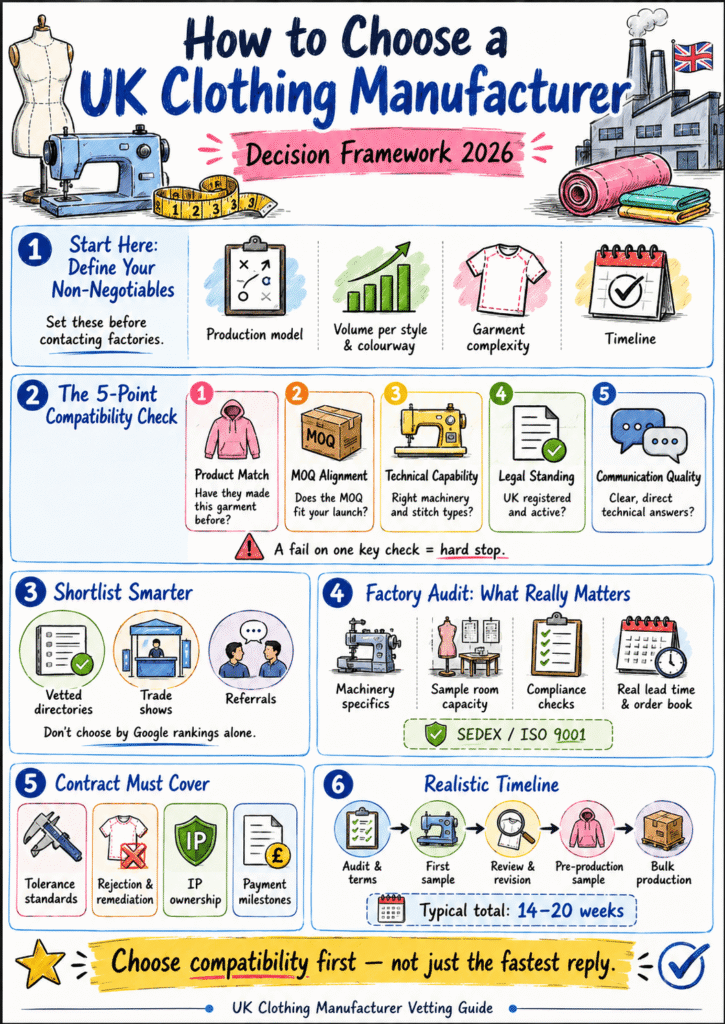
- Run five compatibility checks before requesting any sample: product match, MOQ alignment, technical capability, legal standing, communication quality
- MOQ applies per style, per colourway — not per total order, which is the single most common budgeting mistake
- A factory audit is a go/no-go gate before money changes hands, not a tour after you’ve already committed
- Compliance certifications (SEDEX, ISO 9001) aren’t legally required in the UK, which is exactly why their presence is informative
- Contracts must cover tolerance standards, rejection thresholds, IP ownership, and payment milestones — most templates miss all four
- Realistic timeline from first contact to bulk delivery is 14–20 weeks; compressing this causes most bulk delivery failures
Contents
- 1. Why Most Manufacturer Advice Stops Short
- 2. The 5-Point Compatibility Check
- 3. Define Your Non-Negotiables First
- 4. Shortlist From Vetted Directories, Not Google Rankings
- 5. The Factory Audit: What Actually Matters
- 6. The Contract: Four Clauses Most Templates Miss
- 7. Manufacturer Vetting: Questions Brands Ask Us
- 7.1. What should I ask a UK clothing manufacturer before placing a first order?
- 7.2. How do I verify a UK clothing manufacturer is legitimate?
- 7.3. What is a realistic MOQ for a UK clothing manufacturer?
- 7.4. Do I need to visit a UK manufacturer before sampling?
- 7.5. How long does first contact to first bulk order actually take?
- 8. What This Costs You Versus What It Saves You
Why Most Manufacturer Advice Stops Short
Standard advice says: ask for samples, check reviews, visit the factory, start small. None of it is wrong. None of it tells you what order to do these in, or what a pass actually looks like.
We see the gap most often at the sampling stage. Brands spend £800–£2,000 on a sampling round before confirming the factory could ever produce their garment. Sampling should follow compatibility, not substitute for it.
We run the five checks below before any sample request goes out — not after.
The 5-Point Compatibility Check
Run every prospective manufacturer through these five checks before requesting a sample. A fail on any one of them is a hard stop, not a negotiation point.
| Check | What to Assess | Pass | Fail |
|---|---|---|---|
| 1. Product match | Has this factory made this garment type before? | Verified examples by garment category | Generic portfolio only |
| 2. MOQ alignment | Does their MOQ fit your launch volume? | MOQ at or below your planned run | MOQ forces 50%+ over-order |
| 3. Technical capability | Do they have the right machinery? | Named machines, stitch types, GSM range confirmed | Vague claims, no specifics |
| 4. Legal standing | Are they a registered UK business? | Companies House registration verified, active | No registration, or dissolved |
| 5. Communication quality | Do they answer technical questions directly? | Specific answers within agreed timeframe | Deflection, vague pricing |
The check brands skip most is the third one. A jersey knitwear CMT factory won’t have the machinery for structured outerwear. A woven workwear specialist can’t produce four-needle flatlock activewear. Ask about machinery before you ask for a sample — it costs nothing and saves weeks.
“When we get a referral to a new factory, our first question is always: what went wrong, and how did they handle it? A manufacturer who’s never had a problem is either new or not being honest.” — Silk Routes Manufacturing Team
Define Your Non-Negotiables First
You can’t evaluate a manufacturer against criteria you haven’t set. Before you contact anyone, confirm four things in writing.
Production model. CMT means you arrive with cut fabric and a graded pattern; full-service means the factory sources materials and manages the process. A CMT factory charges less per unit but expects you to show up ready to cut. These are different businesses — approaching a CMT factory expecting full-service wastes both sides’ time.
Volume per style, per colourway. Not your total order. If you have six styles in three colourways and the MOQ is 100 units per style per colour, you need 1,800 units before a single garment ships. This is the number most startups discover after their first call, not before.
Garment complexity. A jersey t-shirt and a structured blazer need different machinery and different skill. Define your construction requirements — seams, closures, fabric weight, embellishment — before you search. This filters out 60–70% of manufacturers immediately, which is the point.
Timeline. Sampling to bulk delivery typically runs 8–14 weeks from tech pack approval. Count backwards from your launch date before you contact anyone. If a factory promises a two-week sample before you’ve even approved a tech pack, they’re either confused about your timeline or telling you what you want to hear.
If you want to talk through your production requirements before you shortlist anyone, our clothing manufacturing services page sets out what we produce and our current capacity.
Shortlist From Vetted Directories, Not Google Rankings
Google rankings for “UK clothing manufacturer” measure SEO budget, not manufacturing quality. The best small-batch specialists often sit on page four, or don’t rank at all.
Three sources apply a vetting layer before listing anyone:
Make It British confirms UK production credentials before listing a factory in its directory — not a quality guarantee, but a domestic-production filter.
The UK Fashion & Textile Association brings members together under shared industry standards, and has tracked UK textile and fashion production for decades.
Trade shows — Source and Pure London both run UK manufacturer sections. Meeting someone in person before sampling removes the ambiguity that kills most projects early.
Referrals beat directories. A knitwear manufacturer recommended by a brand that’s been through three sampling rounds with them tells you more than twenty cold directory listings combined.
The Factory Audit: What Actually Matters
A factory audit is a structured go/no-go assessment, not a tour. Most brands either skip it or treat it as a courtesy visit. Here’s where that goes wrong, and the fix for each.
Mistake 1 — Auditing too late. Brands visit after they’ve already committed emotionally to a factory. Fix: audit before money changes hands and before any sample is commissioned. Treat it as a gate, not a formality.
Mistake 2 — Not checking machinery specifics. Brands don’t know which machines their garment needs, so they don’t ask. Fix: research the key machines for your construction — flatlock for activewear, coverstitch for jersey hems, single needle for tailoring, linking for knitwear seams — and ask to see that exact machine running.
Mistake 3 — Ignoring the sample room. Brands focus on the main floor and miss the development capacity. Fix: ask how many sample machinists the factory has and how many brands they’re juggling. Two sample machinists across thirty brands means your project waits.
Mistake 4 — Skipping the compliance check. Brands assume UK factories are automatically compliant. Fix: ask which audits they hold. SEDEX membership means their ethical practices have been independently assessed. ISO 9001 indicates a documented quality system. None of this is legally mandatory in the UK — which is exactly why a factory that holds it is telling you something real.
Mistake 5 — Taking headline lead times at face value. Brands accept a quoted lead time without asking what triggers it. Fix: ask for lead time from approved sample to bulk delivery, not from first contact — and ask their current order book capacity. A factory at 90% capacity with a six-week queue isn’t a six-week factory.
The Contract: Four Clauses Most Templates Miss
A signed NDA before you share designs isn’t a sign of distrust. It signals you operate professionally, and it filters out factories unwilling to formalise anything.
Tolerance standards. Define acceptable variance on key measurements — typically ±1cm on structured garments, ±0.5cm on fitted sportswear. Without a stated tolerance, “close enough” is the factory’s call, not yours.
Rejection and remediation. What happens if bulk delivery fails QC? Specify the rejection threshold (e.g. above 3% defect rate triggers a full review), who pays for remakes, and the remediation timeline.
IP ownership. If the factory develops a pattern or block for your design, the contract must state the IP belongs to you. Without this clause, moving your own patterns to a different factory later carries legal risk.
Payment milestones. UK standard is 50% deposit on order confirmation, 50% on bulk delivery before shipping. Avoid 100% upfront. Avoid any final payment that isn’t tied to passing your QC inspection.
The Intellectual Property Office publishes guidance on design registration and ownership rights for UK clothing brands — worth reading before you sign anything.
If you’re weighing up whether Silk Routes fits your specific product, our about page sets out what we make and what we turn down.
Manufacturer Vetting: Questions Brands Ask Us
What should I ask a UK clothing manufacturer before placing a first order?
Ask five things directly: their MOQ per style per colourway, the machinery they use for your specific garment type, their current sample queue length, which compliance audits they hold, and their rejection/remediation policy. These five questions alone disqualify roughly half of any shortlist.
How do I verify a UK clothing manufacturer is legitimate?
Check their Companies House registration — confirm active status and at least 12 months of trading. Ask for their company number and verify it yourself rather than trusting a number on their website. Request two current-client references in your garment category and call them, don’t email.
What is a realistic MOQ for a UK clothing manufacturer?
CMT and small-batch UK production typically runs 50–150 units per style per colourway for jersey and basic woven garments, and 30–80 units for tailored or structured pieces. Full-service manufacturers tend to start at 100–200 units. Anything below 50 units per style is available but usually carries a 20–35% premium on unit cost.
Do I need to visit a UK manufacturer before sampling?
Yes, or at minimum run a full video audit of the factory floor. The point isn’t relationship-building — it’s verifying capability before you spend sampling budget. A £400 trip to Leicester or Manchester is far cheaper than a £1,500 sampling round with the wrong factory. A factory that declines a visit from a prospective client is telling you something.
How long does first contact to first bulk order actually take?
Allow 14–20 weeks: 2–4 weeks to audit and agree terms, 2–4 weeks for the first sample, 1–2 weeks for review and revision, 2–3 weeks for a pre-production sample, then 4–6 weeks for bulk production. Brands that skip revision rounds or start bulk before approving a pre-production sample account for most delivery failures we see.
What This Costs You Versus What It Saves You
The framework above adds two to three weeks to your front-end process. It’s designed to.
Factories that pass all five compatibility checks, hold current compliance audits, answer technical questions directly, and put obligations in writing are a small slice of the UK market. They exist, but finding them takes a structured process — not a Google search and whoever answers first.
For the full landscape — manufacturer types, regions, cost benchmarks, and production models across the UK — see our Complete Guide to Clothing Manufacturers UK.