
A fashion sourcing agent’s commission comes straight off your order value. On a £20,000 bulk order, that’s real money gone before a single garment ships.
The question isn’t whether that fee is too high in the abstract. It’s whether what the agent actually does for you justifies it — and the answer changes depending on where your brand is right now.
This guide gives you the six-factor comparison to make that call properly.
Post Summary
- Agent commission is calculated on your total order value, not on any saving they achieve — their incentive is to keep the order moving, not minimise your unit cost
- Going direct gives you full relationship ownership; if you go via an agent first, they often keep the factory relationship if you try to leave
- Agents do not change a factory’s MOQ — they cannot make a 200-unit minimum into a 100-unit minimum
- Neither model removes your responsibility for setting QC standards — an agent coordinates inspection, they don’t define what “acceptable” means for your brand
- Agents earn their fee most clearly when you’re sourcing offshore for the first time, not for UK domestic production
- Most brands that scale successfully start direct with one UK factory, add an agent only for their first offshore move, then transition offshore relationships to direct as volume grows
Contents
- 1. What a Fashion Sourcing Agent Actually Does
- 2. What Going Direct Actually Gives You
- 3. Six-Factor Comparison: Agent vs Direct
- 4. When a Fashion Agent Actually Makes Sense
- 5. When Going Direct Is the Right Move
- 6. Four Mistakes Brands Make Running Both Models
- 7. Manufacturer Sourcing: Questions Brands Ask Us
- 7.1. Do fashion sourcing agents charge upfront fees?
- 7.2. Can I switch from an agent to a direct manufacturer relationship later?
- 7.3. Who owns my clothing designs if I use a sourcing agent?
- 7.4. What percentage do fashion sourcing agents typically charge?
- 7.5. Is a buying house the same as a fashion agent?
- 8. Making the Right Call for Your Brand’s Stage
What a Fashion Sourcing Agent Actually Does
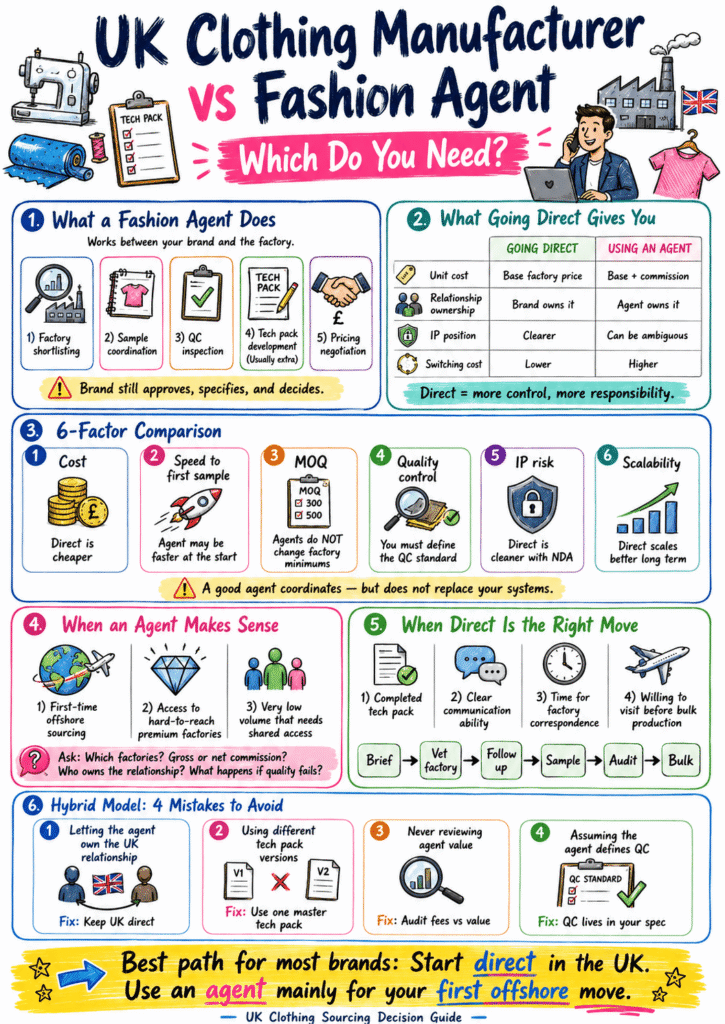
A fashion sourcing agent sits between your brand and the manufacturer — managing the relationship, coordinating production, and handling day-to-day factory contact on your behalf.
What most guides blur is how much agents vary. Some run full-service operations with in-house QC teams and long-standing factory relationships. Others are one person with a contact list and a WhatsApp group.
Here’s what you can legitimately expect from a professional agent, and what stays on your plate regardless:
| Service | Agent Provides | Brand Still Responsible For |
|---|---|---|
| Factory shortlisting | Yes, based on your brief | Approving the shortlist |
| Sample coordination | Yes, manages communication | Approving or rejecting samples |
| QC inspection | Depends on agent tier | Specifying pass/fail criteria |
| Tech pack development | Rarely, usually extra | Producing the original spec |
| Pricing negotiation | Yes, but commission sits on total spend | Understanding the base factory price |
That last row is the one brands miss most. An agent’s commission is calculated on your gross order value, not on whatever saving they negotiate. An agent who talks your unit cost down and takes a cut of a £7,000 order is still paid to keep that order moving — not to shrink your unit cost further than they have to.
What Going Direct Actually Gives You
Going direct means approaching the factory yourself — no intermediary, no agent fee, and you own every conversation.
The UK fashion and textile industry contributes £62 billion to UK GDP and supports 1.3 million jobs — roughly one in every 25 UK jobs. That’s the scale of the domestic manufacturing base you’re stepping into when you go direct with a UK factory.
Direct isn’t inherently simpler. It asks more of you upfront. It gets cheaper and more controllable the moment the relationship is established.
| Factor | Direct Manufacturer | Via Sourcing Agent |
|---|---|---|
| Unit cost | Base factory price | Base price plus commission |
| Relationship ownership | Brand owns it | Agent owns it |
| IP ownership | Clear — your tech pack, your IP | Often ambiguous — depends on agent contract |
| Switching cost | Low, you own the relationship | High, agent controls factory access |
The relationship-ownership row is the one most brands underestimate. Use an agent, then decide to go direct, and the agent frequently keeps the factory relationship. You may have built a supply chain you don’t actually own.
Six-Factor Comparison: Agent vs Direct
Cost. Direct is always cheaper on unit cost, all else equal. An agent’s fee buys real time back — your own outreach hours, a QC visit, a sampling round — but only if what the agent provides genuinely exceeds that cost in concrete terms.
Speed to first sample. Agents can move faster for brands with zero existing factory relationships, since they skip the cold-outreach stage. A brand going cold to an unfamiliar UK factory can expect several weeks of vetting, NDA exchange, and brief alignment before sampling even starts. Once a direct relationship exists, this speed advantage disappears entirely.
“The brands that get genuine value from agents are those entering a completely unfamiliar market — sourcing offshore for the first time, moving into a new product category, or targeting factories where language and culture create real barriers. For UK domestic sourcing, the barriers are lower and the case for an agent is weaker.” — Silk Routes Manufacturing Team
MOQ. Agents don’t change factory minimums. If a factory needs 200 units per style, no agent reduces that threshold. Some claim influence through relationship capital — occasionally true, more often overstated. Don’t engage an agent primarily for MOQ relief without confirming exactly which factories they can genuinely access at lower thresholds.
Quality control responsibility. Neither model removes the brand’s responsibility for outcomes. An agent coordinates QC on your behalf but sets no standard you haven’t defined yourself. A brand with a precise tech pack and clear rejection criteria gets the same QC outcome through either route — and a brand without those documents gets a poor outcome through both.
IP risk. Going direct with a signed NDA gives you the cleanest IP position available. Agent contracts vary widely, and some include clauses letting the agent introduce your designs to other clients or retain access to your patterns. Read the full agent contract before sharing any design documentation — every time.
Scalability. Direct relationships scale more efficiently. As volume grows, you negotiate directly, build preferred-customer status, and get priority on capacity. Through an agent, that same volume growth strengthens the agent’s negotiating position more than yours.
When a Fashion Agent Actually Makes Sense
An agent earns their fee in three situations specifically:
You’re sourcing offshore for the first time. Navigating a market like Bangladesh, Turkey, or Portugal without contacts or language capability carries real risk an experienced local agent can genuinely reduce.
You need a factory tier you can’t reach directly. Some premium factories in Italy or Portugal won’t take cold enquiries below a certain volume threshold — an established agent with a long-term relationship can open that door.
Your volume is too low for direct economics to work. Producing 100 units across two styles a season means a modest annual spend with any single factory. Some won’t invest in a direct relationship at that level. An agent who consolidates orders from several small brands can get you access you wouldn’t otherwise have.
Questions worth asking any agent before you engage one: which factories they actually work with in your category, whether their commission is on gross or net order value, who keeps the factory relationship if you stop working together, and what happens — and who pays — if quality fails on a batch.
When Going Direct Is the Right Move
For most UK brands sourcing from UK domestic manufacturers, direct is the right call — because the barriers that make agents valuable offshore (language, distance, unfamiliar markets) mostly don’t apply at home.
You’re ready to go direct if you have a completed tech pack, can communicate your requirements without an intermediary translating them, have a few hours a week free during active sampling for factory correspondence, and you’re prepared to visit the factory at least once before bulk production starts.
To approach a UK manufacturer directly: confirm the factory has actually produced your garment type before making contact, send a tight brief covering product type, volume per style, target unit cost, timeline, and whether you’re supplying fabric or need full-service, then follow up within five working days if you hear nothing. A factory that doesn’t respond to a well-structured brief is telling you something about their capacity or interest.
If you’re ready to vet a UK factory once you’ve decided to go direct, our how to choose a UK clothing manufacturer guide covers the full five-point compatibility check, the factory audit process, and the contract clauses most brands miss.
If you want to talk through direct production for your brand, our clothing manufacturing services page sets out what we produce and our current capacity.
Four Mistakes Brands Make Running Both Models
Some brands run an agent for offshore production and a direct relationship for UK production side by side. It’s a legitimate hybrid — but it has specific failure modes.
Mistake 1 — Letting the agent manage the UK relationship by default. Brands hand all manufacturer communication to the agent without deciding to. Fix: separate UK and offshore from day one. UK stays direct, offshore goes through the agent if needed — never let an agent become the sole contact for a UK factory you intend to own long-term.
Mistake 2 — Running two different spec documents for the same style. The agent and the direct factory end up with different tech pack versions as the design evolves. Fix: one master tech pack per style with a version number. Any update goes to everyone at once — the spec document is the single source of truth, not an email thread.
Mistake 3 — Never auditing what the agent is actually adding. Brands keep paying commission on autopilot once the relationship is established. Fix: after a few production seasons, weigh total agent fees against the verifiable value delivered — factory access, problems solved, time saved. If the ratio doesn’t hold up, start transitioning to direct.
Mistake 4 — Assuming the agent’s QC is the brand’s QC. Brands hand off quality responsibility and stop specifying pass/fail criteria themselves. Fix: QC criteria live in your tech pack, not in an email to your agent. An agent can coordinate inspection — they can’t define what acceptable quality means for your brand. That has to come from you.
Manufacturer Sourcing: Questions Brands Ask Us
Do fashion sourcing agents charge upfront fees?
Most professional agents work on commission alone, payable when the order is confirmed or on delivery depending on terms. Some charge a separate retainer or project fee for the sourcing search itself before any order exists. Be wary of an agent charging both a retainer and full commission without a clear breakdown of what each covers — that combination often signals limited factory access.
Can I switch from an agent to a direct manufacturer relationship later?
Yes, but timing matters. If your agent introduced you to the factory, your agent contract may include an exclusivity clause preventing direct contact for a defined period. Read your contract before approaching any factory your agent introduced. Once exclusivity expires, approach the factory directly and be upfront about working without an intermediary going forward — most factories prefer direct relationships at volume, since they keep more per unit without commission extraction.
Who owns my clothing designs if I use a sourcing agent?
Your designs belong to you provided your tech pack and patterns were created by you, or on your behalf, before engaging the agent. The risk shows up if the agent’s factory develops a pattern based on your brief with no IP clause in the agent agreement. Always include a clause stating that all patterns, blocks, and design developments created for your brand remain your property regardless of who commissioned them, and have it reviewed by a solicitor before signing.
What percentage do fashion sourcing agents typically charge?
There’s no single industry-standard figure — rates vary by agent, region, product complexity, and order volume, and tend to run as a meaningful percentage of order value rather than a flat fee. Always get the exact commission structure in writing before engaging anyone, and confirm whether it’s calculated on gross or net order value, since that distinction changes what you actually pay.
Is a buying house the same as a fashion agent?
Not quite. A buying house is typically larger, with permanent in-country offices, employed staff, and long-term factory contracts — they buy capacity in bulk and sell it on to brands. A fashion agent is usually an individual or small firm working on commission without holding inventory or factory contracts directly. Buying houses offer more operational infrastructure; agents offer more flexibility and access across a wider range of factories.
Making the Right Call for Your Brand’s Stage
The agent-versus-direct decision isn’t permanent and it isn’t binary. Most brands that scale successfully start direct with one trusted UK factory, bring in an agent for their first offshore move, then transition those offshore relationships to direct as volume grows and the commission no longer pays for itself.
The Intellectual Property Office publishes guidance on design ownership and registration worth reading regardless of which route you take — your IP position should be settled before either model goes near your designs.
For a full picture of the UK manufacturing landscape — production models, regions, costs, and vetting — see our Complete Guide to Clothing Manufacturers UK.