
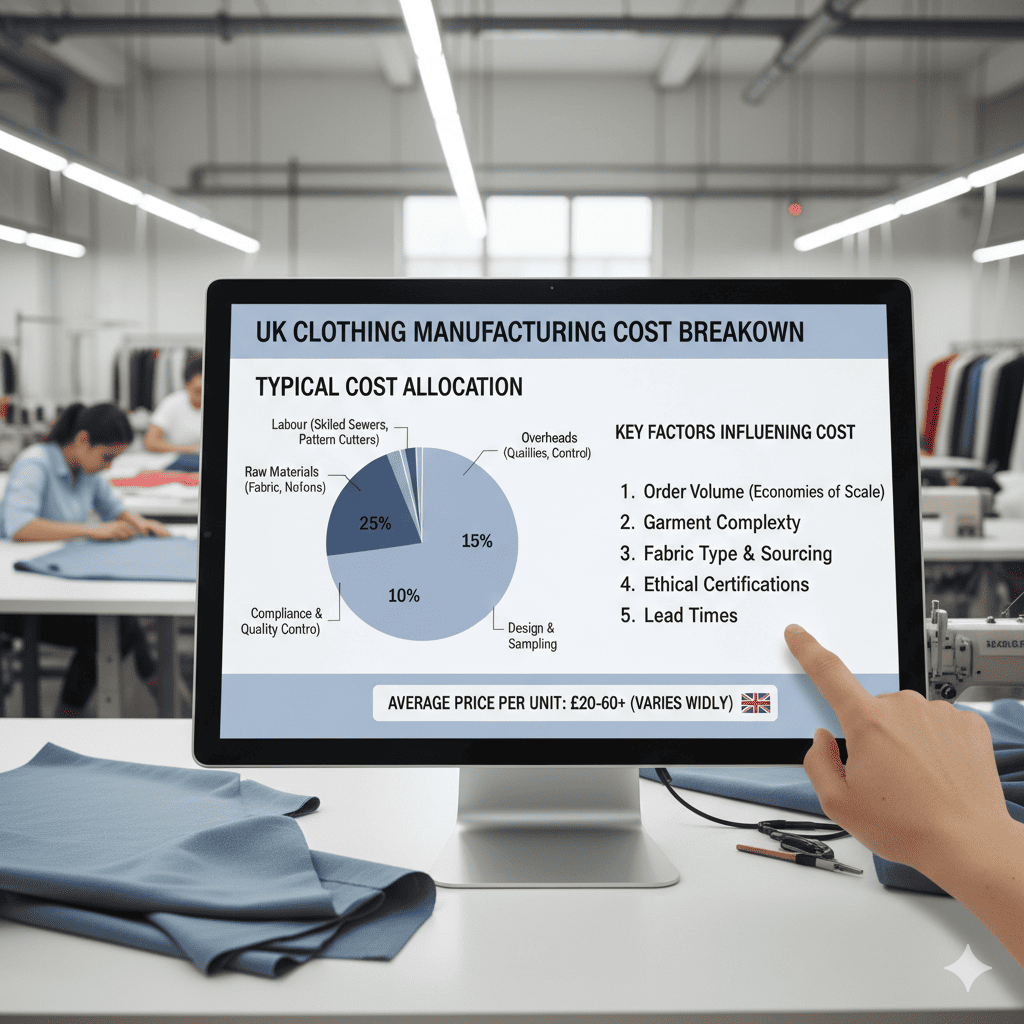
The most common budgeting mistake in UK clothing production is quoting the CMT rate as the unit cost. CMT is labour only. It excludes fabric, trims, pattern cutting, grading, sampling, and packaging — components that routinely add 60–120% on top of the CMT figure.
A factory that quotes you £8 CMT for a jersey top isn’t telling you the garment costs £8 to produce. It’s telling you that cutting and sewing costs £8. The total unit cost will sit somewhere between £16 and £28 depending on your fabric choice, trim specification, and volume.
This guide breaks down every cost component — with 2026 price ranges — so you can build an accurate budget before your first factory conversation.
Post Summary
- CMT is labour only; fabric, trims, pattern cutting, grading, sampling, and packaging add 60–120% on top of the CMT figure
- The National Living Wage rose to £12.71 per hour from 1 April 2026, a 4.1% increase, and is the single biggest driver behind rising UK production costs
- Pre-production costs (pattern cutting, grading, tech pack, sampling) are fixed per style regardless of volume, and shock most founders on their first run
- Samples typically cost 2–3 times the eventual production price, because sampling is development work with no economy of scale
- Volume per style is the single biggest lever on unit cost — 50 units typically carries a 25–40% premium over 200 units
- Full-service manufacturing often beats CMT on true total cost for brands producing under 300 units per style, once hidden logistics costs are counted
Contents
- 0.1. What Drives UK Clothing Manufacturing Costs
- 0.2. 2026 UK CMT Cost Benchmarks by Garment Type
- 0.3. The Full Unit Cost: What Brands Actually Pay
- 0.4. Pre-Production Costs: The Budget Line Every Brand Forgets
- 0.5. How Volume Affects Your Unit Cost
- 1. How much does UK clothingmanufacturing really cost?
- 1.1. CMT cost by garment type
- 1.2. What £25–£40 actually buys you
- 1.3. Volume is the biggest lever on price
- 1.4. Pre-production: the cost every brand forgets
- 1.5. A realistic first production run
- 1.6. UK Manufacturing Costs: Questions Brands Ask Us
- 1.6.1. How much does it cost to manufacture a t-shirt in the UK in 2026?
- 1.6.2. What’s the difference between CMT and full-service manufacturing costs?
- 1.6.3. How much should I budget for my first UK clothing production run?
- 1.6.4. Why are UK manufacturing costs higher than offshore?
- 1.6.5. Do UK clothing manufacturers charge VAT on manufacturing costs?
- 1.7. Building a Realistic Production Budget
What Drives UK Clothing Manufacturing Costs
The National Living Wage rose to £12.71 per hour from 1 April 2026, up 4.1% from the previous £12.21. The Real Living Wage — a separate, voluntary benchmark — sits higher still, at £13.45 across the UK and £14.80 in London, with accredited employers required to implement these rates by 1 May 2026.
Labour is the single largest variable cost in UK domestic production, and it’s rising faster than offshore equivalents. That’s not a reason to avoid UK manufacturing. It’s a reason to build your budget on current labour rates, not figures from two years ago.
Four factors determine your unit cost more than anything else.
Garment complexity. A plain jersey t-shirt requires 8–12 minutes of Standard Minute Value (SMV) to cut and sew. A structured jacket with lining, interfacing, and multiple panels requires 60–90 minutes. At £12.71 per hour, the labour difference between those two garments runs roughly £9–£15 per unit before any other cost is applied.
Volume per style per colourway. UK factories price on volume tiers. Unit cost at 50 pieces per style typically runs 25–40% higher than at 200 pieces, because setup time — lay planning, marker making, machine calibration — gets spread across fewer units at low quantities.
Production model. CMT means you supply cut fabric and patterns. Full-service means the factory sources fabric and develops patterns. Full-service costs more per unit but removes your logistical management burden. For brands producing under 300 units per style, the hidden costs of CMT logistics — fabric shipping, trim sourcing, pattern development commissioned separately — often make full-service the more cost-effective total model. If you’re still deciding which model fits your brand, our how to choose a UK clothing manufacturer guide covers the compatibility check in detail.
Fabric specification. Fabric is typically the largest single cost component — often 40–60% of total unit cost for basics. Grade, GSM, composition, and sourcing lead time all affect price and production scheduling.
2026 UK CMT Cost Benchmarks by Garment Type
These are CMT-only rates — labour to cut, make, and trim. Fabric, pattern cutting, grading, and packaging are excluded.
| Garment Type | CMT Cost Range | Volume Assumption | Key Cost Driver |
|---|---|---|---|
| Basic jersey t-shirt | £5–£10 | 100–300 units | Simple construction, fast SMV |
| Printed hoodie / sweatshirt | £12–£20 | 100–200 units | Panel count, pockets, finishing |
| Tailored trouser / chino | £15–£28 | 50–150 units | Waistband, lining, fly construction |
| Casual dress (jersey) | £10–£18 | 100–200 units | Length and seam complexity |
| Structured dress (woven) | £20–£38 | 50–150 units | Zip, lining, interfacing |
| Activewear set (top + legging) | £18–£30 | 100–200 units | Stretch fabric handling, flatlock |
| Outerwear / structured jacket | £35–£65 | 30–100 units | Lining, interfacing, panel count |
| Knitwear (mid-gauge sweater) | £22–£45 | 30–100 units | Linking seams, garment-dyed finish |
| Workwear shirt | £10–£18 | 100–300 units | Collar, cuffs, button placket |
| Bespoke / complex tailoring | £55–£120+ | Under 30 units | Handwork, multiple fittings |
These ranges reflect volume tiers within each category. At minimum quantities, expect the upper end of each range. At 200+ units per style, expect to negotiate toward the lower end.
The Full Unit Cost: What Brands Actually Pay
CMT is one line item. Here’s how the full unit cost builds for a mid-complexity garment — a printed sweatshirt at 150 units per style.
| Cost Component | Price Range | Notes |
|---|---|---|
| CMT (cut, make, trim) | £14–£18 | Labour to produce the finished garment |
| Fabric | £8–£14 | Jersey fleece, mid-weight, brand-sourced |
| Trims (labels, thread, zips, drawcords) | £1.50–£3.00 | Per unit share of trim cost |
| Packaging (poly bag, hang tag, size sticker) | £0.50–£1.50 | Per unit |
| Fabric shipping to factory | £0.30–£0.80 | Per unit share of freight cost |
| Pattern cutting (amortised) | £0.80–£2.00 | Based on a £200–£400 pattern fee over 150 units |
| Grading (amortised) | £0.40–£1.00 | Based on a £60–£150 grading fee over 150 units |
| Total unit cost (estimate) | £25.50–£40.30 | Before sampling costs or QC visits |
A £55–£85 retail sweatshirt at this unit cost leaves a margin of 35–55% at wholesale, assuming a 2.2–2.5x wholesale markup from unit cost. That’s a workable position for most brands. The mistake is building the business model on the CMT rate alone and discovering the true unit cost only after the first production invoice.
To discuss production costs for your specific garment, visit our clothing manufacturing services page.
Pre-Production Costs: The Budget Line Every Brand Forgets
Pre-production costs are paid before a single bulk unit is produced. They’re non-negotiable, and most brands budget for them poorly on their first run.
Mistake 1 — Treating sampling fees as sunk costs to minimise. Brands view sampling as an administrative hurdle rather than a technical process. Fix: budget £150–£400 per sample round for a UK CMT factory, working from £25–£50 an hour and 3–8 hours per sample garment. As a rule of thumb, samples typically cost two to three times the eventual production price — sampling is development work, with no economy of scale to bring the cost down. Expect at least two rounds, a first fit sample and a pre-production sample, and budget £600–£1,200 for sampling before any bulk unit is approved. Complex or tailored garments often need three.
Mistake 2 — Ignoring pattern cutting costs. Brands assume the factory includes pattern cutting in the CMT rate. Fix: most UK CMT factories expect you to supply a production-ready graded pattern. A professional pattern cutter charges £150–£450 per style depending on complexity, with grading across a standard five-size run (XS–XL) adding £60–£200. These are per-style costs paid once, but they’re real and need to appear in your pre-production budget.
Mistake 3 — Not accounting for fabric minimum lengths. Brands calculate fabric cost based on exactly the metres required. Fix: fabric mills sell by the roll or by minimum cut length, typically 30–50 metres. If your 150-unit style needs 1.5m per unit (225m total), you’re fine. If your 50-unit style needs the same 1.5m per unit (75m total), you may still need to buy a 100m minimum cut — paying for 25m of fabric you can’t use. Factor wastage (10–15%) and minimum cut lengths into every fabric calculation.
Mistake 4 — Forgetting tech pack development. Brands submit a reference garment and expect the factory to work from it. Fix: a professional tech pack costs £200–£600 per style if commissioned from a freelance garment technologist. It isn’t optional for CMT production. Without a precise tech pack specifying stitches per inch, seam types, tolerance, and construction sequence, the factory can’t be held accountable to any quality standard. Budget this explicitly — don’t try to absorb it into the CMT rate.
Mistake 5 — Underestimating QC costs. Brands assume the factory handles quality control as part of the CMT price. Fix: UK factories reject defective units within their own production process, but end-of-line quality control — checking the finished bulk order against your specification — is your responsibility. A QC inspection visit costs a day of your time and travel; a third-party inspection firm typically charges £250–£500 a day. Build one QC cost into every production run budget.
Pre-Production Cost Summary
| Pre-Production Cost | Price Range | Per Style or Per Run? |
|---|---|---|
| Pattern cutting | £150–£450 | Per style |
| Grading (5-size run) | £60–£200 | Per style |
| Tech pack development | £200–£600 | Per style |
| First fit sample | £150–£350 | Per style |
| Pre-production sample | £120–£280 | Per style |
| Fabric swatch approval | £20–£60 | Per colourway |
| QC inspection (own visit) | £50–£200 travel | Per production run |
| QC inspection (third party) | £250–£500 | Per production run |
| Minimum pre-production budget (one style) | £700–£1,900 | Before any bulk production |
For a brand launching three styles in two colourways each, pre-production costs before any bulk units are produced typically land between £3,500 and £9,000. This figure shocks most founders, because most online guides leave it out entirely.
How Volume Affects Your Unit Cost
Volume is the most powerful lever in UK clothing manufacturing pricing. The economics at 50 units per style are fundamentally different from those at 300 units per style.
At 50 units, setup costs — marker making, machine calibration, lab dip approval — get amortised over a small run, so pattern-to-unit overhead stays high. Factories also apply a low-volume premium, typically 25–40% above their standard rate, because small runs disrupt production scheduling and reduce machine efficiency.
At 200 units per style, setup costs spread more thinly, the factory reaches a viable production run length, and per-unit overhead falls. At 300+ units, some factories offer volume discounts of 10–20% below their base rate.
The practical implication: if you’re producing 50 units per style and wondering why your unit cost feels high, the answer is almost always volume, not factory pricing. The fix is either to consolidate styles — fewer styles, higher units per style — or accept the premium as the cost of small-batch flexibility.
How much does UK clothing
manufacturing really cost?
CMT is labour only. Real unit cost is built from seven line items — here's what each one costs in 2026.
from 1 Apr 2026 (+4.1%)
UK-wide, 2025–26
London, 2025–26
CMT cost by garment type
Labour to cut, make and trim only — fabric and trims are extra. Bars show the typical 2026 range.
Source: Silk Routes production data 2025; UK CMT operator benchmarks
What £25–£40 actually buys you
Full unit cost build for a mid-complexity printed sweatshirt at 150 units per style.
Volume is the biggest lever on price
Relative unit cost premium by order volume, indexed to 200 units = baseline.
Setup costs (lay planning, marker making, calibration) are fixed per style — they bite hardest at low volumes.
Pre-production: the cost every brand forgets
Paid once per style, before a single bulk unit is produced.
Samples typically cost 2–3× the eventual production price — sampling is development work with no economy of scale.
A realistic first production run
Three styles, 100–150 units each, two colourways.
Silk Routes — UK Clothing Manufacturer
Data: Low Pay Commission (Apr 2026) · Living Wage Foundation (2025–26) · Make It British · Silk Routes production data 2025
Built by Silk Routes IT Team
UK Manufacturing Costs: Questions Brands Ask Us
How much does it cost to manufacture a t-shirt in the UK in 2026?
A basic jersey t-shirt in the UK costs approximately £16–£28 per unit at 100–200 units per style, covering CMT (£5–£10), fabric (£4–£8), trims and packaging (£2–£4), and pattern/grading amortisation (£1.50–£3.50). At 50 units per style, expect the upper end of that range or above. At 300+ units, experienced brands have brought total unit costs on basics below £14 by consolidating fabric purchasing and negotiating volume terms.
What’s the difference between CMT and full-service manufacturing costs?
CMT is labour only — you supply all materials, patterns, and trims. Full-service manufacturers source fabric, develop patterns, and manage trims on your behalf. Full-service unit costs run 40–70% higher than CMT labour rates, but the model eliminates your logistics burden and the hidden costs of separately commissioning pattern cutting, grading, and fabric sourcing. For brands producing under 200 units per style, full-service often delivers a lower true total cost than CMT once all pre-production costs are counted.
How much should I budget for my first UK clothing production run?
For a realistic first run of three styles at 100–150 units each, budget pre-production costs of £3,000–£7,000 (pattern cutting, grading, tech packs, two sampling rounds per style), plus bulk production costs of £8,000–£18,000 (CMT, fabric, trims, and packaging across 300–450 total units). Total first-run budget: £11,000–£25,000. Brands that budget under £8,000 for a three-style launch are almost always underestimating pre-production or fabric costs.
Why are UK manufacturing costs higher than offshore?
Primarily because UK labour rates sit well above those in Bangladesh, Turkey, or Portugal. The National Living Wage of £12.71 per hour from April 2026 sets the minimum labour floor, well above comparable offshore rates. UK factories also carry higher overhead — rent, energy, compliance, employer National Insurance — that can’t be negotiated away. The commercial case for UK manufacturing rests on lead time, accessible quality control, and Made in Britain positioning, not on competing with offshore on unit cost alone.
Do UK clothing manufacturers charge VAT on manufacturing costs?
Yes — UK manufacturing services carry 20% VAT. If your brand is VAT-registered, you reclaim the input VAT on your quarterly return. If you’re not yet registered (turnover under £90,000), you pay VAT with no reclaim, adding 20% to your effective manufacturing cost. Most fashion brands cross the VAT registration threshold within their first two or three seasons once bulk production starts — factor this into your early-stage cost modelling.
Building a Realistic Production Budget
The brands that hit cash flow problems in their first production season are almost always the ones who budgeted on CMT rates alone and treated fabric, pattern cutting, sampling, and pre-production as afterthoughts.
Pre-production costs are fixed per style regardless of volume. Bulk production costs scale with volume. At low volumes, pre-production represents 30–50% of total spend; at higher volumes, it compresses to 10–20%. The implication for launch strategy: launching with fewer styles at higher unit quantities almost always produces better unit economics than launching with many styles at low quantities.
For a complete picture of the UK manufacturing landscape — types of manufacturers, regions, and how to select the right factory — see our Complete Guide to UK Clothing Manufacturers.