
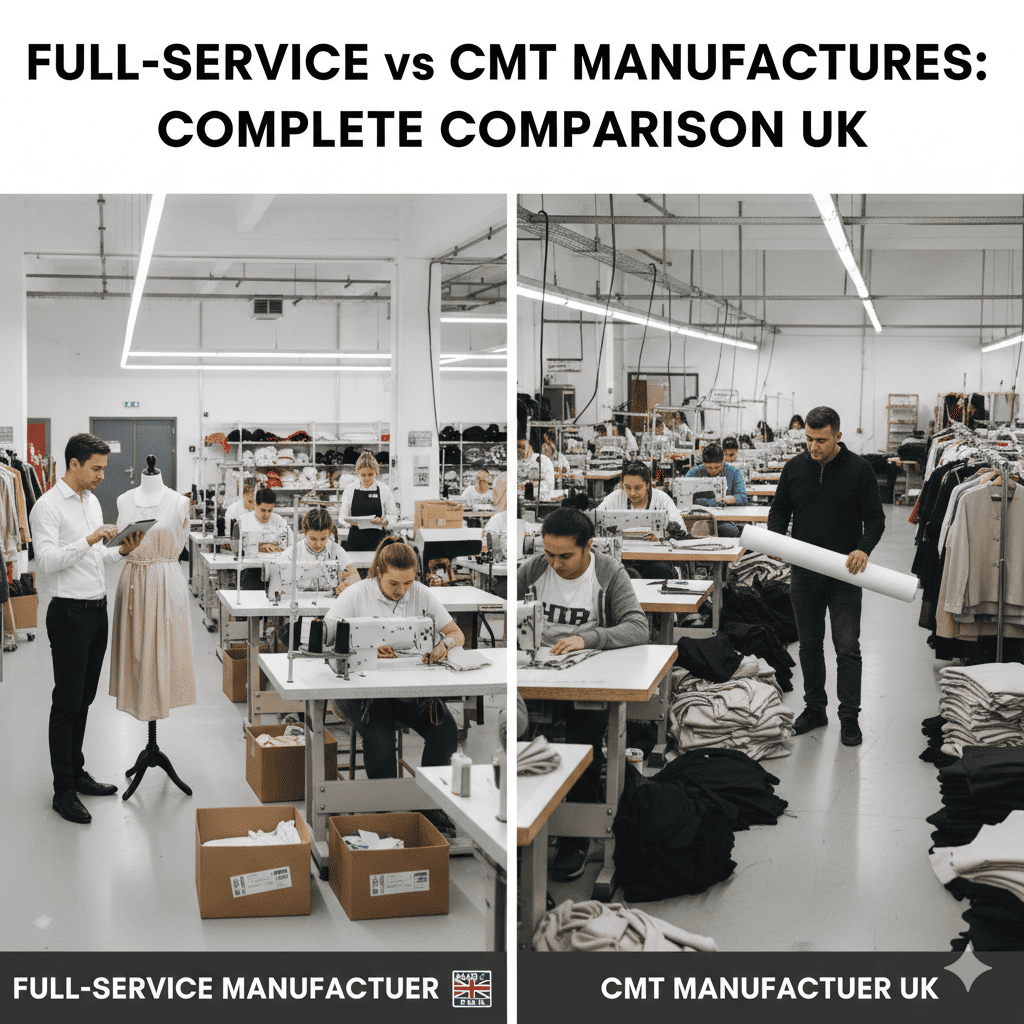
Most brand owners assume full-service manufacturing is the professional choice. It isn’t always.
Picking the wrong production model costs more than the price difference between them. It costs time, re-runs, and control over your own product. Understanding full-service vs CMT manufacturer options before you sign anything is non-negotiable.
This comparison covers exactly what each model includes, what you’re responsible for, the cost reality, and the honest answer on which one suits your brand’s stage. For the broader context on UK production types, see our Complete Guide to Clothing Manufacturers in UK.
Post Summary
- CMT means you supply the fabric, pattern, and tech pack; the factory only cuts, assembles, and finishes
- Full-service means the factory sources fabric, develops patterns, and manages production, typically at a 15–30% unit price premium
- Even in full-service, final approval stays with the brand — you’re handing over the build process, not your product
- CMT total cost can exceed full-service once brand-side fabric procurement, pattern cutting, and tech pack costs are counted
- The right choice depends on readiness, not budget: do you already have production-ready patterns and supplier relationships?
- Switching models mid-range is common, but MOQ and fabric utilisation terms don’t carry over automatically between factories
Contents
- 1. What Is CMT Manufacturing?
- 2. What Is Full-Service (Full Package) Manufacturing?
- 3. Side-by-Side Comparison: What Each Model Includes
- 4. Cost Differences: CMT vs Full-Service
- 5. Who Should Use CMT vs Full-Service?
- 6. Common Mistakes When Choosing a Manufacturing Model
- 7. Which Model Suits UK Manufacturing Specifically?
- 8. CMT vs Full-Service: Questions Brands Ask Us
- 8.1. What’s the main difference between CMT and full-service clothing manufacturing?
- 8.2. Do I need a tech pack for CMT manufacturing?
- 8.3. Is full-service manufacturing more expensive overall?
- 8.4. Can I switch from full-service to CMT as my brand grows?
- 8.5. What does a UK CMT factory typically not include?
- 9. Making the Right Call Before You Commit
What Is CMT Manufacturing?
CMT stands for Cut, Make, Trim. The factory cuts your fabric, assembles the garment, and applies finishing trims — buttons, zips, labels, and so on.
Everything before that point is your job. You source the fabric. You supply the pattern. You deliver a completed tech pack. The manufacturer executes your brief precisely — nothing more.
CMT is a production service, not a design or sourcing service.
“CMT is not a shortcut. It requires more brand-side preparation than most new founders expect. If your tech pack is incomplete, production stops — and that’s on you, not the factory.” — Silk Routes Manufacturing Team
What Is Full-Service (Full Package) Manufacturing?
Full-service — sometimes called full package or OEM clothing manufacturing — covers the entire production chain.
The manufacturer handles fabric sourcing, pattern making, sampling, grading, cutting, assembly, finishing, and often quality control. You supply a concept, a brief, or approved samples. They handle the rest.
This sounds simpler. In practice, it transfers creative and sourcing control to the factory floor.
If you want to explore our clothing manufacturing services and understand how Silk Routes structures full-service work, that page covers our process in detail.
Side-by-Side Comparison: What Each Model Includes
| Responsibility | CMT | Full-Service |
|---|---|---|
| Fabric sourcing | Brand | Manufacturer |
| Pattern making | Brand | Manufacturer |
| Tech pack creation | Brand | Manufacturer (with brand input) |
| Sampling | Shared | Manufacturer |
| Cutting | Manufacturer | Manufacturer |
| Assembly (make) | Manufacturer | Manufacturer |
| Trim sourcing (zips, buttons, labels) | Brand (usually) | Manufacturer |
| Grading across sizes | Brand | Manufacturer |
| Quality control | Brand | Manufacturer (or shared) |
| Final approval | Brand | Brand |
The table above shows what most guides miss: even in full-service, final approval stays with the brand. You’re not handing over your product — you’re handing over the build process.
Cost Differences: CMT vs Full-Service
The price gap between models is real, but it’s often misread.
CMT unit costs are lower because the manufacturer is doing less. But total brand-side costs — fabric procurement, pattern cutting, tech pack development, logistics — can exceed the factory savings entirely. Our UK manufacturing cost breakdown covers the specific 2026 price ranges for each of these line items.
| Cost Element | CMT | Full-Service |
|---|---|---|
| Factory unit cost | Lower | Higher (15–30% premium typical) |
| Fabric sourcing (brand cost) | Brand absorbs | Included in factory price |
| Pattern making (brand cost) | Brand pays separately | Included |
| Tech pack development | Brand pays (or already has) | Shared or included |
| Quality control burden | Brand (higher exposure) | Reduced (factory QC layer) |
| Minimum order quantities | Often lower | Often higher |
| Total cost (small run) | Can be higher overall | More predictable |
The UK fashion and textile industry contributes £62 billion to the UK economy and supports 1.3 million jobs — a scale of domestic production where UK labour costs sit well above many offshore equivalents. That higher domestic labour cost applies to both production models roughly equally, which means the CMT-versus-full-service price gap is generally narrower in the UK than it would be when comparing the same two models offshore. The actual financial decision depends heavily on whether your brand already owns its patterns and supplier relationships.
Who Should Use CMT vs Full-Service?
This is where most guides oversimplify. The answer isn’t about budget — it’s about readiness.
CMT is right for you if
You already have completed, production-ready patterns. You have an established fabric supplier relationship. Your tech pack is to production standard — not a mood board or rough sketch. You want to control your material costs and quality at source.
Established brands scaling a proven range, or designers who have trained in pattern making, are the natural CMT client.
“Brands that do CMT well have usually already done full-service first. They know exactly what information the factory needs because they’ve seen what happens when it’s missing.” — Silk Routes Manufacturing Team
Full-service is right for you if
You’re launching a first collection without in-house pattern or sourcing capability. You want a faster route from concept to sample. You’re working with a manufacturer who has strong existing fabric supplier relationships you can’t easily replicate.
New brands, brands entering unfamiliar product categories, and brands working under time pressure tend to get more value from full-service, despite the higher unit cost.
The practical mistake: assuming you can do CMT because you have sketches and a fabric reference. CMT requires a production-ready package. If your tech pack isn’t factory-standard, a CMT arrangement collapses into expensive rework.
Common Mistakes When Choosing a Manufacturing Model
Mistake 1 — Choosing CMT to save money without having production-ready patterns. Brands conflate “I have a design” with “I have a pattern.” They aren’t the same thing. A sketch becomes a pattern through grading and technical development — work that takes time and specialist skill. Fix: commission pattern making through a UK pattern cutter before approaching any CMT factory. Don’t approach CMT with anything less than a graded, size-set pattern.
Mistake 2 — Assuming full-service means no brand input required. The name implies the factory handles everything. In practice, poor briefs from the brand side produce poor garments, regardless of how capable the factory is. Fix: brief to the same standard you would for CMT. Approved reference samples, written specs, and clear approval criteria are non-negotiable even in full-service.
Mistake 3 — Not accounting for fabric lead times in CMT planning. Brands calculate the factory’s production lead time but forget that sourcing, testing, and delivering fabric to the factory adds weeks, sometimes months. Fix: map the full timeline from fabric order to factory delivery, not just the cut-to-ship timeline. Build in a minimum four-week buffer for fabric procurement.
Mistake 4 — Switching models mid-range without updating MOQ expectations. A brand using full-service moves to CMT for their second run, expecting the same minimums. CMT factories often have lower MOQ flexibility, but not always — it depends on fabric utilisation. Fix: confirm MOQ terms and fabric utilisation requirements directly with the CMT factory before committing to the range size. Don’t assume the previous factory’s terms transfer to a new model.
Mistake 5 — Ignoring ownership of patterns and materials in the contract. In full-service arrangements, the factory often develops the patterns. Brands assume they own them automatically. Fix: specify pattern and tooling ownership explicitly in the manufacturing contract. This applies to both models — don’t rely on a verbal agreement.
Which Model Suits UK Manufacturing Specifically?
FOB manufacturing and full-package models are common offshore, where factories have scale fabric purchasing power. In the UK, most manufacturers operate a hybrid — they can source fabric through established relationships, but they often prefer to work with brands that come with their own.
UK cut-make-trim factories tend to be smaller, more specialist operations. Their pricing reflects skill and craftsmanship, not volume. A brand bringing production-ready materials to a UK CMT factory gets access to that expertise without the sourcing markup.
Full-service through a UK manufacturer — like the approach we use at Silk Routes — suits brands that want UK-origin credentials combined with a complete production service. It isn’t the cheapest option, but it’s the most complete one for brands without an in-house production team. Manufacturers carrying Made in Britain certification have committed to a code of conduct around genuine domestic production, which is worth checking regardless of which model you choose.
UK manufacturing’s competitive position increasingly rests on quality, shorter lead times, and verifiable domestic provenance rather than competing with offshore producers on unit price alone — a positioning reflected across UK industry bodies including the British Fashion Council, and one that shapes which production model makes sense for which brand.
CMT vs Full-Service: Questions Brands Ask Us
What’s the main difference between CMT and full-service clothing manufacturing?
CMT (Cut, Make, Trim) means the factory only handles cutting, assembling, and finishing the garment. The brand supplies the fabric, patterns, and tech pack. Full-service means the manufacturer handles sourcing, pattern making, sampling, and production, typically at a 15–30% unit price premium.
Do I need a tech pack for CMT manufacturing?
Yes — a production-standard tech pack is mandatory for CMT. Without it, the factory can’t cut or construct the garment accurately. CMT factories don’t develop specs from scratch; they execute yours. Budget at least 4–6 weeks for tech pack development if you don’t already have one.
Is full-service manufacturing more expensive overall?
Not always. Full-service has a higher unit cost, but it removes the brand-side expense of pattern making, fabric sourcing, and sampling management. For brands without existing supplier relationships or in-house pattern capability, full-service total cost is often lower once all inputs are counted.
Can I switch from full-service to CMT as my brand grows?
Yes, and many UK brands do. The transition works best when you’ve retained your patterns from the full-service phase and built direct fabric supplier relationships. Confirm MOQ terms and fabric delivery requirements with your CMT factory before committing to a range.
What does a UK CMT factory typically not include?
Standard UK CMT exclusions: fabric sourcing, yarn or material procurement, pattern grading, tech pack creation, and sometimes labelling and packaging. Some factories also exclude trim sourcing (zips, buttons, labels). Always request a written scope of work before signing — what’s included varies factory to factory.
Making the Right Call Before You Commit
The CMT vs full-service decision isn’t a question of which model is better. It’s a question of what your brand can actually execute.
If you have the technical assets — patterns, tech packs, supplier relationships — CMT gives you cost control and material ownership. If you don’t, full-service isn’t the expensive option. It’s the realistic one.
Both models require a capable, communicative manufacturer. For brands working through this decision for the first time, our how to choose a UK clothing manufacturer guide covers the broader landscape of vetting factories and what to look for before you commit.