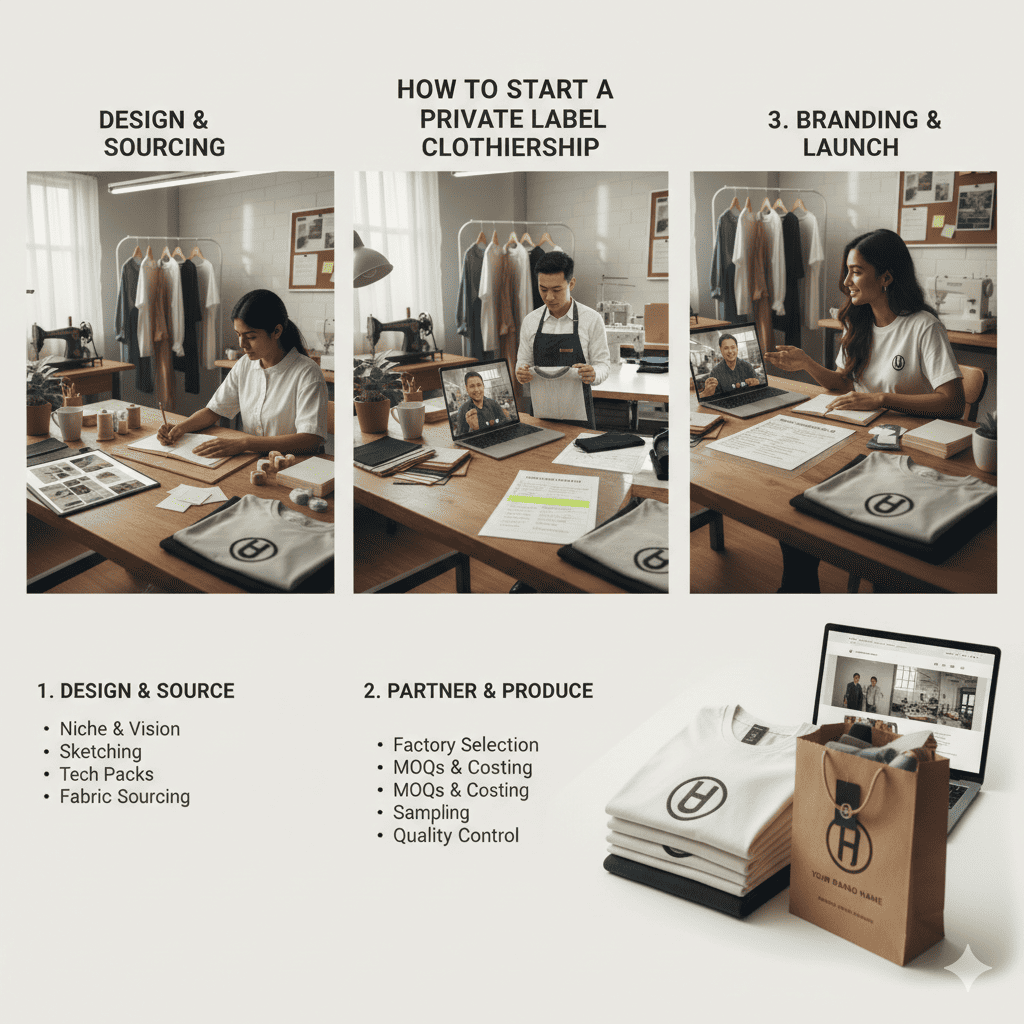
Maya had a clear vision. A fitted midlayer fleece, her own label, sold direct to outdoor enthusiasts online. She had the Instagram following, the product idea, and the supplier she found on a directory. What she did not have was a tech pack, a realistic sampling budget, or any understanding of what “private label” actually required from her before the factory would move.
Six months later, Maya had spent £3,200, received two samples she could not approve, and still had no production run. The idea was not the problem. The preparation was.
This guide covers everything Maya needed to know before she made her first call — so your private label journey starts where hers should have.
Summary
- Private label clothing means commissioning a garment built entirely to your specification — your design, fabric, and construction, with your branding
- The realistic cost to launch a private label clothing line in the UK runs from £3,000 to £15,000 for a single-style first run including development, production, and branding
- A completed tech pack is non-negotiable before any UK manufacturer will begin sampling
- The private label process runs in six stages: concept, tech pack, sampling, approval, production, and delivery — each stage must be completed before the next begins
- UK CMT manufacturers now accept private label runs from 30 to 50 units for simple construction — making genuine private label accessible to first-time founders
Contents
- 1. What Private Label Clothing Actually Means
- 2. Stage 1 — Concept and Product Definition
- 3. Stage 2 — Tech Pack Development
- 4. Stage 3 — Finding and Briefing a UK Private Label Manufacturer
- 5. Stage 4 — Sampling
- 6. Stage 5 — Production
- 7. Stage 6 — Labelling, Packaging, and First Delivery
- 8. What a Private Label Clothing Line Costs: Realistic Total Budget
- 9. Common Private Label Mistakes First-Time Founders Make
- 10. FAQ
- 10.1. How long does it take to launch a private label clothing line in the UK?
- 10.2. What is the minimum order for private label clothing in the UK?
- 10.3. Do I need a registered company to work with a UK clothing manufacturer?
- 10.4. Can I use overseas fabric for UK private label production?
- 10.5. What certifications should I look for in a UK private label manufacturer?
- 11. What Maya Did Differently the Second Time
- 12. Citations and Sources
What Private Label Clothing Actually Means
Private label is not putting your logo on someone else’s product. That is white label.
Private label means a manufacturer produces a garment built entirely to your specification. Your design. Your fabric choice. Your construction brief. The product does not exist until you commission it — and once it does, no other brand sells it.
| Factor | Private Label | White Label |
|---|---|---|
| Product design | Custom to your spec | Pre-designed by factory |
| Exclusivity | Yes | No |
| Development required | Tech pack, sampling | Label and packaging only |
| MOQ | 30–300 units | 1–50 units |
| Brand defensibility | High | Low |
| Time to first delivery | 10–20 weeks | 1–4 weeks |
The distinction matters because it determines what you need to prepare, what it costs, and what you own at the end.
Maya’s mistake was treating the factory as a design partner. Private label factories are production partners — they execute your specification. The design work happens before you approach them.
Stage 1 — Concept and Product Definition
Every private label clothing line starts with a product decision, not a brand decision.
Before a tech pack can be written, before a factory can be approached, you need to define exactly what you are making.
Three questions to answer at this stage:
1. What is the garment? Not “a fleece” — a midlayer quarter-zip fleece in 280gsm recycled polyester with flatlock seams, drop hem, and media port. The more precisely you can describe your product, the faster and cheaper your tech pack and sampling process will be.
2. Who is making it for? Your target customer determines your fit standard, your size range, your fabric weight, and your price point. A midlayer for female outdoor athletes sits in a different spec entirely from one for urban commuters.
3. Where does it sit in the market? Your retail price determines your maximum allowable unit cost — which determines your minimum viable MOQ. Work backwards from your retail price to your unit cost target before you approach a single factory.
UK manufacturer data from UKFT consistently shows that brands with a clearly defined product specification at the outset spend 40 to 60% less in total development costs than those who refine the concept through multiple sampling rounds.
Our guide to low MOQ and private label clothing manufacturers UK covers how to align your product concept with realistic UK manufacturing capabilities before you commit to a direction.
Stage 2 — Tech Pack Development
A tech pack is the document that turns your product concept into a manufacturing instruction. Without it, no UK clothing manufacturer will quote you, sample for you, or begin production.
It contains:
- Technical flat drawings (front, back, detail views)
- Measurements and graded size specifications
- Fabric specification (weight, composition, finish, certification)
- Construction details (seam type, stitch density, hem finish)
- Label, trim, and hardware placement
- Colourway specifications and print or embroidery artwork
Maya had sketches and a fabric sample she liked. That is a starting point for a tech pack — not a substitute for one.
“A complete tech pack cuts our onboarding time by 60%. It tells us everything we need to quote accurately, source correctly, and sample right first time. Without it, we are guessing — and guessing costs both of us time and money.” — Silk Routes Manufacturing Team
What tech pack development costs:
| Option | Cost | Best For |
|---|---|---|
| Freelance tech pack designer | £150–£500 per style | Single style, clear concept |
| Fashion design graduate | £100–£300 per style | Budget-conscious founders |
| Specialist tech pack service | £300–£800 per style | Complex construction |
| In-house (if design qualified) | Time cost only | Founders with design background |
For a first private label style, budget £200 to £500 for a freelance tech pack. It is the most important spend in the entire development process.
Stage 3 — Finding and Briefing a UK Private Label Manufacturer
With a tech pack complete, you are ready to approach manufacturers. Without one, you are not.
The UK private label manufacturer landscape splits into three main types for a first-time founder:
CMT manufacturers cut, make, and trim from fabric you supply or source. MOQ typically 30 to 100 units. Best for founders who want control over fabric and lowest entry point into private label.
Full-service manufacturers handle fabric sourcing, cutting, making, and finishing. MOQ typically 100 to 300 units. Best for founders who want a single point of contact and are comfortable with a higher volume commitment.
Specialist manufacturers focus on specific product categories — knitwear, tailoring, activewear. MOQ varies. Best when your product requires category-specific expertise that generalist factories cannot deliver.
According to McKinsey’s State of Fashion research, brands that select manufacturers based on category expertise — rather than lowest price — report significantly better first-run quality and faster reorder relationships.
When briefing a manufacturer, send:
- Your completed tech pack
- Your target MOQ and timeline
- Your fabric specification or reference
- Any certification requirements (GOTS, OEKO-TEX, WRAP)
Do not send a mood board. Do not send a paragraph describing your brand. Send a production document.
If you want to explore what a private label partnership looks like at Silk Routes, speak to our team about your product brief.
Stage 4 — Sampling
Sampling is the stage where your tech pack becomes a physical garment for the first time. It is also the stage most first-time founders underbudget for.
| Sampling Stage | Typical Cost | Timeline |
|---|---|---|
| First sample | £80–£250 per style | 2–4 weeks |
| Revision sample | £80–£200 per style | 1–3 weeks |
| Pre-production sample | £80–£150 per style | 1–2 weeks |
| Size set (graded) | £300–£600 per size run | 2–4 weeks |
Budget for two revision rounds minimum. First samples are almost never approved without changes — and that is not a sign of a bad factory. It is the sampling process working as intended.
Maya approved her second sample despite a fit issue she was not sure about. That uncertainty became 200 units she could not sell. The rule is simple: do not approve a sample you would not sell at full price.
Textile Exchange research on quality assurance in garment production confirms that brands with a structured sampling approval process — including written sign-off criteria before production — report defect rates 60% lower than those who approve samples informally.
A sealed pre-production sample — signed off by both brand and factory before production begins — is the most important document in your private label process. It is the reference standard against which every unit in the production run is measured.
Our guide to low MOQ and private label clothing manufacturers UK covers how to structure the sampling process and what to check at each approval stage.
Stage 5 — Production
With a sealed pre-production sample approved, production can begin.
What happens during production:
- Factory schedules your run into their production calendar
- Production deposit paid — typically 50% of total production cost
- Fabric cut to your pattern
- Garments made, trimmed, labelled, and finished
- Mid-production QC check at approximately 30% of run completion
- Final QC on completed units before despatch
- Balance payment on QC approval
- Despatch to your address or fulfilment partner
| Production Variable | Impact on Timeline |
|---|---|
| Fabric pre-sourced | Saves 2–4 weeks |
| Trims confirmed before production | Saves 1–2 weeks |
| Pre-production sample approved | Saves 1–2 weeks |
| Slot booked in advance | Saves 1–3 weeks |
The mid-production QC check is the one step most small brands skip to save time. It is the one step that saves the most time when something goes wrong. Catching a seam issue at 30% of production means correcting 30 units. Catching it at 100% means correcting the entire run.
“We always build a mid-production check into our process. It adds half a day. It has saved us from delivering faulty runs on more occasions than we would ever want to count.” — Silk Routes Manufacturing Team
Stage 6 — Labelling, Packaging, and First Delivery
The final stage before your private label product reaches a customer is labelling and packaging — and it is the stage that makes the garment a branded product rather than a finished unit.
UK labelling requirements under the Textile Products (Labelling and Fibre Composition) Regulations 2012 require every garment sold in the UK to carry:
- Fibre content and percentage
- Care instructions
- Country of manufacture
- Your brand name or registered trademark
These must be confirmed and supplied to the factory before production begins — not after. A garment that reaches you without compliant labelling cannot legally be sold in the UK.
Maya received her first run without country of origin on the care labels. She had to hand-apply stickers to 200 units before she could despatch a single order. Two hours per unit. That is the cost of not confirming label spec before production.
Packaging budget for a private label launch:
| Item | Cost (per 200 units) |
|---|---|
| Woven labels | £80–£200 |
| Swing tags | £60–£150 |
| Polybags | £20–£60 |
| Tissue paper | £30–£80 |
| Mailer boxes | £120–£300 |
Total packaging cost for a 200-unit private label launch: £310 to £790.
What a Private Label Clothing Line Costs: Realistic Total Budget
| Stage | Low Estimate | High Estimate |
|---|---|---|
| Tech pack | £150 | £500 |
| Sampling (2 rounds) | £160 | £500 |
| Fabric (CMT, 100 units) | £300 | £900 |
| Production (100 units, jersey) | £1,000 | £1,300 |
| Labels and packaging | £310 | £790 |
| Branding (logo, design) | £150 | £800 |
| Total to first delivery | £2,070 | £4,790 |
For a woven or more complex style at 100 units, add 30 to 50% across sampling and production. For a full-service manufacturer at 150 units, total budget typically runs £5,000 to £10,000.
The private label investment is front-loaded. Once your tech pack is approved and your factory relationship is established, reorder costs fall significantly — the development cost is already sunk and the factory knows your product.
Common Private Label Mistakes First-Time Founders Make
1. Approaching factories before the tech pack is complete A factory without a tech pack cannot quote, cannot sample, and cannot schedule. Every week spent waiting for a brief is a week lost from your launch timeline.
Fix: Commission your tech pack before you contact a single manufacturer. One week of upfront investment saves four to six weeks of back-and-forth.
2. Approving a sample with known fit issues The pressure to move to production after two sampling rounds is real. Approving a sample with a fit problem you are “not sure about” is the most expensive decision in private label manufacturing.
Fix: Establish written approval criteria before sampling begins. The sample either meets them or it does not. If it does not, another revision round is cheaper than a production run of unwearable garments.
3. Not confirming label compliance before production UK labelling regulations apply to every garment sold. A label without fibre content, care instructions, or country of manufacture is non-compliant — and the responsibility is yours as the brand, not the factory’s.
Fix: Submit your label spec to the factory as part of the tech pack. Confirm compliance before production begins, not after delivery.
4. Ordering too many styles on the first run A three-style private label launch at 100 units each commits £6,000 to £12,000 in untested stock. If one style does not sell, the others subsidise the loss.
Fix: Launch with one style. Prove sell-through at 50 to 70% within 90 days. Then commission the second style with confirmed demand data.
5. Not registering a trademark before going public Your brand name is your most valuable asset. A competitor who registers your brand name in Class 25 (clothing) before you do can legally prevent you from trading under it.
Fix: File a UK trademark application for your brand name before your brand is public. The UKIPO fee is £170 for one class. It is the cheapest insurance you will buy.
FAQ
How long does it take to launch a private label clothing line in the UK?
From completed tech pack to first delivery, allow 12 to 20 weeks for a first private label run. This includes two sampling rounds (4 to 8 weeks) and production (4 to 8 weeks). Without a completed tech pack, add two to four weeks. Without pre-sourced fabric, add two to four weeks. The fastest first runs happen when everything is resolved before the factory starts.
What is the minimum order for private label clothing in the UK?
UK CMT manufacturers now accept private label runs from 30 to 50 units for simple jersey construction where fabric is supplied by the brand. Full-service manufacturers typically require 100 to 300 units. Below 30 units, bespoke cut-and-sew manufacturing is not commercially viable — print-on-demand is the alternative.
Do I need a registered company to work with a UK clothing manufacturer?
No — sole traders can work with UK manufacturers. However, registering as a limited company before taking orders provides liability protection, improves your credibility with factories and wholesale buyers, and costs £12 to £50 through Companies House. Most founders who start as sole traders wish they had registered as a limited company from the outset.
Can I use overseas fabric for UK private label production?
Yes. Many UK CMT manufacturers work with fabric supplied by the brand regardless of origin. If your fabric is sourced overseas, factor in lead time — typically two to six weeks for Europe, four to eight weeks for Asia. Fabric must arrive at the factory before production can begin. Always confirm the factory’s requirements for fabric inspection and delivery format before ordering.
What certifications should I look for in a UK private label manufacturer?
For ethical production, look for WRAP accreditation or SA8000 certification. For sustainable materials, confirm GOTS certification if organic cotton is in your spec. OEKO-TEX Standard 100 certification on fabrics confirms no harmful substances. These certifications matter most if your brand positioning includes ethical or sustainable claims — without them, the claims are unverifiable.
What Maya Did Differently the Second Time
Maya came back six months after her first attempt. This time she arrived with a completed tech pack, a fabric reference from a UK textile merchant, a confirmed budget for two sampling rounds, and a realistic 100-unit MOQ target.
Her first sample needed one revision. Her second sample was approved. Her production run of 100 units completed in five weeks. She sold 70% within 60 days of launch.
The product had not changed. The preparation had.
The full picture of how to find and work with UK private label manufacturers — including how to structure your MOQ and manage your first production run — is in our guide to low MOQ and private label clothing manufacturers UK.
Ready to start your private label clothing line properly? Find out how Silk Routes works with first-time founders from tech pack to delivery.
Citations and Sources
[1]. UKFT — UK Fashion & Textile Industry: Facts and Figures 2024. https://ukft.org/facts-and-figures24/
[2]. McKinsey & Company — The State of Fashion 2024. https://www.mckinsey.com/industries/retail/our-insights/state-of-fashion-2024
[3]. Textile Exchange — Materials Market Report 2023. https://textileexchange.org/knowledge-center/reports/materials-market-report-2023/
[4]. UK Government — Textile Products (Labelling and Fibre Composition) Regulations 2012. https://www.legislation.gov.uk/uksi/2012/1102/contents
[5]. UK Government — UKIPO Trademark Registration Guidance. https://www.gov.uk/how-to-register-a-trade-mark