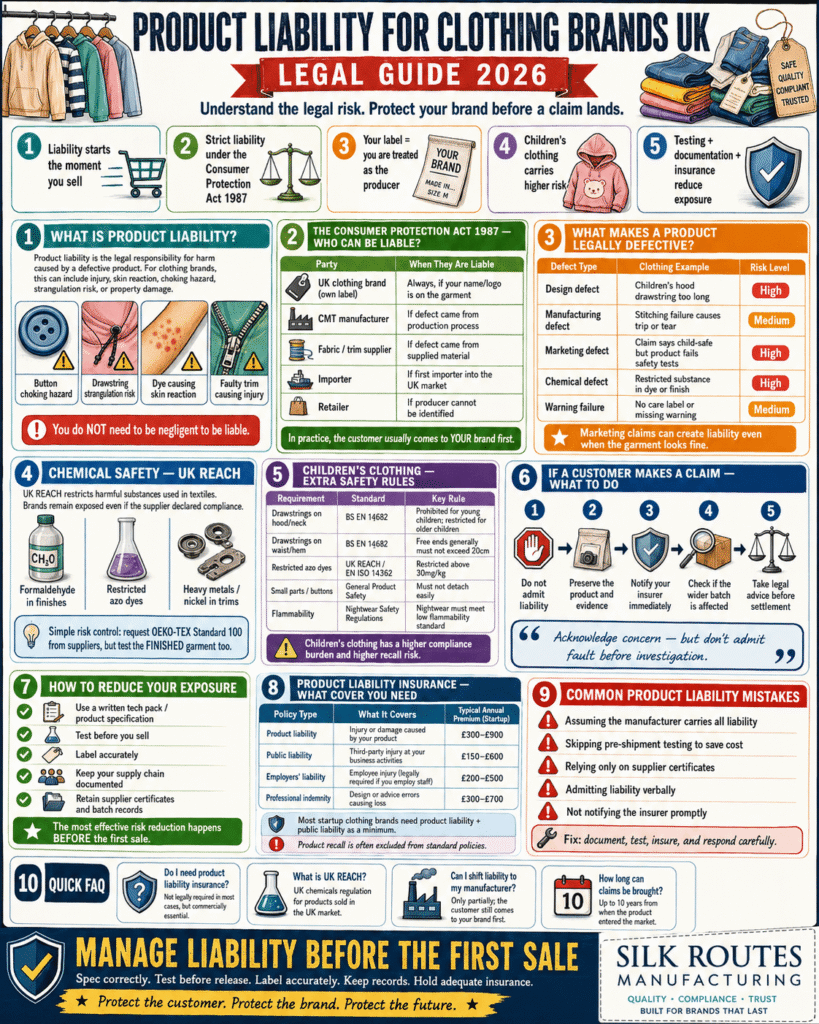
![Product Liability for Clothing Brands UK [Legal Guide 2026]](https://silkroutes.co.uk/wp-content/uploads/2026/06/Product-Liability-for-Clothing-Brands-UK-1.png)
Most clothing startups think product liability is a large-brand problem. It’s not.
The moment you sell a garment to a customer in the UK, you carry legal exposure for harm that product causes, regardless of your size, your revenue, or whether the fault was yours or your manufacturer’s. That’s not a technicality. That’s the Consumer Protection Act 1987.
This guide covers what product liability actually means for a clothing brand, where the legal risk sits, and the specific steps that protect you before a claim lands. Once you’ve confirmed your manufacturing model, our approach to sourcing covers the production side of this in full.
Contents
- 1. What Is Product Liability for Clothing Brands?
- 2. The Consumer Protection Act 1987 — Your Obligations
- 3. What Makes a Clothing Product Legally Defective?
- 4. Chemical Safety — REACH and UK Regulations for Clothing
- 5. Children’s Clothing — Additional Safety Requirements
- 6. What to Do If a Customer Makes a Product Liability Claim
- 7. How to Reduce Your Product Liability Exposure
- 8. Product Liability Insurance — What Cover You Need
- 9. Common Product Liability Mistakes Clothing Brands Make
- 10. FAQ
- 10.1. What is the Consumer Protection Act 1987 and how does it affect clothing brands?
- 10.2. Do I need product liability insurance as a UK clothing startup?
- 10.3. What is UK REACH and does it apply to my clothing brand?
- 10.4. Can I shift liability to my manufacturer if the defect was their fault?
- 10.5. What happens if Trading Standards investigates my clothing brand?
- 11. Managing Your Liability Before the First Sale
What Is Product Liability for Clothing Brands?
Product liability is the legal obligation a business has when a defective product causes harm to a consumer.
For clothing brands, this includes physical injury: a button that chokes a child, a drawstring that strangles, a dye that causes a chemical burn. It also includes property damage caused by a faulty product.
The key point most startup guides get wrong: you don’t have to be negligent to be liable. UK law imposes strict liability under the Consumer Protection Act 1987, which means a claimant doesn’t have to prove you were careless, only that the product was defective and caused harm.
You’re exposed even if the defect originated with your fabric supplier, your CMT manufacturer, or an overseas trim supplier you sourced through a third party.
The Consumer Protection Act 1987 — Your Obligations
The Consumer Protection Act 1987 (CPA) is the primary legislation governing product liability in the UK. It implements the EU Product Liability Directive into UK law and remains fully in force post-Brexit.
Under the CPA, liability falls on the producer of the product. For a clothing brand, you’re treated as the producer if your name or logo appears on the garment, even if you didn’t manufacture a single thread of it. This is the clause that surprises most startup founders.
| Party | When They Are Liable |
|---|---|
| UK clothing brand (own label) | Always — regardless of who manufactured |
| CMT manufacturer (UK) | If defect originated in their production process |
| Fabric / trim supplier | If defect originated in supplied materials |
| Importer (if brand is non-UK) | First importer into UK market carries liability |
| Retailer (stocking your brand) | If producer cannot be identified |
What this table shows is that multiple parties can carry simultaneous liability. But from a practical standpoint, your customer will come to you first, because your label is in the garment.
The Consumer Protection Act 1987 gives claimants up to 10 years to bring a claim from the date the product was put into circulation, with a 3-year limitation period from when the damage was discovered.
If you’re working through a manufacturer to develop your private label range, make sure your contract specifies exactly where defect liability rests. See our clothing manufacturing services for how we structure those agreements.
What Makes a Clothing Product Legally Defective?
A product is legally defective under the CPA if it fails to provide the level of safety that persons generally are entitled to expect.
That’s a deliberately broad standard. Courts assess it on context, including how the product was marketed, what instructions or warnings were provided, and when it was put into circulation.
| Defect Type | Clothing Example | Risk Level |
|---|---|---|
| Design defect | Drawstring on children’s hood exceeds length limit | High — affects all units |
| Manufacturing defect | Stitching failure causing item to unravel and trip wearer | Medium — affects specific batch |
| Marketing defect | Garment sold as suitable for children but fails safety tests | High — affects all units |
| Chemical defect | Fabric dye containing restricted substance causes skin reaction | High — regulatory breach |
| Warning failure | No care label, product damages wearer due to incorrect wash | Medium — preventable |
Design defects are the most expensive to defend because they affect your entire product line, not a single batch. A single faulty garment is recoverable. A systemic design failure can trigger a full recall.
The counterintuitive insight most startup guides skip: marketing defects, the way you describe your product, can create liability independently of any physical flaw. Calling a garment “machine washable at 60°C” when the dye runs at that temperature is a defect in law, even if the garment itself is physically intact.
Chemical Safety — REACH and UK Regulations for Clothing
UK REACH (Registration, Evaluation, Authorisation and Restriction of Chemicals) replaced EU REACH post-Brexit and is enforced by the Health and Safety Executive (HSE). It restricts substances used in the production and finishing of textiles.
Restricted substances relevant to clothing include formaldehyde (used in crease-resistance finishes), azo dyes (restricted where they can release carcinogenic aromatic amines above 30mg/kg in fabric that has prolonged skin contact), and heavy metals including nickel (used in metal trims and zips).
The practical problem for clothing brands: your fabric supplier declares compliance, but you carry liability if their material fails a UK market test. Requesting an OEKO-TEX Standard 100 certificate from your fabric supplier is one of the simplest risk controls available. It doesn’t give you absolute protection, but it demonstrates due diligence, which matters significantly if a claim is brought against you.
Trading Standards authorities can pull products from sale and prosecute brands for UK REACH breaches. The fine is unlimited for serious cases. Prosecution doesn’t require proof of intent.
Children’s clothing carries an additional layer of restriction under the General Product Safety Regulations, covered in the next section.
Children’s Clothing — Additional Safety Requirements
Children’s garments carry stricter liability exposure than adult clothing. A defect that causes minor irritation in an adult can cause serious harm to a child, and courts assess that disparity directly.
The UK-specific standards for children’s clothing sit under BS EN 14682 (cords and drawstrings), the aromatic amine testing standards under EN ISO 14362, and the General Product Safety Regulations.
| Requirement | Standard | Key Rule |
|---|---|---|
| Drawstrings on hood/neck | BS EN 14682 | Prohibited entirely for young children (up to around age 7); restricted further for older children up to 14 |
| Drawstrings on waist/hem | BS EN 14682 | Free ends generally must not exceed 20cm when the garment is extended |
| Restricted azo dyes | REACH Annex XVII / tested to EN ISO 14362 | Restricted above 30mg/kg in fabric with prolonged skin contact |
| Small parts / buttons | General Product Safety Regulations | Must withstand force test — no detachment risk |
| Flammability | Nightwear (Safety) Regulations 1985 | Nightwear must meet low flammability standard |
Our take: if you’re launching a children’s clothing line as a startup, the compliance burden is meaningfully higher than adult clothing, and the liability exposure for a mistake is proportionally more serious. It’s not a reason to avoid the category, but it should be a deliberate choice made with eyes open.
Failure to meet children’s garment safety standards can result in product withdrawal notices from Trading Standards and mandatory recall. The cost of a recall at scale, logistics, consumer communication, replacement, typically dwarfs the cost of compliance testing at the outset.
What to Do If a Customer Makes a Product Liability Claim
Most first-time founders freeze when a claim arrives. The correct sequence isn’t complicated, but deviating from it creates additional exposure.
“Step 1 — do not admit liability. Acknowledge the customer’s complaint, express concern, and commit to investigating. Any written or verbal admission of fault before investigation is complete can be used against you in legal proceedings.” — Silk Routes Manufacturing Team
Step 2 — Preserve evidence. Retain the product sample if returned. Don’t destroy any batch from the same production run. Preserve all supplier documentation, test certificates, and spec sheets relating to that product.
Step 3 — Notify your insurer immediately. Most product liability policies require prompt notification of a potential claim. Late notification can void cover.
Step 4 — Assess whether a wider batch is affected. A single complaint may indicate a manufacturing batch defect. If so, proactive withdrawal is far less damaging than a Trading Standards-enforced recall.
Step 5 — Take legal advice before settling. Settlement amounts in clothing product liability cases vary widely. A brief from a product liability solicitor before you respond formally is almost always worth the cost.
How to Reduce Your Product Liability Exposure
The most effective risk reduction is upstream, in how you specify, source, and test your product before it reaches a customer.
Use a written product specification. Your tech pack is your first line of legal defence. A detailed spec sheet showing that you designed to standard, and that your manufacturer was contractually required to meet it, shifts some liability back to the manufacturer if they deviated. No spec, no argument.
Test before you sell. Pre-shipment testing through a UKAS-accredited laboratory costs between £200–£800 per product depending on the test suite. That’s your lowest-cost liability control. An OEKO-TEX certificate from your supplier is useful, but independent pre-shipment testing of your finished garment is better.
Label correctly. UK labelling requirements under the Textile Products (Labelling and Fibre Composition) Regulations 2012 require accurate fibre content labelling. A garment described as 100% cotton that tests at 85% cotton is a Trading Standards issue, not just a customer complaint.
Keep your supply chain documented. Maintain a file for each product: supplier certificates, test reports, country of origin, fibre composition, production batch. If a claim is made 3 years after sale, you’ll need that paper trail.
Product Liability Insurance — What Cover You Need
Product liability insurance isn’t a legal requirement in the UK for most clothing brands, but it’s effectively non-negotiable from a commercial standpoint. Major retailers won’t stock your brand without a valid certificate of insurance, typically showing a minimum of £2 million cover.
| Policy Type | What It Covers | Typical Annual Premium (Startup) |
|---|---|---|
| Product liability | Injury or damage caused by your product | £300–£900 |
| Public liability | Third-party injury in your business premises | £150–£600 |
| Employers’ liability | Employee injury (legally required if you employ staff) | £200–£500 |
| Professional indemnity | Design or advice errors causing client loss | £300–£700 |
Most startup clothing brands need product liability combined with public liability as a minimum. If you sell through Amazon or major retailers, check the specific insurance requirements in their seller or supplier terms, as retailer requirements vary and are worth confirming directly rather than assuming a figure.
The mistake most brands make: buying the cheapest policy without reading what the policy excludes. Product recalls, for example, are typically excluded from standard product liability policies. Recall insurance is a separate product and is worth considering if you’re scaling volume.
Common Product Liability Mistakes Clothing Brands Make
Assuming the manufacturer carries all liability. Founders believe that because the factory made the garment, the factory is responsible for defects. Your brand name is on the label — under the CPA, you’re the producer in the eyes of UK law.
Fix: ensure your manufacturing contract specifies that the manufacturer indemnifies you for defects caused by their process, and that they carry adequate product liability insurance themselves.
Skipping pre-shipment testing to reduce cost. Testing feels expensive when margins are tight at low MOQ.
Fix: commission a UKAS-accredited lab for a finished garment test report before releasing your first order. Budget £300–£600. The alternative, a product liability claim or a Trading Standards notice, costs orders of magnitude more.
Using supplier test certificates as your own compliance. A fabric supplier provides an OEKO-TEX certificate and the brand treats this as full compliance.
Fix: supplier certificates cover the input material, not your finished garment. Dye bleed, trim failure, or assembly defects can occur after that material passes its own test. Always test the finished product.
Admitting liability verbally when a complaint arrives. A founder wants to appear responsive and apologises directly for the defect in their first reply.
Fix: separate acknowledgement from admission. You can say “I am very sorry you experienced this and I take it seriously” without saying “this is our fault.”
Not notifying the insurer promptly. The founder handles the complaint directly, believing it will resolve, and notifies the insurer weeks later.
Fix: notify your insurer as soon as a potential liability claim is raised, even if you believe the complaint won’t escalate.
FAQ
What is the Consumer Protection Act 1987 and how does it affect clothing brands?
The Consumer Protection Act 1987 imposes strict liability on businesses for defective products that cause harm. For clothing brands, this means you’re legally responsible for harm caused by your garments, regardless of whether you manufactured them, if your brand name appears on the label. Claims can be brought up to 10 years after the product entered the market.
Do I need product liability insurance as a UK clothing startup?
It’s not legally required in the UK for most clothing brands, but any serious retail partner will typically require evidence of product liability cover, often around £2 million, before stocking your products. Policies for startup brands typically start at £300–£600 per year.
What is UK REACH and does it apply to my clothing brand?
UK REACH is the post-Brexit chemicals regulation enforced by the Health and Safety Executive. It restricts certain substances used in textile production, including formaldehyde, some azo dye compounds, and nickel in metal trims. Any clothing sold in the UK market must comply. A breach can result in product withdrawal by Trading Standards and an unlimited fine.
Can I shift liability to my manufacturer if the defect was their fault?
Partially. If you have a manufacturing contract that includes an indemnity clause for defects caused by the manufacturer, you can seek to recover costs from them. However, your customer’s primary claim will still come to you as the brand, and you must handle it, then pursue the manufacturer separately. No contract clause removes your liability to the end consumer.
What happens if Trading Standards investigates my clothing brand?
Trading Standards can issue improvement notices, withdraw products from sale, require a public recall, or prosecute for serious breaches. Investigations are often triggered by consumer complaints or market surveillance testing. Full cooperation and documented compliance evidence are your most effective response. Penalties for serious breaches, particularly those involving children’s products, include unlimited fines and reputational damage that’s difficult to recover from.
Managing Your Liability Before the First Sale
Product liability isn’t something you manage after a claim arrives. By that point, your options are reactive and expensive.
The practical checklist is short: spec your products correctly, test them against UK standards before release, label them accurately, keep your supply chain documented, and hold adequate insurance. None of these steps is complex. All of them are cheaper than a claim.
If you’re building a clothing brand on a private label model and want to understand how manufacturing decisions affect your legal position, our full guide to low MOQ and private label clothing manufacturers in the UK covers sourcing, production, and supplier relationships in detail.
To discuss how we structure manufacturing contracts and quality controls at Silk Routes, visit our about page.