
Contents
- 1.
- 1.1. Post Summary
- 1.2. What Is EN ISO 11612 and Who Needs to Comply?
- 1.3. What EN ISO 11612 Performance Levels Mean
- 1.4. Inherently FR vs Treated FR Fabrics
- 1.5. Is 100% Cotton Flame Resistant?
- 1.6. Arc Flash Protection vs Flame Resistance
- 1.7. EN ISO 11612 in Oil, Gas and Petrochemical Work
- 1.8. FR Workwear for Welding and Metal Processing
- 1.9. UKCA, CE and FR Workwear Certification
- 1.10. What Can Be Customised on FR Workwear?
- 1.11. Common Compliance Mistakes When Sourcing FR Workwear
- 1.12. How Silk Routes Sources Flame-Resistant Workwear
- 1.13. FAQ
- 1.14. Specifying FR Workwear Without Guesswork
A garment described as “fire resistant” is not automatically suitable for industrial heat and flame exposure.
For buyers sourcing flame resistant workwear EN ISO 11612 UK, the specification has to start with the hazard. Fabric composition, garment construction, protective performance, certification and any additional risks such as electrical arc exposure all influence what should actually be worn.
EN ISO 11612 is one of the key standards used for protective clothing where workers may be exposed to heat and flame.
Post Summary
EN ISO 11612 covers protective clothing for heat and flame hazards
Flame resistance and arc-flash protection are not the same requirement
FR fabrics can be inherently flame resistant or chemically treated
100% cotton is not automatically flame resistant
Garment construction matters alongside fabric performance
Branding, trims and repairs can affect protective performance
PPE selection should follow a documented workplace risk assessment
Certification must match the exact garment being purchased
What Is EN ISO 11612 and Who Needs to Comply?
EN ISO 11612 applies to protective clothing intended to protect wearers against heat and flame, excluding specialised firefighting clothing and certain other highly specific applications.
The standard evaluates several types of thermal exposure rather than treating “fire resistance” as one universal property.
The Health and Safety Executive places PPE selection within workplace risk management. Protective clothing should therefore be selected because a risk assessment identifies a hazard, not because a garment carries an FR label.
Industries where heat and flame protection may be relevant include:
Oil and gas
Utilities
Welding and metal fabrication
Foundries
Petrochemical operations
Heavy manufacturing
Engineering
Electrical maintenance
Industrial processing
Our view is that buyers should never start an FR enquiry with “We need flame-resistant overalls.”
Start with the hazard.
The manufacturer needs to know what workers may actually encounter before fabric and garment construction can be specified.
What EN ISO 11612 Performance Levels Mean
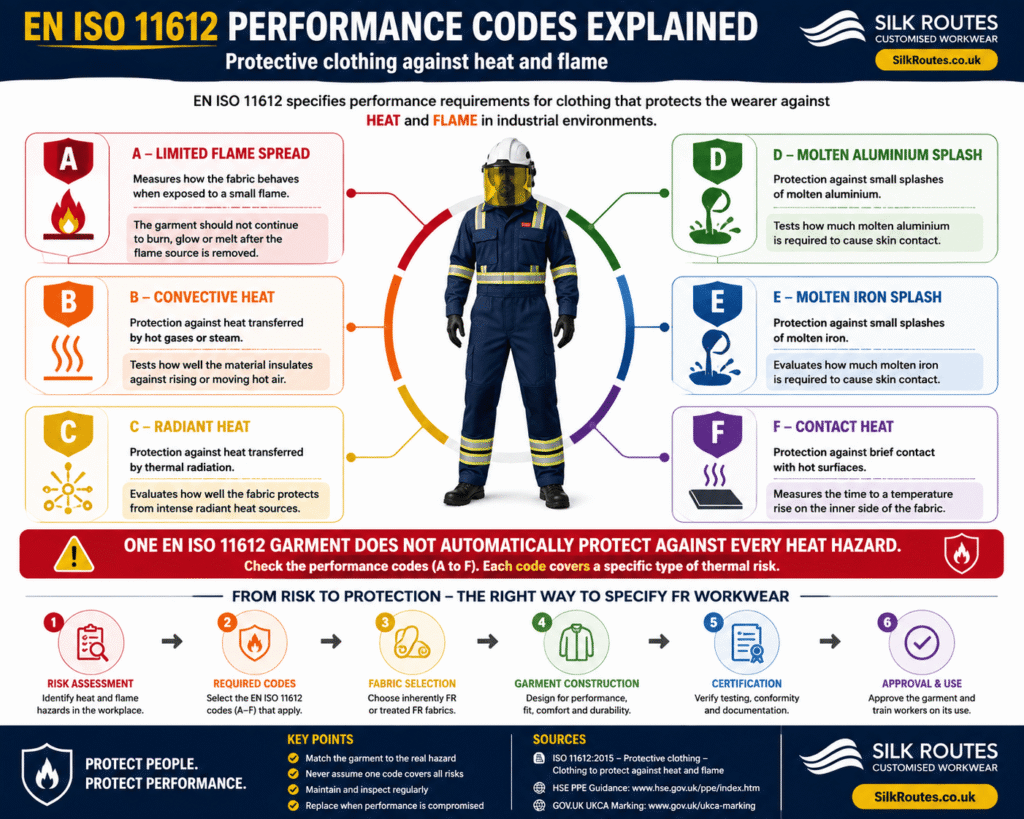
EN ISO 11612 uses different test categories to represent different forms of heat and flame exposure.
A garment can therefore carry several performance codes rather than one simple pass-or-fail rating.
| Code | Hazard Type | What It Relates To |
|---|---|---|
| A | Limited flame spread | Behaviour when exposed to flame |
| B | Convective heat | Heat transferred through moving hot gases |
| C | Radiant heat | Heat transferred through thermal radiation |
| D | Molten aluminium splash | Protection against aluminium splash |
| E | Molten iron splash | Protection against iron splash |
| F | Contact heat | Heat transferred through direct contact |
The first mistake buyers make is assuming that every EN ISO 11612 garment provides identical protection.
It does not.
A garment tested for one thermal hazard may not provide the same performance against another.
The exact performance coding should therefore be matched to the risk assessment.
Silk Routes Manufacturing Team: Ask for the complete EN ISO 11612 performance classification, not simply confirmation that a garment is “EN ISO 11612 compliant”.
Businesses developing technical workwear can review our clothing manufacturing services before turning a protective requirement into a production specification.
Inherently FR vs Treated FR Fabrics
Flame-resistant clothing generally reaches its protective performance through one of two routes.
The first uses fibres whose flame-resistant properties are inherent to the material.
The second uses fabrics that receive a chemical treatment designed to provide flame-resistant performance.
Neither route is automatically superior for every application.
Inherently Flame-Resistant Fabrics
Nomex is one of the best-known inherently flame-resistant fibre families.
Its protective properties come from the fibre structure rather than a finish applied after weaving.
Inherently FR materials can be attractive for demanding industrial applications because the protective characteristic is built into the material itself.
However, cost, comfort, garment weight and the required hazard performance still need consideration.
Kevlar may also appear in protective textile systems where heat resistance, strength or reinforcement is required.
It is not simply a substitute for every FR fabric.
Different fibres perform different jobs.
Treated Flame-Resistant Fabrics
Treated FR fabrics begin with a base material, commonly cotton or a cotton-rich blend, and receive a flame-resistant treatment.
Proban and Pyrovatex are examples of treatment technologies associated with FR textiles.
The advantage can be a more familiar textile feel and a different cost structure from inherently FR fibres.
The trade-off is that buyers need to pay close attention to the approved laundering procedure and the specific treatment performance.
What guides often get wrong is reducing the decision to “inherent lasts forever, treated does not.”
The useful question is whether the exact fabric retains its certified protective performance throughout the intended garment life under the approved maintenance regime.
| Fabric Route | Main Strength | Main Procurement Question |
|---|---|---|
| Inherent FR | Protection built into fibre structure | Does it meet the required hazard performance? |
| Treated FR | Can combine familiar textile properties with FR treatment | What laundering and lifecycle controls apply? |
| FR blend | Balances several performance characteristics | Which component provides which function? |
| Reinforced FR fabric | Adds strength in high-wear areas | Is the complete construction approved? |
Is 100% Cotton Flame Resistant?
No.
Ordinary 100% cotton is not automatically flame resistant.
Cotton can burn, and a garment should not be treated as FR simply because it is made from natural fibre.
This is an important procurement distinction.
A cotton garment may be treated with an FR technology and then tested against an applicable standard.
That does not mean every cotton garment provides the same protection.
What buyers get wrong is confusing “does not melt like some synthetics” with “is flame resistant.”
Those are different properties.
A non-melting fibre can still ignite and continue burning.
If cotton-based FR workwear is required, procurement should request evidence for the exact treated fabric and finished garment.
Arc Flash Protection vs Flame Resistance
Flame resistance and electrical arc protection overlap, but they are not interchangeable.
A worker exposed to electrical arc hazards may need clothing assessed specifically for the thermal effects of an electric arc.
EN ISO 11612 focuses on heat and flame hazards.
Electrical arc protection is addressed through additional standards and performance testing.
| Requirement | Main Hazard | Buyer Must Check |
|---|---|---|
| EN ISO 11612 | Heat and flame | Performance codes for relevant thermal exposure |
| Arc-rated clothing | Electrical arc thermal energy | Arc-specific test and rating |
| Anti-static clothing | Electrostatic discharge risk | Applicable electrostatic requirement |
| Chemical protective clothing | Chemical exposure | Chemical-specific performance |
| High visibility clothing | Visibility hazard | EN ISO 20471 requirements |
The common mistake is purchasing one FR garment and assuming it covers every industrial hazard.
It may not.
A utility worker could potentially need flame resistance, arc protection, high visibility and electrostatic properties within the same clothing system.
Each requirement should be specified separately.
The HSE electrical safety guidance makes clear that electrical risks need to be controlled through proper systems of work rather than clothing alone.
EN ISO 11612 in Oil, Gas and Petrochemical Work
Oil, gas and petrochemical environments can combine several hazards.
Heat, flame, explosive atmospheres, static electricity and chemical exposure may all influence clothing requirements.
An EN ISO 11612 certification therefore answers only part of the procurement question.
The workplace risk assessment may identify additional requirements.
ATEX environments are a good example.
A garment being used where explosive atmospheres are possible may need electrostatic considerations alongside flame resistance.
The HSE fire and explosion guidance covers employer responsibilities for managing these kinds of risks.
What buyers get wrong is searching for an “ATEX uniform” as though one garment label solves the whole problem.
ATEX relates to hazardous environments and equipment controls.
Clothing requirements should be derived from the specific risks present in that environment.
FR Workwear for Welding and Metal Processing
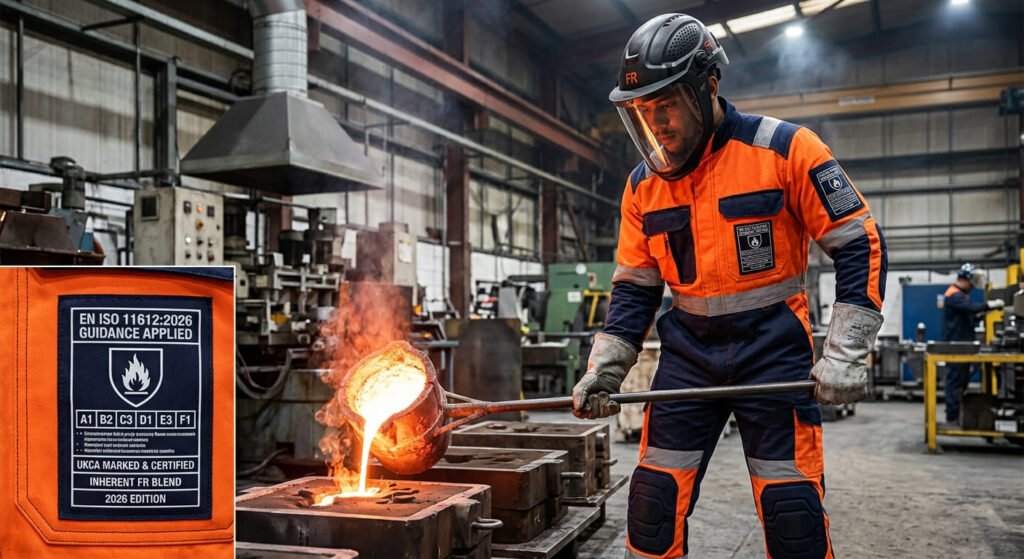
Welding and foundry work can involve sparks, radiant heat and molten-metal exposure.
These hazards are not identical.
A garment appropriate for general heat exposure may not provide adequate protection against molten metal splash.
This is why EN ISO 11612 separates performance categories.
The D and E codes deal specifically with molten aluminium and molten iron splash performance.
Buyers should not specify them unless those hazards actually exist.
Equally, they should not omit them when workers genuinely face molten-metal exposure.
Garment design matters as well.
Open pockets, cuffs, folds and exposed closures can create places where hot particles collect.
The fabric can pass a test while poor garment design still creates practical risk.
UKCA, CE and FR Workwear Certification
Protective clothing supplied as PPE needs appropriate conformity assessment and supporting documentation.
Current marking requirements can change, so procurement teams should verify the latest GOV.UK UKCA guidance rather than relying on outdated post-Brexit articles.
The label alone should not be treated as complete evidence.
Ask for documentation that identifies:
Manufacturer
Product or style reference
Applicable standard
Performance classification
Conformity information
Relevant notified or approved body details where applicable
Care instructions
Size designation
Traceability information
What guides get wrong is treating certification as a property of a fabric roll.
The finished garment matters.
Changing fabric, seam construction, closures, reflective tape or other components can potentially affect protective performance.
What Can Be Customised on FR Workwear?
FR workwear can be branded and customised, but changes need more control than ordinary corporate clothing.
Embroidery, badges, reflective tape, zips, press studs, labels and contrast panels all become part of the finished garment.
| Custom Feature | Possible | Key Check |
|---|---|---|
| Embroidered logo | Yes, subject to specification | Thread, backing and placement |
| Heat-applied logo | Sometimes | Application compatibility |
| Reflective tape | Yes | Required certification and layout |
| Contrast panels | Possible | Fabric protective performance |
| Pockets | Possible | Hazard and garment design |
| Zips | Possible | Component suitability |
| Press studs | Possible | Material and exposure requirements |
| Custom labels | Yes | Must not compromise protective area |
What does not work is taking an approved FR garment and making uncontrolled modifications afterwards.
Replacing a certified component with a visually similar ordinary component can change the protective system.
Silk Routes Manufacturing Team: Freeze the complete approved FR garment specification before bulk production. Fabric, trims, branding and construction should all be controlled on repeat orders.
Common Compliance Mistakes When Sourcing FR Workwear
1. Buying “Fire Resistant” Clothing Without a Standard
Why it happens: FR terminology is used loosely in product descriptions.
Why it fails: The claim does not tell the buyer what hazard performance has actually been tested.
Fix: Specify EN ISO 11612 and the required performance classifications.
2. Assuming Cotton Is FR
Why it happens: Cotton does not behave like melting thermoplastic fibres.
Why it fails: Ordinary cotton can still ignite and burn.
Fix: Use a tested FR fabric or treated cotton system where the risk assessment requires flame resistance.
3. Confusing Arc Rating With Flame Resistance
Why it happens: Both involve thermal hazards.
Why it fails: Electrical arc performance requires additional assessment.
Fix: Specify arc requirements separately from EN ISO 11612.
4. Ignoring Garment Construction
Why it happens: Procurement focuses on fabric certificates.
Why it fails: Seams, pockets, trims and closures form part of the finished garment.
Fix: Review certification for the complete clothing system.
5. Adding Unapproved Branding
Why it happens: Logos are treated as purely decorative.
Why it fails: Thread, backing or heat-applied materials may introduce components not covered by the original specification.
Fix: Include branding during development and approval.
6. Reordering a Visually Similar Product
Why it happens: Another supplier offers a cheaper garment with the same colour and appearance.
Why it fails: Visual similarity proves nothing about protective performance.
Fix: Compare the exact standard, performance codes, fabric and certification.
How Silk Routes Sources Flame-Resistant Workwear
FR workwear production should begin with the hazard specification.
We would first establish the required garment type, EN ISO 11612 performance, any additional protective standards, fabric route, sizing and branding requirements.
Sampling then needs to preserve those technical requirements rather than treating them as optional extras.
Repeat ordering also matters.
An approved FR garment should have a controlled record covering material, trims, construction and decoration.
You can read more about Silk Routes and our manufacturing background on the About Silk Routes page.
FAQ
What are the requirements for flame-resistant clothing?
FR clothing should be selected against the workplace hazard and the relevant protective-clothing standard.
For EN ISO 11612, buyers should check at least 1 applicable performance classification beyond the basic standard reference because different codes relate to different thermal hazards.
What is Category 3 protective clothing?
Category III PPE is associated with protection against risks that may cause very serious consequences, including death or irreversible damage to health.
It is one of 3 PPE risk categories, and Category III products generally require the highest level of conformity-assessment oversight.
Is 100% cotton considered FR?
No. Ordinary 100% cotton should not be assumed to be flame resistant.
A cotton-based garment needs a tested FR treatment or certified protective construction if flame resistance is required; checking 1 fabric-composition label is not enough to establish FR performance.
Is EN ISO 11612 the same as arc-flash protection?
No.
EN ISO 11612 addresses heat and flame hazards, while electrical arc protection requires additional arc-specific testing; procurement should treat these as at least 2 separate protective requirements where both hazards exist.
Can FR clothing be embroidered with a company logo?
It can be possible when the decoration is compatible with the approved protective specification.
Approve at least 1 fully branded production sample and ensure the embroidery thread, backing and placement do not introduce an uncontrolled change to the garment.
Specifying FR Workwear Without Guesswork
Start with the hazard, not the fabric brand.
Define the required EN ISO 11612 performance, any arc, anti-static, chemical or visibility requirements, then select the fabric and garment construction that meet those conditions.
Branding comes afterwards.
That order prevents a common and expensive mistake: selecting an attractive FR garment first, then discovering that it does not cover the actual workplace risk.
For the wider manufacturing context around technical protective garments, see our Specialist Clothing Manufacturers UK guide.