Contents
- 1.
- 1.1. Post Summary
- 1.2. Is Denim Still Produced in the UK?
- 1.3. Types of Denim Production Available in the UK
- 1.4. How Denim Is Made: From Fibre to Finished Garment
- 1.5. UK Denim Wash and Finish Capabilities
- 1.6. MOQ for UK Denim Production
- 1.7. Cost of UK Denim Manufacturing vs Offshore
- 1.8. How to Brief a UK Denim Manufacturer
- 1.9. Fabric Sourcing for UK Denim Production
- 1.10. Common Mistakes When Producing Denim in the UK
- 1.11. How Silk Routes Supports Denim Brands
- 1.12. FAQ
- 1.13. Building a Denim Product That Can Be Repeated
UK denim production still exists, but it is more specialised than many new brands expect.
For founders researching denim production UK, the challenge is rarely finding somebody who can sew a pair of trousers. Denim manufacturing involves fabric selection, shrinkage control, specialist machinery, pocket construction, hardware, washing, finishing and fit development.
Raw selvedge jeans, stretch fashion denim and heavily washed five-pocket jeans can all require different suppliers and processes.
Post Summary
UK denim production is available, but specialist capability matters
Raw and selvedge denim require different planning from washed fashion denim
Stretch denim changes fit, pattern and recovery requirements
Wash development can alter colour, measurements and garment feel
MOQ should be checked by style, fabric, wash and colour
Fabric sourcing often has a bigger effect on cost than sewing alone
Samples should be tested after the intended wash process
Strong denim production starts with the fabric and finish, not the pocket label
Is Denim Still Produced in the UK?
Yes, denim garments can still be produced in the UK.
The better question is what part of the denim supply chain is available domestically for your particular product.
The UK has clothing manufacturers capable of cutting and sewing jeans, jackets and other denim garments, but not every factory handles specialist denim equally well.
The UK Fashion & Textile Association represents businesses across UK fashion and textile manufacturing, including companies involved in domestic production and specialist garment making.
A factory producing lightweight fashion trousers may not have the machinery or experience needed for heavyweight jeans.
Denim sewing can involve:
Heavy fabric feeding
Flat-felled seams
Chain stitching
Bar tacking
Rivet installation
Metal buttons
Heavy topstitch thread
Specialist waistband construction
Our view is that buyers should ask about machinery and previous denim production before discussing price.
“Can you make jeans?” is too broad.
“Can you manufacture a 14 oz five-pocket jean with felled inseams, rivets and heavy topstitching?” gives the factory something useful to answer.
Types of Denim Production Available in the UK
Denim is not one fabric category with one production route.
Different weights, fibre blends, finishes and garment styles affect how a manufacturer approaches production.
| Denim Type | Typical Characteristics | Production Challenge | Common Product |
|---|---|---|---|
| Raw denim | Unwashed, rigid appearance | Shrinkage and break-in behaviour | Jeans, jackets |
| Selvedge denim | Woven with finished self-edge | Fabric utilisation and authentic construction | Premium jeans |
| Standard denim | Conventional woven denim | Stable repeat production | Fashion jeans |
| Stretch denim | Elastane or stretch component | Recovery and fit control | Skinny jeans, fitted skirts |
| Lightweight denim | Softer and easier drape | Avoiding over-heavy construction | Shirts, dresses |
| Heavyweight denim | Dense and rigid | Machinery and seam bulk | Heritage jeans, workwear |
Raw and Selvedge Denim
Raw denim is denim that has not received the extensive washing or distress finishing associated with many fashion jeans.
Its appearance changes with wear.
That appeals to brands selling heritage, workwear and enthusiast products.
Selvedge denim is defined by the finished edge produced by shuttle-loom weaving.
The self-edge is often visible when the trouser cuff is turned up.
A selvedge edge does not automatically make the fabric better.
Quality still depends on fibre, yarn, weave, dyeing, finishing and construction.
The mistake is paying a premium for the word “selvedge” while ignoring fabric weight and garment engineering.
Premium selvedge production also requires careful marker planning because the fabric is usually narrower than modern wide-width denim.
That can increase fabric consumption.
Standard Weight Denim
Standard commercial denim offers more flexibility for fashion brands.
It can be sourced across different weights, colours and fibre compositions.
The advantage is production familiarity.
The trade-off is differentiation.
A basic indigo jean can look very similar to thousands of existing products unless the fit, wash, construction or detailing creates a clear identity.
Stretch and Performance Denim
Stretch denim commonly introduces elastane or another stretch component.
This changes how patterns should be developed.
A rigid denim pattern cannot always be transferred directly to stretch fabric.
The garment may grow during wear, recover differently after washing or feel too tight if the stretch characteristics are not understood.
Fit approval therefore needs to happen in the actual production fabric.
A substitute sample fabric can hide problems.
How Denim Is Made: From Fibre to Finished Garment
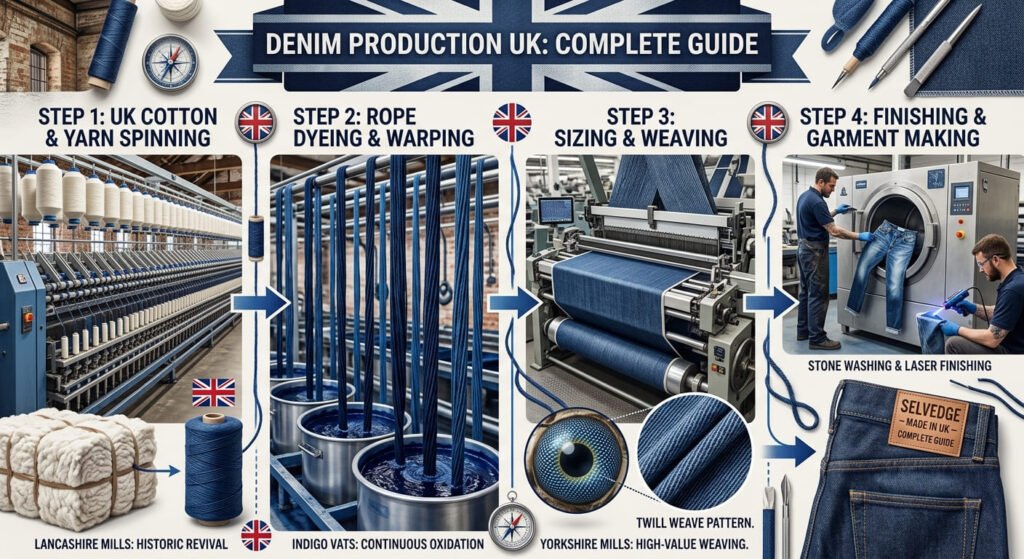
Denim production begins long before the sewing line.
At a high level, the process follows this sequence:
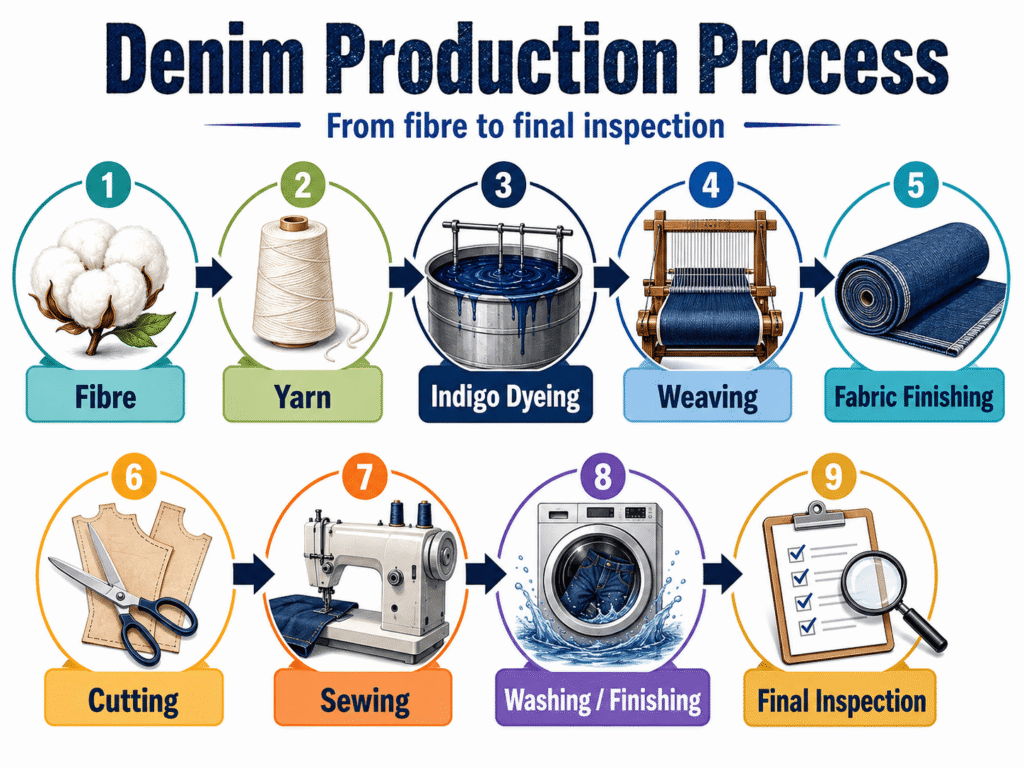
Fibre → Yarn → Indigo Dyeing → Weaving → Fabric Finishing → Cutting → Sewing → Washing/Finishing → Final Inspection
Cotton remains the dominant fibre associated with traditional denim.
The Textile Exchange publishes material guidance and reporting around preferred fibres, recycled inputs and lower-impact textile sourcing.
1. Fibre and Yarn
Traditional denim is strongly associated with cotton yarn.
Modern denim may also include:
Recycled cotton
Polyester
Recycled polyester
Elastane
Other performance fibres
Yarn construction influences the eventual look and texture of the denim.
2. Indigo Dyeing
Classic blue denim uses indigo-dyed warp yarns.
The yarn surface receives colour while the inner fibre remains less deeply dyed.
This contributes to the fading behaviour associated with denim.
Indigo dyeing therefore has a direct influence on how a garment ages.
3. Weaving
Denim is normally woven as a twill fabric.
The characteristic diagonal surface becomes visible in the cloth.
Selvedge denim uses a different weaving approach from mass-produced wide-width denim.
4. Fabric Finishing
Fabric can receive treatments to control shrinkage, hand feel and surface appearance.
These decisions affect the finished garment before any wash development begins.
5. Cutting
Denim patterns are laid onto the fabric and cut.
Heavyweight denim needs accurate handling because thickness can affect cutting precision.
6. Sewing
Jeans construction may involve multiple specialist operations.
Pocket positioning, topstitch spacing, waistband attachment, bartacks and hardware all influence the finished appearance.
7. Washing and Finishing
The garment may remain raw or move through one or more wash processes.
This is where denim can change dramatically.
8. Inspection
Measurements, hardware, seams, shade and wash appearance should be checked against the approved sample.
That inspection matters because wash processes can shift both colour and size.
UK Denim Wash and Finish Capabilities
Wash development is one of the most important parts of fashion denim.
The same base fabric can produce very different garments depending on treatment.
Common effects include:
| Finish | Visual Effect | Key Control |
|---|---|---|
| Rinse wash | Cleaner, softened denim | Shrinkage |
| Stone-style wash | Worn surface appearance | Consistency |
| Enzyme wash | Softer, aged look | Processing control |
| Bleach effect | Lighter shade | Colour consistency |
| Garment dye | Alternative colour | Shade control |
| Distressing | Worn areas | Repeatability |
Traditional denim finishing has also raised environmental concerns around water, energy, chemicals and waste.
WRAP works on reducing the environmental impacts of textiles through more circular approaches to clothing and material use.
What brands get wrong is approving a wash visually without checking measurements.
A jean can look perfect after washing and still fail because the waist, inseam or leg opening has changed.
The approved sample should therefore be measured before and after the intended treatment.
Silk Routes Manufacturing Team: Treat the wash recipe as part of the product specification. Changing the wash can change shade, hand feel and measurements even when the sewing remains identical.
Brands planning a denim collection can review our clothing manufacturing services before moving from development into bulk production.
MOQ for UK Denim Production
Denim MOQ varies because the order may contain several different minimums.
The factory’s sewing minimum is only one of them.
A denim project can also face:
Fabric supplier MOQ
Custom dye MOQ
Wash-house minimum
Hardware minimum
Label minimum
Per-colour minimum
Per-style minimum
A 300-piece order can become difficult if it contains several fabrics, washes and colourways.
| Order Structure | Relative Complexity |
|---|---|
| One jean, one fabric, one wash | Lower |
| One jean, several washes | Moderate |
| Several styles, same denim | Moderate |
| Several fabrics and washes | Higher |
| Custom denim development | High |
| Custom hardware and trims | Higher |
The most effective way to lower production complexity is often to reduce variation.
One denim fabric used across jeans, a skirt and a jacket can be easier to manage than three fabrics across three products.
What brands often get wrong is negotiating the garment MOQ before checking the fabric MOQ.
The factory cannot manufacture 50 pieces economically if the fabric supplier requires a much larger commitment.
Cost of UK Denim Manufacturing vs Offshore
Denim cost is heavily influenced by the specification.
Labour matters, but it is not the only driver.
| Cost Area | Lower Cost Direction | Higher Cost Direction |
|---|---|---|
| Fabric | Standard commercial denim | Premium selvedge |
| Construction | Simple denim trouser | Traditional five-pocket jean |
| Hardware | Stock components | Custom branded hardware |
| Wash | Raw or simple rinse | Multi-stage fashion wash |
| Topstitching | Standard | Heavy specialist stitching |
| Quantity | Larger repeat run | Small fragmented order |
| Sampling | Minor fit adjustment | Multiple wash and fit rounds |
UK production can offer advantages where brands value proximity, communication and smaller development cycles.
Offshore production can offer scale advantages when order quantities justify them.
The decision should not be reduced to one unit price.
A lower factory price may be offset by larger fabric commitments, freight, development delays or excess stock.
Our opinion is that early-stage denim brands should calculate the cash tied up in the entire production run, not just the cost per jean.
How to Brief a UK Denim Manufacturer
A useful denim brief starts with the fabric.
Include:
Product type
Denim weight
Fibre composition
Rigid or stretch construction
Required wash
Fit
Size range
Stitch colour
Stitch density
Pocket design
Rivets
Buttons
Zip
Leather or alternative patch
Labels
Quantity
Target delivery date
The tech pack should also show topstitch lines clearly.
Denim often uses contrast stitching as a design feature.
Small inconsistencies become visible quickly.
Fabric Sourcing for UK Denim Production
The garment manufacturer and fabric supplier do not have to be in the same country.
A UK-sewn jean may use denim woven elsewhere.
This is common in specialist clothing production.
The useful sourcing question is whether the fabric can be supplied consistently in the required quantity and specification.
For brands working on lower-impact collections, fabric documentation matters.
OEKO-TEX provides textile testing and certification systems that can help buyers assess certain chemical and product-safety requirements.
Sustainability claims need to be specific.
“Eco denim” tells a buyer almost nothing.
Ask what has changed:
Fibre source?
Recycled content?
Dye process?
Water consumption?
Chemical inputs?
Wash process?
Garment durability?
The British Fashion Council also supports programmes around responsible fashion and the wider UK fashion ecosystem.
A strong sourcing brief defines which of these issues actually matters to the brand.
Common Mistakes When Producing Denim in the UK
1. Selecting a Factory Without Denim Machinery
Why it happens: The manufacturer already produces trousers.
Why it fails: Heavy seams and specialist jean construction can demand different machinery.
Fix: Ask for examples of comparable denim garments.
2. Approving Fit Before the Final Wash
Why it happens: The first sample is checked in raw fabric.
Why it fails: Washing can alter measurements.
Fix: Approve the post-wash sample.
3. Ignoring Fabric Width
Why it happens: Buyers compare denim only by price per metre.
Why it fails: Narrow selvedge cloth can consume more fabric.
Fix: Compare usable fabric width and garment consumption.
4. Using Too Many Washes in a Small Order
Why it happens: Brands want variety.
Why it fails: Each wash creates another production and approval route.
Fix: Launch with fewer controlled finishes.
5. Treating Stretch Denim Like Rigid Denim
Why it happens: The fabrics look similar.
Why it fails: Stretch and recovery change fit.
Fix: Develop the pattern in the production fabric.
6. Choosing Hardware at the End
Why it happens: Buttons and rivets appear minor.
Why it fails: Hardware affects appearance, cost and lead time.
Fix: Approve trims during sampling.
How Silk Routes Supports Denim Brands
Denim production works best when fabric, construction and finishing are developed together.
Silk Routes can help brands organise those requirements before production, including garment type, fabric specification, wash direction, hardware and fit.
For smaller brands, controlling the number of washes and trims can make the first order easier to manage.
You can read more about our manufacturing background on the About Silk Routes page.
FAQ
Who is the largest producer of denim?
The supplied brief does not provide a current verified global ranking for one largest denim producer, so naming a company or country as number 1 would be unreliable without a fresh industry dataset.
Major denim manufacturing capacity exists across several countries, including China, India, Pakistan, Bangladesh and Turkey, but the leading producer can vary depending on whether the metric is fabric volume, jeans production, exports or company-level output.
What are the big 3 denim brands?
“Big 3” is not a single recognised industry classification.
If comparing well-known heritage denim labels, buyers should define at least 3 criteria—sales, global recognition and market reach—before treating any three brands as an authoritative ranking.
How is denim made step by step?
A simplified production sequence has 8 main stages: fibre, yarn, indigo dyeing, weaving, fabric finishing, cutting, sewing, then garment washing and final inspection.
Individual products may add extra stages for distressing, garment dyeing, specialist hardware or other finishing.
What is 100% denim made of?
Traditional 100% denim usually means fabric made from 100% cotton fibres woven into a denim twill.
Modern denim can also contain elastane, polyester, recycled fibres or other materials, so the fibre-composition label should be checked rather than assuming every denim garment is pure cotton.
Is selvedge denim better than normal denim?
Not automatically.
Selvedge describes a weaving characteristic rather than one universal quality grade; compare at least 4 factors—fibre, yarn, weave, finish and construction—before judging whether a particular selvedge denim is superior.
Building a Denim Product That Can Be Repeated
The first jean is only half the job.
A commercial product needs to be repeatable.
Keep records of:
Approved fabric
Fabric width
Wash recipe
Stitch colour
Hardware
Pattern version
Measurement specification
Labels
Packaging
That record helps prevent the second production run from becoming a different product.
For the wider context of specialist garment manufacturing, see our Specialist Clothing Manufacturers UK guide.