Contents
- 1.
- 2. Which Leather Jacket Production Route Fits Your Brand?
- 2.1. Three Main Leather Production Routes
- 2.2. Interactive Leather Route Finder
- 2.3. Material & Manufacturer Fit
- 2.4. Four Premium Production Risk Zones
- 2.5. Premium Leather Jacket Production Flow
- 2.6. Pre-Production Timeline
- 2.7. Leather Types: Lambskin, Cowhide and Goatskin
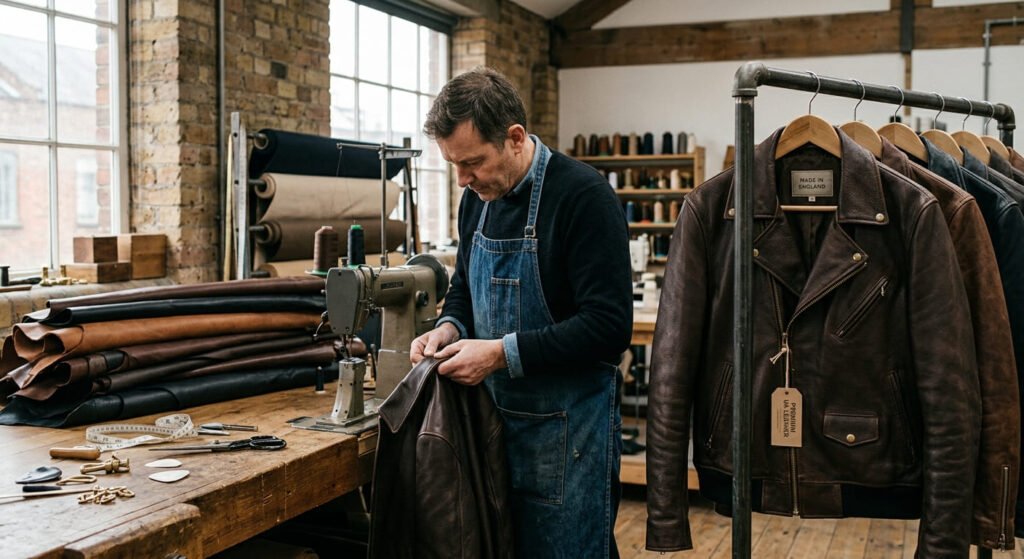
- 2.8. What Makes Leather Cutting Different From Fabric Cutting
- 2.9. Leather Yield and Panel Planning
- 2.10. Specialist Skills and Equipment Required
- 2.11. Needle Holes Are Permanent
- 2.12. Hardware Can Make or Break a Premium Jacket
- 2.13. Leather Jacket Lining
- 2.14. The Walsall Leather Heritage
- 2.15. MOQ and Lead Times for UK Leather Jacket Production
- 2.16. Cost of UK Leather Jacket Manufacturing
- 2.17. UK vs Offshore Leather Production
- 2.18. How to Brief a UK Leather Garment Manufacturer
- 2.19. Common Mistakes When Commissioning Leather Clothing
- 2.19.1. 1. Choosing Leather From a Photograph
- 2.19.2. 2. Ignoring Natural Variation
- 2.19.3. 3. Using a General Jacket Factory
- 2.19.4. 4. Choosing Hardware Too Late
- 2.19.5. 5. Treating Vegan Leather Like Natural Leather
- 2.19.6. 6. Ignoring Lining Ease
- 2.19.7. 7. Making Too Many Sample Corrections in the Same Leather
- 2.20. How Silk Routes Supports Leather Garment Brands
- 2.21. FAQ
- 2.21.1. What should I look for in a UK leather jacket manufacturer?
- 2.21.2. What leather is best for a premium jacket?
- 2.21.3. Can UK manufacturers make vegan leather jackets?
- 2.21.4. Why do leather jackets cost more to manufacture than fabric jackets?
- 2.21.5. Can a small brand manufacture bespoke leather jackets in the UK?
- 2.22. Premium Leather Starts Before the First Stitch
Leather does not forgive bad cutting.
With ordinary woven fabric, a small cutting or stitching error can sometimes be corrected. Leather is different. Every needle hole remains. Every scar, grain variation and cutting decision can show in the finished jacket.
That is why choosing the right leather jacket manufacturers UK is less about finding a factory that can sew a jacket and more about finding one that understands leather as a material.
Premium production depends on hide selection, cutting judgement, specialist machinery, lining, hardware and finishing.
Post Summary
Leather jacket manufacturing requires specialist material knowledge
Hide selection and panel matching affect the final appearance
Lambskin, cowhide and goatskin behave differently
Vegan leather alternatives need their own construction approach
Needle holes in leather are permanent
Hardware and lining quality strongly affect perceived value
MOQ depends on leather availability, colours, components and style complexity
Cost is driven heavily by material yield and labour
Walsall remains historically important to Britain’s leather industry
A manufacturer should show relevant leather-garment experience before sampling
Leather Jacket Manufacturing in the UK — What Remains in 2026
Leather manufacturing has deep roots in Britain.
Today, UK leather production is more specialist than mass-market.
The strongest opportunities tend to be in:
Premium fashion
Bespoke garments
Small-batch production
Heritage-style leather goods
Motorcycle-inspired jackets
Luxury accessories
Sampling and development
The supplied brief asks specifically about what remains of UK leather manufacturing in 2026 and the role of Walsall.
Because current manufacturer activity changes and live verification is unavailable here, this article does not claim a definitive list of currently operating leather factories.
The useful sourcing question is not:
“Is leather still made in the UK?”
It is:
“Which UK workshops still have the skills needed for my exact leather product?”
Types of Leather Garments UK Manufacturers Produce
| Product Type | Main Production Challenge | Manufacturer Capability |
|---|---|---|
| Fashion leather jacket | Panel matching + silhouette | Garment pattern + leather cutting |
| Biker-style jacket | Hardware + reinforcement | Heavy-duty stitching |
| Leather overshirt | Soft drape | Lightweight leather handling |
| Bomber jacket | Rib + lining integration | Mixed-material construction |
| Bespoke jacket | Individual fit | Pattern adjustment |
| Leather waistcoat | Edge + seam finishing | Precision construction |
| Motorcycle-style garment | Structure + abrasion-focused design | Specialist heavy leather work |
Fashion Leather Jackets
Fashion jackets may use softer leather and cleaner construction.
Typical styles include:
Bomber jackets
Blousons
Cropped jackets
Overshirts
Minimal zip jackets
Tailored leather jackets
Here, visual consistency matters.
Panels should look balanced in:
Grain
Colour
Texture
Finish
Biker and Motorcycle-Inspired Jackets
A fashion biker jacket may include:
Multiple zips
Belt hardware
Epaulettes
Snap fasteners
Reinforced seams
Heavier leather
Hardware alignment becomes important.
One zip sitting slightly off can make an otherwise expensive jacket look poorly made.
Bespoke Leather Garments
Bespoke production puts more emphasis on individual fit.
The manufacturer may adjust:
Shoulder
Chest
Sleeve
Armhole
Waist
Garment length
Leather fitting needs care because repeated needle work can damage the material.
Genuine vs Vegan Leather — Options Available in the UK
Leather and leather alternatives should not be treated as interchangeable.
| Material | Typical Character | Main Production Consideration |
|---|---|---|
| Genuine leather | Natural grain variation | Hide grading + panel matching |
| Lambskin | Soft and lightweight | Delicate handling |
| Cowhide | Stronger and heavier | Cutting + machine capability |
| Goatskin | Durable with distinctive grain | Grain matching |
| PU-based alternative | More uniform surface | Heat + needle behaviour |
| Bio-based alternative | Depends on construction | Supplier specification |
Genuine Leather
Natural leather varies.
One hide may contain:
Grain variation
Colour variation
Veins
Scars
Growth marks
Those are part of the material.
The cutter must decide which areas belong on visible panels and which should be avoided.
Vegan Leather Alternatives
“Vegan leather” describes a broad category, not one material.
Alternatives may use synthetic or partially bio-based structures.
They can behave differently from natural leather when:
Cut
Folded
Stitched
Heated
Pressed
The manufacturer should follow the material supplier’s handling specification rather than assume standard leather techniques will work.
Which Leather Jacket Production Route Fits Your Brand?
Interactive sourcing guide for fashion jackets, biker styles, bespoke garments and leather alternatives.
Three Main Leather Production Routes
Best for fashion jackets, soft lambskin, overshirts and refined silhouettes.
Best for structured biker styles, heavier hides, reinforced seams and substantial hardware.
Best for individual fit, small-batch development and premium customisation.
Interactive Leather Route Finder
Find the manufacturer specialism that best matches your jacket
Material & Manufacturer Fit
| Material / Style | Best-Fit Capability | Critical Control | Common Risk |
|---|---|---|---|
| Lambskin fashion jacket | Premium leather garment specialist | Panel matching + soft handling | Visible grain mismatch |
| Cowhide biker jacket | Heavy leather specialist | Machine capacity + reinforcement | Bulk at seams |
| Goatskin jacket | Leather garment specialist | Grain + panel balance | Surface inconsistency |
| Vegan alternative | Specialist outerwear / leather-alternative handler | Material-specific sewing behaviour | Heat or needle damage |
| Bespoke leather | Small workshop / bespoke specialist | Pattern + fitting control | Too many irreversible alterations |
Four Premium Production Risk Zones
Premium Leather Jacket Production Flow
Pre-Production Timeline
All route suggestions are qualitative sourcing guidance and do not represent universal factory classifications.
Leather Types: Lambskin, Cowhide and Goatskin
Lambskin
Lambskin is often chosen for premium fashion jackets because it can feel soft and supple.
It works well where drape and comfort matter.
The downside is that softer skins need careful handling.
Cowhide
Cowhide is generally associated with more substantial leather garments.
It can suit:
Biker jackets
Structured jackets
Workwear-inspired styles
The sewing setup needs to match the material thickness.
Goatskin
Goatskin has a distinctive grain and can offer a useful balance between durability and flexibility.
It still needs careful panel matching.
Silk Routes Manufacturing Team: Do not choose leather by name alone. Approve the actual hand feel, thickness, grain and finish before cutting the production batch.
What Makes Leather Cutting Different From Fabric Cutting
Fabric is normally supplied as a relatively consistent roll.
Leather is supplied as hides or skins.
That changes cutting completely.
A cutter must work around:
Natural marks
Edge areas
Thickness variation
Grain direction
Colour differences
Defects
Two panels may have the same pattern shape but still look wrong together if the grain differs too much.
This makes cutting judgement a major part of premium leather production.
Leather Yield and Panel Planning
Leather yield is less predictable than roll fabric.
The entire surface of a hide may not be usable for a visible garment panel.
A jacket with large uninterrupted pieces can therefore consume material inefficiently.
Examples include:
Large back panels
Long sleeves
Wide front panels
Panel design can influence yield.
That does not mean a premium jacket should be chopped into unnecessary sections just to save material.
The design and material need to be balanced.
Specialist Skills and Equipment Required
Leather garment manufacturing usually needs different handling from normal apparel production.
| Capability | Why It Matters |
|---|---|
| Leather cutting | Controls yield and appearance |
| Specialist needles | Reduces damage |
| Appropriate sewing machines | Handles thickness and feeding |
| Edge finishing | Improves appearance |
| Hardware setting | Secures snaps and rivets |
| Zip installation | Critical for alignment |
| Lining construction | Controls comfort |
| Leather pressing/finishing | Requires material awareness |
Operator skill matters more than simply owning the machinery.
A factory can have the right machine and still produce poor leather garments if the team lacks experience.
Needle Holes Are Permanent
Leather does not heal in the way fabric can.
If a seam is unpicked, the holes remain.
This means the production team needs to get:
Seam position
Stitch length
Zip alignment
Pocket placement
Hardware placement
right early.
Repeated corrections can leave visible damage.
Hardware Can Make or Break a Premium Jacket
Premium leather jackets often use more hardware than ordinary garments.
This may include:
Main zip
Pocket zips
Snaps
Buckles
Rivets
D-rings
Hardware quality affects:
Weight
Feel
Finish
Durability
Perceived value
Cheap hardware on expensive leather is immediately noticeable.
The same applies to colour.
Zip teeth, pullers and snaps should work together visually.
Leather Jacket Lining
The lining is easy to overlook because it sits inside the garment.
It still affects comfort and durability.
Check:
Lining composition
Sleeve lining
Ease
Hem attachment
Pocket bag construction
Colour
Static behaviour
A lining that is too tight can restrict the jacket even if the leather shell fits correctly.
The Walsall Leather Heritage
Walsall has a long-standing association with Britain’s leather trade, particularly saddlery and leather goods.
That history matters because specialist leather skills often grow around established industrial clusters.
For a fashion brand, however, heritage alone is not enough.
The relevant question is whether a supplier currently has the skills and machinery for:
Leather garments
Apparel pattern cutting
Jacket construction
Lining
Fashion hardware
The brief specifically includes Walsall leather industry as a core entity.
Current operating businesses should be checked individually before a sourcing decision.
MOQ and Lead Times for UK Leather Jacket Production
There is no single useful MOQ for leather jackets.
The minimum may depend on:
Hide availability
Leather colour
Finish
Jacket style
Hardware
Lining
Size range
Sampling
Supplier minimums
| Production Setup | Relative MOQ Pressure |
|---|---|
| Stock leather + standard hardware | Lower |
| Custom colour | Higher |
| Custom hardware | Higher |
| Multiple jacket colours | Higher |
| Several styles | Higher |
| Bespoke development | Different production model |
A low garment MOQ can still be difficult if the leather tannery or hardware supplier has a larger minimum.
That is why material MOQ and garment MOQ should be discussed separately.
The brief requests MOQ and lead-time statistics, but fixed 2026 numbers are not included without a verified current source.
Cost of UK Leather Jacket Manufacturing
Leather jackets are material-heavy products.
Cost is affected by:
| Cost Driver | Why It Matters |
|---|---|
| Leather type | Material value differs |
| Hide quality | Premium grading costs more |
| Usable yield | Not every area can be cut |
| Panel size | Large panels reduce flexibility |
| Hardware | Premium zips/snaps add cost |
| Lining | Adds material + labour |
| Pocket count | Adds operations |
| Construction detail | More sewing time |
| Sampling | Leather development is costly |
| Finishing | Specialist handling |
The cheapest leather is not always the cheapest jacket.
Poorer material can create:
Lower cutting yield
More rejection
More panel matching problems
That can offset the initial saving.
UK vs Offshore Leather Production
A UK production route may make sense when the brand values:
Smaller development runs
Faster communication
Closer sample control
Premium positioning
Bespoke work
Offshore production may make more sense where:
Volumes are high
Specialist leather supply chains already exist
Unit cost is the dominant factor
Neither route is automatically better.
The decision depends on the product and business model.
How to Brief a UK Leather Garment Manufacturer
A leather jacket brief should include more than a sketch.
Specify:
Jacket type
Fit
Size range
Leather type
Preferred thickness
Finish
Colour
Grain expectation
Panel construction
Zip type
Zip colour
Snaps
Buckles
Pockets
Lining
Labels
Stitching
Edge finish
Quantity
Packaging
Also provide close-up references for:
Collar
Cuffs
Pocket opening
Zip construction
Hem
Hardware
Brands developing premium jackets can review our clothing manufacturing services before commissioning samples.
Common Mistakes When Commissioning Leather Clothing
1. Choosing Leather From a Photograph
Why it happens: It is convenient.
Why it fails: Photographs do not show hand feel, thickness or grain properly.
Fix: Approve a physical material swatch or sample.
2. Ignoring Natural Variation
Why it happens: The buyer expects roll-fabric uniformity.
Why it fails: Leather naturally varies.
Fix: Define acceptable variation before cutting.
3. Using a General Jacket Factory
Why it happens: The factory already makes outerwear.
Why it fails: Leather cutting and sewing need different skills.
Fix: Ask for comparable leather garments.
4. Choosing Hardware Too Late
Why it happens: Zips and snaps feel secondary.
Why it fails: Hardware affects pattern, weight and appearance.
Fix: Finalise hardware during development.
5. Treating Vegan Leather Like Natural Leather
Why it happens: Both look similar.
Why it fails: Construction behaviour can differ.
Fix: Follow the specific material’s handling requirements.
6. Ignoring Lining Ease
Why it happens: Only the shell is fit-tested.
Why it fails: A tight lining can restrict movement.
Fix: Check shell and lining together.
7. Making Too Many Sample Corrections in the Same Leather
Why it happens: Brands want to save sampling material.
Why it fails: Previous needle holes remain visible.
Fix: Use a fresh sample when major construction changes are required.
How Silk Routes Supports Leather Garment Brands
Leather garment development needs tighter material control than standard apparel.
Silk Routes can help brands organise:
Leather requirements
Material alternatives
Hardware
Lining
Pattern development
Sampling
Production specifications
Quality-control points
The objective is to lock the material and construction before expensive bulk cutting begins.
You can learn more about our manufacturing background on the About Silk Routes page.
FAQ
No Google People Also Ask results were available for this query, so these are buyer FAQs rather than claimed PAA questions.
What should I look for in a UK leather jacket manufacturer?
Look for proven leather-garment experience rather than general outerwear experience.
Check at least 5 areas: leather cutting, specialist sewing, panel matching, hardware installation and lining construction.
What leather is best for a premium jacket?
It depends on the desired structure and hand feel.
Compare at least 4 properties: softness, thickness, grain and intended garment use before choosing the leather.
Can UK manufacturers make vegan leather jackets?
Some leather-garment or specialist outerwear manufacturers may be able to work with leather alternatives.
Before sampling, check at least 3 issues: material thickness, sewing behaviour and finishing requirements.
Why do leather jackets cost more to manufacture than fabric jackets?
Material yield and specialist labour are major reasons.
Leather production typically adds at least 4 cost areas beyond normal outerwear: hide grading, selective cutting, specialist sewing and hardware handling.
Can a small brand manufacture bespoke leather jackets in the UK?
Potentially, yes, particularly through specialist workshops or small-batch producers.
The practical starting point is to define 4 things clearly: leather, jacket construction, size range and expected quantity.
Premium Leather Starts Before the First Stitch
A premium leather jacket is won or lost before most of the sewing begins.
Hide selection, panel placement, cutting, hardware and lining decisions set the standard.
The manufacturer then needs the skill to preserve that quality through construction.
When assessing a leather garment manufacturer UK, look past the finished photograph.
Ask how the leather was selected.
Ask how panels were matched.
Ask how hardware was installed.
Ask how the material was handled during sampling.
Those answers reveal whether you are dealing with a genuine leather specialist or simply a factory willing to try.
For wider specialist production guidance, see our Specialist Clothing Manufacturers UK guide.