
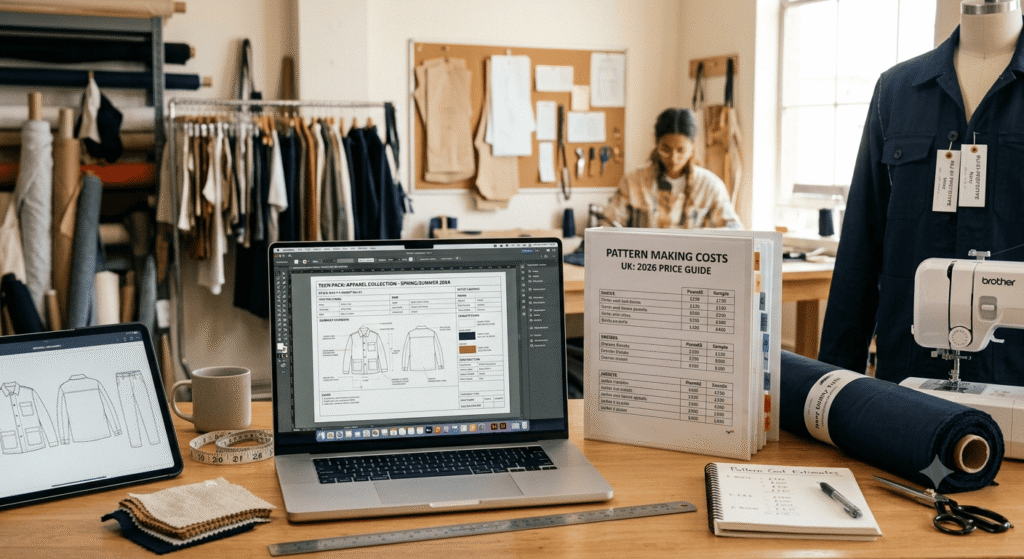
A simple T-shirt pattern and a tailored jacket pattern can differ in price by more than 500% — and most first-time brand owners have no idea which side of that gap their design sits on.
This guide breaks down pattern making costs UK brands can expect in 2026, what drives the price up or down, and where the real savings are (and aren’t).
In this article:
- What pattern making actually involves and why it’s priced the way it is
- Cost breakdown by garment complexity, from T-shirts to tailored jackets
- Freelance pattern cutter vs agency pricing
- Hand-cut vs CAD digital pattern making cost differences
- What grading adds to your total spend
- The mistakes that push pattern costs higher than they need to be
Contents
- 1. What Does Pattern Making Involve in Clothing Production?
- 2. Pattern Making Cost Breakdown in the UK — 2026 Figures
- 3. Freelance Pattern Cutter vs Pattern Making Agency — Cost Comparison
- 4. Hand-Cut vs CAD Digital Pattern Making — Price and Quality Difference
- 5. Block to Graded Pattern — What Grading Adds to the Cost
- 6. How to Find a Pattern Maker in the UK
- 7. Questions to Ask a Pattern Maker Before Committing
- 8. Common Pattern Making Mistakes That Cost Brands Money
- 9. FAQ
What Does Pattern Making Involve in Clothing Production?
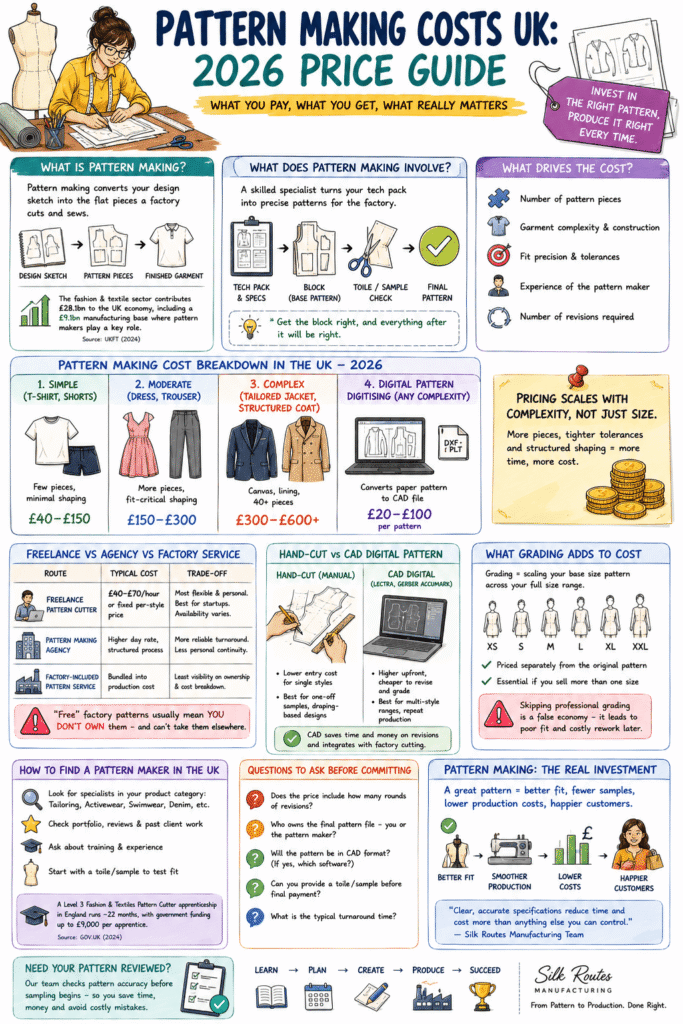
Pattern making converts your design sketch into the flat pieces a factory cuts and sews. It’s a skilled, specialist job — the fashion and textile sector as a whole contributes £28.1bn to the UK economy, including a £9.1bn manufacturing base that pattern makers sit directly inside (UKFT).
A pattern maker works from your tech pack’s flat sketch and measurement chart to build a first pattern, called a block. Get that stage wrong, and every sample after it inherits the error.
Pattern Making Cost Breakdown in the UK — 2026 Figures
Pricing scales with complexity, not just size. A garment with more pattern pieces, tighter tolerances, or structured shaping takes longer to draft and costs more.
| Garment Complexity | Typical UK Price Range | What Drives the Cost |
|---|---|---|
| Simple (T-shirt, shorts) | £40–£150 | Few pattern pieces, minimal shaping |
| Moderate (dress, trouser) | £150–£300 | More pieces, fit-critical shaping |
| Complex (tailored jacket, structured coat) | £300–£600+ | Canvas, lining, forty-plus pieces |
| Digital pattern digitising (any complexity) | £20–£100 per pattern | Converts paper pattern to CAD file |
Simple Garment Pattern (T-shirt, Shorts)
A basic T-shirt or shorts pattern typically has few pieces and minimal shaping, which keeps drafting time — and cost — low. Most pattern cutters can complete one in a few hours including a first toile check.
Moderate Complexity (Dress, Trouser)
Dresses and trousers introduce darts, waistbands, and fit-critical curves that take longer to get right. Expect at least one round of pattern correction after the first toile.
Complex Garment (Tailored Jacket, Structured Coat)
A tailored jacket can involve forty or more pattern pieces once lining, canvassing, and interfacing are accounted for. This complexity is why tailoring specialists charge at the top of the market range.
Freelance Pattern Cutter vs Pattern Making Agency — Cost Comparison
| Route | Typical Cost | Trade-Off |
|---|---|---|
| Freelance pattern cutter | £40–£70/hour or fixed per-style price | Most flexible, best for startups, but availability varies |
| Pattern making agency | Higher day rate, structured process | More reliable turnaround, less personal continuity |
| Factory-included pattern service | Bundled into production cost | Least visibility on pattern ownership and cost breakdown |
A factory that makes your pattern “for free” as part of production usually means you don’t own that pattern — and can’t take it elsewhere if the relationship sours. That trade-off matters more than the headline saving.
Hand-Cut vs CAD Digital Pattern Making — Price and Quality Difference
| Method | Cost Impact | Best For |
|---|---|---|
| Hand-cut (manual) | Lower entry cost for single styles | One-off samples, draping-based designs |
| CAD digital (Lectra, Gerber AccuMark) | Higher upfront, cheaper to revise and grade | Multi-style ranges, repeat production |
Digital pattern files integrate directly with most UK factories’ cutting equipment, and revisions don’t require redrawing from scratch. If you’re planning more than two or three styles, CAD pays for itself through easier grading and faster revisions alone.
Block to Graded Pattern — What Grading Adds to the Cost
Grading takes your approved sample-size pattern and scales it across your full size range. It’s priced separately from the original pattern, and it’s not optional if you’re selling more than one size.
Skipping professional grading to save money is one of the most common false economies in early-stage production — an incorrectly graded size range means refitting every size individually later, at a much higher total cost.
How to Find a Pattern Maker in the UK
“Clear, accurate specifications reduce time and cost more than anything else you can control as a brand.” — Silk Routes Manufacturing Team
Look for a pattern cutter who specialises in your product category — tailoring, activewear, and swimwear all require different technical knowledge, and a generalist will take longer on unfamiliar construction.
A Level 3 Fashion and Textiles Pattern Cutter apprenticeship in England runs around 22 months, with government funding available up to £9,000 per apprentice (GOV.UK) — a useful signal of the formal training investment behind a properly qualified pattern cutter.
If you’d rather have your pattern reviewed as part of a full production quote, our clothing manufacturing services team checks pattern accuracy before sampling begins.
Questions to Ask a Pattern Maker Before Committing
Ask whether the quoted price includes one round of revisions, since most freelancers include one set of alterations before charging extra. Confirm in writing.
Ask who owns the finished pattern file — you, or the pattern maker. This matters if you switch manufacturers later and need to bring your pattern with you.
Ask whether they work in your specific product category. A pattern cutter skilled in eveningwear won’t necessarily be efficient drafting technical outerwear.
Common Pattern Making Mistakes That Cost Brands Money
Sending vague or incomplete specifications. Insufficient information leads to trial and error, which the pattern cutter bills for. Fix: provide a complete tech pack with measurements and construction detail before requesting a quote.
Choosing the cheapest quote without checking specialism. A low price from a generalist can cost more in revisions than a specialist’s higher quote. Fix: check portfolio examples in your specific product category first.
Skipping professional grading to cut costs. Poor grading forces a refit of every size later, at greater expense than doing it properly the first time. Fix: budget for grading as a separate, non-negotiable line item.
Not accounting for fabric efficiency in the pattern layout. A pattern that wastes fabric on the cutting table adds cost to every unit you produce, not just the sample. Fabric waste reduction is a stated priority across the UK textile sector under WRAP’s UK Textiles Pact, and layout efficiency is one of the few places a brand can influence it directly through pattern design.
Constantly changing the design after the pattern is finalised. Each revision after sign-off usually incurs additional cost and delay. Fix: lock the design before commissioning the final pattern, not during it.
FAQ
How much does pattern making cost in the UK?
Pattern making in the UK typically ranges from £40 for a simple T-shirt pattern to £600 or more for a complex tailored jacket, depending on complexity and the pattern cutter’s experience. Freelance rates commonly run £40–£70 per hour.
How much does a pattern maker charge per hour?
Most UK freelance pattern cutters charge between £40 and £70 per hour, with senior tailoring specialists at the higher end. Many prefer a fixed per-style price over hourly billing for straightforward garments.
Is CAD pattern making more expensive than hand cutting?
CAD digital pattern making usually has a higher upfront cost than hand-cutting a single pattern, but it becomes cheaper over multiple styles because revisions and grading are faster. For a one-off sample, hand-cutting is often the more economical choice.
How much does pattern grading cost?
Grading is priced separately from the original pattern and depends on how many sizes are in your range. It’s a distinct cost line, not something bundled automatically into the pattern price.
Can I make my own pattern to save money?
You can draft a basic pattern yourself for a simple style, but incomplete technical knowledge often leads to fit problems that cost more to correct later. For anything beyond the simplest garments, a professional pattern cutter’s experience usually pays for itself in fewer sampling rounds.