
Two brands can order the exact same garment, in the exact same fabric, from two different factories — and end up with a 30% difference in landed cost. The gap almost always comes down to what’s actually included in the number they were quoted, not the quality of the garment itself.
This guide breaks down production costing fabric to finished garment UK brands need to understand — every line item, in order, from raw fabric to a garment sitting in your warehouse.
In this article:
- What actually goes into the cost of producing a finished garment
- The full costing structure, line by line
- Pre-production costs that get amortised into your unit price
- Landed cost — everything added after the factory gate
- How MOQ affects each cost component
- How to build your own costing sheet
- The mistakes that quietly destroy margins
Contents
- 1. Production Costing: Fabric to Finished Garment
- 1.1. The Garment Costing Structure
- 1.2. Pre-Production Cost Calculator
- 1.3. Landed Cost — What's Added After the Factory Gate
- 1.4. Common Costing Mistakes
- 1.5. The Full Garment Costing Structure — Line by Line
- 1.6. Pre-Production Costs That Get Amortised Into Unit Price
- 1.7. Landed Cost — What Gets Added After the Factory Gate
- 1.8. How MOQ Affects Each Cost Component
- 1.9. Building Your Own Costing Sheet — Step by Step
- 1.10. Common Costing Mistakes That Destroy Margins
- 1.11. The Silk Routes Approach to Transparent Costing
- 1.12. FAQ
What Does It Actually Cost to Produce a Finished Garment in the UK?
A finished garment’s cost is built from five core components: fabric, CMT (Cut, Make, Trim) labour, trims and labels, packaging, and manufacturer overhead and margin. On top of that sits landed cost — duty, VAT, and freight — which only applies once the garment leaves the factory.
Fabric typically represents the single largest cost component for most garments, though the exact split shifts depending on complexity — a heavily trimmed, multi-panel garment shifts more cost into labour and components.
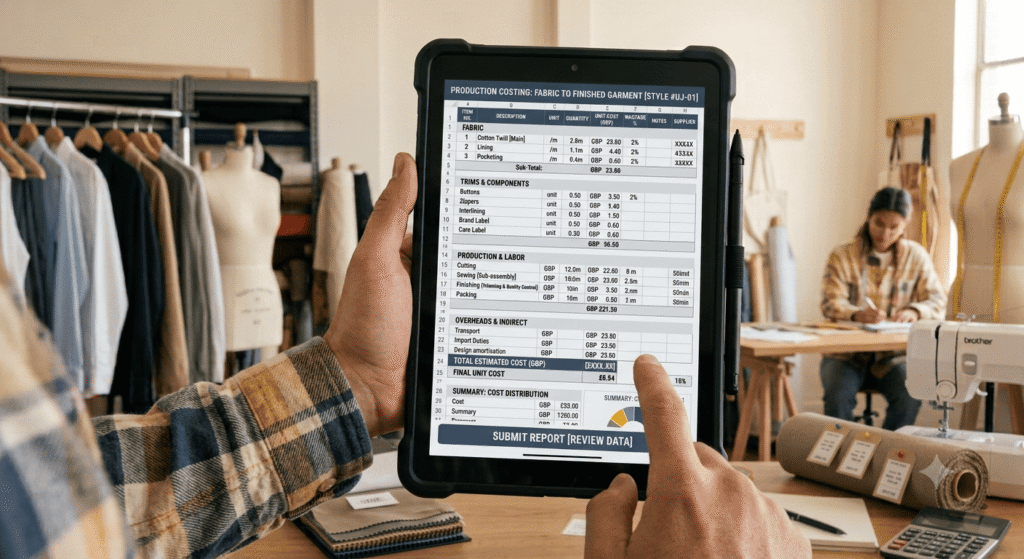
Production Costing: Fabric to Finished Garment
An interactive breakdown of every cost line from raw fabric to a delivered garment — including a live pre-production amortisation calculator.
The Garment Costing Structure
Relative weight of each cost line in a typical garment — fabric usually carries the most weight, packaging the least.
Pre-Production Cost Calculator
Drag the slider to see how a fixed £300 pattern-making cost spreads across different order quantities — the core reason unit cost improves at volume.
Landed Cost — What's Added After the Factory Gate
For imports from countries without a UK trade agreement, this is what typically stacks on top of the factory price.
*Typical UK Global Tariff rate for clothing from non-preferential countries (UKFT). Goods from FTA countries may qualify for reduced or zero duty. VAT is charged on the customs value plus duty, not on the factory price alone.
Common Costing Mistakes
Want your costing sheet checked against a real production quote?
Talk to Silk Routes
The Full Garment Costing Structure — Line by Line
| Cost Component | What It Covers | Typically Affected By |
|---|---|---|
| Fabric Cost | Raw material, per metre or per kg | Fibre type, weight, sourcing volume |
| CMT Labour | Cutting, sewing, trimming | Garment complexity, factory location |
| Trims & Labels | Zips, buttons, care labels, hangtags | Component quality, supplier |
| Packaging & Finishing | Poly bags, cartons, pressing | Packaging spec, order volume |
| Overhead Recovery & Margin | Factory overhead plus profit margin | Factory pricing model, order size |
Fabric Cost
Fabric is priced per metre or per kilogram depending on the fabric type, and cost varies enormously by fibre content, weight, and finish. Fabric consumption per garment — how many metres one unit actually uses, including wastage — matters as much as the price per metre itself.
CMT (Cut, Make, Trim) Labour
CMT covers the actual cutting, sewing, and finishing labour, and it’s priced per garment based on how many operations the construction requires. A simple T-shirt might need a handful of sewing operations; a lined jacket can need dozens, and CMT cost scales accordingly.
Trims and Labels
Every zip, button, care label, and hangtag adds a small cost per unit that compounds quickly across a full Bill of Materials. Brands often underestimate this line because each individual trim looks cheap in isolation.
Packaging and Finishing
Poly bagging, folding, pressing, and any special finishing touches are usually priced per unit and scale with order volume. Custom packaging — branded poly bags or specific hangtag printing — adds cost that generic packaging avoids.
Overhead Recovery and Manufacturer Margin
Factories build their overhead — rent, utilities, equipment, admin staff — into their unit pricing, alongside their margin. This is the line most brands never see broken out separately, since it’s usually folded into the overall CMT or unit quote rather than itemised.
Pre-Production Costs That Get Amortised Into Unit Price
| Cost | How It’s Typically Handled |
|---|---|
| Pattern making | Often a flat fee, sometimes rolled into first order’s unit cost |
| Sample rounds | Charged separately, occasionally credited against bulk order |
| Grading | Priced per size, added once across the full order |
| Digitising (CAD) | One-off cost, sometimes waived for larger repeat orders |
These costs exist regardless of your order quantity, which is exactly why unit price improves so much with larger orders — a £300 pattern cost spread across 100 units adds £3 per unit; spread across 1,000 units, it adds 30p.
Landed Cost — What Gets Added After the Factory Gate
| Addition | Typical Rate | Notes |
|---|---|---|
| Import Duty | Around 12% for clothing under the UK Global Tariff | Applies to non-preferential origin countries; FTA countries may qualify for reduced or zero duty |
| Import VAT | 20% standard rate | Charged on customs value plus duty |
| Freight | Varies by volume and method | Sea freight cheaper per unit; air freight faster but costlier |
| Customs Broker Fees | Varies | Often a flat fee per shipment |
Clothing imported from countries without a UK trade agreement typically attracts a duty rate of around 12% under the UK Global Tariff, though the exact rate depends on the specific commodity code (UKFT). Origin matters significantly here — goods qualifying under a free trade agreement can access reduced or zero duty, which is why country of manufacture affects landed cost as much as factory pricing does.
How MOQ Affects Each Cost Component
Larger order quantities improve unit cost across nearly every line — fabric gets cheaper per metre at volume, CMT labour cost per unit often drops slightly with longer production runs, and pre-production costs amortise across more units.
Trims and packaging costs tend to be the least MOQ-sensitive, since per-unit component pricing often stays similar regardless of order size, only dropping meaningfully at very high volumes. Understanding which costs actually improve with volume — and which don’t — helps set realistic expectations when negotiating MOQ with a factory.
Building Your Own Costing Sheet — Step by Step
Start with fabric cost per unit, calculated from consumption (metres per garment) multiplied by price per metre, including a reasonable wastage allowance. This single figure is worth getting right first, since it usually carries the most weight in the final number.
Add CMT labour cost as quoted by your factory, then layer in trims, labels, and packaging as a per-unit total from your Bill of Materials. Keep pre-production costs as a separate line, amortised across your order quantity, rather than folding them silently into unit cost.
Finally, add landed cost — duty, VAT, and freight — only if you’re importing; UK-manufactured garments skip this stage entirely. If you want your costing checked against an actual production quote, our clothing manufacturing services team can walk through a real costing breakdown with you.
Common Costing Mistakes That Destroy Margins
Forgetting to amortise pre-production costs. Pattern making, sampling, and grading costs quietly disappear from many first-time costing sheets. Fix: always include these as a distinct line, spread across your order quantity.
Ignoring fabric wastage in consumption calculations. Real-world cutting always produces some wastage, and pricing based on theoretical fabric use alone underestimates true cost. Fix: build a realistic wastage percentage into your fabric consumption figure.
Not accounting for landed cost on imported goods. A factory-gate unit price looks attractive until duty, VAT, and freight are added on top. Fix: always calculate landed cost, not factory price, when comparing manufacturers in different countries.
Assuming trims are a negligible cost. Individually cheap components add up fast across a full BOM, especially on garments with multiple trims. Fix: cost every single trim line item, not just an estimated “small addition.”
Comparing quotes without checking what’s included. One factory’s quote might include packaging and labels; another’s might not. Fix: request an itemised cost breakdown from every factory you’re comparing, not just a single unit price.
The Silk Routes Approach to Transparent Costing
We break every quote down by line item — fabric, CMT, trims, packaging, and overhead — rather than presenting a single bundled unit price. That transparency makes it possible to see exactly where your budget is going, and where there’s room to adjust.
If you’re building your first costing sheet and want it reviewed against real production figures, get in touch through our clothing manufacturing services page.
FAQ
What is included in the cost of producing a garment?
Garment production cost typically includes fabric, CMT (Cut, Make, Trim) labour, trims and labels, packaging, and manufacturer overhead and margin. If the garment is imported, landed cost — duty, VAT, and freight — is added on top of the factory-gate price.
What is landed cost in clothing production?
Landed cost is the total cost of a garment once it arrives at your warehouse, including the factory price plus import duty, import VAT, freight, and any customs broker fees. It’s the true cost figure to use for margin calculations, not just the factory-quoted unit price.
How much import duty applies to clothing imported into the UK?
Clothing imported from countries without a UK trade agreement typically attracts a duty rate of around 12% under the UK Global Tariff. Goods originating from countries with a UK free trade agreement may qualify for reduced or zero duty, depending on rules of origin.
Why does MOQ affect my per-unit garment cost?
Larger order quantities spread fixed pre-production costs like pattern making and grading across more units, and often unlock better fabric and CMT pricing too. Some costs, like trims and packaging, are less sensitive to volume and may not drop significantly until very high order quantities.
How do I build a costing sheet for my clothing brand?
Start with fabric cost per unit based on consumption and wastage, then add CMT labour, trims, labels, and packaging as a full per-unit total. Include amortised pre-production costs as a separate line, and add landed cost on top only if you’re importing from overseas.