
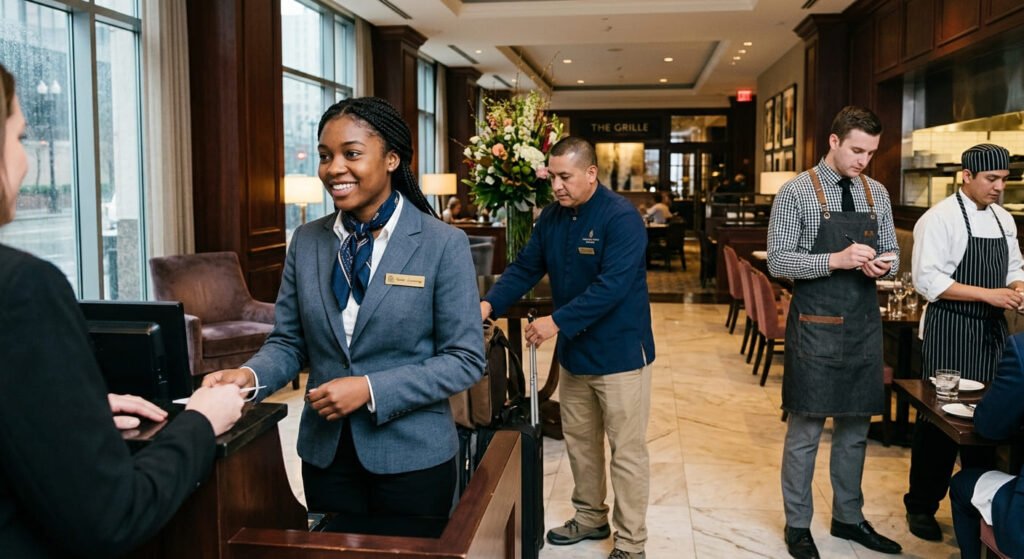
A hotel group can easily make one expensive mistake: ordering the same uniform specification for reception, housekeeping, restaurant, bar and kitchen teams.
Those roles look connected on an organisation chart. They place very different demands on clothing.
For hospitality uniform manufacturers UK, the job is therefore not simply producing shirts, trousers and aprons. The manufacturer has to balance appearance, movement, wash performance, branding, replacement stock and the working environment of each team.
Contents
- 1. Post Summary
- 2. Why Hospitality Uniforms Need a Specialist Manufacturer
- 3. Front-of-House vs Back-of-House Uniform Requirements
- 4. Hotel Uniform Specifications — What Procurement Teams Need
- 5. Restaurant and Bar Staff Uniform Requirements
- 6. Custom Branding — Embroidery, Print and Badge Options
- 7. MOQ and Lead Times for Hospitality Uniform Orders
- 8. Cost Guide for Hospitality Uniform Manufacturing UK
- 9. How to Write a Hospitality Uniform Brief
- 10. Common Mistakes When Sourcing Hospitality Uniforms
- 10.1. 1. Buying One Garment Specification for Every Department
- 10.2. 2. Choosing Fabric Before Confirming the Cleaning Method
- 10.3. 3. Adding Large Embroidery to Lightweight Shirts
- 10.4. 4. Ignoring Staff Movement During Fit Approval
- 10.5. 5. Forgetting Replacement Stock
- 10.6. 6. Creating Too Many Small Variations
- 11. How Silk Routes Supports Hospitality Clients
- 12. FAQ
- 13. Building a Hospitality Uniform Programme That Can Be Reordered
Post Summary
Front-of-house and back-of-house garments need different specifications
Hotel reception clothing should prioritise presentation and repeatability
Housekeeping uniforms need movement, durability and practical pocket placement
Chef garments need heat-aware fabric choices and frequent-wash performance
Embroidery suits many hospitality logos, but not every garment
MOQ should be planned by style, colour and size rather than total headcount alone
Reorder planning matters as much as the first production run
A detailed uniform brief reduces sampling changes and production delays
Why Hospitality Uniforms Need a Specialist Manufacturer
Hospitality clothing sits between fashion and workwear. A uniform has to support a brand image while surviving repeated shifts, laundering and staff turnover.
That combination changes how garments should be developed.
A tailored reception jacket may need clean lapels, stable colour matching and concealed branding. A housekeeping tunic needs easier movement, usable pockets and a fabric that remains presentable after repeated cleaning.
Kitchen garments bring another set of demands. Chef jackets, trousers and aprons operate around heat, food, moisture and frequent washing.
Our view is simple: choosing a garment because it looks good in a catalogue is not enough for hospitality.
The working role should determine the specification before colour, logo placement or decorative details are finalised.
Hospitality businesses planning multiple garment types can review our clothing manufacturing services before preparing a production brief.
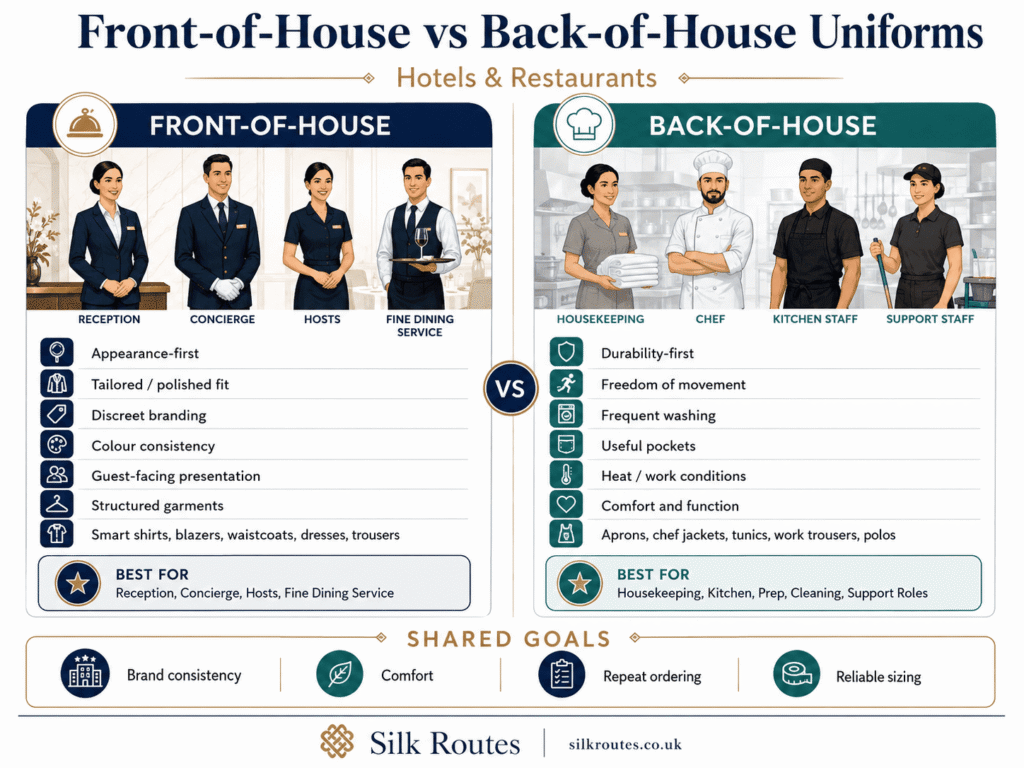
Front-of-House vs Back-of-House Uniform Requirements
The difference is not simply formal versus casual.
Front-of-house clothing is usually seen by guests for long periods. Back-of-house clothing often faces more movement, washing, heat, moisture and physical work.
| Requirement | Front-of-House | Back-of-House |
|---|---|---|
| Main priority | Presentation and brand consistency | Function and durability |
| Typical garments | Shirts, blouses, jackets, waistcoats, dresses, trousers | Tunics, chef jackets, work trousers, aprons, polos |
| Fabric focus | Drape, colour consistency, crease recovery | Washability, movement, abrasion resistance |
| Branding | Often discreet | Can be more functional and visible |
| Fit | Structured or semi-tailored | Movement-focused |
| Replacement cycle | Appearance-driven | Wear-driven |
A common sourcing error is treating both groups as one uniform programme.
That usually creates compromises. Front-of-house garments may become too workwear-like, while back-of-house garments become unnecessarily delicate.
Silk Routes Manufacturing Team: Specify each job role separately before combining garments into one production order. Shared colours are fine; shared construction requirements often are not.
Hotel Uniform Specifications — What Procurement Teams Need
Hotel uniforms usually cover more roles than restaurant-only programmes.
Reception, concierge, housekeeping, porters, spa staff, maintenance teams, food service and management may all require different garments.
Reception and Concierge
Reception clothing carries much of the visual identity of a hotel.
Fabric weight, jacket structure, trouser shape, skirt length, shirt collar design and logo position need to remain consistent across size ranges.
Men’s hospitality uniforms also need proper consideration here. Simply converting a women’s or unisex style into larger sizes can create poor shoulder fit, sleeve balance and trouser proportions.
For mixed teams, separate blocks for men’s, women’s and unisex garments can produce a more reliable fit.
Housekeeping
Housekeeping uniforms work hard.
Staff bend, reach, carry linen, push equipment and move continuously between rooms. A visually sharp garment that restricts shoulder or hip movement will quickly become unpopular.
Pocket placement also matters.
A decorative pocket that cannot hold working items is wasted construction.
The better specification is usually one that combines a professional silhouette with enough ease through the shoulders, waist and hips.
Management Clothing
Management garments may need stronger visual distinction without looking disconnected from the wider team.
This can be achieved through colour variation, jackets, different trims, neckwear or more restrained embroidery rather than creating an entirely separate clothing range.
Our preference is to keep enough shared design language that the hotel still looks like one organisation.
Restaurant and Bar Staff Uniform Requirements
Restaurants need clothing that can survive faster service cycles and more frequent contact with food, drink and cleaning routines.
A fine-dining restaurant may use shirts, waistcoats and tailored trousers. A casual restaurant may favour polos, overshirts, aprons and work trousers.
Bars introduce their own problems.
Sleeves, cuffs and loose decorative features should not interfere with pouring, glass handling or cleaning. Darker fabrics can disguise some marks, but they also show lint and fading more clearly.
Chef Uniforms
Chef garments need a different specification from waiting staff.
Heat, moisture, repeated washing and movement around equipment all influence fabric and construction choices.
A chef jacket should not be selected using the same criteria as a reception shirt.
Breathability, sleeve design, fastening choice and ease of movement usually matter more than decorative detailing.
Aprons
Aprons appear simple but can create problems when specified poorly.
Strap length, bib height, pocket position, fabric thickness and fastening construction all affect daily use.
Heavy fabrics can feel premium but become uncomfortable through long shifts. Very light fabrics may crease easily or lose structure.
Silk Routes Manufacturing Team: Test aprons during a real shift or simulated service movement. Standing still in a fitting room does not reveal strap pressure, pocket position or movement problems.
Custom Branding — Embroidery, Print and Badge Options
Branding should be chosen after the garment and fabric are confirmed.
Embroidery is widely used for hotel and restaurant uniforms because it can create a clean, durable logo application on polos, shirts, jackets, aprons and selected workwear.
It is not automatically the right option everywhere.
Dense embroidery on lightweight fabric can distort the garment. Large logos can also create stiffness.
Hospitality uniform embroidery UK projects therefore need stitch density, backing and placement reviewed during sampling.
Screen printing may work better for larger graphics on casual T-shirts or promotional garments.
Heat-applied transfers can suit names, role identifiers or some smaller-volume applications.
Badges can be useful when roles or names change frequently.
| Branding Method | Best Suited To | Main Consideration |
|---|---|---|
| Embroidery | Polos, shirts, jackets, aprons | Weight and stitch density |
| Screen printing | T-shirts, casual uniforms | Artwork size and print area |
| Heat transfer | Names, numbers, small runs | Application temperature and fabric |
| Woven badge | Role identification, heritage styling | Attachment method |
| Name badge | Hotels and customer-facing teams | Easy staff replacement |
Brand consistency also means controlling thread colour, print colour and logo dimensions.
Approving these details during sampling prevents different departments receiving slightly different versions of the same identity.
MOQ and Lead Times for Hospitality Uniform Orders
MOQ is often misunderstood.
A buyer may say, “We need 300 uniforms,” while the order actually contains five garments, three colours and a wide size range. Manufacturers have to plan production by style and variation, not just by total unit count.
A 300-piece programme can therefore behave like several much smaller orders.
Typical production planning should consider:
| Order Factor | Effect on Production |
|---|---|
| More garment styles | More patterns and sewing operations |
| More colours | More fabric and trim allocation |
| Wider size range | More cutting and stock complexity |
| Custom fabric | Longer material preparation |
| Custom branding | Extra sampling and approval |
| Individual names | Additional decoration handling |
| Repeat stock | Requires continuity planning |
Silk Routes works with production requirements that vary by garment, fabric and construction. For many custom projects, lower-volume production becomes easier when buyers reduce unnecessary colour and style fragmentation.
Lead time should also be measured from approval, not from the first enquiry.
Sampling, fit changes, fabric sourcing, logo approval and pre-production sign-off all happen before bulk sewing begins.
A restaurant opening date should therefore be worked backwards through the complete production process.
Cost Guide for Hospitality Uniform Manufacturing UK
Hospitality uniform pricing cannot be reduced to one reliable per-garment figure without a specification.
A plain polo with a small embroidered chest logo has a very different cost structure from a fully custom reception jacket with lining, branded buttons and bespoke fabric.
The main cost drivers are predictable.
| Cost Driver | Lower Cost Direction | Higher Cost Direction |
|---|---|---|
| Construction | Simple polo or apron | Tailored jacket |
| Fabric | Stock fabric | Custom-developed fabric |
| Branding | Small single logo | Multiple locations or complex artwork |
| Trim | Standard buttons and labels | Bespoke trims |
| Quantity | Larger repeatable run | Small fragmented run |
| Sizing | Standard grading | Multiple custom fit blocks |
| Sampling | Minor changes | Several redevelopment rounds |
The cheapest garment can become expensive if it needs replacing quickly.
Procurement teams should compare cost per wear, consistency of repeat orders and laundering performance rather than purchasing price alone.
Best hospitality uniforms are therefore not necessarily the most expensive products.
They are the garments that fit the role, withstand the intended cleaning routine and can be reordered consistently.
How to Write a Hospitality Uniform Brief
A strong brief removes assumptions.
Start with roles and working conditions rather than asking a manufacturer to “design a smart hotel uniform”.
Include:
Staff role
Garment type
Expected quantity
Men’s, women’s or unisex fit
Required size range
Preferred colour
Fabric preferences
Washing requirements
Logo artwork
Branding position
Pocket requirements
Opening or launch date
Repeat-order expectations
Photographs and reference garments can help, but they should not replace measurements or construction instructions.
For bespoke garments, a proper tech pack is much safer than a collection of screenshots.
The parent guide on specialist clothing manufacturers UK explains how specialist product requirements change the manufacturer selection process.
Common Mistakes When Sourcing Hospitality Uniforms
1. Buying One Garment Specification for Every Department
Why it happens: Procurement wants visual consistency and easier ordering.
Why it fails: Reception, housekeeping, kitchen and bar teams work in different conditions.
Fix: Keep shared branding but specify garments by role.
2. Choosing Fabric Before Confirming the Cleaning Method
Why it happens: Fabric appearance dominates the sampling discussion.
Why it fails: A fabric can look excellent before laundering and perform poorly after repeated cleaning.
Fix: Tell the manufacturer how garments will be washed before fabric approval.
3. Adding Large Embroidery to Lightweight Shirts
Why it happens: Larger branding is assumed to create stronger visibility.
Why it fails: Dense stitching can pull or distort lightweight fabric.
Fix: Test the exact logo size and stitch density on production fabric.
4. Ignoring Staff Movement During Fit Approval
Why it happens: Fittings are carried out standing upright.
Why it fails: Hospitality work involves reaching, carrying, bending and repetitive movement.
Fix: Include movement tests during sample fitting.
5. Forgetting Replacement Stock
Why it happens: The first opening order receives all the attention.
Why it fails: New employees, damaged garments and size changes create immediate replacement demand.
Fix: Plan reorder quantities and fabric continuity before bulk production.
6. Creating Too Many Small Variations
Why it happens: Every department requests its own colour, trim or logo treatment.
Why it fails: Small production lots increase complexity and make repeat ordering harder.
Fix: Standardise fabric and core colours wherever roles allow it.
How Silk Routes Supports Hospitality Clients
Silk Routes approaches hospitality projects as a garment-development problem rather than a logo-printing exercise.
We start by separating working roles, garment requirements and branding needs. Samples can then be checked for fit, construction, decoration and practical use before bulk production.
Our manufacturing background also helps when buyers need several related products under one brand identity, such as reception shirts, restaurant polos, aprons and staff jackets.
You can read more about Silk Routes and our manufacturing approach.
FAQ
What uniforms are commonly used in hotels?
A hotel may need uniforms across more than 5 staff groups, including reception, housekeeping, concierge, restaurant teams and management.
The specification should reflect each role rather than using one garment type throughout the property.
Which fabric is best for restaurant staff uniforms?
There is no single fabric specification that suits every restaurant role.
A practical starting point is to compare at least 3 factors: wash frequency, working temperature and required appearance.
Is embroidery suitable for hospitality uniforms?
Yes, particularly for polos, shirts, jackets and aprons.
Before bulk production, approve at least 1 embroidery sample on the exact garment fabric because lightweight materials can react differently to dense stitching.
How many uniform pieces should each employee receive?
The number depends on shift patterns, laundering and replacement arrangements.
Many buyers calculate requirements around at least 2 working sets per employee, then add contingency stock according to staff turnover and laundry cycles.
Should hotels use different uniforms for men and women?
Separate fit blocks can improve shape and comfort for structured garments.
For a mixed workforce, testing at least 2 fit approaches—gender-specific and unisex—can show which works better for the selected garment.
Building a Hospitality Uniform Programme That Can Be Reordered
A hospitality uniform programme should work beyond opening day.
The real test comes months later when a new employee needs an unusual size, a damaged apron must be replaced or another branch needs matching garments.
That is why specification records, approved colours, logo files, fabric references and size data should be kept from the first production run.
Treat hospitality uniforms as a repeatable supply programme rather than a one-off purchase.
For the wider manufacturing context, see our Specialist Clothing Manufacturers UK guide.