
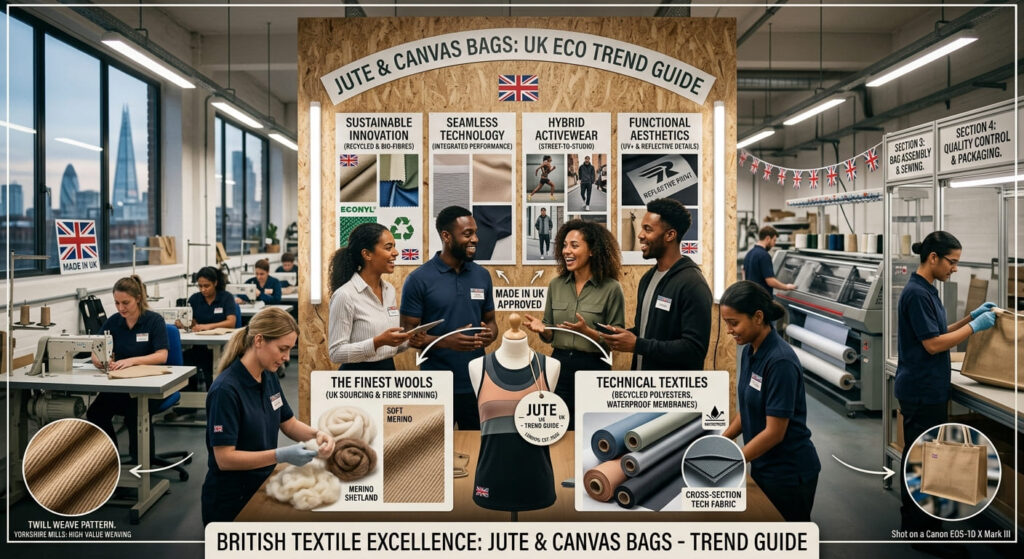
An “eco bag” is not automatically sustainable just because it is made from jute or canvas.
Material matters, but so do durability, construction, printing, sourcing evidence and how long the bag is actually used.
That is why choosing the right jute and canvas bag manufacturers UK should involve more than asking for a natural fibre and adding a green logo.
A good reusable bag needs to survive repeated use.
If the handles fail, the print cracks or the seams open after a short time, the environmental story weakens quickly.
Contents
- 1. Post Summary
- 2. Why UK Brands Are Choosing Jute and Canvas Bags in 2026
- 3. Types of Eco Bags UK Manufacturers Produce
- 4. Jute vs Canvas vs Recycled Materials
- 5. Which Eco Bag Material & Production Route Fits Your Brand?
- 6. Three Common Eco-Bag Routes
- 7. Interactive Eco-Bag Route Finder
- 8. Material & Decoration Fit
- 9. Four Production Checkpoints
- 10. What Makes an Eco Bag Actually Work?
- 11. Fabric Weight and Construction — What Buyers Should Specify
- 12. Handles, Gussets and Reinforcement
- 13. Printing and Branding Options for Eco Bags
- 14. Screen Printing on Canvas and Jute
- 15. Transfer Printing
- 16. Embroidery on Eco Bags
- 17. Screen Print vs Transfer vs Embroidery
- 18. Sustainability Credentials to Look For
- 19. Reuse Matters More Than the Word “Eco”
- 20. MOQ and Lead Times for UK Eco Bag Manufacturing
- 21. Cost Comparison: UK vs Overseas Eco Bag Production
- 22. How to Brief a UK Eco Bag Manufacturer
- 23. What to Ask Before Approving the Sample
- 24. Common Mistakes When Sourcing Eco Bags
- 24.1. 1. Calling a Bag Sustainable Because It Is Jute
- 24.2. 2. Choosing Fabric Weight Too Late
- 24.3. 3. Ignoring Handle Strength
- 24.4. 4. Using Detailed Artwork on Rough Jute
- 24.5. 5. Making Unsupported Recycled Claims
- 24.6. 6. Comparing Quotes Without Matching Specifications
- 24.7. 7. Assuming UK Production Means Every Material Is UK-Made
- 25. How Silk Routes Supports Sustainable Accessories Brands
- 26. FAQ
- 27. Build the Bag Around Its Real Use
Post Summary
Jute, cotton canvas and recycled fabrics all suit different bag types
Material choice alone does not prove sustainability
Bag durability and expected reuse should influence the specification
Fabric weight affects structure, print quality and carrying capacity
Handle attachment is one of the most important construction points
Screen printing often suits larger simple graphics
Embroidery can add durability but also extra material and process complexity
Recycled-content claims should be supported by supplier documentation
MOQ is affected by fabric, colour, print method, handle type and packaging
Sustainability credentials should be checked, not assumed from marketing language
Why UK Brands Are Choosing Jute and Canvas Bags in 2026
Reusable bags have become a familiar part of retail, events, exhibitions, gifting and branded merchandise.
They are used by:
Fashion brands
Retail shops
Museums
Corporate organisations
Universities
Hospitality businesses
Charities
Event organisers
Jute and canvas are popular because they can combine practical carrying capacity with visible branding.
But the term eco bag is broad.
A bag should be assessed through several questions:
What is it made from?
How durable is it?
How often is it likely to be reused?
How was it printed?
Can the material claims be verified?
Is the construction strong enough for the intended load?
The supplied content brief specifically calls for jute, cotton canvas and recycled-material bags, together with branding options, sustainability credentials, MOQ and sourcing considerations.
Types of Eco Bags UK Manufacturers Produce
| Bag Type | Typical Material | Common Use | Main Production Priority |
|---|---|---|---|
| Jute shopper | Natural jute | Retail, gifting | Handle strength |
| Canvas tote | Cotton canvas | Fashion, merchandise | Fabric weight + print |
| Recycled tote | Recycled textile | Branded merchandise | Claim verification |
| Gusset bag | Jute or canvas | Shopping | Base reinforcement |
| Drawstring bag | Cotton or recycled fabric | Events | Cord channel strength |
| Corporate bag | Canvas/jute blend | Promotions | Branding consistency |
Jute Bags
Jute has a coarse, natural appearance that works well for:
Retail shoppers
Gift bags
Bottle bags
Grocery-style bags
Corporate merchandise
The fabric is usually more textured than cotton canvas.
That texture affects printing.
Fine artwork may not reproduce as cleanly as it would on a smoother fabric.
Cotton Canvas Totes
Canvas offers a smoother surface and can suit brands wanting:
Cleaner printing
More fashion-led styling
Stronger structure
Longer handles
Custom pockets
Premium finishing
Canvas weight matters.
A light promotional tote and a structured retail shopper should not use the same construction.
Recycled Material Bags
Recycled fabrics can include:
Recycled cotton
Recycled polyester
Mixed recycled fibres
The important part is not simply using the word “recycled”.
Brands should ask what documentation supports the claim.
Jute vs Canvas vs Recycled Materials
| Material | Main Strength | Main Limitation | Best Fit |
|---|---|---|---|
| Jute | Natural appearance + stiffness | Coarse print surface | Retail and gifting |
| Cotton canvas | Smooth + versatile | Impact depends on sourcing | Fashion and branded totes |
| Recycled cotton | Uses recovered fibre | Strength can vary | Promotional and casual bags |
| Recycled polyester | Durable + stable | Synthetic fibre | Technical/reusable bags |
| Jute/cotton blend | Softer than pure jute | Mixed-fibre end-of-life | Premium eco-style bags |
There is no universal winner.
The right material depends on the intended life of the product.
Related reading: screen printing prices · clothing embroidery techniques
Which Eco Bag Material & Production Route Fits Your Brand?
Interactive sourcing guide for jute, cotton canvas and recycled-material bags.
Three Common Eco-Bag Routes
Best for rustic retail, gifting and natural-look promotional bags.
Best for fashion totes, stronger retail use and cleaner decoration.
Best when verified recycled content is central to the product brief.
Interactive Eco-Bag Route Finder
Choose your product priorities
Material & Decoration Fit
| Material | Best For | Decoration Fit | Main Check |
|---|---|---|---|
| Jute | Natural-look retail and gifting | Bold screen print, simple labels | Print clarity on coarse surface |
| Cotton canvas | Fashion, retail, reusable totes | Screen print, transfer, embroidery | Fabric weight + handle strength |
| Recycled cotton | Casual branded bags | Print and labels | Strength + recycled-content evidence |
| Recycled polyester | Durable technical bags | Transfer, print, labels | Construction + claim documentation |
| Jute/cotton blend | Premium eco-style shopper | Print, embroidery, labels | Mixed-material specification |
Four Production Checkpoints
What Makes an Eco Bag Actually Work?
All recommendations are qualitative sourcing guidance. Sustainability claims should be supported by appropriate supplier or certification documentation.
Fabric Weight and Construction — What Buyers Should Specify
Bag briefs often say:
“Canvas tote, natural colour.”
That is not enough.
Fabric weight changes:
Hand feel
Structure
Durability
Print behaviour
Sewing difficulty
Cost
The buyer should also specify:
Bag dimensions
Handle dimensions
Gusset
Pocket
Lining
Closure
Carrying purpose
A bag intended for brochures has different load requirements from one designed for groceries.
Handles, Gussets and Reinforcement
Handles are one of the highest-stress areas on a reusable bag.
Check:
Handle width
Handle length
Attachment depth
Stitch formation
Reinforcement
Common reinforcement methods include:
Box stitching
Cross stitching
Multiple stitch rows
Gussets
A gusset increases capacity.
It may be added at:
Sides
Base
Both
A larger bag usually needs more attention to load distribution.
Base Construction
For heavier contents, the base becomes important.
A poor base seam can fail even when the fabric itself is strong.
Silk Routes Manufacturing Team: When approving a reusable bag, inspect the handle attachment before admiring the print. Branding is useless if the bag cannot carry its intended load.
Printing and Branding Options for Eco Bags
Different materials suit different decoration techniques.
| Method | Best For | Main Advantage | Main Limitation |
|---|---|---|---|
| Screen printing | Logos, simple artwork | Efficient repeat printing | Limited for complex colour |
| Digital/transfer print | Detailed artwork | Greater design flexibility | Material compatibility |
| Embroidery | Premium logos | Durable + textured | Adds weight and stitching |
| Woven label | Subtle branding | Clean finish | Smaller visual impact |
| Printed label | Internal branding | Useful for care/content info | Not main decoration |
Screen Printing on Canvas and Jute
Screen printing is widely suited to bold graphics and logos.
Canvas usually offers a smoother print surface.
Jute is more textured.
That means small text and very fine lines may reproduce differently.
For jute, artwork should often be simplified.
Transfer Printing
Transfer-based methods can support more detailed designs.
But they need to be checked against:
Fibre type
Surface texture
Heat tolerance
Flexibility
A branding method should be chosen after the material, not before it.
Embroidery on Eco Bags
Embroidery can create a premium effect.
It can work well for:
Corporate bags
Premium retail totes
Uniform-linked accessories
But it also adds:
Thread
Stitch density
Backing
Machine time
That means an embroidered bag is not automatically “more sustainable” simply because it looks durable.
The whole construction still matters.
Screen Print vs Transfer vs Embroidery
| Requirement | Screen Print | Transfer | Embroidery |
|---|---|---|---|
| Simple logo | Strong | Strong | Strong |
| Fine detail | Moderate | Strong | Limited |
| Natural jute | Good for bold artwork | Depends on method | Possible |
| Canvas | Strong | Strong | Strong |
| Premium texture | Low | Low | High |
| Lightweight bag | Strong | Strong | May add bulk |
The best method depends on both design and fabric.
Sustainability Credentials to Look For
Sustainability should be documented.
Useful areas to check include:
Fibre Certification
For cotton products, brands may consider certification systems such as GOTS where relevant.
The Global Organic Textile Standard covers certified organic fibres and processing requirements within its certification system.
Recycled Content
For recycled claims, ask:
What percentage is recycled?
What is the source fibre?
Is documentation available?
Is the finished product certified or only the fabric?
Chemical Management
Dyes, inks and finishes matter too.
A natural base fibre does not automatically mean every part of the finished bag has the same environmental profile.
Traceability
Ask where:
Fabric came from
Printing happened
Sewing happened
Packaging came from
Credible suppliers should be able to explain the production chain.
Reuse Matters More Than the Word “Eco”
A reusable bag has to be reused.
That sounds obvious, but it changes how products should be specified.
A stronger bag may require:
More fabric
More reinforcement
Heavier handles
Yet it may also survive much longer.
Sustainability therefore involves a trade-off between material input and useful life.
That is why durability should be considered alongside fibre type.
MOQ and Lead Times for UK Eco Bag Manufacturing
There is no universal MOQ for jute or canvas bags.
MOQ can be influenced by:
Stock fabric availability
Custom fabric colour
Print colour
Print method
Handle construction
Labels
Packaging
Number of sizes
Number of designs
| Specification | Relative MOQ Pressure |
|---|---|
| Stock natural canvas | Lower |
| Standard jute | Lower |
| Custom-dyed fabric | Higher |
| Multi-colour print | Higher |
| Custom hardware | Higher |
| Several bag sizes | Higher |
| Special recycled fabric | Depends on supplier availability |
Material MOQ and sewing MOQ should be discussed separately.
A bag factory may accept a small sewing order while the fabric or print supplier has a different minimum.
The brief requests current MOQ and lead-time statistics. I have not inserted fixed 2026 figures without a verified live source.
Cost Comparison: UK vs Overseas Eco Bag Production
Cost depends on more than sewing labour.
| Cost Driver | UK Production | Overseas Production |
|---|---|---|
| Sampling communication | Often easier | Depends on supplier |
| Freight | Lower domestic movement | International freight |
| Small-batch flexibility | Can be attractive | Varies |
| Very large volumes | Often higher unit cost | Can be competitive |
| Development control | Easier to inspect locally | Requires remote management |
| Material sourcing | Depends on origin | May be closer to fibre supply |
A low overseas unit price does not automatically mean a lower total landed cost.
Consider:
Freight
Duties
Sampling
Packaging
Quality control
Rework
Storage
Likewise, UK production is not automatically more sustainable.
If the jute, cotton, ink and trims are imported, the supply chain may still be international.
How to Brief a UK Eco Bag Manufacturer
A strong bag brief should include:
Bag type
Finished dimensions
Material
Fabric weight/specification
Colour
Gusset
Handle material
Handle width
Handle length
Handle attachment
Reinforcement
Pocket if required
Closure if required
Branding method
Artwork dimensions
Artwork colours
Print location
Labels
Sustainability claim
Required evidence
Quantity
Packaging
Brands developing bags and accessories can review our clothing manufacturing services before commissioning samples.
What to Ask Before Approving the Sample
Ask the manufacturer:
Is this the production fabric?
Are these the production handles?
Is the printing method final?
Is the thread specification final?
Are reinforcement stitches final?
Is the bag size measured finished or before washing?
What supporting documents exist for any sustainability claims?
The approval sample should represent bulk production as closely as possible.
Common Mistakes When Sourcing Eco Bags
1. Calling a Bag Sustainable Because It Is Jute
Why it happens: Jute has a natural appearance.
Why it fails: Material alone does not describe the full product impact.
Fix: Consider durability, inks, trims, sourcing and reuse.
2. Choosing Fabric Weight Too Late
Why it happens: Buyers focus on the logo first.
Why it fails: Fabric weight affects structure, feel and print.
Fix: Approve the material before final branding decisions.
3. Ignoring Handle Strength
Why it happens: Handles look simple.
Why it fails: They carry the load.
Fix: Review attachment and reinforcement during sampling.
4. Using Detailed Artwork on Rough Jute
Why it happens: Artwork is designed digitally.
Why it fails: Coarse fibres reduce fine print definition.
Fix: Test-print the actual material.
5. Making Unsupported Recycled Claims
Why it happens: Supplier descriptions are copied directly.
Why it fails: Marketing language may not provide traceability.
Fix: Request supporting documentation.
6. Comparing Quotes Without Matching Specifications
Why it happens: Two suppliers both quote a “canvas tote”.
Why it fails: Fabric, handles and construction may be completely different.
Fix: Compare like-for-like specifications.
7. Assuming UK Production Means Every Material Is UK-Made
Why it happens: Manufacturing location is confused with material origin.
Why it fails: Fibres and fabrics may come from elsewhere.
Fix: Ask separately about material origin and manufacturing location.
How Silk Routes Supports Sustainable Accessories Brands
Eco-bag sourcing requires coordination between material, construction, branding and evidence.
Silk Routes can help brands organise:
Jute and canvas specifications
Recycled-material options
Printing
Embroidery
Handle construction
Sampling
Labels
Packaging
Production requirements
Quality-control points
The objective is to create a bag that supports the sustainability claim through useful design and durable construction—not just terminology.
You can learn more about our manufacturing experience on the About Silk Routes page.
FAQ
No Google People Also Ask results were available for this query, so these are buyer FAQs rather than claimed Google PAA questions.
Is jute better than canvas for eco bags?
Neither material is automatically better.
Compare at least 4 factors: intended use, durability, print requirement and sourcing evidence before choosing.
What is the best material for a reusable tote bag?
It depends on how the bag will be used.
A useful specification should define at least 4 things: load, expected reuse, branding method and desired structure.
Can canvas bags be screen printed?
Yes, canvas is commonly suitable for screen printing.
Before bulk production, approve at least 3 variables: fabric colour, ink result and artwork size on the actual fabric.
Can UK manufacturers make recycled-material bags?
Some manufacturers can work with recycled fabrics where suitable material is available.
Check at least 3 points: fibre composition, supplier documentation and compatibility with the chosen construction.
What should I ask an eco bag manufacturer before ordering?
Ask about material origin, construction, decoration and supporting sustainability documents.
Those 4 areas give a stronger picture than asking only whether the bag is “eco-friendly”.
Build the Bag Around Its Real Use
The most sustainable-looking bag is not necessarily the strongest product.
Good sourcing starts with use.
What will the bag carry?
How often should it be reused?
How will it be branded?
What evidence supports the material claims?
Answer those questions first.
Then select the jute, canvas or recycled material that fits the job.
For broader specialist product sourcing guidance, see our Specialist Clothing Manufacturers UK guide.
