Contents
- 1.
- 1.1. Post Summary
- 1.2. Trouser & Chino Manufacturers UK: Production in 2026
- 1.3. Types of Trouser Production Available from UK Manufacturers
- 1.4. Front Rise and Back Rise Matter
- 1.5. Seat Shape Matters Too
- 1.6. Pressing Is Part of Tailoring
- 1.7. Chinos and Smart Casual
- 1.8. Stretch Chinos
- 1.9. Smart-Casual Trousers
- 1.10. Workwear and Cargo Trousers
- 1.11. Cargo Pocket Construction
- 1.12. Workwear Reinforcement
- 1.13. Tailored vs Chino vs Workwear Production
- 2. Which Trouser Manufacturing Route Fits Your Brand?
- 2.1. Three Common Trouser Production Routes
- 2.2. Interactive Trouser Manufacturer Fit Finder
- 2.3. Trouser Type & Manufacturer Fit
- 2.4. Four Trouser Production Risk Zones
- 2.5. How a Trouser Is Built
- 2.6. Key Fabric Options for UK Trouser Production
- 2.7. Cotton Twill
- 2.8. Stretch Twill
- 2.9. Wool and Wool-Blend Suiting
- 2.10. Polyester-Viscose Blends
- 2.11. Canvas and Heavy Twill
- 2.12. Ripstop
- 2.13. Corduroy
- 2.14. Trouser Fit Is a System
- 2.15. Common Trouser Fit Problems
- 2.16. Trouser Waistband Construction
- 2.17. Straight Waistbands
- 2.18. Contoured Waistbands
- 2.19. Elasticated Waistbands
- 2.20. Belt Loops
- 2.21. Fly Construction
- 2.22. Pocket Construction
- 2.23. Chino Sampling UK — What Should Be Approved
- 2.24. Wear Testing Matters
- 2.25. MOQ and Lead Times for UK Trouser Manufacturers
- 2.26. Fabric MOQ Can Be the Real Minimum
- 2.27. Lead Time Depends on Development Stage
- 2.28. Cost of UK Trouser Manufacturing
- 2.29. Why Tailored Trousers Cost More
- 2.30. Why Cargo Trousers Can Also Be Expensive
- 2.31. How to Brief a UK Trouser Manufacturer
- 2.32. Specify Finished Garment Measurements
- 2.33. Define Fit Clearly
- 2.34. Specify Pocket Position
- 2.35. Specify Stitching
- 2.36. Common Mistakes When Commissioning Trousers
- 2.36.1. 1. Approving Only the Waist Measurement
- 2.36.2. 2. Ignoring Back Rise
- 2.36.3. 3. Choosing Fabric After Pattern Development
- 2.36.4. 4. Treating Every Twill the Same
- 2.36.5. 5. Ignoring Pocket Flare
- 2.36.6. 6. Forgetting Belt-Loop Strength
- 2.36.7. 7. Overloading Cargo Trousers With Pockets
- 2.36.8. 8. Comparing Quotes With Different Specifications
- 2.37. How Silk Routes Supports Menswear and Womenswear Brands
- 2.38. FAQ
- 2.39. Good Trousers Are Mostly About What You Cannot See
Trousers are one of those garments that look straightforward until the fit goes wrong. This guide covers what to expect from trouser & chino manufacturers UK brands work with, from fit to MOQ.
A waistband can gape. A front rise can pull. A back rise can feel too short. A pocket can flare. A crease can twist. A perfectly good fabric can still produce a poor garment if the pattern and construction are wrong.
That is why choosing the right trouser manufacturers UK matters.
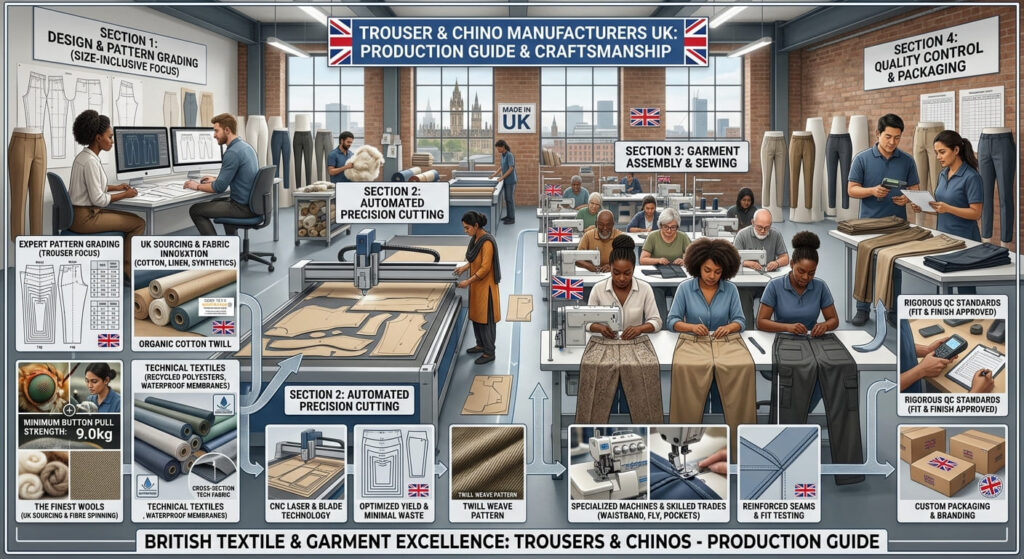
The brief for this article covers tailored trousers, chinos, workwear and cargo styles, key fabrics, sampling, MOQ, lead time, costing and how to brief a UK trouser manufacturer.
Post Summary
Trouser production depends heavily on pattern balance and waistband construction
Tailored trousers need different skills from casual chinos or workwear bottoms
Chinos usually prioritise durability, repeatability and clean casual finishing
Workwear trousers need stronger seams, pockets and reinforcement
Stretch fabrics change pattern, seam and recovery requirements
Waistband, rise and seat fit are critical approval points
Fabric choice strongly affects sewing, pressing and comfort
MOQ depends on style, fabric, trims, colourways and supplier setup
Cost should be compared against identical specifications
The best UK supplier is the one already experienced in your trouser category
Trouser & Chino Manufacturers UK: Production in 2026
UK production can cover a wide range of trouser categories.
Manufacturers may work with:
Tailored trousers
Formal trousers
Chinos
Smart-casual trousers
Stretch chinos
Workwear trousers
Cargo trousers
Uniform trousers
Women’s tailored trousers
Men’s casual trousers
The supplied brief specifically targets brand owners and buyers looking for UK manufacturers producing trousers, chinos and tailored bottoms.
But “trouser manufacturer” is still a broad description.
A factory making lightweight chinos may not be the right fit for structured tailored trousers.
A workwear specialist may be excellent at reinforcement and utility construction but less suited to refined formal finishing.
The correct production route depends on the product.
Types of Trouser Production Available from UK Manufacturers
| Trouser Type | Typical Construction | Common Fabrics | Main Production Priority |
|---|---|---|---|
| Tailored trousers | Structured waistband, fly, pockets | Wool blends, suiting, twill | Fit + pressing |
| Formal trousers | Clean seams, crease, lining options | Suiting, crepe, blends | Finish |
| Chinos | Casual waistband, fly, pockets | Cotton twill, stretch twill | Repeatability |
| Smart casual | Refined chino/tailoring hybrid | Cotton blend, stretch | Fit + finish |
| Workwear | Reinforced seams, utility pockets | Heavy twill, canvas | Durability |
| Cargo trousers | Multiple pockets, tabs | Ripstop, cotton twill | Pocket construction |
| Stretch trousers | Fitted pattern, stretch seams | Cotton elastane blends | Recovery + fit |
Tailored and Formal Trousers
Tailored trousers need strong pattern control.
Important areas include:
Waist
Hip
Front rise
Back rise
Seat
Thigh
Knee
Hem
The waistband also matters.
A tailored trouser may include:
Structured waistband
Waistband curtain
Belt loops
Fly shield
Hook-and-bar closure
Welt pockets
Slant pockets
Pressed crease
These operations require precision.
A small error around the rise or waistband can affect the entire fit.
Front Rise and Back Rise Matter
Two trousers can have the same waist and hip measurements and still fit very differently.
That is because rise controls how the garment sits through the crotch and seat.
Problems may include:
Pulling at front
Excess fabric under seat
Waistband tipping
Crotch discomfort
Back waistband dropping
The pattern must be balanced.
Seat Shape Matters Too
The back pattern influences:
Seat room
Drape
Waist position
Back rise
For fitted formal trousers, this area needs careful sampling.
A measurement chart alone is not enough.
Pressing Is Part of Tailoring
Pressing should not be treated as something done only at the end.
Good trouser production may require pressing during construction.
This helps shape:
Creases
Seams
Waistband
Pocket edges
Hems
A poorly pressed tailored trouser can look inferior even if the stitching is technically correct.
Chinos and Smart Casual
Chinos sit between casualwear and tailoring.
They often use:
Cotton twill
Cotton-blend twill
Stretch twill
Brushed cotton
Garment-dyed fabrics
Common construction details include:
Slant front pockets
Welt back pockets
Belt loops
Zip fly
Button closure
Clean waistband
Twin-needle details
A good chino manufacturer UK needs repeatable fit.
The garment may look simple, but pocket alignment, waistband shape and seam consistency all matter.
Stretch Chinos
Stretch chinos use fabrics containing elastane or another stretch component.
That affects:
Fit
Seam tension
Recovery
Waistband construction
Too much negative ease can cause pulling.
Too little recovery can produce bagging at:
Knees
Seat
Waist
The sample should be tested after wear.
Smart-Casual Trousers
Smart-casual trousers combine relaxed comfort with cleaner finish.
They may include:
Stretch
Drawcord waist
Elasticated back
Clean front
Tapered leg
The main challenge is balancing comfort with a polished silhouette.
Workwear and Cargo Trousers
Workwear construction has different priorities.
Durability becomes more important than refined tailoring.
Features may include:
Reinforced knees
Tool pockets
Cargo pockets
Bar tacks
Triple-needle stitching
Heavy-duty zips
Elasticated waist sections
Strong belt loops
The manufacturer needs experience with heavier fabrics and reinforcement.
Cargo Pocket Construction
Cargo trousers look simple until the pocket system is added.
A cargo pocket may include:
Bellows
Flaps
Press studs
Velcro
Reinforced corners
Internal compartments
Poor pocket placement can distort the leg.
The pocket must work while the wearer moves.
Workwear Reinforcement
High-stress areas may need reinforcement around:
Pocket openings
Belt loops
Crotch
Knee
Fly
Cargo pockets
This can be achieved through:
Bar tacks
Extra stitch rows
Reinforcement patches
Strong seam construction
Tailored vs Chino vs Workwear Production
| Requirement | Tailored | Chino | Workwear |
|---|---|---|---|
| Fit precision | Very high | High | Moderate-high |
| Pressing | Critical | Important | Lower priority |
| Reinforcement | Moderate | Moderate | High |
| Pocket complexity | Medium | Medium | Often high |
| Fabric weight | Light-medium | Medium | Medium-heavy |
| Stretch use | Possible | Common | Possible |
| Formal finish | High | Medium | Low |
| Durability focus | Medium | High | Very high |
Which Trouser Manufacturing Route Fits Your Brand?
Interactive guide for matching trouser style, fabric, fit and construction complexity to the right production capability.
Three Common Trouser Production Routes
Best for formal trousers, wool blends, structured waistbands, welt pockets and precision pressing.
Best for cotton twill, stretch chinos, casual tailoring and repeatable branded collections.
Best for heavy twill, ripstop, utility pockets, reinforcement and durability-led construction.
Interactive Trouser Manufacturer Fit Finder
Build your trouser brief
Trouser Type & Manufacturer Fit
| Production Route | Best Fit | Capability Needed | Main Risk |
|---|---|---|---|
| Tailored specialist | Formal trousers, wool blends | Pattern balance + pressing + welt pockets | Rise / waistband / finish |
| Chino manufacturer | Cotton twill, smart casual | Repeatable fit + clean pocket construction | Pocket flare / shrinkage |
| Stretch specialist | Slim stretch chinos | Stretch handling + recovery control | Knee / seat bagging |
| Workwear specialist | Canvas, ripstop, utility trousers | Heavy sewing + reinforcement | Bulk / weak stress points |
| Hybrid casual-tailoring route | Smart casual, premium chinos | Clean finish + comfort construction | Fit inconsistency |
Four Trouser Production Risk Zones
How a Trouser Is Built
Recommendations are qualitative sourcing guidance. Physical fit, movement testing and production-equivalent sampling remain the strongest basis for bulk approval.
Key Fabric Options for UK Trouser Production
The supplied brief specifically calls for key fabric options.
| Fabric | Typical Use | Main Production Consideration |
|---|---|---|
| Cotton twill | Chinos | Shrinkage + pressing |
| Stretch twill | Slim chinos | Recovery |
| Wool blend | Tailored trousers | Pressing + shape |
| Polyester-viscose | Formal/workwear | Stability |
| Canvas | Heavy workwear | Needle + seam strength |
| Ripstop | Cargo/workwear | Reinforcement |
| Corduroy | Casual trousers | Nap direction |
| Linen blend | Summer trousers | Creasing + movement |
| Denim-weight twill | Casual bottoms | Bulk |
| Crepe | Women’s formal trousers | Drape |
Cotton Twill
Cotton twill is one of the most common chino fabrics.
It offers:
Durability
Structure
Familiar appearance
But it can shrink.
Pre-production testing should check:
Dimensional stability
Colour
Surface
Wash behaviour
Stretch Twill
Stretch twill gives better movement.
It is particularly useful for:
Slim chinos
Fitted trousers
Women’s tailored trousers
The main concern is recovery.
A fabric that stretches but does not recover well may bag after wear.
Wool and Wool-Blend Suiting
Wool blends are common in tailored trousers.
They can provide:
Drape
Shape
Formal appearance
But the manufacturer needs good pressing control.
Heat, steam and pressure affect the final finish.
Polyester-Viscose Blends
These blends are common in:
Uniform trousers
Formal trousers
Workwear
They can offer good stability and repeatability.
The exact fibre composition and finish still matter.
Canvas and Heavy Twill
Heavy fabrics suit:
Workwear
Utility trousers
Cargo styles
But heavier fabric creates more bulk around:
Waistband
Fly
Pockets
Hem
The machine setup must cope with multiple layers.
Ripstop
Ripstop is often used in cargo or technical trousers.
It can work well where durability matters.
Manufacturing still needs:
Correct seam choice
Reinforcement
Pocket engineering
Corduroy
Corduroy has a visible pile direction.
All panels should be cut consistently.
If one panel is reversed, colour and texture may appear different.
Trouser Fit Is a System
Trouser fit should not be reduced to waist and inside leg.
A strong fit review looks at:
Waist
Hip
Rise
Seat
Thigh
Knee
Calf
Hem
Leg balance
The pattern needs to work as a whole.
Common Trouser Fit Problems
Waistband Gaping
Usually seen at the back.
Possible causes:
Waist-to-hip relationship
Incorrect waistband shape
Poor pattern balance
Front Pulling
Horizontal drag lines may appear around the front crotch.
Possible causes include:
Rise
Hip ease
Front fork shape
Excess Fabric Under Seat
This may suggest:
Too much back length
Incorrect back rise
Seat-shape mismatch
Twisted Leg
A trouser leg can rotate.
This may come from:
Grainline error
Cutting
Fabric distortion
Pattern balance
Pocket Flare
Slant pockets can open away from the body.
This may be caused by:
Fit tension
Pocket angle
Hip tightness
Trouser Waistband Construction
A waistband can be:
Straight
Contoured
Elasticated
Part-elastic
Drawcord
Structured
The correct type depends on the style.
Straight Waistbands
Straight waistbands are common in:
Chinos
Casual trousers
They work best when the garment shape supports them.
Contoured Waistbands
Contoured waistbands are shaped to follow the body.
They can improve fit around:
Women’s trousers
Fitted styles
They require more pattern precision.
Elasticated Waistbands
Elasticated waists suit:
Casual trousers
Pull-on styles
Comfort-led products
Elastic quality matters.
Poor elastic can lose recovery.
Belt Loops
Belt loops look simple but need consistent:
Width
Placement
Reinforcement
Loops at stress points need to be securely attached.
Fly Construction
Common fly options include:
Zip fly
Button fly
Mock fly
Concealed side zip
For chinos, zip fly is common.
For tailored trousers, closures may include hooks, bars or internal buttons.
Pocket Construction
Trousers often contain several pocket types.
Slant Pockets
Common on chinos and formal trousers.
They need:
Clean opening
Stable pocket bag
Correct angle
Welt Pockets
Common at the back.
Poorly made welt pockets are immediately noticeable.
Check:
Symmetry
Opening
Corner finish
Alignment
Patch Pockets
Used in:
Casualwear
Workwear
They need consistent placement.
Chino Sampling UK — What Should Be Approved
Sampling should review:
Waist fit
Hip fit
Front rise
Back rise
Seat
Thigh
Leg shape
Hem
Waistband
Fly
Pockets
Belt loops
Fabric recovery
Pressing
Stitch quality
For workwear, also inspect reinforcement.
For tailored trousers, inspect internal finishing.
Wear Testing Matters
Static fit is not enough.
Ask the wearer to:
Sit
Walk
Bend
Climb stairs
This can reveal:
Rise problems
Pocket flare
Waist movement
Knee restriction
MOQ and Lead Times for UK Trouser Manufacturers
The brief requests current MOQ and lead-time information.
There is no reliable universal MOQ across all UK trouser manufacturers.
MOQ depends on:
Trouser style
Fabric
Colourways
Size range
Pocket construction
Trims
Wash/finish
Supplier setup
| Specification | Relative MOQ / Production Pressure |
|---|---|
| Simple cotton chino | Lower |
| Multiple colourways | Higher |
| Custom-dyed fabric | Higher |
| Tailored wool trousers | Higher complexity |
| Cargo with many pockets | Higher complexity |
| Stretch chino | Moderate |
| Workwear with reinforcement | Moderate-high |
Fabric MOQ Can Be the Real Minimum
The garment factory may accept a smaller sewing quantity.
But fabric or trim suppliers may impose their own minimums.
This may apply to:
Custom-dyed twill
Branded buttons
Custom zips
Waistband components
Always separate:
garment MOQ from material MOQ.
Lead Time Depends on Development Stage
A repeat chino style can move faster than a new tailored trouser.
Development may require:
Pattern
First sample
Fit correction
Revised sample
Size grading
Production sample
Do not confuse sewing time with total development time.
Cost of UK Trouser Manufacturing
The brief also requests a cost section.
Without verified live supplier quotes, fixed 2026 prices would be misleading.
The useful comparison is by cost driver.
| Cost Driver | Lower Pressure | Higher Pressure |
|---|---|---|
| Fabric | Standard twill | Premium/specialist |
| Waistband | Simple | Structured/contoured |
| Pockets | Basic | Multiple/welt/cargo |
| Fit | Relaxed | Tailored/slim |
| Lining | None | Partial/full |
| Reinforcement | Minimal | Heavy workwear |
| Colourways | One | Several |
| Quantity | Larger repeat | Small batch |
Why Tailored Trousers Cost More
Tailored trousers may require:
More pattern development
More pressing
More internal construction
More precise pockets
Structured waistband
The number of operations increases.
Why Cargo Trousers Can Also Be Expensive
Cargo trousers are not automatically cheaper because they are casual.
Cost can rise through:
Multiple pockets
Flaps
Reinforcement
Hardware
Extra stitch operations
Complexity matters more than whether the garment is called casual or formal.
How to Brief a UK Trouser Manufacturer
A useful brief should include:
Front technical drawing
Back technical drawing
Measurement chart
Fabric specification
Fabric weight
Stretch content where relevant
Waistband construction
Fly construction
Pocket type
Belt-loop specification
Seam type
Stitch detail
Hem
Size range
Colourways
Quantity
Labels
Packaging
Brands preparing trouser or chino collections can review our clothing manufacturing services before sampling.
Specify Finished Garment Measurements
Do not send only body measurements.
The factory needs finished garment measurements.
These may include:
Waist
Hip
Front rise
Back rise
Thigh
Knee
Hem
Inside leg
Outside leg
Define Fit Clearly
Words like:
Slim
Regular
Relaxed
Tapered
are useful, but not enough on their own.
Support them with actual garment measurements.
Specify Pocket Position
Do not simply say:
“Two back pockets.”
Define:
Width
Height
Position
Type
For cargo styles, give pocket dimensions and placement.
Specify Stitching
Include:
Stitch type
Thread colour
Visible topstitching
Reinforcement points
Common Mistakes When Commissioning Trousers
1. Approving Only the Waist Measurement
Why it happens: Waist feels like the main fit point.
Why it fails: Rise, seat and hip can still be wrong.
Fix: Approve the full fit.
2. Ignoring Back Rise
Why it happens: Buyers focus on front appearance.
Why it fails: The garment can feel uncomfortable sitting or bending.
Fix: Test movement during fittings.
3. Choosing Fabric After Pattern Development
Why it happens: Fabric sourcing is delayed.
Why it fails: Stretch and drape can alter fit.
Fix: Develop the pattern in production-equivalent fabric.
4. Treating Every Twill the Same
Why it happens: The fabrics appear similar.
Why it fails: Weight, stretch and shrinkage differ.
Fix: Test the actual fabric.
5. Ignoring Pocket Flare
Why it happens: It is accepted as a minor issue.
Why it fails: It usually indicates fit or pocket-construction problems.
Fix: Correct the pattern before bulk.
6. Forgetting Belt-Loop Strength
Why it happens: Loops are visually small.
Why it fails: They are high-stress components.
Fix: Reinforce attachment.
7. Overloading Cargo Trousers With Pockets
Why it happens: More features appear more functional.
Why it fails: Weight and bulk increase.
Fix: Design pockets around real use.
8. Comparing Quotes With Different Specifications
Why it happens: Both quotes say “chino”.
Why it fails: Fabric, pockets, waistband and stitching may differ.
Fix: Quote identical tech packs.
How Silk Routes Supports Menswear and Womenswear Brands
Trouser development is heavily dependent on fit, pattern balance and construction.
Silk Routes can help coordinate:
Fabric sourcing
Pattern development
Sampling
Fit review
Waistband construction
Pocket specification
Trims
Stitching
Production planning
Quality-control requirements
The aim is to match the right supplier capability to the garment rather than treating all trouser factories as interchangeable.
You can learn more about our manufacturing background on the About Silk Routes page.
FAQ
No Google People Also Ask questions were supplied for this article, so these are practical buyer FAQs rather than claimed Google PAA data.
What types of trousers do UK manufacturers produce?
UK manufacturers can produce tailored trousers, chinos, smart-casual bottoms, workwear and cargo styles depending on capability.
Check at least 4 areas before selecting a supplier: pattern skill, fabric experience, pocket construction and finishing.
Are chinos easier to manufacture than tailored trousers?
Usually they involve less tailoring structure, but they still require accurate fit and repeatable construction.
At minimum, review 5 fit zones: waist, hip, rise, seat and leg shape.
Can UK trouser manufacturers produce stretch chinos?
Yes, some manufacturers work with stretch twills and cotton-elastane blends.
Before bulk, check at least 3 things: stretch, recovery and fit after wear.
What should I send to a UK chino manufacturer?
Send a proper tech pack rather than a sketch alone.
Include at least 6 essentials: measurements, fabric, waistband, pockets, fly and quantity.
Should trousers be wear-tested before production?
Yes.
A simple fit session should include at least 4 movements: standing, sitting, walking and bending.
Good Trousers Are Mostly About What You Cannot See
Customers notice the result.
They may not notice:
Rise shape
Grainline
Pocket bag
Waistband structure
Reinforcement
Pressing sequence
But those hidden decisions determine whether the trousers fit and wear properly.
That is why selecting trouser manufacturers UK should be based on:
Product type
Pattern capability
Fabric experience
Construction
Sampling quality
not simply the cheapest sewing price.
A good chino factory should understand repeatable casual fit.
A good tailored trouser manufacturer should understand shape and pressing.
A good workwear trouser supplier should understand reinforcement and durability.
Start with the product.
Then choose the production capability.
For broader specialist clothing-production guidance, see our Specialist Clothing Manufacturers UK guide.
