Contents
- 1.
- 1.1. Post Summary
- 1.2. Dress Manufacturing in the UK — What Is Available in 2026
- 1.3. Types of Dress Production UK Manufacturers Handle
- 1.4. Shirt Dresses
- 1.5. Wrap Dresses
- 1.6. Midi and Maxi Dresses
- 1.7. Formal and Occasion Wear
- 1.8. Evening Dresses
- 1.9. Wedding and Bridal
- 1.10. Casual vs Formal Dress Manufacturing
- 2. Which Dress Manufacturing Route Fits Your Collection?
- 2.1. Three Common Dress Production Routes
- 2.2. Interactive Dress Manufacturer Fit Finder
- 2.3. Dress Type & Manufacturer Fit
- 2.4. Four Production Risk Zones
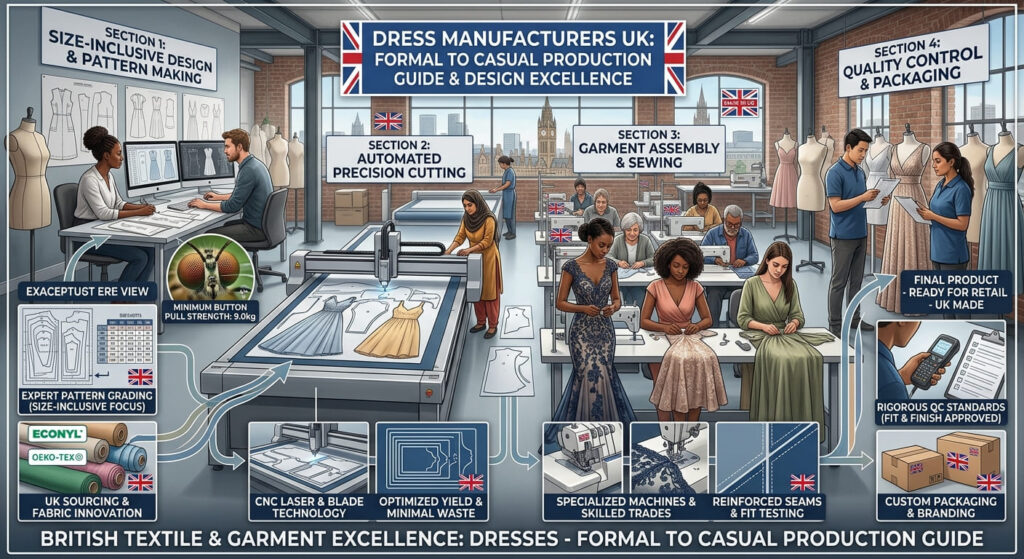
- 2.5. From Dress Idea to Bulk Production
- 2.6. Key Fabric Capabilities for UK Dress Production
- 2.7. Cotton and Poplin
- 2.8. Linen
- 2.9. Viscose and Rayon-Type Fabrics
- 2.10. Jersey
- 2.11. Crepe
- 2.12. Satin
- 2.13. Chiffon
- 2.14. Lace
- 2.15. Dress Fit Is More Than Bust, Waist and Hip
- 2.16. What Is Dress Balance?
- 2.17. Dress Sampling UK — What Should Be Approved
- 2.18. Fit Sample vs Production Sample
- 2.19. Dress Closures
- 2.20. Invisible Zips
- 2.21. Linings
- 2.22. Facings and Understitching
- 2.23. MOQ and Lead Times for UK Dress Manufacturers
- 2.24. Why Fabric MOQ Can Control the Whole Order
- 2.25. Lead Time Depends on Development Readiness
- 2.26. Cost Benchmarks for UK Dress Manufacturing
- 2.27. Casual Dress Cost Drivers
- 2.28. Formal Dress Cost Drivers
- 2.29. How to Compare UK Dress Manufacturing Quotes
- 2.30. How to Brief a UK Dress Manufacturer
- 2.31. Include Construction Details
- 2.32. Define Length From a Fixed Point
- 2.33. Specify Ease
- 2.34. Common Mistakes When Commissioning Dresses
- 2.34.1. 1. Choosing a General Factory for Specialist Occasionwear
- 2.34.2. 2. Approving Fit Only on a Mannequin
- 2.34.3. 3. Ignoring Fabric Drape
- 2.34.4. 4. Measuring Only Bust, Waist and Hip
- 2.34.5. 5. Setting the Hem Too Early
- 2.34.6. 6. Ignoring Lining Fit
- 2.34.7. 7. Adding Details After Sampling
- 2.34.8. 8. Comparing Quotes With Different Fabrics
- 2.35. How Silk Routes Supports Womenswear Brands
- 2.36. FAQ
- 2.36.1. What types of dresses can UK manufacturers produce?
- 2.36.2. Can UK manufacturers produce low-MOQ dresses for startup brands?
- 2.36.3. What fabric is easiest for a first dress collection?
- 2.36.4. How many dress samples should I make before bulk production?
- 2.36.5. What should I send to a UK dress manufacturer?
- 2.37. The Right Dress Manufacturer Depends on the Dress
A dress can look simple on a hanger and still be difficult to manufacture well.
Fit has to work through the bust, waist, hip and length. Fabric has to behave properly. Seams need to sit cleanly. Zips, linings, facings, gathers, darts and hems all affect the final result.
That is why choosing the right dress manufacturers UK matters more than finding a factory that simply says it can sew womenswear.
The brief for this article covers casual dresses, formal and occasion wear, bridal, fabric capability, sampling, MOQ, lead time and commissioning.
Post Summary
UK dress manufacturers may specialise in very different womenswear categories
Casual dresses need repeatable fit and efficient construction
Formal and occasion wear require stronger finishing and fabric-handling skills
Bridal and wedding dresses often need specialist sampling and construction
Fabric choice determines much of the pattern, seam and finishing strategy
Sampling should test fit, balance and fabric behaviour
One dress style can require several specialist operations
MOQ depends on fabric, colourways, trims, complexity and supplier setup
Cost should be compared against the same specification, not garment name alone
The strongest manufacturer is the one whose existing capability matches your dress category
Dress Manufacturing in the UK — What Is Available in 2026
UK dress production spans a wide range of womenswear.
Manufacturers may work with:
Casual day dresses
Shirt dresses
Wrap dresses
Midi dresses
Maxi dresses
Evening dresses
Wedding-guest dresses
Occasion wear
Bridalwear
Uniform-style dresses
Small premium collections
The phrase dress manufacturer UK therefore covers very different factory capabilities.
A workshop experienced in simple cotton shirt dresses may not be the right supplier for:
Bias-cut satin
Fully lined eveningwear
Boned bodices
Bridal lace
Structured occasion dresses
The reverse is also true.
A specialist occasion-wear studio may be unnecessarily complex for a straightforward casual cotton dress.
The best sourcing decision starts by matching product complexity to factory capability.
Types of Dress Production UK Manufacturers Handle
| Dress Category | Typical Construction | Common Fabrics | Main Manufacturing Priority |
|---|---|---|---|
| Casual day dress | Simple seams, gathers, pockets | Cotton, viscose, linen | Fit consistency |
| Shirt dress | Collar, placket, cuffs | Cotton, poplin, linen | Precision |
| Wrap dress | Tie construction, overlap | Jersey, viscose, woven | Coverage + fit |
| Midi/maxi dress | Longer panels, drape | Viscose, crepe, cotton | Balance + hem |
| Formal dress | Lining, shaping, closures | Crepe, satin, jacquard | Finish quality |
| Occasion wear | Structured/semi-structured | Satin, lace, velvet | Specialist handling |
| Bridal | Complex fit + detailing | Lace, tulle, satin | Sampling + precision |
Casual and Everyday Dresses
Casual dresses usually depend on:
Good basic pattern cutting
Consistent grading
Efficient sewing
Stable fabric handling
Reliable pressing
Common styles include:
T-shirt dresses
Smock dresses
Shirt dresses
Wrap dresses
Slip-style day dresses
Midi and maxi dresses
The construction may be simpler than formalwear, but that does not make fit less important.
A casual dress is often expected to work across more sizes and more body shapes.
Shirt Dresses
Shirt dresses combine dress construction with shirt-making details.
They may include:
Collar
Collar stand
Front placket
Buttons
Cuffs
Sleeve plackets
Belt
Pockets
This requires accuracy.
A slightly twisted collar or uneven placket can make the whole garment look poorly made.
Wrap Dresses
Wrap dresses look straightforward but require careful overlap.
The manufacturer must consider:
Bust coverage
Waist tie position
Skirt overlap
Movement
Fabric drape
A wrap dress that fits standing still but opens excessively when walking has not been developed properly.
Midi and Maxi Dresses
Longer dresses increase the importance of:
Grainline
Fabric relaxation
Panel balance
Hem level
A small distortion near the waist can become much more obvious across a long skirt.
Formal and Occasion Wear
Formal dresses usually need more controlled construction.
They may include:
Lining
Invisible zips
Boning
Interfacing
Understitching
Facings
Darts
Princess seams
Pleats
Hand finishing
The manufacturer needs more than standard CMT sewing capability.
The garment has to be pressed and handled carefully throughout production.
Evening Dresses
Evening dresses may use:
Satin
Crepe
Velvet
Chiffon
Lace
Sequins
Beaded fabrics
Each introduces different production risks.
For example:
Satin can mark.
Velvet has a pile direction.
Chiffon can move while cutting.
Sequins can interfere with seams and needles.
A manufacturer should have experience with the actual material category.
Wedding and Bridal
Bridalwear is a specialist area.
It can involve:
Multiple fittings
Internal support
Structured bodices
Lace placement
Tulle layers
Hand finishing
Long skirts
Trains
Special closures
A general womenswear factory should not automatically be assumed suitable.
Bridal production requires high control over fit and finishing.
Silk Routes Manufacturing Team: The more formal the dress, the more important it becomes to approve construction from the inside as well as the outside.
Casual vs Formal Dress Manufacturing
| Requirement | Casual Dress | Formal / Occasion Dress |
|---|---|---|
| Construction | Simpler | More complex |
| Lining | Optional | Common |
| Internal structure | Limited | More likely |
| Fabric sensitivity | Moderate | Often high |
| Fit tolerance | Moderate | Lower |
| Pressing | Important | Critical |
| Hand finishing | Limited | More common |
| Sampling rounds | Fewer possible | Often more |
Neither is “better”.
They are different production jobs.
Which Dress Manufacturing Route Fits Your Collection?
Interactive guide for matching dress style, fabric and construction complexity to the right production capability.
Three Common Dress Production Routes
Best for shirt dresses, wrap dresses, day dresses and repeatable casual collections.
Best for lined crepe, satin, lace and more carefully finished formal dresses.
Best for boning, layered construction, lace placement, fittings and specialist finishing.
Interactive Dress Manufacturer Fit Finder
Build your dress brief
Dress Type & Manufacturer Fit
| Production Route | Best Fit | Capability Needed | Main Risk |
|---|---|---|---|
| Casual womenswear | Shirt, wrap, cotton, viscose | Pattern consistency + efficient sewing | Fit/balance inconsistency |
| Jersey specialist | Stretch casual dresses | Stretch machinery + seam control | Distortion |
| Premium dress specialist | Lined crepe, satin, fitted dresses | Pressing + lining + closures | Fabric marking / poor finish |
| Occasionwear specialist | Chiffon, lace, layered dresses | Delicate fabric handling | Cutting / seam quality |
| Bridal specialist | Structured, boned, lace-heavy bridal | Fit development + hand finish | Construction / fitting failure |
Four Production Risk Zones
From Dress Idea to Bulk Production
Recommendations are qualitative sourcing guidance. A physical fit sample and production-equivalent sample remain the strongest basis for approval.
Key Fabric Capabilities for UK Dress Production
Fabric is one of the strongest determinants of dress manufacturing difficulty.
| Fabric | Common Use | Main Production Issue |
|---|---|---|
| Cotton poplin | Shirt/day dresses | Shrinkage + pressing |
| Linen | Casual summer dresses | Creasing + movement |
| Viscose | Wrap/midi dresses | Drape + instability |
| Jersey | Casual/stretch dresses | Stretch control |
| Crepe | Formal dresses | Seam/pressing control |
| Satin | Evening/occasion | Surface marking |
| Chiffon | Layered dresses | Cutting + handling |
| Lace | Occasion/bridal | Placement + seam planning |
| Velvet | Eveningwear | Nap direction |
| Tulle | Bridal/formal | Layer management |
Cotton and Poplin
Cotton is common for:
Shirt dresses
Summer dresses
Uniform-style dresses
It is relatively stable, but the manufacturer still needs to consider:
Shrinkage
Pressing
Grain
Colour consistency
For fitted cotton dresses, pre-production wash behaviour should be understood.
Linen
Linen gives a natural premium appearance.
It also creases.
Construction needs to account for:
Fabric movement
Seam behaviour
Pressing
Shrinkage
Linen is particularly suited to:
Relaxed dresses
Shirt dresses
Summer collections
Viscose and Rayon-Type Fabrics
Viscose can produce excellent drape.
It can also move during:
Cutting
Sewing
Hanging
This matters on:
Bias areas
Long skirts
Wrap dresses
Fabric should be allowed to relax where necessary before final hem approval.
Jersey
Jersey is useful for:
T-shirt dresses
Body-skimming dresses
Casual stretch styles
The manufacturer needs appropriate equipment and seam construction.
A woven-dress specialist does not automatically have strong stretchwear capability.
Crepe
Crepe is widely used in:
Formal dresses
Occasion wear
Wedding-guest dresses
It can offer good drape and structure.
However, pressing and seam handling still need careful control.
Satin
Satin can create a premium finish.
It also exposes mistakes.
Issues can include:
Needle marks
Press marks
Seam show-through
Surface damage
A manufacturer experienced with cotton is not automatically experienced with satin.
Chiffon
Chiffon needs careful cutting.
Layered cutting can shift.
Narrow hems and seam finishing also require skill.
This is one reason chiffon-heavy occasionwear should be handled by a manufacturer familiar with lightweight fabrics.
Lace
Lace changes the cutting strategy.
The manufacturer may need to consider:
Motif placement
Seam visibility
Pattern matching
Underlining
Lining
Premium lace dresses often need more manual handling than standard fabric dresses.
Dress Fit Is More Than Bust, Waist and Hip
A useful dress fit review should also assess:
Shoulder position
Neckline
Armhole
Bust point
Waist position
Back length
Skirt balance
Hem level
A garment can match the measurement chart and still look wrong.
That is because dress fit depends on balance, not dimensions alone.
What Is Dress Balance?
Balance describes how the garment hangs around the body.
Problems can show as:
Front hem lifting
Back hem dropping
Side seams moving forward
Neckline pulling
Waistline tilting
These can come from:
Pattern shape
Body shape
Fabric
Construction
That is why fit samples matter.
Dress Sampling UK — What Should Be Approved
Sampling should check more than styling.
Approve:
Silhouette
Bust fit
Waist placement
Hip ease
Sleeve fit
Neckline
Closure
Length
Lining
Internal construction
Fabric behaviour
Finishing
For formal dresses, also inspect:
Boning
Bust support
Understitching
Seam allowance
Hand finishing
Fit Sample vs Production Sample
A fit sample answers:
Does the shape and construction work?
A production-equivalent sample answers:
Does the final garment work with the actual fabric, trims and finishing?
Both questions matter.
Dress Closures
Closures can include:
Invisible zip
Standard zip
Buttons
Hooks and eyes
Ties
Elastic
Concealed plackets
The closure affects:
Fit
Sewing sequence
Cost
Wearability
Invisible Zips
Invisible zips are common in:
Formal dresses
Occasion wear
Fitted dresses
A badly inserted zip can:
Ripple
Twist
Sit unevenly
The zip should follow the seam cleanly.
Linings
Lining can improve:
Comfort
Opacity
Shape
Finish
But it also introduces another layer that must fit correctly.
A lining that is too short can pull the outer garment.
A lining that is too long can show below the hem.
Facings and Understitching
Facings help finish:
Necklines
Armholes
Understitching helps keep facings or linings from rolling outward.
These details are often invisible when correct.
That is exactly why they matter.
MOQ and Lead Times for UK Dress Manufacturers
There is no useful single MOQ for all dress manufacturers UK.
MOQ varies according to:
Dress style
Fabric
Number of colourways
Trim requirements
Construction
Size range
Supplier setup
| Project Type | Relative MOQ Pressure |
|---|---|
| Simple stock-fabric day dress | Lower |
| Several colourways | Higher |
| Custom-dyed fabric | Higher |
| Fully lined formal dress | Higher complexity |
| Bridal / specialist occasionwear | Specialist |
| Multiple styles in one collection | Depends on shared materials |
The brief requests current UK MOQ and lead-time statistics.
I have not inserted fixed 2026 figures without live supplier verification.
Why Fabric MOQ Can Control the Whole Order
A dress manufacturer may be prepared to sew a small batch.
But the fabric supplier may require more material than the garment factory needs.
The same can apply to:
Custom lining
Buttons
Zips
Lace
Special trims
Always ask separately about:
garment MOQ and material MOQ.
Lead Time Depends on Development Readiness
A simple approved repeat style is different from a new formal dress requiring:
Pattern development
Fit corrections
Fabric testing
Lining development
Trim sourcing
Development time should not be confused with sewing time.
Cost Benchmarks for UK Dress Manufacturing
The supplied brief requests UK dress-manufacturing cost benchmarks.
Without verified live quotes, fixed 2026 unit prices would be misleading.
The more useful comparison is by cost driver.
| Cost Driver | Lower Pressure | Higher Pressure |
|---|---|---|
| Construction | Simple | Structured |
| Fabric | Stable | Delicate/slippery |
| Lining | Unlined | Fully lined |
| Closures | Simple | Multiple/special |
| Detail | Minimal | Pleats, gathers, lace |
| Finishing | Standard | Hand finishing |
| Colourways | One | Several |
| Quantity | Larger repeat run | Very small batch |
Casual Dress Cost Drivers
Casual styles often become expensive when they include many small details.
For example:
Collar
Placket
Cuffs
Pockets
Belt
Multiple panels
A casual shirt dress can therefore involve more operations than a simple formal slip dress.
Do not price by garment category alone.
Formal Dress Cost Drivers
Formal dresses tend to increase cost through:
Lining
Structure
Delicate fabric
Additional pressing
More careful handling
Hand finishing
The garment may also need more sampling.
How to Compare UK Dress Manufacturing Quotes
Give each supplier the same:
Tech pack
Fabric specification
Construction
Quantity
Size range
Colourways
Packaging
Otherwise, quotations are not comparable.
How to Brief a UK Dress Manufacturer
A useful dress-manufacturing brief should include:
Technical drawing
Front and back views
Measurement specification
Fabric
Fabric weight where relevant
Lining
Colourways
Stitch and seam requirements
Zip or closure
Pockets
Hem
Label placement
Size range
Quantity
Packaging
Quality expectations
Brands preparing dresses and womenswear collections can review our clothing manufacturing services before sampling.
Include Construction Details
A sketch alone does not tell the factory how to build the dress.
Specify whether seams should be:
Overlocked
French seamed
Bound
Fully enclosed
Pressed open
where relevant.
Define Length From a Fixed Point
“Midi length” is not a production measurement.
Specify the length from a defined reference point.
Examples include:
High shoulder point
Waist
Centre back
Consistency matters across sizes.
Specify Ease
The difference between body measurement and garment measurement affects comfort.
For fitted garments, the manufacturer needs to know whether the dress should be:
Close fitting
Semi fitted
Relaxed
Oversized
Do not leave the fit intention to guesswork.
Common Mistakes When Commissioning Dresses
1. Choosing a General Factory for Specialist Occasionwear
Why it happens: The supplier already makes womenswear.
Why it fails: Delicate fabrics and structured dresses need specific skills.
Fix: Review similar previous products.
2. Approving Fit Only on a Mannequin
Why it happens: It is quick.
Why it fails: A mannequin does not move like a person.
Fix: Conduct a real fit test.
3. Ignoring Fabric Drape
Why it happens: The design is approved before final fabric selection.
Why it fails: Fabric changes silhouette.
Fix: Sample in production-equivalent fabric.
4. Measuring Only Bust, Waist and Hip
Why it happens: Those are the familiar measurements.
Why it fails: Shoulder, back length and balance also affect fit.
Fix: Use a complete measurement specification.
5. Setting the Hem Too Early
Why it happens: The first sample looks correct.
Why it fails: Long drapey fabrics can settle after hanging.
Fix: Check final hem after the fabric has relaxed where appropriate.
6. Ignoring Lining Fit
Why it happens: The lining is hidden.
Why it fails: It can pull the outer garment.
Fix: Approve lining and shell together.
7. Adding Details After Sampling
Why it happens: Buyers refine the design late.
Why it fails: A new pocket, belt or sleeve detail can affect pattern and production sequence.
Fix: Lock the specification before bulk.
8. Comparing Quotes With Different Fabrics
Why it happens: Both quotes appear to be for the same dress.
Why it fails: Fabric handling can significantly alter production difficulty.
Fix: Quote identical materials and construction.
How Silk Routes Supports Womenswear Brands
Dress production is one of the clearest examples of why product type matters when choosing a manufacturer.
Silk Routes can help coordinate:
Fabric sourcing
Pattern requirements
Sampling
Fit review
Dress construction
Linings
Closures
Labels
Production planning
Quality-control requirements
The objective is to match the garment to the correct production capability rather than treating every womenswear supplier as interchangeable.
You can learn more about our manufacturing background on the About Silk Routes page.
FAQ
No Google People Also Ask questions were supplied for this article, so these are practical buyer FAQs rather than claimed Google PAA data.
What types of dresses can UK manufacturers produce?
UK manufacturers can work across casual, shirt, wrap, formal, occasion and specialist dress categories depending on capability.
Before choosing a supplier, check at least 4 areas: fabric experience, construction, sampling and finishing.
Can UK manufacturers produce low-MOQ dresses for startup brands?
Some suppliers may accept smaller batches, but MOQ depends on both garment production and materials.
Ask separately about at least 2 minimums: sewing MOQ and fabric/trim MOQ.
What fabric is easiest for a first dress collection?
Stable woven fabrics are generally easier to control than highly slippery or delicate fabrics.
For a first collection, compare at least 4 factors: drape, shrinkage, seam behaviour and pressing.
How many dress samples should I make before bulk production?
There is no fixed number.
At minimum, development should resolve 3 stages: fit, construction and production-equivalent fabric/trim approval.
What should I send to a UK dress manufacturer?
Send a complete production brief rather than only a sketch.
At minimum, include 6 core items: technical drawing, measurements, fabric, construction, quantity and size range.
The Right Dress Manufacturer Depends on the Dress
“Dress manufacturer” is too broad a description on its own.
A casual cotton shirt dress.
A bias-cut satin evening dress.
A lined crepe occasion dress.
A bridal gown.
They are all dresses.
But they require different production strengths.
The best dress manufacturers UK are not necessarily the ones offering the widest list of products.
They are the ones whose equipment, operators, pattern capability and finishing experience match your actual garment.
Start with the dress.
Then choose the manufacturer.
For broader specialist clothing-production guidance, see our Specialist Clothing Manufacturers UK guide.
