
![Nearshoring Garment Production: Europe & North Africa Guide [2026]](https://silkroutes.co.uk/wp-content/uploads/2026/04/Nearshoring-Garment-Production-Europe-North-Africa-Guide.png)
Most UK brands that move to nearshore production discover the same thing within two seasons: it isn’t as simple or as cheap as the guides said it would be.
Nearshoring has real advantages. It also has real costs, real lead time realities, and a post-Brexit duty position that’s more nuanced than most content on this topic admits. This post gives you the honest comparison across Portugal, Turkey, Morocco, and Tunisia, what each hub actually offers, what it costs, and when the model makes commercial sense.
For the broader sourcing framework, see our Complete Guide to Clothing Manufacturers in UK.
Post Summary
- Nearshoring reduces lead times versus Asia by 8–14 weeks on a full cycle basis, but doesn’t match UK domestic for speed on small runs
- The UK has a trade agreement with every major nearshore destination covered here; genuinely qualifying goods from Portugal, Turkey, Morocco, and Tunisia can all access 0% duty, not the flat 12% many guides assume
- Morocco and Tunisia offer the lowest unit costs of the four hubs, but carry longer lead times and more variable quality tiers than Portugal or Turkey
- EU sustainability regulation timelines have shifted significantly; the CSDDD is now delayed to 2028–2029 and scoped only to very large companies, easing near-term pressure on smaller brands
- Each nearshore hub has distinct product specialisms; choosing the wrong hub for your category is the most common nearshoring mistake
- The commercial case for nearshoring strengthens for brands with EU distribution ambitions, not just UK-only sales
Contents
- 1. What Is Nearshoring in Fashion Manufacturing?
- 2. Top Nearshore Garment Hubs for UK Brands
- 3. Cost Comparison: Nearshore vs Far East vs UK
- 4. Lead Times: Nearshore Reality Check
- 5. Ethical and Sustainability Standards by Region
- 6. EU Regulations Affecting Nearshore Production in 2026
- 7. When Nearshoring Makes the Most Commercial Sense
- 8. Mistakes UK Brands Make When Nearshoring
- 9. Nearshoring: Questions Brands Ask Us
- 9.1. Is nearshoring more expensive than Far East production for UK brands?
- 9.2. What import duty applies to nearshore garments entering the UK?
- 9.3. Which nearshore destination offers the fastest lead times for UK brands?
- 9.4. Are nearshore factories certified to sustainability standards?
- 9.5. Is nearshoring right for a small UK brand with under 200 units per style?
- 10. The Nearshore Decision Is About Your Distribution, Not Just Your Distance
What Is Nearshoring in Fashion Manufacturing?
Nearshoring is the practice of sourcing garment production from geographically close countries rather than traditional Far East hubs like China, Bangladesh, or Vietnam. For UK brands, the nearshore zone typically means Europe and North Africa, with Portugal, Turkey, Morocco, and Tunisia the most established destinations.
What guides get wrong: they define nearshoring purely by geography. In practice, nearshoring is a lead time and risk management strategy, the geography is the mechanism, not the benefit. A brand that nearshores without shorter lead times, better oversight, or reduced supply chain risk has gained nothing but higher unit costs.
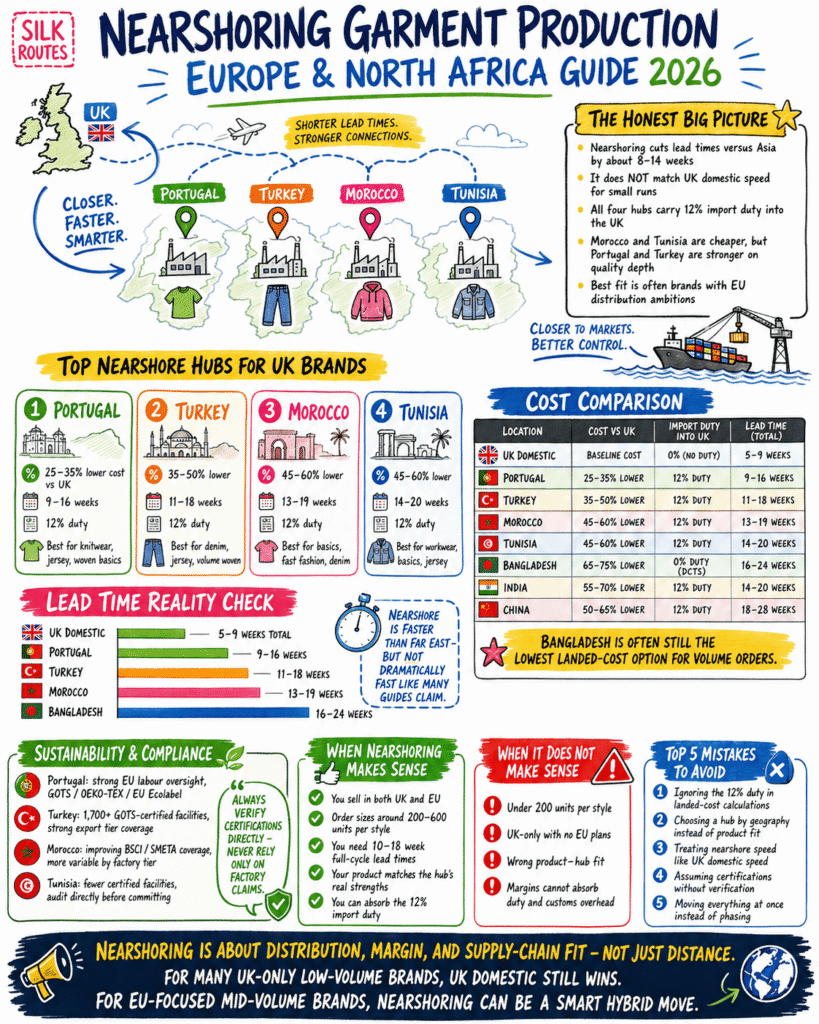
Top Nearshore Garment Hubs for UK Brands
| Hub | Typical Unit Cost vs UK | Lead Time (full cycle) | Duty If Rules of Origin Met | Strongest Categories |
|---|---|---|---|---|
| Portugal | 25–35% lower | 9–16 weeks | 0% | Knitwear, jersey, woven basics |
| Turkey | 35–50% lower | 11–18 weeks | 0% | Denim, jersey, volume woven |
| Morocco | 45–60% lower | 13–19 weeks | 0% | Basics, fast fashion, denim |
| Tunisia | 45–60% lower | 14–20 weeks | 0% | Workwear, basics, jersey |
The UK has a trade agreement covering every one of these four destinations, the UK-EU Trade and Cooperation Agreement for Portugal, the UK-Turkey FTA, and continuity Association Agreements with Morocco and Tunisia inherited from their prior EU arrangements. Genuinely qualifying goods, meaning the garment underwent sufficient processing in that country rather than simply being assembled there from third-country fabric, can access 0% duty in all four cases.
This is the part most nearshoring guides get backwards. Goods that fail the rules of origin test, most commonly because the fabric was imported from outside the qualifying zone, fall back to the standard UK Global Tariff, which for most clothing categories runs around 12%. The duty outcome depends on your specific supply chain, not on which country the label says.
Portugal
Portugal’s strengths are quality knitwear, cotton jersey, and premium woven basics, concentrated in the Porto and Braga clusters. CITEVE, Portugal’s textile technology centre, provides quality benchmarking and certification support across the sector.
What guides get wrong about Portugal: they either assume seamless pre-Brexit trade still applies, or assume a flat duty now applies to everything. Neither is right. Genuinely EU-originating Portuguese clothing can enter the UK at 0% duty under the Trade and Cooperation Agreement, provided the exporter declares origin correctly. The EU-origin advantage for selling into EU markets is separate and only matters if you have EU distribution plans.
Turkey
Turkey offers a deeper and more diverse manufacturing base than Portugal, strong in denim, jersey, knitwear, and volume woven. The Istanbul and Bursa clusters have long-established relationships with major European brands.
What guides get wrong about Turkey: they quote factory production time as the lead time. The full cycle from order placement to UK warehouse receipt is 11–18 weeks once shipping, port handling, and customs clearance are included, not the 4–6 weeks factory floor time sometimes cited.
Morocco
Morocco has built a significant garment export industry over the past two decades, primarily serving French and Spanish fast fashion brands. Casablanca and the surrounding industrial zones are the main manufacturing hubs. Unit costs are meaningfully lower than Portugal or Turkey, and the UK-Morocco Association Agreement sets out the preferential trade terms and rules of origin that determine your duty position.
The honest caveat: Morocco’s manufacturing base is heavily oriented toward fast fashion volume production. Complex garments, premium knitwear, and technical product are less well served. Factory certification and audit coverage varies significantly by tier.
Tunisia
Tunisia is the least discussed of the major nearshore options and suits specific brand profiles. It’s strong in workwear, jersey basics, and volume woven product. Italian and French brands have used Tunisian production for decades.
For UK brands, Tunisia is furthest from the UK of the four nearshore options and has the least established UK-facing factory base. Lead times are the longest in the nearshore group and the customs broker infrastructure for UK-bound shipments is less mature than Morocco or Turkey, though the UK-Tunisia Association Agreement provides the same preferential duty mechanism as the other three hubs for goods that meet its rules of origin.
Cost Comparison: Nearshore vs Far East vs UK
The nearshore cost position sits between UK domestic and traditional Far East sourcing, but the gap with Far East is narrower than it was five years ago.
| Source | Unit Cost vs UK | Duty (if rules of origin met) | Full Cycle Lead Time |
|---|---|---|---|
| UK domestic | Baseline | None | 5–9 weeks |
| Portugal | 25–35% lower | 0% | 9–16 weeks |
| Turkey | 35–50% lower | 0% | 11–18 weeks |
| Morocco | 45–60% lower | 0% | 13–19 weeks |
| Tunisia | 45–60% lower | 0% | 14–20 weeks |
| Bangladesh | 65–75% lower | 0% (DCTS) | 16–24 weeks |
| India | 55–70% lower | 0% from 15 July 2026 | 14–20 weeks |
| China | 50–65% lower | 12% (no preferential agreement) | 18–28 weeks |
The table reveals something most brands miss: when rules of origin are met, Bangladesh’s combination of the lowest unit costs and zero duty makes it more competitive than any nearshore destination on a total landed cost basis for volume orders, despite the longest lead time. Nearshoring beats Bangladesh financially mainly when speed, flexibility, or sustainability credentials are factored in, not on unit cost plus duty alone, since most of these routes can now reach similar duty outcomes when documented correctly.
If you want to understand how UK domestic production sits in this cost matrix, our UK manufacturing cost breakdown covers how we price across different volume bands.
Lead Times: Nearshore Reality Check
The lead time advantage of nearshoring over Far East is real but routinely overstated.
| Source | Sample Turnaround | Bulk Production | Shipping to UK | Total Full Cycle |
|---|---|---|---|---|
| UK domestic | 1–3 weeks | 4–6 weeks | 0 | 5–9 weeks |
| Portugal | 2–4 weeks | 5–8 weeks | 3–5 days + customs | 9–16 weeks |
| Turkey | 3–5 weeks | 6–9 weeks | 7–10 days + customs | 11–18 weeks |
| Morocco | 3–6 weeks | 7–10 weeks | 3–5 days + customs | 13–19 weeks |
| Bangladesh | 4–7 weeks | 7–11 weeks | 21–28 days + customs | 16–24 weeks |
The nearshore lead time advantage over Bangladesh is 3–8 weeks on a full cycle basis, meaningful for seasonal reactive buying, but not the transformational speed improvement the concept is often sold as.
What guides get wrong: they compare factory production time only. Every nearshore destination still requires a UK customs declaration regardless of whether duty is owed, which adds 2–5 days and £100–£200 per shipment in broker fees. For brands running small, frequent replenishment orders, this overhead accumulates quickly.
Ethical and Sustainability Standards by Region
Sustainability credentials vary significantly across the nearshore landscape. Brands making supply chain claims need to verify, not assume.
Portugal operates under EU labour law with strong regulatory oversight. GOTS, OEKO-TEX STANDARD 100, and EU Ecolabel are available through CITEVE-affiliated factories. Transparency is generally high at Tier 1 factories.
Turkey has a substantial number of GOTS-certified facilities, among the highest globally, and strong OEKO-TEX coverage at export-oriented Tier 1 factories. Labour standards are governed by Turkish employment law; audit coverage at sub-tier factories is variable.
Morocco has made progress on factory safety and social compliance, particularly in larger Casablanca-area factories serving major European brands. BSCI and SMETA audit coverage exists at Tier 1 level. Certification is less consistent below that.
Tunisia has fewer internationally certified facilities than the other three hubs. Brands sourcing from Tunisia should conduct independent BSCI or SMETA audits before committing.
“Certification availability in a country does not mean the specific factory you’re working with holds any certification. Always verify directly, never take a factory’s self-reported compliance at face value.” — Silk Routes Manufacturing Team
EU Regulations Affecting Nearshore Production in 2026
This section needs updating from what most guides still say, because the timeline has moved significantly.
The EU Corporate Sustainability Due Diligence Directive (CSDDD) requires larger companies to conduct human rights and environmental due diligence across their supply chains. Following the EU’s Omnibus simplification package, the practical application date has been pushed back materially, with most in-scope companies now facing application from around 2028–2029, and the scope narrowed to very large organisations, broadly those with 1,000 or more employees and net turnover well above €450 million, with the largest threshold sitting around €1.5 billion.
What this means in practice: for most independent and mid-market UK fashion brands, CSDDD compliance pressure is not an imminent 2026 concern, and won’t directly apply to your business at all unless you sit within or supply into those very large company thresholds. It’s still worth understanding the direction of travel, since wholesale partners or larger customers further up your supply chain may ask supply chain questions ahead of their own compliance timelines, but the urgency some guides attach to this for smaller brands is overstated.
The EU Ecolabel for textiles, available to Portugal-manufactured product, provides a credible sustainability credential for EU market positioning that remains relevant regardless of CSDDD timing, and is a more immediate, accessible lever for brands wanting EU sustainability positioning today.
What guides get wrong: they present EU regulatory alignment as an automatic and urgent benefit of nearshoring. In practice, the regulatory timeline has slipped, and active engagement, documentation, auditing, supply chain mapping, matters more than the geography of where you source.
When Nearshoring Makes the Most Commercial Sense
Nearshoring isn’t the right model for every brand. It suits specific commercial profiles.
Nearshoring makes commercial sense when:
You have EU distribution alongside UK sales and want EU-origin manufacturing credentials. Your order volumes are 200–600 units per style, too large for purely reactive UK domestic, too small to justify Far East economics. Your product category aligns with a nearshore hub’s genuine strengths, knitwear in Portugal, denim in Turkey, basics in Morocco. You need full cycle lead times of 10–18 weeks, faster than Far East, acceptable for seasonal buying. You’ve confirmed your supply chain’s rules-of-origin position rather than assuming a duty rate either way.
Nearshoring does not make commercial sense when:
You manufacture under 200 units per style, UK domestic is faster and any duty savings disappear against the higher per-unit overhead on small runs. You’re UK-only with no EU distribution plans, the EU-origin advantage is irrelevant to you specifically. Your product category isn’t well served by the nearshore hub you’re considering. You haven’t checked whether your specific supply chain actually qualifies for preferential duty, and you can’t absorb the 12% fallback rate if it doesn’t.
For a full picture of how nearshoring fits within a broader UK and offshore sourcing strategy, our Complete Guide to Clothing Manufacturers in UK covers the complete sourcing landscape.
Mistakes UK Brands Make When Nearshoring
Mistake 1 — Assuming a duty rate without checking rules of origin. Brands either assume a flat 12% applies to all nearshore sourcing, or assume EU/FTA membership guarantees 0% automatically. Fix: get a proper rules-of-origin assessment for your specific supply chain before building a cost model. The answer depends on where your fabric comes from, not just which country assembles the garment.
Mistake 2 — Choosing a nearshore hub based on geography rather than product category fit. Brands hear Portugal is a premium nearshore option and approach Portuguese factories for technical outerwear or complex structured product, categories where Portugal’s factory base is thin. Fix: match the hub to the product. Portugal for knitwear and jersey. Turkey for denim and volume woven. Morocco for fast fashion basics. Tunisia for workwear and simple jersey. Go to the hub with genuine depth in your category.
Mistake 3 — Treating nearshore lead times as equivalent to UK domestic. Brands focus on factory production time and ignore shipping, customs clearance, and broker overhead. Fix: always calculate the full cycle, order placement to UK warehouse receipt. Add shipping, 2–5 days customs clearance, and £100–£200 broker fee per shipment to every nearshore lead time calculation, regardless of whether duty itself is owed.
Mistake 4 — Assuming nearshore factories hold sustainability certifications without verification. Brands associate proximity to Europe with higher standards. Fix: verify all certifications directly through the issuing body’s public database before approving any supplier. GOTS verification at global-standard.org. OEKO-TEX at oeko-tex.com/en/label-check. Never rely on factory-supplied documents.
Mistake 5 — Nearshoring all production at once rather than phasing. Brands want a clean supply chain simplification and cut Far East suppliers before nearshore production is proven. Fix: run nearshore production in parallel with existing supply for at least one full season before transitioning. Prove the model on two or three styles before committing the range.
Nearshoring: Questions Brands Ask Us
Is nearshoring more expensive than Far East production for UK brands?
On a factory gate basis, yes, typically 25–60% higher depending on the destination. However, nearshore production removes long-haul sea freight costs, and when rules of origin are met, all four major nearshore hubs can access 0% UK duty, the same outcome Bangladesh achieves through DCTS. Whether nearshoring or Bangladesh wins on total landed cost depends on your specific volume and whether your supply chain genuinely qualifies for preferential treatment.
What import duty applies to nearshore garments entering the UK?
It depends on whether the goods meet rules of origin under the relevant UK trade agreement, not simply on which country they were made in. Genuinely qualifying goods from Portugal, Turkey, Morocco, or Tunisia can all access 0% duty. Goods that don’t meet the rules of origin, most commonly because the fabric came from outside the qualifying zone, fall back to the standard 12% UK Global Tariff rate. Always check your factory’s fabric sourcing before assuming either rate.
Which nearshore destination offers the fastest lead times for UK brands?
Portugal offers the fastest full cycle lead times among the four nearshore hubs, typically 9–16 weeks from order placement to UK warehouse receipt. Turkey follows at 11–18 weeks. Both are significantly faster than Bangladesh (16–24 weeks) but don’t match UK domestic production (5–9 weeks).
Are nearshore factories certified to sustainability standards?
It varies significantly by hub and factory tier. Turkey has one of the largest numbers of GOTS-certified facilities globally. Portugal has strong OEKO-TEX and EU Ecolabel coverage at Tier 1 factories. Morocco and Tunisia have fewer certified facilities and more variable coverage below Tier 1. Always verify directly through the certification body’s public database, never rely on factory self-reporting.
Is nearshoring right for a small UK brand with under 200 units per style?
Generally not, for UK-only brands. At under 200 units per style, UK domestic production offers faster lead times, no customs documentation burden, and direct oversight. Even with 0% duty achievable on qualifying nearshore goods, the per-shipment customs broker overhead and longer lead time still make UK domestic the simpler option at this volume. Nearshoring makes more commercial sense at 200–600 units per style, or for brands with EU distribution ambitions where the EU-origin credential adds value beyond the UK duty question.
The Nearshore Decision Is About Your Distribution, Not Just Your Distance
Nearshoring works. But it works for a specific brand profile, mid-volume, EU-distribution-aware, with a product category that matches a hub’s genuine manufacturing strengths, and with a supply chain you’ve actually checked against rules of origin rather than assumed.
For UK-only brands at low volumes, UK domestic production frequently beats every nearshore option on operational simplicity, even where the duty outcome is favourable. For brands with volume, EU ambitions, and the right product category, nearshoring can deliver real commercial value.
The decision isn’t about geography. It’s about your distribution map, your margin architecture, and whether you’ve done the rules-of-origin homework most guides skip. For a full sourcing comparison across all options available to UK brands, the broader pillar guide linked at the top of this article covers the complete sourcing landscape.