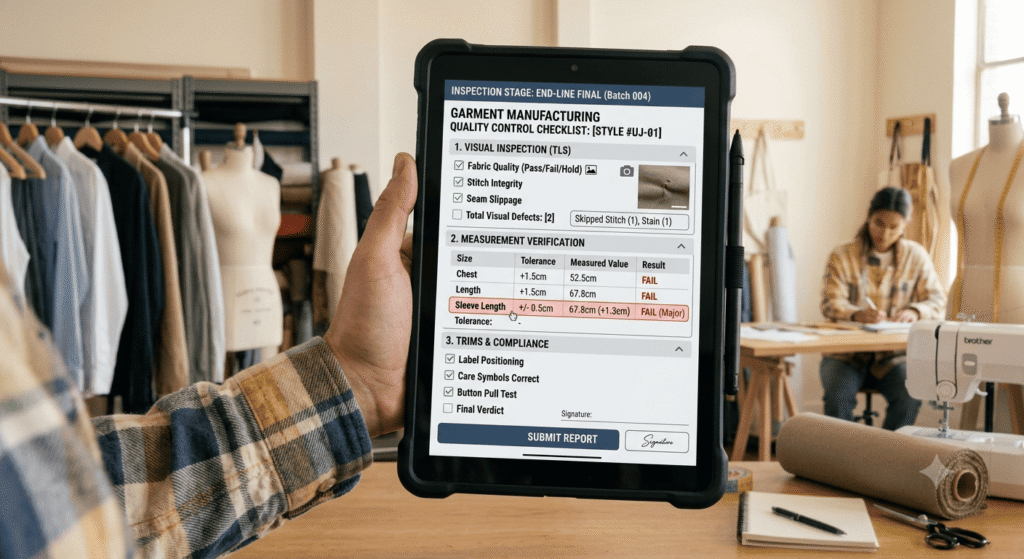
A batch of 500 garments can pass every measurement check and still fail on delivery — because nobody checked stitch density, or nobody classified a recurring defect as major instead of minor. A proper QC checklist exists precisely to stop quality control from depending on one inspector’s memory.
This guide is a working QC checklist clothing manufacturing UK brands and production managers can use during and after any production run.
In this article:
- Why a structured QC checklist matters more than “checking the garments look right”
- The three stages of quality control, from inline to final inspection
- AQL standards and how they actually apply to clothing
- Critical, major, and minor defect classification
- A complete garment QC checklist across every key category
- A measurement tolerance chart for common garment points
- When to bring in a third-party QC inspector
- The QC failures that repeat across production runs
Contents
- 1. Why a QC Checklist Is Essential for Every Clothing Production Run
- 2. The Three Stages of Clothing Quality Control
- 3. AQL Standards for Clothing — How to Apply Them
- 4. Defect Classification — Critical, Major, and Minor
- 5. The Complete Garment QC Checklist
- 6. Measurement Tolerance Chart for Clothing
- 7. When to Use a Third-Party QC Inspector
- 8. Common QC Failures and How to Prevent Them
- 9. The Silk Routes QC Approach
- 10. FAQ
Why a QC Checklist Is Essential for Every Clothing Production Run
Without a written checklist, quality control depends entirely on whoever happens to be inspecting that day — and different inspectors notice different things. A checklist makes quality consistent across inspectors, factories, and production runs.
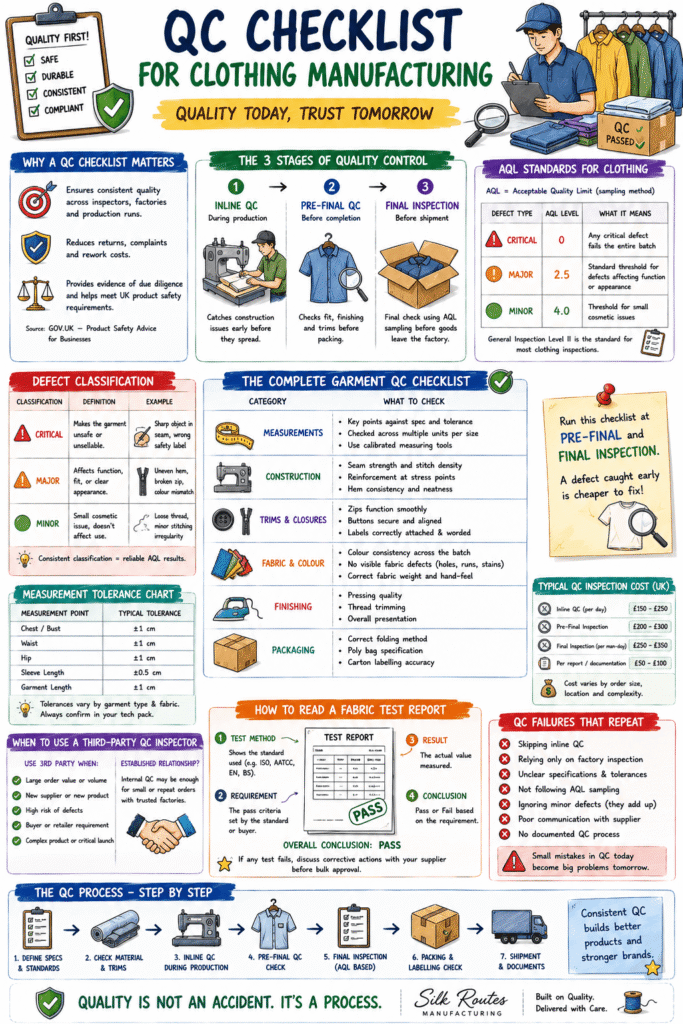
Beyond consistency, a documented QC process gives you evidence if a compliance issue arises later. UK product safety law places responsibility on the business placing goods on the market, and being able to show a structured inspection process matters if a safety question ever comes up (GOV.UK).
The Three Stages of Clothing Quality Control
| Stage | When It Happens | What It Catches |
|---|---|---|
| Inline QC | During active production | Construction issues before they multiply across the batch |
| Pre-Final QC | Once garments are mostly complete | Fit, finishing, and trim issues before packing |
| Final Inspection | Before shipment | Overall batch quality against AQL standards |
Inline QC — During Production
Inline QC checks garments as they move through the production line, catching construction problems while only a portion of the batch is affected. Catching a stitching error at garment 50 out of 500 saves 450 garments from the same fault.
Pre-Final QC — Before Completion
Pre-final QC happens once garments are largely finished but before final packing, checking fit, trims, and finishing details while there’s still time to correct issues without delaying shipment.
Final Inspection — Before Shipment
Final inspection is the last check before goods leave the factory, typically conducted using AQL-based sampling rather than checking every single unit. This is the checkpoint most likely to be conducted by a third-party inspector rather than factory staff alone.
AQL Standards for Clothing — How to Apply Them
Acceptable Quality Limit (AQL) is the sampling method most clothing inspections use instead of checking every garment in a batch — a statistically representative sample is checked, and the result is applied to the whole lot.
| Defect Type | Typical AQL Level | What It Means |
|---|---|---|
| Critical | 0 | Any critical defect fails the entire batch |
| Major | 2.5 | Standard threshold for defects affecting function or appearance |
| Minor | 4.0 | Threshold for small cosmetic issues |
General Inspection Level II is the standard used for most clothing inspections, balancing sample size against inspection cost. The exact sample size scales with your total order quantity, not a fixed number regardless of batch size.
Defect Classification — Critical, Major, and Minor
| Classification | Definition | Example |
|---|---|---|
| Critical | Makes the garment unsafe or unsellable | Sharp object left in seam, wrong safety label |
| Major | Affects function, fit, or clear appearance | Uneven hem, broken zip, significant colour mismatch |
| Minor | Small cosmetic issue, doesn’t affect use | Loose thread, minor stitching irregularity |
Classifying defects consistently matters as much as spotting them. A defect logged as “minor” by one inspector and “major” by another makes your AQL results meaningless over time.
The Complete Garment QC Checklist
| Category | What to Check |
|---|---|
| Measurements | Key points against spec and tolerance, checked across multiple units per size |
| Construction | Seam strength, stitch density, reinforcement at stress points, hem consistency |
| Trims & Closures | Zips function smoothly, buttons secure, labels correctly attached and worded |
| Fabric & Colour | Colour consistency across the batch, no visible fabric defects, correct fabric weight |
| Finishing | Pressing quality, thread trimming, overall presentation |
| Packaging | Correct folding method, poly bag specification, carton labelling accuracy |
Run this checklist at both pre-final and final inspection stages — a defect caught only at final inspection is far more expensive to fix than one caught earlier.
Measurement Tolerance Chart for Clothing
| Measurement Point | Typical Tolerance |
|---|---|
| Chest/Bust | ±1cm |
| Waist | ±1cm |
| Hip | ±1cm |
| Sleeve Length | ±0.5cm |
| Garment Length | ±1cm |
Tolerances can vary by garment type and fabric — knits typically tolerate slightly more variance than structured wovens. Confirm the exact tolerance range in your tech pack rather than assuming these figures apply universally.
When to Use a Third-Party QC Inspector
Bring in a third-party inspector for larger orders, new supplier relationships, or any order where the cost of a failed shipment would be significant. Independent inspection removes the conflict of interest that exists when a factory inspects its own output.
For smaller or lower-risk orders with an established, trusted manufacturer, in-house inspection combined with a clear checklist may be sufficient. The decision should scale with the cost of getting it wrong, not simply the order size alone.
Common QC Failures and How to Prevent Them
No written checklist, relying on inspector judgement alone. Different inspectors notice different things, leading to inconsistent results across batches. Fix: use the same written checklist for every inspection, regardless of who’s conducting it.
Only inspecting at final stage. Waiting until final inspection to catch problems means defects have already multiplied across the whole batch. Fix: build inline and pre-final checks into the production timeline, not just a final pass.
Inconsistent defect classification. Treating the same defect as major on one inspection and minor on another makes AQL data unreliable over time. Fix: agree defect classification examples with your factory in writing before production starts.
Skipping measurement checks in favour of visual inspection only. A garment can look correct and still fail its measurement tolerance. Fix: physically measure a sample of units at every inspection stage, not just at final sign-off.
No third-party inspection on high-risk orders. Relying solely on factory self-inspection removes an independent check exactly when it matters most. Fix: use a third-party inspector for large orders, new suppliers, or safety-sensitive garment categories.
The Silk Routes QC Approach
We apply the same written checklist across every inspection stage, so a defect classification doesn’t depend on which team member happens to be checking that day. Measurement checks are physical, not visual-only, at every stage from pre-final through to final inspection.
If you’re setting up a QC process for your first production run, our clothing manufacturing services team can walk you through what inspection stages make sense for your order size and risk level.
FAQ
What is a QC checklist in clothing manufacturing?
A QC checklist is a written, standardised list of everything that needs to be checked at each stage of garment production — measurements, construction, trims, fabric, and packaging. It ensures inspection results are consistent regardless of who’s conducting the check.
What is AQL in garment quality control?
AQL (Acceptable Quality Limit) is the sampling standard used to inspect a representative portion of a production batch rather than every single unit. Typical clothing AQL levels are 0 for critical defects, 2.5 for major defects, and 4.0 for minor defects.
What’s the difference between a major and minor defect in clothing?
A major defect affects a garment’s function, fit, or clearly visible appearance, such as a broken zip or significant colour mismatch. A minor defect is a small cosmetic issue, like a loose thread, that doesn’t affect how the garment functions or fits.
When should I use a third-party QC inspector?
Third-party inspection is most valuable for larger orders, new supplier relationships, or any order where a failed shipment would be costly. For smaller orders with an established, trusted manufacturer, in-house inspection with a clear checklist may be sufficient.
What measurement tolerance is normal for clothing?
Common tolerances for points like chest, waist, and garment length are around ±1cm, with tighter tolerances of about ±0.5cm for sleeve length. Exact tolerances can vary by garment type and fabric, so they should be confirmed in the tech pack rather than assumed.