
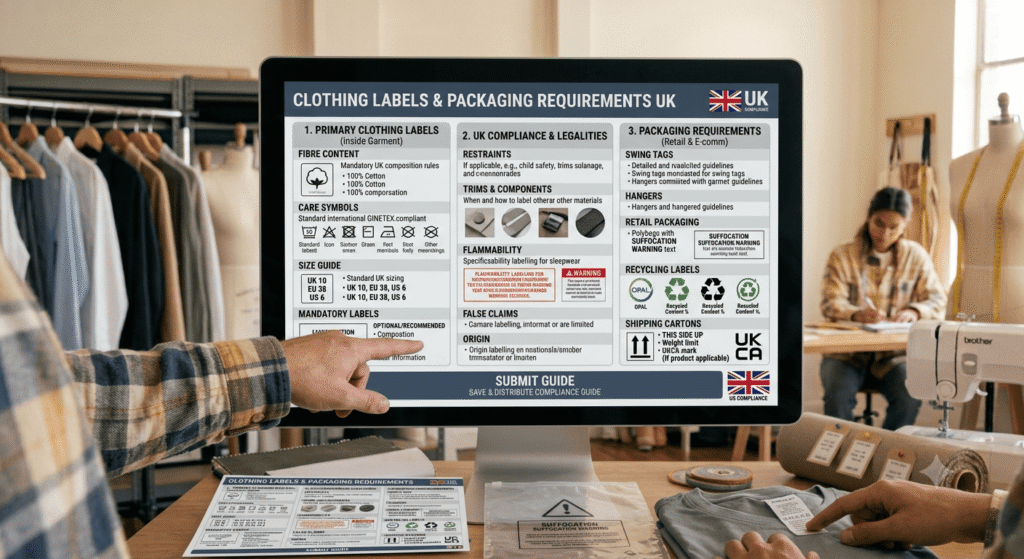
Get labelling wrong on a clothing product, and it’s not just a design inconvenience — it can be a Trading Standards enforcement issue. Yet most brands only really understand which labels are legally required versus commercially expected once something’s already gone to print.
This guide sets out the clothing labels packaging requirements UK brands need to follow, covering exactly what’s mandatory by law and what’s simply strong commercial practice.
In this article:
- What labels are legally required on clothing sold in the UK
- Fibre content labelling rules and common mistakes
- Care label requirements — what’s mandatory versus commercial practice
- Whether country of origin labelling is required
- Brand, size, swing tag, and barcode conventions
- Packaging requirements, including Extended Producer Responsibility
- The compliance mistakes that catch brands out
Contents
- 1. What Labels Are Legally Required on Clothing Sold in the UK?
- 2. Fibre Content Labelling — Rules and Common Mistakes
- 3. Care Label Requirements — ISO Symbols and UK Law
- 4. Country of Origin — Is It Required?
- 5. Brand and Size Labels — Commercial Best Practice
- 6. Swing Tags and Hang Tags — Legal vs Commercial
- 7. Barcode and Retail Scanning Requirements
- 8. Packaging Requirements for UK Clothing Brands
- 9. Common Labelling and Packaging Compliance Mistakes
- 10. How Silk Routes Ensures Label Compliance for Client Brands
- 11. FAQ
- 11.1. What labels are legally required on clothing sold in the UK?
- 11.2. Is care labelling a legal requirement in the UK?
- 11.3. Do I need to state the country of origin on UK clothing labels?
- 11.4. What packaging regulations apply to UK clothing brands?
- 11.5. What happens if my fibre content label is inaccurate?
What Labels Are Legally Required on Clothing Sold in the UK?
| Label Type | Legally Required? | Notes |
|---|---|---|
| Fibre Content | Yes | Mandatory under UK law for all textile products |
| Care Instructions | No | Not legally required, but standard commercial practice |
| Country of Origin | No | Not generally required, but a false claim is illegal |
| Animal-Origin Parts | Yes, if applicable | Must state “contains non-textile parts of animal origin” |
| Size Label | No | Commercial expectation, not a legal requirement |
| Brand Label | No | Commercial practice only |
Fibre content is the one label UK law actually requires on every textile product. Everything else on this list is either conditional or purely commercial convention — which is exactly where confusion tends to creep in.
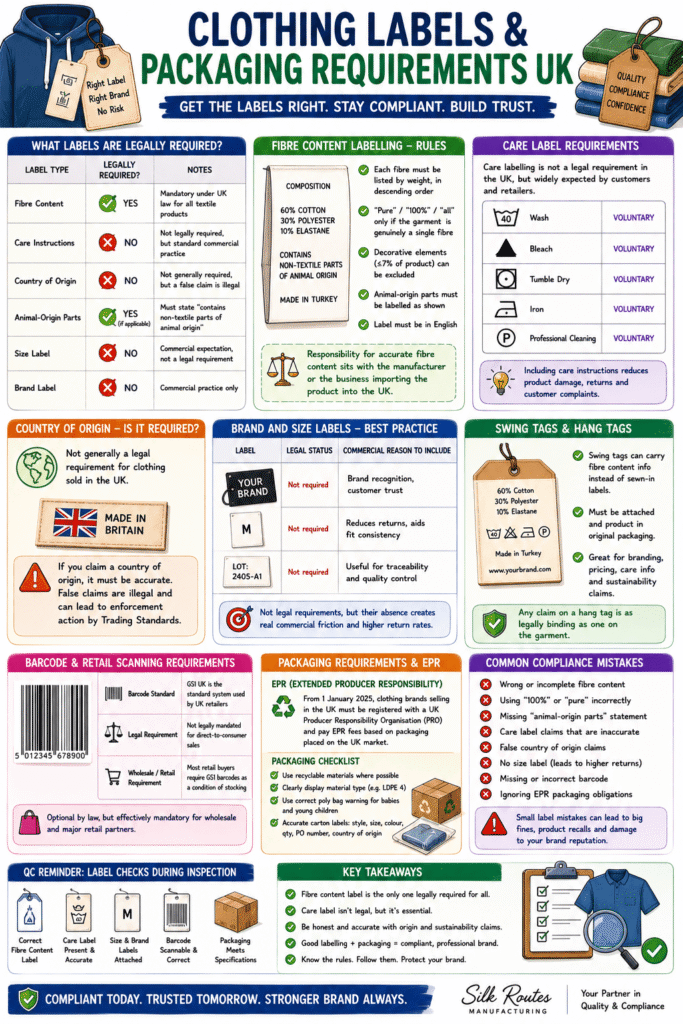
Fibre Content Labelling — Rules and Common Mistakes
Fibre content labelling in the UK is governed by the Textile Products (Labelling and Fibre Composition) Regulations 2012, which require every textile product to carry a label stating its fibre content accurately (GOV.UK).
| Rule | Detail |
|---|---|
| Multi-fibre garments | Each fibre must be listed by weight, in descending order |
| “Pure” / “100%” / “all” | Only usable if the garment is genuinely a single fibre |
| Decorative elements | Components making up 7% or less of the product can be excluded |
| Animal-origin parts | Must be labelled “contains non-textile parts of animal origin” |
| Language | Label must be in English |
Responsibility for accurate fibre content sits with the manufacturer or the business importing the product into the UK — not the retailer selling it on. Getting this wrong isn’t a minor labelling slip; misdescribing fibre content is a compliance breach with real enforcement risk.
Care Label Requirements — ISO Symbols and UK Law
Care labelling is not a legal requirement in the UK, which surprises most brands given how universal it’s become. Every major retailer expects it, and its absence increases return rates and customer complaints, but there’s no statute mandating it.
| Element | Status |
|---|---|
| Wash symbol | Voluntary, ISO 3758 standard widely used |
| Bleach symbol | Voluntary |
| Tumble dry symbol | Voluntary |
| Iron symbol | Voluntary |
| Professional cleaning symbol | Voluntary |
Even though care labelling isn’t legally required, including it reduces the number of garments damaged through incorrect washing — and fewer damaged garments means fewer returns and complaints to handle.
Country of Origin — Is It Required?
Country of origin labelling is not generally a legal requirement for clothing sold in the UK domestic market. Where it becomes a legal issue is if you make a country of origin claim that isn’t accurate — a garment displaying a British flag or “Made in Britain” branding when it wasn’t manufactured there is a false and illegal claim, not just a labelling oversight.
If you do want to make an origin claim commercially, make sure it’s precisely accurate and can be evidenced, since Trading Standards treats origin misrepresentation as a serious issue rather than a technicality.
Brand and Size Labels — Commercial Best Practice
| Label | Legal Status | Commercial Reason to Include |
|---|---|---|
| Brand Label | Not required | Brand recognition, customer trust |
| Size Label | Not required | Reduces returns, aids fit consistency |
| Batch/Lot Reference | Not required | Useful for traceability and quality control |
None of these are legally mandated, but their absence creates real commercial friction — a garment with no size label is far more likely to be returned as “didn’t fit,” regardless of the actual fit quality.
Swing Tags and Hang Tags — Legal vs Commercial
Swing tags can legally carry your fibre content declaration instead of a sewn-in label, provided the garment is sold in its original packaging with the tag attached — this flexibility exists specifically for products like hosiery or accessories where a sewn label isn’t practical.
Beyond the legal minimum, swing tags are a commercial branding opportunity — pricing, care instructions, brand story, and sustainability claims commonly appear here. Just be careful that any sustainability or origin claim on a hang tag is as accurate as one printed on the garment itself; a hang tag claim is just as legally binding as a sewn-in label.
Barcode and Retail Scanning Requirements
| Requirement | Detail |
|---|---|
| Barcode Standard | GS1 UK is the standard system used by UK retailers |
| Legal Requirement | Not legally mandated for direct-to-consumer sales |
| Wholesale/Retail Requirement | Most retail buyers require GS1 barcodes as a condition of stocking |
Barcoding isn’t a legal requirement, but it’s effectively mandatory if you plan to sell through wholesale or major retail partners — most buyers won’t onboard a product without a compliant barcode already assigned.
Packaging Requirements for UK Clothing Brands
| Requirement | Who It Applies To | Detail |
|---|---|---|
| Extended Producer Responsibility (EPR) | Turnover £1m+ and 25+ tonnes of packaging annually | Must report packaging data; fees apply above £2m turnover / 50+ tonnes |
| Packaging Safety | All businesses | Packaging must not present a safety risk, particularly to children |
| Recyclability Labelling | Being phased in | Requirements have shifted; check current guidance before printing packaging |
UK businesses with an annual turnover of £1 million or more that supply or import more than 25 tonnes of packaging must report packaging data under Extended Producer Responsibility rules, with additional fee obligations applying once turnover exceeds £2 million or packaging volume exceeds 50 tonnes (GOV.UK). Most small and early-stage clothing brands sit below these thresholds, but it’s worth checking as order volumes scale.
Common Labelling and Packaging Compliance Mistakes
Assuming care labels are legally required. They’re not, but skipping them still increases returns significantly. Fix: include care labelling as standard commercial practice, even without a legal obligation.
Making an unverified country of origin claim. A “Made in Britain” or flag-based claim that isn’t accurate is a legal issue, not just a branding choice. Fix: only make origin claims you can evidence precisely.
Miscalculating fibre percentages on blended fabrics. Listing fibres out of weight order or rounding percentages incorrectly is a common compliance slip. Fix: verify fibre composition figures against your fabric supplier’s actual test data, not estimates.
Ignoring EPR packaging thresholds as you scale. Brands often don’t realise they’ve crossed the reporting threshold until well after it applies. Fix: track your annual packaging tonnage and turnover against current EPR thresholds each year.
Treating swing tag claims as less binding than garment labels. A sustainability or origin claim on a hang tag carries the same legal weight as one sewn into the garment. Fix: apply the same accuracy standard to every label type, not just the main garment label.
How Silk Routes Ensures Label Compliance for Client Brands
We check fibre content declarations against actual fabric composition data before labels go to print, not after — catching a percentage error before production is far cheaper than a relabelling exercise afterward.
If you’re finalising labelling for your first UK production run, our clothing manufacturing services team can review your label content before it’s committed to print.
FAQ
What labels are legally required on clothing sold in the UK?
Fibre content labelling is the main legal requirement for clothing sold in the UK, under the Textile Products (Labelling and Fibre Composition) Regulations 2012. Care labels, size labels, and country of origin are not legally required, though care and size labelling are strong commercial practice.
Is care labelling a legal requirement in the UK?
No, care labelling is not a legal requirement in the UK, though it’s expected by virtually every retailer and reduces returns caused by incorrect washing. Most brands include it as standard practice even though there’s no statutory obligation to do so.
Do I need to state the country of origin on UK clothing labels?
Country of origin is not generally a legal requirement for clothing sold in the UK domestic market. However, if you do make an origin claim, such as “Made in Britain,” it must be accurate — a false claim is a legal compliance issue, not just a labelling choice.
What packaging regulations apply to UK clothing brands?
UK businesses with an annual turnover of £1 million or more that supply or import more than 25 tonnes of packaging annually must report packaging data under Extended Producer Responsibility rules. Most small and early-stage clothing brands fall below this threshold, but it’s worth monitoring as your order volumes grow.
What happens if my fibre content label is inaccurate?
An inaccurate fibre content label is a breach of the Textile Products (Labelling and Fibre Composition) Regulations 2012 and can result in Trading Standards enforcement action. It’s the manufacturer’s or importer’s responsibility to ensure the label matches the garment’s actual composition, not the retailer’s.