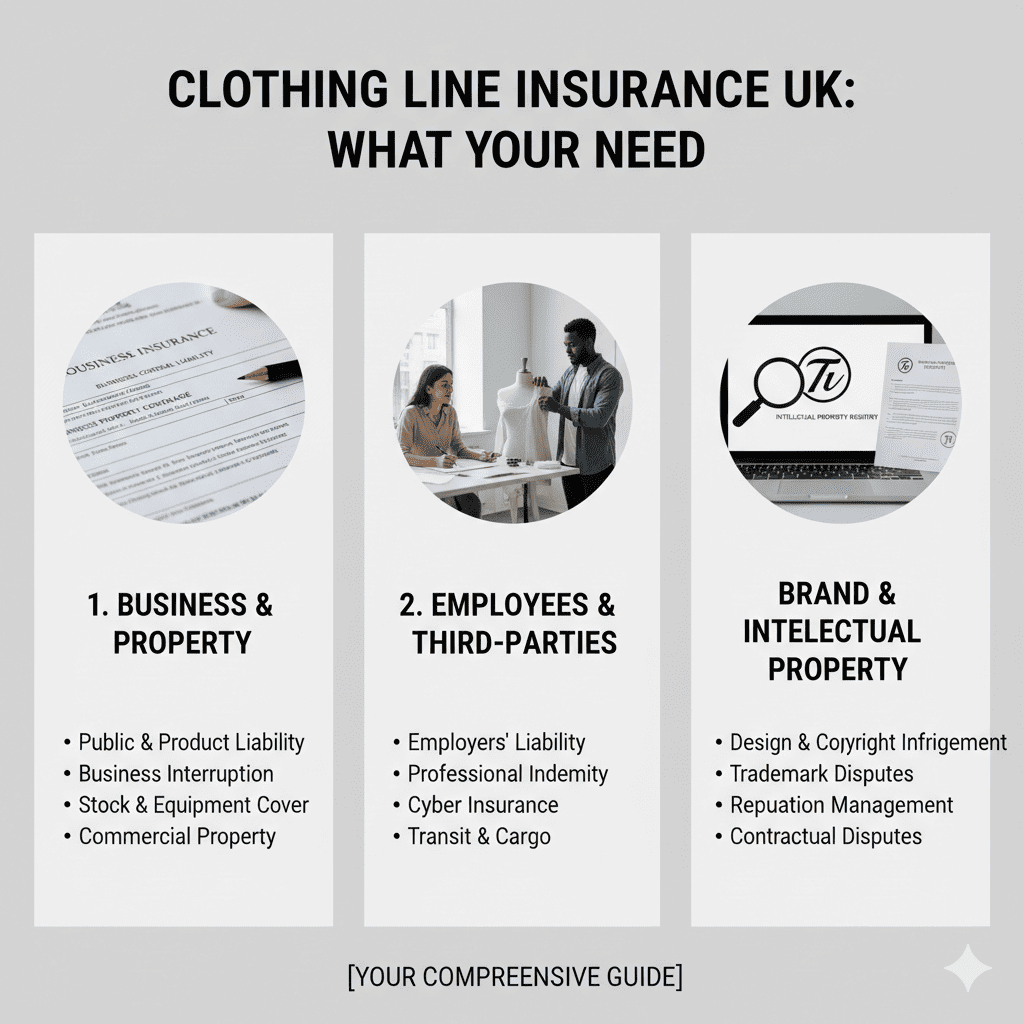
A recent ABI-commissioned survey of UK SMEs found that 39% of firms with one to nine employees didn’t have the legally required employers’ liability insurance in place, and 28% of sole traders reported having no insurance at all. Fashion and clothing brands consistently rank among the most exposed categories, because most founders insure the business they think they have rather than the liabilities they actually carry.
A clothing brand that manufactures product, sells to consumers, holds stock, and employs or contracts workers carries five to eight distinct insurance exposures, most of which a standard business insurance policy doesn’t cover.
This guide covers every insurance type a UK clothing brand needs, what each covers, and what happens when the wrong policy, or no policy, is in place when something goes wrong.
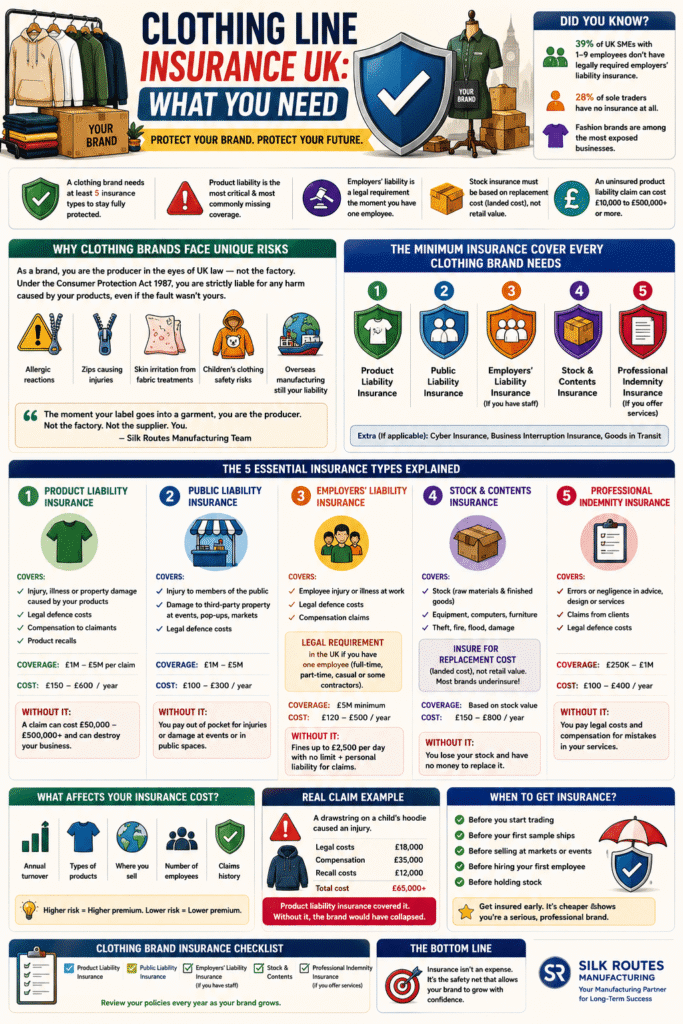
- A UK clothing brand needs a minimum of five insurance types: product liability, public liability, employers’ liability (if you have staff), stock and contents, and professional indemnity if you offer services
- Product liability insurance is the most critical and most commonly absent — it covers claims arising from a garment causing injury or harm to the customer who wears it
- Employers’ liability insurance is a legal requirement in the UK the moment you have one employee, including part-time staff, casual workers, and some contractors
- Stock insurance must reflect replacement cost at landed cost, not retail value — most brands underinsure by using retail price as the insured value
- An uninsured product liability claim involving a garment defect can result in costs of £10,000 to £500,000+, far exceeding the value of a first production run
Contents
- 1. Why Clothing Brands Face Specific Insurance Exposures
- 2. Insurance Type 1 — Product Liability Insurance
- 3. Insurance Type 2 — Public Liability Insurance
- 4. Insurance Type 3 — Employers’ Liability Insurance
- 5. Insurance Type 4 — Stock and Contents Insurance
- 6. Insurance Type 5 — Professional Indemnity Insurance
- 7. Insurance Type 6 — Cyber Liability Insurance
- 8. What a Combined Policy Looks Like
- 9. Regulatory Compliance: The Insurance That Is Not Optional
- 10. Common Insurance Mistakes UK Clothing Brands Make
- 11. FAQ
- 11.1. Is product liability insurance a legal requirement for UK clothing brands?
- 11.2. How much product liability cover does a clothing brand need?
- 11.3. Does employers’ liability apply to freelancers I hire occasionally?
- 11.4. Does my Shopify store need separate insurance?
- 11.5. What happens if a customer claims my garment caused an allergic reaction?
- 12. Insurance Is the Infrastructure, Not the Afterthought
Why Clothing Brands Face Specific Insurance Exposures
A clothing brand isn’t just a retailer. It’s a product manufacturer, and in the eyes of UK law, the brand that puts its name on a garment is the responsible party for that garment’s safety, regardless of where it was manufactured.
Under the Consumer Protection Act 1987, producers, which includes brands that commission the manufacture of products under their name, are strictly liable for damage caused by defective products. This liability doesn’t require proof of negligence. If a garment you sell causes injury, you’re liable whether or not the fault was yours, your manufacturer’s, or a third party’s.
This is the core insurance exposure most clothing startup guides don’t explain: the brand, not the factory, is the producer in the eyes of UK law. The factory’s liability ends at the factory gate. Yours begins at the customer’s door.
Clothing brands sourcing from overseas manufacturers remain fully responsible for product safety compliance under UK law, including compliance with the General Product Safety Regulations and the Consumer Protection Act 1987. For a brand whose production is handled by a third-party manufacturer, the insurance question, and the legal exposure, isn’t reduced. It’s the same as for a brand operating its own factory.
Insurance Type 1 — Product Liability Insurance
What it is: covers claims made against your brand for injury, illness, or property damage caused by a product you sell.
Why clothing brands need it: a garment that causes an allergic reaction, a zip that injures a child, a fabric treatment that causes skin irritation, a cord on children’s clothing that presents a strangulation risk — all of these are product liability claims. The garment doesn’t have to be manufactured incorrectly for a claim to arise. It simply has to cause harm.
What it covers:
- Legal costs of defending a product liability claim
- Compensation awarded to the claimant
- Costs of product recall if a defective batch must be withdrawn from the market
- Claims arising from overseas manufacturing where the brand is the named producer
What it doesn’t cover:
- Deliberate non-compliance with product safety regulations
- Products known to be defective at the point of sale
- Claims arising before the policy start date
Coverage level: minimum £1 million per claim is the industry standard for clothing brands. £2 million to £5 million is appropriate for brands selling children’s clothing or products with specific safety requirements.
Cost: typically £150 to £600 per year for a startup clothing brand, depending on turnover, product type, and geographic markets. Children’s clothing carries a higher premium than adult clothing due to specific regulatory requirements.
What happens without it: a product liability claim without insurance is a personal liability for the sole trader or an uninsured corporate liability for a limited company. At £50,000 to £500,000 in legal and compensation costs for a serious claim, an uninsured product liability event ends most startup brands immediately.
“Every clothing brand we work with is reminded of the same thing: the moment your label goes into a garment, you are the producer. Not the factory. Not the supplier. You. Product liability insurance is not optional, it’s the commercial precondition of being in the clothing business.” — Silk Routes Manufacturing Team
Insurance Type 2 — Public Liability Insurance
What it is: covers claims made by members of the public for injury or property damage caused by your business activities.
Why clothing brands need it: if you sell at markets, pop-up shops, trade shows, or any physical location, public liability insurance covers any claim arising from those activities. A customer who trips over a display rail at your market stand, or whose property is damaged at a pop-up event, is a public liability claim.
What it covers:
- Injury to members of the public arising from your business activities
- Damage to third-party property caused by your business
- Legal costs of defending claims
Coverage level: minimum £1 million. Many market venues, pop-up locations, and trade shows require evidence of £2 million or £5 million public liability insurance before you can trade. Check the venue requirement before applying.
Cost: typically £100 to £350 per year for a startup clothing brand without a permanent retail location. Higher for brands with regular market or trade show activity.
Note: trade show organisers such as Spring Fair, Scoop, and INDX Shows typically require proof of public liability insurance, often at least £2 million, as a condition of exhibiting. This is non-negotiable and must be in place before the event.
Insurance Type 3 — Employers’ Liability Insurance
What it is: covers claims made by employees who suffer injury or illness in the course of their work for your business.
Why clothing brands need it: under the Employers’ Liability (Compulsory Insurance) Act 1969, every UK business with one or more employees, including part-time staff, casual workers, and some contractor arrangements, must hold employers’ liability insurance with a minimum cover of £5 million.
Failure to hold employers’ liability insurance when required is a criminal offence. The Health and Safety Executive can fine businesses £2,500 for every day they operate without suitable insurance, plus up to £1,000 for failing to display a valid certificate.
Who counts as an employee for this purpose: full-time staff, part-time staff, temporary workers, and in some cases self-employed contractors who work exclusively for your business, use your equipment, or are under your direct supervision.
Who doesn’t require employers’ liability: sole traders with no staff, limited companies where the only employee is also the sole director and shareholder.
Cost: typically £150 to £500 per year for a startup clothing brand with 1 to 5 employees. Often bundled with public liability in a combined SME policy.
Insurance Type 4 — Stock and Contents Insurance
What it is: covers the loss, damage, or theft of your stock (clothing inventory) and business contents (equipment, fixtures, fittings).
Why clothing brands need it: a startup brand holding £3,000 to £15,000 of production stock at home, in a warehouse, or at a third-party logistics partner is carrying a significant uninsured asset if stock insurance isn’t in place. Fire, flood, theft, or accidental damage can write off an entire production run, and with no insurance, the loss is unrecoverable.
Critical calculation — insuring at the right value:
Most startup brands make one of two errors on stock insurance:
Error 1 — Insuring at retail price: a brand holding 100 units at £55 RRP calculates their insured stock value as £5,500. The insurance payout on a claim, however, is the replacement cost, the landed cost of replacing the stock, not its retail value. If the landed cost is £14 per unit, the replacement cost is £1,400. Insuring at £5,500 overpays on premium.
Error 2 — Insuring at factory price, not landed cost: a brand calculates stock value at factory unit price (£12 per unit) rather than landed cost (£14 per unit including freight and packaging). Insure at landed cost.
Correct stock valuation for insurance purposes: Stock insured value = number of units × landed cost per unit. At 100 units, £14 landed cost: insure for £1,400 minimum.
What stock insurance covers:
- Loss or theft of stock at your premises, warehouse, or 3PL
- Damage from fire, flood, or accidental damage
- Transit damage (check whether your policy covers stock in transit separately)
- Stock held at trade shows or markets (check — many standard policies exclude this)
What it doesn’t cover: stock held at a manufacturer’s premises (this is the manufacturer’s insurance exposure until delivery is accepted), stock that deteriorates due to storage conditions, and unexplained stock losses without evidence of theft.
Cost: typically £150 to £400 per year for £10,000 to £50,000 of stock cover.
If you’re weighing when stock risk transfers from your manufacturer to your brand, see our clothing manufacturing services — that transfer point is exactly when your stock insurance obligation begins.
Insurance Type 5 — Professional Indemnity Insurance
What it is: covers claims arising from professional advice or services that result in financial loss to a client.
Why some clothing brands need it: if your business provides design services, styling consultancy, brand strategy advice, or any other professional service to clients, in addition to manufacturing and selling clothing, professional indemnity insurance covers claims arising from those services.
Clothing brands that need it: founders who offer fashion design or consultancy services alongside their brand; brands that provide custom design or manufacturing services to other brands; wholesale or sourcing agents who advise clients on manufacturing.
Clothing brands that don’t need it: brands that solely design, manufacture, and sell their own product — the product liability policy covers the product; there’s no professional advice exposure.
Coverage level: minimum £100,000 for startup consultancy activity. Most clients of professional services in fashion require evidence of £1 million minimum cover.
Cost: typically £200 to £600 per year for a startup with limited consultancy turnover.
Insurance Type 6 — Cyber Liability Insurance
What it is: covers costs arising from data breaches, cyberattacks, and online fraud affecting your business.
Why clothing brands with e-commerce stores need it: a DTC clothing brand operating a Shopify store collects customer personal data, names, addresses, payment details, and is subject to UK GDPR obligations. A data breach that exposes customer data triggers an ICO reporting obligation and potentially regulatory fines, plus the cost of notifying affected customers.
What it covers:
- Costs of investigating and notifying a data breach
- Legal costs of responding to regulatory action
- Business interruption costs if systems are taken offline by an attack
- Ransomware payment costs (check policy terms — not all cyber policies cover this)
Cost: typically £150 to £400 per year for a startup e-commerce brand with under £500,000 annual turnover.
When it becomes essential: immediately for any brand operating a Shopify store or collecting customer payment data. UK GDPR fines for serious data breaches can reach 4% of annual global turnover.
What a Combined Policy Looks Like
Most UK insurance brokers offer combined small business policies that bundle multiple cover types. For a startup clothing brand, the most efficient approach is a single combined policy that includes:
| Cover | Minimum Level | Annual Cost Estimate |
|---|---|---|
| Product liability | £2 million | Included in combined policy |
| Public liability | £2 million | Included in combined policy |
| Employers’ liability | £5 million (if any staff) | Included or +£100–£200 |
| Stock and contents | Landed cost of inventory | £150–£400 depending on stock value |
| Cyber liability | £250,000 | £150–£300 |
| Total combined estimate | £400–£1,200/year |
Specialist fashion and retail insurance providers in the UK include Hiscox, Simply Business, Direct Line for Business, and AXA Business. A broker who specialises in retail or fashion will structure a policy that covers the specific exposures of a clothing brand rather than applying a generic small business policy.
What to avoid: a generic home business insurance policy that has been extended to cover “small business activities.” These policies almost always exclude product liability for manufactured goods, the primary exposure of a clothing brand.
Regulatory Compliance: The Insurance That Is Not Optional
Beyond commercial insurance, UK clothing brands have regulatory compliance obligations that function as a form of risk management:
Product safety compliance: all garments sold in the UK must comply with the General Product Safety Regulations. This isn’t insurance, it’s a legal requirement. Non-compliant products can be recalled by Trading Standards regardless of whether the brand has insurance.
Children’s clothing regulations: garments for children must comply with specific safety standards — cord length restrictions, flammability requirements, and chemical restrictions under UK REACH. A product liability claim arising from a children’s clothing item that didn’t comply with these regulations may not be covered by your product liability insurance if non-compliance constitutes negligence.
Textile labelling: all garments sold in the UK must comply with the Textile Products (Labelling and Fibre Composition) Regulations 2012. Non-compliant labelling is a Trading Standards enforcement issue, and may affect the validity of product liability insurance if the claim arises from a product that wasn’t compliantly labelled.
UKFT’s compliance guidance is a useful general resource for UK clothing brands covering labelling, chemical restrictions, flammability, and product safety.
Common Insurance Mistakes UK Clothing Brands Make
Having no product liability insurance at all. The most common and most dangerous gap. A startup brand that hasn’t yet had a claim often concludes it doesn’t need product liability insurance.
Fix: product liability insurance is purchased before the first unit is sold, not after. The premium is £150 to £600 per year. The uninsured claim cost starts at £10,000 and rises from there.
Using a personal home insurance policy for business stock. A personal home insurance policy that includes contents cover almost never covers business stock held at home.
Fix: stock insurance is a business policy. If stock is held at home, the business stock insurance policy explicitly covers that location.
Not updating stock value as inventory grows. A brand that insures £1,500 of stock in month one and holds £8,000 of stock by month six without updating the policy is underinsured by £6,500.
Fix: review and update stock insured value quarterly. As production runs increase, the insured value increases proportionally.
Not checking venue insurance requirements before a market or trade show. Arriving at a market or trade show without the required minimum public liability cover means you cannot trade.
Fix: check the insurance requirements of every market, pop-up, and trade show before booking. Request the minimum required coverage in writing.
Assuming the manufacturer’s insurance covers the brand. A manufacturer’s insurance doesn’t cover product claims arising from goods the brand sells after they leave the factory.
Fix: the brand’s product liability insurance covers the brand’s product from the point of sale to the customer.
FAQ
Is product liability insurance a legal requirement for UK clothing brands?
Product liability insurance isn’t a statutory legal requirement in the UK, unlike employers’ liability insurance. However, it’s functionally essential: under the Consumer Protection Act 1987, clothing brands are strictly liable for defective products that cause harm, and the legal and compensation costs of an uninsured claim typically exceed the total annual revenue of a startup brand.
How much product liability cover does a clothing brand need?
A minimum of £1 million per claim for adult clothing sold in the UK. £2 million to £5 million for children’s clothing, which carries higher regulatory requirements and a higher claims risk profile.
Does employers’ liability apply to freelancers I hire occasionally?
Sometimes. The test isn’t whether the person is employed on a contract of employment, it’s whether the relationship has the characteristics of employment. A freelancer who works exclusively for your brand, uses your equipment, and is under your direction is likely to be treated as an employee for insurance purposes.
Does my Shopify store need separate insurance?
Cyber liability insurance covers data breach risks arising from your e-commerce store. Product liability and public liability cover applies to products sold online in the same way as products sold physically. Check your policy wording for “distance selling” or “online sales” to confirm.
What happens if a customer claims my garment caused an allergic reaction?
This is a product liability claim. If you hold product liability insurance, the insurer takes over the legal defence and covers any compensation awarded. Allergic reaction claims in clothing typically arise from undisclosed chemical treatments, dyes, or fabric finishes, all covered under product liability where the product is the cause.
Insurance Is the Infrastructure, Not the Afterthought
Most startup brands treat insurance as a box to tick after the brand is launched, something to sort out once there’s revenue to pay for it.
The legal and commercial exposure of a clothing brand begins the moment the first garment is sold. The Consumer Protection Act 1987 doesn’t wait for the brand to become profitable before it applies.
Insurance for a clothing brand is infrastructure, the same category as a tech pack, a manufacturing relationship, or a business bank account. It’s established before the first sale, not after the first claim.
The cost of the minimum insurance package for a UK clothing startup, product liability, public liability, stock cover, and cyber, is typically £400 to £800 per year. The cost of the first uninsured product liability claim starts at £10,000.
For the full picture on how to structure your manufacturing relationship in a way that reduces your product liability exposure, correct labelling, compliant spec, documented QC, our guide to low MOQ and private label clothing manufacturers UK covers every stage of the process from tech pack to delivery.
Ready to discuss how your manufacturing process affects your insurance and compliance obligations? Find out how Silk Routes works with startup brands on product specification and quality control.
People also ask
What kind of insurance do I need for a clothing business? At minimum: product liability (£1m+), public liability (£1-2m), employers’ liability (£5m, legally required with any staff), and stock/contents cover at landed cost. Add cyber liability if you run an e-commerce store, and professional indemnity only if you offer design or consultancy services alongside your own product.
What documents are required for insurance? Insurers typically ask for: your business registration details (Companies House number if a limited company), estimated or actual annual turnover, number of employees, stock value at landed cost, details of your manufacturing arrangement (UK or overseas, your own factory or a third-party manufacturer), and trading history if you have any. For product liability specifically, insurers may ask for your tech pack or product specification and details of any safety testing or certifications.
How to start a clothing line in the UK? In outline: register as a sole trader or limited company at Companies House, develop your product (tech pack, fabric, sampling), confirm a UK manufacturer and MOQ, put core insurance in place (product liability, public liability, employers’ liability if hiring), set up your sales channel (Shopify or similar), and complete a first production run before scaling. Our guide to low MOQ and private label clothing manufacturers UK covers the manufacturing side of this in detail.
What insurance do I need to carry goods? If you or a courier are physically transporting stock, goods-in-transit insurance covers loss or damage while items are being moved, between your manufacturer and your warehouse, or to a trade show or market, for example. This is separate from general stock and contents cover, which typically applies to stock at a fixed location, so check whether your policy includes transit cover or whether you need it added separately.