
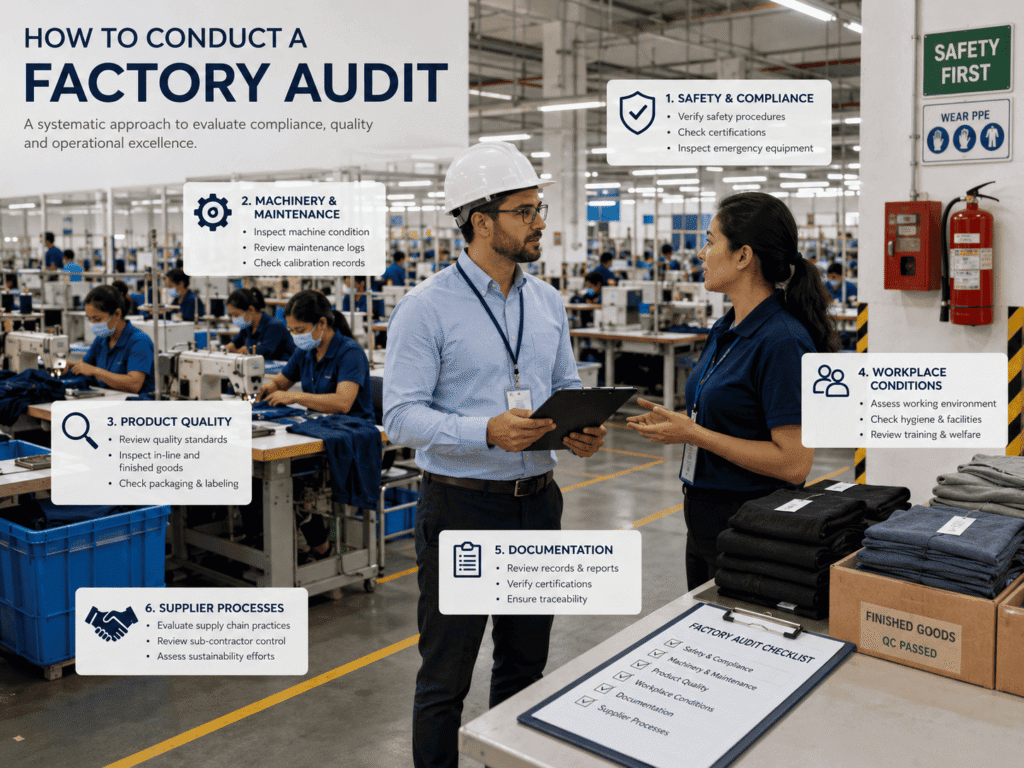
Most brands treat a factory audit as a formality to get through before placing a first order — tick the box, get the report, move on to production. That’s backwards. A factory audit that only happens once, before the relationship starts, tells you nothing about whether conditions hold up under order pressure six months later. This guide covers the types of factory audits, how to prepare for one, a full checklist of what to inspect, and how to read the report you get back.
In this article:
- Why factory audits matter beyond a one-time compliance check
- The four main types of factory audit and what each one covers
- A 30-point checklist covering social compliance, quality, safety, and environment
- How SEDEX and BSCI compare as third-party audit standards
- Common red flags that signal a factory audit isn’t being taken seriously
Contents
- 0.1. Why Every Clothing Brand Should Conduct Factory Audits
- 0.2. Types of Factory Audits — What Each Covers
- 0.3. How to Prepare for a Factory Audit
- 0.4. The Factory Audit Checklist — 30 Key Points
- 0.5. How to Read and Act on an Audit Report
- 0.6. SEDEX vs BSCI — Third-Party Audit Standards Compared
- 0.7. Common Factory Audit Red Flags
- 0.8. The Silk Routes Supplier Audit Approach
- 1. Factory audit checklist
- 1.1. FAQ
- 1.1.1. How often should a factory audit be repeated?
- 1.1.2. Can a brand conduct its own factory audit without a third party?
- 1.1.3. What’s the difference between an announced and unannounced audit?
- 1.1.4. Do UK-based factories need the same audits as overseas suppliers?
- 1.1.5. How long does a typical factory audit take?
Why Every Clothing Brand Should Conduct Factory Audits
Factory audits aren’t just good practice — for larger brands, supply chain due diligence is becoming a legal expectation rather than an optional extra. Under the UK’s Transparency in Supply Chains provision, commercial organisations with a turnover of £36 million or more operating in the UK are required to publish an annual statement setting out the steps they’ve taken to identify and address modern slavery risk in their supply chains.
Smaller brands don’t fall under that legal threshold, but the underlying risk doesn’t disappear just because a company is below it. A factory audit is the practical mechanism that actually generates the evidence a modern slavery statement — or any supplier due diligence process — depends on.
Types of Factory Audits — What Each Covers
Not every audit covers the same ground, and brands often assume one audit type covers everything.
| Audit Type | What It Covers | Typically Requested By |
|---|---|---|
| Social Compliance | Labour standards, working hours, wages, worker treatment | Retailers, ethical sourcing teams |
| Quality System | Production process control, QC procedures, documentation | Brand quality managers |
| Health and Safety | Fire safety, machine guarding, chemical handling, emergency procedures | Insurers, brand compliance teams |
| Environmental | Waste management, effluent treatment, energy use | Sustainability-focused brands |
Social Compliance Audit
A social compliance audit examines labour conditions — working hours, wage records, freedom of association, and treatment of workers — usually against an established code such as the ETI Base Code. This is the audit type most commonly requested by retailers before approving a new supplier.
Quality System Audit
A quality system audit checks whether a factory’s internal QC process is documented, followed consistently, and capable of catching defects before shipment — rather than checking the quality of any single garment. It’s less about spot-checking finished product and more about whether the system that produces consistent quality actually exists.
Health and Safety Audit
A health and safety audit covers fire precautions, machine guarding, chemical storage, and emergency evacuation procedures. In England and Wales, factories carry a legal duty under the Regulatory Reform (Fire Safety) Order 2005 to have a fire risk assessment in place and record its findings — worth confirming directly for any UK-based supplier, since this isn’t optional guidance but a statutory requirement.
Environmental Audit
An environmental audit reviews waste handling, water and effluent treatment, and energy consumption against local regulatory standards or a voluntary framework the factory has signed up to. This audit type has grown in importance as more brands report on supply chain environmental impact, not just their own operations.
How to Prepare for a Factory Audit
“Send the factory the audit scope in writing before the visit — vague expectations lead to a defensive factory floor and a less useful report.” — Silk Routes Manufacturing Team
Preparation matters as much for brands running the audit as for the factory being audited. Before scheduling a visit, confirm which audit type or standard applies, whether it’s announced or unannounced, and which documents the factory needs to have ready.
“Don’t audit only once and assume conditions hold. Build re-audits into your production calendar, especially for suppliers you’re scaling volume with.” — Silk Routes Manufacturing Team
Brands working with a UK manufacturing partner through Silk Routes’ clothing manufacturing services can request audit documentation as part of onboarding, rather than treating it as a separate process arranged after the relationship is already underway.
The Factory Audit Checklist — 30 Key Points
| Category | Checklist Items |
|---|---|
| Documentation (6) | Business licence, worker contracts, wage records, working hours logs, fire risk assessment, insurance certificates |
| Labour Standards (6) | Minimum age verification, freedom of association, no forced overtime, wage payment method, grievance procedure, anti-discrimination policy |
| Health & Safety (7) | Fire extinguishers serviced and accessible, emergency exits unobstructed, machine guarding in place, PPE provided and used, first aid kits stocked, COSHH-compliant chemical storage, evacuation drill records |
| Quality Systems (5) | In-line QC checkpoints, defect tracking log, corrective action process, measurement spec sheets on the floor, final inspection records |
| Environmental (4) | Waste segregation, wastewater treatment (if applicable), chemical inventory list, energy usage records |
| Facility Condition (2) | Structural condition of the building, adequate lighting and ventilation |
Chemical storage checks should reference COSHH — the Control of Substances Hazardous to Health Regulations — since this is the legal framework UK factories operate under for handling hazardous substances safely.
How to Read and Act on an Audit Report
“A clean audit report with zero findings is often a red flag, not a good sign — it usually means the auditor wasn’t given real access.” — Silk Routes Manufacturing Team
Most audit reports separate findings into minor and major non-compliances, with major findings requiring a documented corrective action plan and a follow-up timeline. Read the corrective action plan closely — a factory that engages seriously with fixing findings is a better long-term partner than one with a spotless report and no visible improvement process.
Set a re-audit date at the same time you review the report, rather than leaving the next audit undated. An open-ended “we’ll check again eventually” rarely happens in practice once production pressure returns.
SEDEX vs BSCI — Third-Party Audit Standards Compared
| Factor | SEDEX (SMETA) | amfori BSCI |
|---|---|---|
| What It Is | A social audit methodology assessing sites against the ETI Base Code | A social compliance system built around amfori’s own Code of Conduct |
| Certification | Not a certification — no pass/fail, informational only | Not a certification — rated A to E, with follow-up required below B |
| Scope Options | 2-Pillar (labour, health & safety) or 4-Pillar (adds environment, business ethics) | Fixed scope across 13 performance areas per audit |
| Report Sharing | Uploaded to the Sedex platform, shareable with multiple buyers | Uploaded to the amfori Sustainability Platform, shared between amfori members |
Both SEDEX’s SMETA audit and amfori BSCI are widely recognised, non-certifying assessment frameworks rather than pass/fail certifications — the useful output in both cases is the corrective action plan, not a binary result. Which one a factory needs typically comes down to which framework the buyer or retailer already requires, since a factory serving multiple international buyers often maintains both.
Common Factory Audit Red Flags
Red Flag 1: Worker interviews happen only in front of management. Why it happens: factories sometimes stage-manage interviews to control what’s said. Fix: insist on private worker interviews as a non-negotiable audit condition, away from any supervisor.
Red Flag 2: Wage records don’t match verbal statements from workers. Why it happens: some factories keep two sets of records — one for audits, one reflecting actual practice. Fix: cross-check payment records against bank transfer evidence, not just paper logs.
Red Flag 3: No documented corrective action from a previous audit. Why it happens: factories sometimes treat findings as a one-off box-tick rather than something requiring follow-through. Fix: request evidence of action taken on every finding from the prior audit before scheduling a new one.
Red Flag 4: Fire exits blocked or emergency signage missing during the visit. Why it happens: storage and production pressure often push safety infrastructure down the priority list. Fix: treat this as an immediate stop — a fire risk assessment obligation under UK law exists precisely because this kind of gap is where fatalities happen.
The Silk Routes Supplier Audit Approach
We treat factory audits as an ongoing part of the supplier relationship, not a one-time gate before the first order goes to production. Every audit finding gets logged against a re-audit schedule rather than filed away once corrective actions are reported complete.
This same discipline around checkpoints runs through the full production process, where factory standards are treated as a live part of the relationship rather than a one-time approval step. Read more about Silk Routes and how supplier audits fit into our wider manufacturing approach.
Factory audit checklist
An interactive companion to "How to Conduct a Factory Audit" — track a live checklist, compare third-party audit standards, and follow the audit-to-corrective-action journey.
Social compliance
Labour standards, working hours, wages, worker treatment.
Quality system
Whether a documented QC process is actually followed.
Health and safety
Fire safety, machine guarding, chemical handling.
Environmental
Waste handling, effluent treatment, energy use.
Sedex (SMETA)
- Assessed against the ETI Base Code
- 2-Pillar (labour, health & safety) or 4-Pillar scope
- Not a certification — informational report only
- Shared via the Sedex platform with multiple buyers
amfori BSCI
- Assessed against amfori's own Code of Conduct
- Fixed scope across 13 performance areas
- Graded A to E, not pass or fail
- Follow-up audit required for grades below B
- 1
Define scope and prepare
Confirm audit type, announced or unannounced, and documents needed.
- 2
On-site audit
Document review, facility walkthrough, private worker interviews.
- 3
Audit report
Findings categorised as minor or major non-compliance.
- 4
Corrective action plan
Factory addresses each finding against a documented timeline.
- 5
Re-audit
Follow-up scheduled — sooner for major findings.
FAQ
How often should a factory audit be repeated?
Most brands re-audit annually at minimum, though factories with previous major findings or rapidly scaling order volume often warrant a follow-up within 6 months. There’s no single legal requirement dictating frequency for smaller brands — it’s a risk-based judgement call tied to order volume and prior findings.
Can a brand conduct its own factory audit without a third party?
Yes — a first-party audit conducted by the brand itself is common, especially for smaller suppliers, though it carries less external credibility than a third-party SMETA or BSCI audit. Many brands use a first-party visit for ongoing relationship management and reserve third-party audits for initial supplier approval or larger retail partnerships.
What’s the difference between an announced and unannounced audit?
An announced audit gives the factory advance notice of the exact date, while an unannounced audit arrives with little or no warning to capture typical day-to-day conditions. Unannounced audits are generally considered more reliable for social compliance findings, since factories have less opportunity to temporarily adjust conditions beforehand.
Do UK-based factories need the same audits as overseas suppliers?
UK-based factories are still subject to standard legal requirements like the Fire Safety Order and COSHH regulations, but may not require the same social compliance audit types often mandated for overseas sourcing due to differing labour law enforcement contexts. It’s still good practice to apply a consistent audit standard across all suppliers regardless of location, particularly for larger brands with a modern slavery statement obligation.
How long does a typical factory audit take?
A single-site audit typically takes one to three days on-site, depending on facility size and whether it’s a 2-pillar or 4-pillar scope. Larger facilities with multiple production lines or worker interview requirements at the upper end of that range should be expected to take longer.