

Most small businesses approaching a UK clothing manufacturer for the first time get turned away. Not because the idea is bad — because they arrive unprepared, and unprepared costs a factory more to onboard than a small order is worth.
We’ve worked with hundreds of small business owners at Silk Routes. The ones who get production moving quickly aren’t the ones with the biggest budgets — they’re the ones who show up ready.
This guide covers exactly what that preparation looks like.
Summary
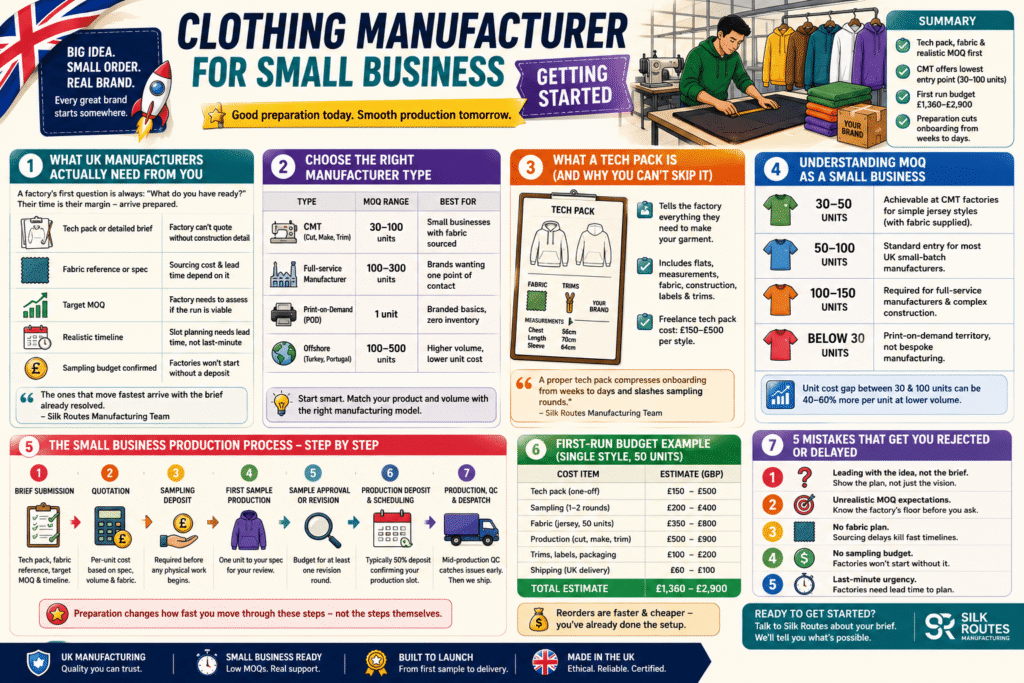
- Most UK manufacturers need a tech pack, confirmed fabric direction, and a realistic MOQ before they’ll quote
- CMT manufacturers offer the lowest entry point — typically 30–100 units per style
- Total first-run budget for a single-style launch runs roughly £1,360–£2,900 to first delivery
- The most common rejection reasons are incomplete briefs, unrealistic MOQ expectations, and no sampling budget
- Arriving prepared cuts onboarding from weeks to days
Contents
- 1. What UK Manufacturers Actually Need From a Small Business
- 2. Choosing the Right Manufacturer Type
- 3. What a Tech Pack Is — And Why You Can’t Start Without One
- 4. Understanding MOQ as a Small Business
- 5. The Small Business Production Process, Step by Step
- 6. What It Costs to Get Started
- 7. Five Mistakes Small Businesses Make With Manufacturers
- 8. FAQ
- 8.1. What’s the minimum budget to work with a UK manufacturer as a small business?
- 8.2. Do UK manufacturers work with businesses with no production experience?
- 8.3. How long from first contact to first delivery?
- 8.4. Can I negotiate MOQ as a small business?
- 8.5. What should I look for in a manufacturer for a small business run?
- 9. Your First Production Run Is a Process, Not a Transaction
What UK Manufacturers Actually Need From a Small Business
A factory’s first question is never “what’s your idea?” It’s “what do you have ready?”
A manufacturer’s time is their margin. Every hour spent helping a small business clarify a brief or explain what a tech pack is costs the factory money it won’t recover on a low-volume order.
| What You Need Ready | Why It Matters |
|---|---|
| Tech pack or detailed brief | Factory can’t quote without construction detail |
| Fabric reference or spec | Sourcing cost and lead time depend on it |
| Target MOQ | Factory needs to assess if the run is viable |
| Realistic timeline | Slot planning needs lead time, not urgency |
| Sampling budget confirmed | Factories won’t start without a deposit |
“We consistently see small business enquiries stall for weeks when there’s no tech pack to work from — every clarifying question adds a delay neither side wants. The ones that move fastest arrive with the brief already resolved.” — Silk Routes Manufacturing Team
The gap between a rejected enquiry and an accepted one is almost always preparation, not budget.
Choosing the Right Manufacturer Type
Not every factory is set up for small business work, and the wrong choice wastes weeks for nothing.
| Manufacturer Type | MOQ Range | Best For |
|---|---|---|
| CMT (Cut, Make, Trim) | 30–100 units | Small businesses with fabric sourced |
| Full-service | 100–300 units | Brands wanting one point of contact |
| Print-on-demand | 1 unit | Branded basics, zero inventory |
| Offshore (Turkey, Portugal) | 100–500 units | Higher volume, lower unit cost |
We work as a CMT manufacturer at Silk Routes, and that model is the right starting point for most small businesses. You source or supply the fabric — control over quality and cost — and the factory handles cutting, making, and finishing.
What doesn’t work: approaching a full-service manufacturer with a 30-unit order and no tech pack. The factory’s cost to onboard a new client is the same regardless of order size, and at 30 units there’s no margin in the order to cover it.
For a full breakdown of manufacturer types by volume, our guide to low MOQ and private label clothing manufacturers UK covers how to match your product to the right factory before you start making calls.
What a Tech Pack Is — And Why You Can’t Start Without One
A tech pack is the single document that tells a manufacturer everything they need to produce your garment. Without it, a factory can’t cut fabric, quote accurately, or begin production.
It contains technical flat drawings, measurements, fabric specification, construction details, and label and trim placement. It’s a production document, not a mood board or a photo of something you like.
“We see small businesses arrive with a Pinterest board and a rough idea. That’s a starting point for a conversation, not a production brief — the brands that move fastest invest in a proper tech pack before they call us.” — Silk Routes Manufacturing Team
Freelance tech pack services typically charge £150–£500 per style. For a single-style launch, this is the most important £150–£500 you’ll spend — it compresses factory onboarding from weeks to days and cuts sampling rounds from three down to one or two.
Understanding MOQ as a Small Business
MOQ is the factory’s floor, not a negotiating position. It exists because every production run carries fixed costs — pattern development, machine setup, quality checks — that can’t be spread thinly enough below a certain volume.
For a small business, the practical landscape looks like this:
- 30–50 units: achievable at CMT factories for simple jersey styles with fabric supplied
- 50–100 units: standard entry for most UK small-batch manufacturers
- 100–150 units: required for full-service manufacturers and complex construction
- Below 30 units: print-on-demand territory, not bespoke manufacturing
The unit cost gap between 30 and 100 units is significant — often 40–60% more per unit at the lower volume. Model your unit economics at both your minimum viable volume and your likely reorder volume before committing to a factory.
The Small Business Production Process, Step by Step
We walk every new client through the same seven steps at Silk Routes — preparation changes how fast you move through them, not the steps themselves.
- Brief submission — tech pack, fabric reference, target MOQ, and timeline.
- Quotation — a per-unit cost based on your spec, volume, and fabric.
- Sampling deposit — required before any physical work begins; treat any factory skipping this with caution.
- First sample production — one unit to your spec, for your review.
- Sample approval or revision — budget for at least one revision round.
- Production deposit and scheduling — typically 50%, confirming your slot.
- Production, QC, and despatch — a mid-production QC check catches issues before completion.
McKinsey’s State of Fashion analysis has consistently flagged operational discipline — forecasting, sourcing, and inventory management — as a key differentiator for smaller players navigating cost pressure. That discipline starts with following this process rather than shortcutting sampling or skipping QC to save a week.
If you want to talk through what a first run would cost for your specific product, speak to the Silk Routes team before you commit to a volume.
What It Costs to Get Started
The honest number most guides avoid giving is the total cost to first delivery — not just the production line item.
| Cost Item | Low Estimate | High Estimate |
|---|---|---|
| Tech pack (freelance) | £150 | £500 |
| First sample | £80 | £250 |
| Fabric (CMT, 50 units) | £200 | £600 |
| Production (50 units, jersey) | £700 | £900 |
| Labels and trims | £100 | £300 |
| Total to first delivery | £1,360 | £2,900 |
For a woven or more complex style, add 30–50% across production and sampling. This doesn’t include branding, e-commerce, or marketing.
Five Mistakes Small Businesses Make With Manufacturers
Approaching too many factories at once. Sending a vague brief to fifteen factories produces fifteen generic responses. Fix: approach three to five with a complete brief.
Asking for a quote without a tech pack. “£8 to £22 per unit” is a placeholder, not a quote. Fix: commission a tech pack before approaching any manufacturer.
Expecting sampling to be free. Sampling costs the factory real fabric and machine time. Fix: budget £80–£250 per style as a mandatory line item.
Confusing sample capacity with production MOQ. A factory that samples at one unit doesn’t accept production runs at one unit. Fix: confirm production MOQ explicitly on the first call, in writing.
Signing a purchase order without a written lead time. A verbal eight-week commitment means nothing when it slips. Fix: put the agreed delivery date, and what happens if it’s missed, into the PO before production starts.
FAQ
What’s the minimum budget to work with a UK manufacturer as a small business?
For a single jersey style at 50 units — tech pack, sampling, fabric, production, and basic labelling — budget £1,500–£2,500 minimum to first delivery. Below £1,500, sampling and quality control get squeezed hard.
Do UK manufacturers work with businesses with no production experience?
Yes — preparation matters more than experience. A first-time brand with a complete tech pack and realistic MOQ expectations gets taken more seriously than an experienced buyer with an incomplete brief.
How long from first contact to first delivery?
With a complete tech pack and pre-sourced fabric, 8–12 weeks is realistic including two sampling rounds. Add two to four weeks if the tech pack still needs developing, and the same again if fabric needs sourcing.
Can I negotiate MOQ as a small business?
Sometimes — factories are more likely to move on MOQ when you arrive with a complete tech pack, offer faster payment, or commit to a confirmed reorder in writing. The leverage is strongest before your first order, not after.
What should I look for in a manufacturer for a small business run?
Four things: willingness to work at your volume, experience with your product type, a clear sampling process with written costs, and a verifiable production history. If a factory can’t show examples at your volume tier, keep looking.
Your First Production Run Is a Process, Not a Transaction
Getting started with a manufacturer as a small business is a staged process — brief, sample, approval, production — and each stage needs preparation before the next begins.
The British Fashion Council’s Commercialising Creativity research points to the same barrier repeatedly across UK fashion businesses: the gap that stalls growth is rarely capital alone, it’s readiness. What we see at Silk Routes matches that pattern exactly.
The factory relationship you build on your first run is the foundation for every reorder after it. Ready to discuss your first production run? Find out how Silk Routes supports small businesses from brief to delivery.