
Most clothing brand lookbooks don’t get opened. They get downloaded, glanced at for thirty seconds, and forgotten, because they were built around the product rather than around the customer’s imagination.
We’ve worked with brands on their first production runs for fifteen years. The brands that use their lookbook to win wholesale meetings and convert DTC customers are the ones that treat it as a brand story document, not a product catalogue. The ones that don’t confuse the two.
Here’s how to build a lookbook that actually works.
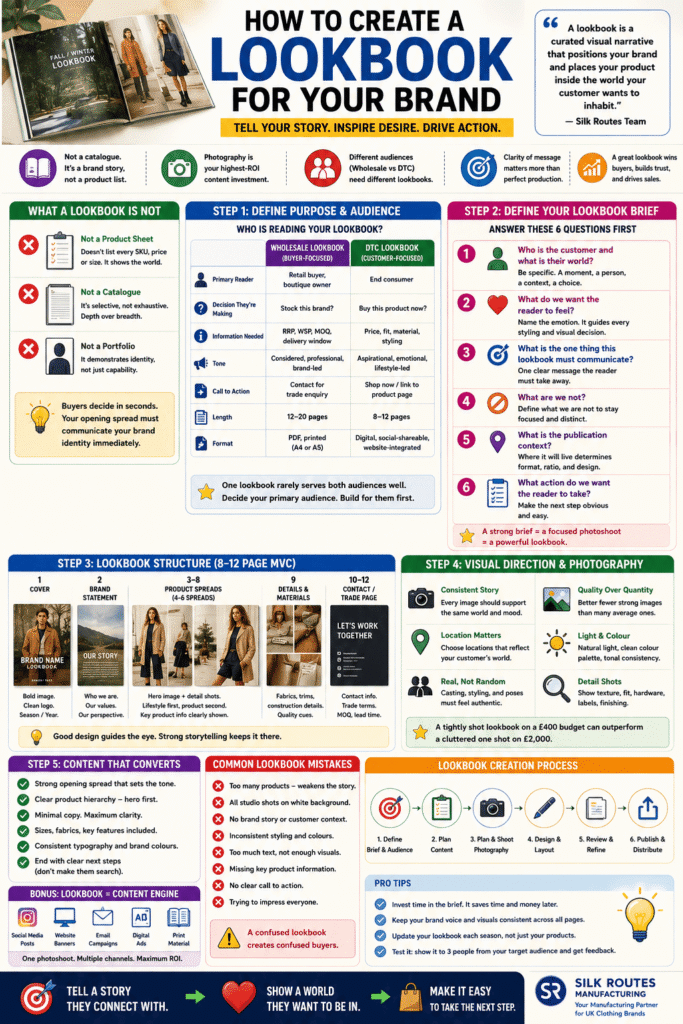
- A clothing brand lookbook is a curated visual narrative, not a product catalogue, that positions the brand, communicates the customer, and contextualises the product in a lifestyle or moment
- The minimum viable lookbook for a UK startup brand is 8 to 12 pages: cover, brand statement, 4 to 6 product spreads, and a contact or trade page
- Lookbook photography is the single highest-ROI content investment a new clothing brand makes — every other channel draws from it
- A wholesale lookbook and a DTC lookbook serve different audiences and require different information architecture — a single document rarely serves both well
- Production quality matters less than editorial clarity — a tightly shot, well-lit lookbook on a £400 photography budget outperforms a cluttered one shot on £2,000
Contents
- 1. What a Lookbook Is Not
- 2. Step 1 — Define the Purpose and Audience Before You Shoot Anything
- 3. Step 2 — Define Your Lookbook Brief
- 4. Step 3 — Build the Lookbook Structure
- 5. Step 4 — Plan the Photography Production
- 6. Step 5 — Write the Copy
- 7. Step 6 — Design and Production
- 8. Step 7 — Distribution Strategy
- 9. Timing Your Lookbook
- 10. Common Lookbook Mistakes Clothing Brands Make
- 11. FAQ
- 12. The Lookbook Is the Brand Before the Brand Has a Customer
What a Lookbook Is Not
Before we explain what works, we need to be direct about what doesn’t.
A lookbook is not a product sheet. A product sheet lists SKUs, colourways, pricing, and sizing. A lookbook shows a world, one that your customer wants to inhabit, and places your product inside it.
A lookbook is not a catalogue. A catalogue is exhaustive. A lookbook is selective. The best lookbooks show fewer products than the brand makes, choosing depth of narrative over breadth of range.
A lookbook is not a portfolio. A portfolio demonstrates capability. A lookbook demonstrates identity. Those two things look entirely different on a page.
What we see consistently fail: brands that photograph every product in the collection against a white background, stack those images into a PDF, add their logo to the cover, and call it a lookbook. That document is a price list with pictures. It doesn’t create desire, it doesn’t communicate identity, and it doesn’t differentiate the brand from any other brand making the same product.
In our experience, wholesale buyers decide within the first few seconds of opening a lookbook whether it’s worth continuing to review. A cover and opening spread that don’t immediately communicate a clear brand identity end the review before the products are even reached.
Step 1 — Define the Purpose and Audience Before You Shoot Anything
We’re direct about this with every brand we work with: the lookbook brief comes before the photography brief. If you don’t know who is reading the lookbook and what you want them to do after reading it, you can’t brief a photographer to shoot it.
The two audiences that require different lookbooks:
| Element | Wholesale Lookbook | DTC Lookbook |
|---|---|---|
| Primary reader | Retail buyer, boutique owner | End consumer |
| Decision they’re making | Stock this brand? | Buy this product now? |
| Information they need | RRP, WSP, MOQ, delivery window | Price, fit, material, styling |
| Tone | Considered, professional, brand-led | Aspirational, emotional, lifestyle-led |
| Call to action | Contact for trade enquiry | Shop now / link to product page |
| Length | 12–20 pages | 8–12 pages |
| Format | PDF, printed A4 or A5 | Digital, social-shareable, website-integrated |
A single lookbook document can’t effectively serve both audiences. The information architecture, the tone, and the call to action are different enough that attempting to serve both produces a document that serves neither well.
Decide which audience is primary for your first lookbook. Build for them first. Adapt for the second audience separately.
If you’re at the stage where you need your manufacturing brief and lookbook timeline aligned, see our clothing manufacturing services — the two should be planned together, not sequentially.
Step 2 — Define Your Lookbook Brief
We never brief a photographer without a written lookbook brief. The brief is not a mood board. It’s a document that answers six specific questions before a single frame is shot.
The six-question lookbook brief:
1. Who is the customer and what is their world? Not demographics. Not “women aged 25 to 40 interested in sustainability.” A specific moment: a specific person, in a specific context, making a specific choice. “A woman who trained in architecture, now running her own practice, who dresses with precision and dislikes obvious branding.” That level of specificity produces a coherent set of visual decisions.
2. What do we want the reader to feel? Not what we want them to think. Feel. “Quiet confidence.” “Considered ease.” “The feeling of being exactly where you want to be.” This single sentence becomes the brief for every styling, location, and lighting decision.
3. What is the one thing this lookbook must communicate? If a reader could only take one message from this document, what is it? Not “our products are good.” Something specific: “This brand treats the garment as a precision object.” One message, clearly identified.
4. What are we not? As important as what we are. Are we not athletic? Not corporate? Not fashion-forward? Not casual? The “not” list eliminates the styling, location, and model choices that would dilute the brand identity.
5. What is the publication context? Where will this lookbook live? Emailed PDF to buyers? Instagram Stories? Printed for trade shows? An A4 leave-behind? The publication context determines format, aspect ratio, page dimensions, and whether copy will be legible.
6. What is the call to action? Every lookbook ends with someone doing something. What is that action? Contact for trade terms? Visit the online store? Follow on Instagram? The call to action must be explicit — buried or absent CTAs are the most common lookbook failure after weak photography.
Step 3 — Build the Lookbook Structure
We use the same structural framework for every brand we advise on lookbook production, adapting the length and weighting for wholesale versus DTC, but keeping the sequence consistent.
Standard lookbook structure:
| Page | Content | Purpose |
|---|---|---|
| Cover | Brand name, season/year, one defining image | Brand identity signal — the first-impression decision |
| 2 | Brand statement | 30–50 words. What the brand is and who it’s for. Not a mission statement. |
| 3–4 | Opening editorial spread | Full-bleed lifestyle image — no product detail, all atmosphere |
| 5–8 | Product spreads (2–4 pages) | Each page: one key product, styled, in context. Copy: product name, key material, RRP |
| 9–10 | Detail spread | Close-up construction, fabric texture, label, finishing. Shows quality without claiming it. |
| 11 | Collection overview | Small images of all pieces together — the only page that functions as a catalogue |
| 12 | Contact / trade page | Brand contact, website, trade terms (wholesale) or shop link (DTC) |
What doesn’t work: opening with a product image. The cover is not the place for your hero product, it’s the place for your brand world. A product on the cover signals that the brand doesn’t understand the difference between brand identity and product marketing.
What doesn’t work: more than one product per spread in the main editorial section. Crowded spreads reduce the perceived value of each product. One product, styled with intention, photographed in a world, that’s a spread that creates desire.
Step 4 — Plan the Photography Production
Photography is the single investment in lookbook production that can’t be compensated for in post. Weak photography with strong copy is still a weak lookbook. Strong photography with no copy is still a strong lookbook.
We advise every startup brand to treat photography as a production cost, the same category as sampling or manufacturing, not as a marketing cost.
DTC clothing brands with professional product photography tend to convert noticeably better than those relying on supplier images or unedited mobile photography — often enough to recover the photography investment within the first production run.
Photography production for a startup lookbook:
| Element | Budget Option | Mid-Range | Notes |
|---|---|---|---|
| Photographer | £300–£500/half day | £600–£1,200/full day | Creative direction is part of this cost |
| Model | £150–£300 | £400–£800 | Friends-and-network works for DTC; invest for wholesale |
| Location | £0–£100 (outdoor, owned space) | £200–£500 (studio hire) | Location communicates brand world — choose deliberately |
| Styling | £0 (self-styled) | £150–£400 | Critical for wholesale lookbooks |
| Hair and makeup | £0–£100 | £200–£400 | Varies significantly by brand positioning |
| Editing | Included (most photographers) | £100–£300 separately | Confirm what’s included before booking |
| Total | £450–£1,000 | £1,500–£3,100 |
What we say doesn’t work: shooting your entire collection in one half-day without a location scout, a styling brief, or a shot list. That approach produces technically adequate images with no editorial coherence, every frame is a product record, not a brand moment.
What we say works: a shot list built from the lookbook structure, reviewed against the brand brief, with a defined number of hero images and detail shots per product before the shoot begins.
“We see brands spend £1,500 on photography and use three images. They didn’t brief the photographer, they briefed a catalogue. A one-page lookbook brief given to a £400 photographer produces more usable content than a £1,500 shoot with no brief.” — Silk Routes Manufacturing Team
Step 5 — Write the Copy
A lookbook is not a copy-heavy document. But the copy it does carry is disproportionately important, because it’s the only direct communication the brand has with the reader in a document that’s otherwise visual.
Four types of copy in a lookbook:
Brand statement (page 2): 30 to 50 words. This is the hardest copy to write in the entire document. It must say what the brand is, who it’s for, and why it exists, without sounding like a mission statement, a values list, or a generic “sustainable quality” claim. Write twenty versions and choose the one that doesn’t sound like any other brand’s statement.
Product copy (product spreads): product name, primary material, and RRP. Nothing more for a DTC lookbook. For a wholesale lookbook, add wholesale price and available colourways. Product copy in a lookbook is a caption, not a description.
Detail captions (detail spreads): one or two sentences about the construction decision or material choice shown in the close-up. “280gsm recycled fleece, brushed on the reverse for warmth without weight.” Specific, technical, confident, not marketing language.
CTA copy (final page): direct and functional. “Trade enquiries: [email] / [website]” for wholesale. “Shop the collection at [URL]” for DTC. The CTA page is not the place for brand voice, it’s the place for clear instruction.
What doesn’t work: copy that describes what the reader can already see. “This striking jacket is photographed against a natural backdrop” adds no information. “Waxed organic cotton, mid-weight for three-season use” adds information the reader cannot see.
Step 6 — Design and Production
We’re specific about what does not require a professional designer and what does.
Does not require a professional designer: layout in Canva, Adobe Express, or a similar tool using a minimal template with consistent margins, one typeface in two weights, and a coherent grid. Clean and minimal beats ornate and inconsistent in every lookbook format.
Requires a professional designer (or significant design capability): a wholesale lookbook for department store buyers, a printed trade show lookbook, or any document where typographic precision and print-ready production files are required.
Non-negotiable layout principles:
- Consistent margins across every page — ideally 20mm or larger
- No more than two typefaces — one display (headlines), one body (copy and captions)
- White space is not wasted space — the gap around an image communicates the product’s perceived value
- Full-bleed images should bleed to the edge on all four sides, not float on a white background
- Product name and price always in the same position on every product spread — the reader’s eye learns the layout
File specifications for output:
| Format | Specification | Notes |
|---|---|---|
| Digital PDF | RGB, 150dpi minimum, optimised under 10MB | For email and digital sharing |
| Print PDF | CMYK, 300dpi, with 3mm bleed | For physical printing |
| Social (Instagram) | Square or 9:16, JPEG/PNG under 1MB | Adapted from lookbook spreads |
| Website integration | Individual images at 72dpi, web-optimised | Not the PDF — individual images |
Step 7 — Distribution Strategy
A lookbook no one reads is a design exercise. Distribution is as important as production, and it’s the stage most first-time brands treat as an afterthought.
Wholesale distribution:
- Email to a named buyer contact, not a generic “info@” address. Research the correct buyer before sending.
- Subject line: brand name, season, product category, not “Lookbook” or “Please see attached”
- Follow up in seven days if no response. One follow-up only.
- Physical printed lookbook for trade shows — A5 or A4, wire-bound or perfect-bound, not stapled
- Leave-behind at any showroom or buyer meeting — never leave without one
DTC distribution:
- Hosted on website as a downloadable PDF, gated behind email capture for list building
- Excerpted as an Instagram carousel — typically 6 to 8 selected images from the full lookbook
- Used as the visual language for paid advertising creative — lookbook images as ad creative, not product-white-background images
- Shared with micro-influencers alongside gifted product — the lookbook tells them what the brand is, reducing the briefing required
Brands that turn up to trade shows with a physical lookbook and a clear trade information page consistently make a stronger impression than those presenting only digital materials on a laptop or phone.
Timing Your Lookbook
The lookbook production timeline must align with the manufacturing timeline. Photography can’t happen before the product exists, and waiting for final production stock means delaying the lookbook by the full manufacturing lead time.
Two approaches that work:
Option A — Photography on pre-production samples. If your PP sample is approved and sealed, it’s identical to what the production run will deliver. Shooting on the PP sample means your lookbook is ready before the production run completes, so you can distribute it to buyers and begin building your waitlist while production finishes.
Option B — Photography on first production units. If your production timeline allows it, photograph on the first units delivered from the run. This eliminates any risk of a styling inconsistency between the sample and the production spec.
What doesn’t work: waiting until all production stock is delivered, sorted, and quality-checked before scheduling the photographer. That approach delays the lookbook by three to four weeks after an already long production timeline, and means your wholesale and DTC marketing begins weeks after it could have.
Common Lookbook Mistakes Clothing Brands Make
Building the lookbook before the brand brief is complete. A lookbook built without a defined brand statement, a defined customer, and a defined “what we are not” list produces a visually competent document with no identity.
Fix: write the brand brief before briefing the photographer. The brief answers: who is the customer, what do we want them to feel, what is the one thing we must communicate, what are we not.
Shooting every product in the collection. A lookbook that attempts to show everything the brand makes is a catalogue. Catalogues don’t create desire.
Fix: choose your strongest four to six products. Build the editorial narrative around them. The rest of the range is in the order sheet or the website, not the lookbook.
No shot list before the photography day. A shoot without a shot list produces an unpredictable set of images, some strong, most adequate, without the specific hero images the lookbook structure requires.
Fix: build a shot list from the lookbook structure before the photographer is briefed. Every page of the lookbook requires a defined image, on the list, before the shoot begins.
Using only on-model photography. Lookbooks that show only the garment on a model miss the opportunity to communicate construction quality, material character, and finishing detail.
Fix: include a dedicated detail spread — close-ups of fabric texture, seam finish, label, and key construction details.
No printed version for wholesale. A digital-only lookbook for wholesale brand introductions assumes buyers will open a PDF at their desk and review it carefully. Many won’t.
Fix: produce a print run of 50 to 100 physical lookbooks for wholesale use. Cost: £150 to £400 at trade-print quality. The return on a single wholesale stocking relationship is many multiples of that investment.
FAQ
How long should a clothing brand lookbook be?
Eight to twelve pages for a DTC lookbook. Twelve to twenty for a wholesale lookbook. Beyond twenty pages, a lookbook becomes a catalogue and loses the editorial coherence that makes it effective.
Do I need a designer to produce a lookbook?
Not necessarily. Canva and Adobe Express both support minimal lookbook layouts that a non-designer can produce competently if the photography is strong. A professional designer is required for print-ready wholesale lookbooks and any lookbook that needs to compete at a high level for department store buyer attention.
Can I shoot a lookbook on a phone?
For DTC use, in specific conditions — controlled natural light, a considered location, a styled subject — phone photography can produce usable lookbook images. For wholesale, it’s not appropriate. Buyers assess the production quality of the lookbook as a proxy for the production quality of the garment.
Should my lookbook include prices?
For a wholesale lookbook: yes, wholesale price (WSP), recommended retail price (RRP), and available colourways. For a DTC lookbook: include RRP. Omitting price from a DTC lookbook creates friction, the reader has to navigate away to find it.
How often should a clothing brand produce a new lookbook?
Seasonally for wholesale brands, buyers expect a new lookbook with each seasonal collection. For DTC-only brands, a lookbook is produced when the range or brand identity changes materially enough to warrant new editorial imagery.
The Lookbook Is the Brand Before the Brand Has a Customer
The lookbook is the first complete expression of a clothing brand’s identity. Not the Instagram feed, not the website, and not the first production run, the lookbook, because it’s the only format that asks a viewer to sit with a brand for long enough to understand it.
We’ve seen brands with modest production budgets win wholesale meetings on the strength of a precisely briefed, editorially coherent lookbook. We’ve seen brands with strong product lose those same meetings because their lookbook communicated nothing beyond the product’s existence.
The product is necessary. The lookbook is what makes the product mean something to someone who has never worn it.
For the full picture on how to align your lookbook production with your manufacturing timeline, from PP sample photography to first-run stock, our guide to low MOQ and private label clothing manufacturers UK covers how to structure the production process so your marketing and manufacturing move in parallel.
Ready to discuss your first production run and how to time it with your brand launch? Find out how Silk Routes works with startup brands from brief to delivery.