
Contents
- 1.
- 1.1. What Is a Garment Fit Session and Why Does It Matter?
- 1.2. Fit Model vs Dress Form — When to Use Each
- 1.3. What to Assess at Each Fit Session Stage
- 1.4. Ease Allowance — How Much Is Right for Each Garment Type?
- 1.5. How to Complete a Fit Comment Sheet
- 1.6. How Many Fit Sessions Are Typically Needed?
- 1.7. Common Fit Problems and How to Resolve Them
- 1.8. Building Fit Sessions Into Your Production Timeline
- 1.9. FAQ
- 1.9.1. Can a brand skip a fit model entirely and only use a dress form?
- 1.9.2. How long does a single fit session typically take?
- 1.9.3. What’s the difference between ease allowance and grading?
- 1.9.4. Should fit comment sheets be shared with the factory directly?
- 1.9.5. Does a graded pattern need re-checking every time it’s reused for a new season?
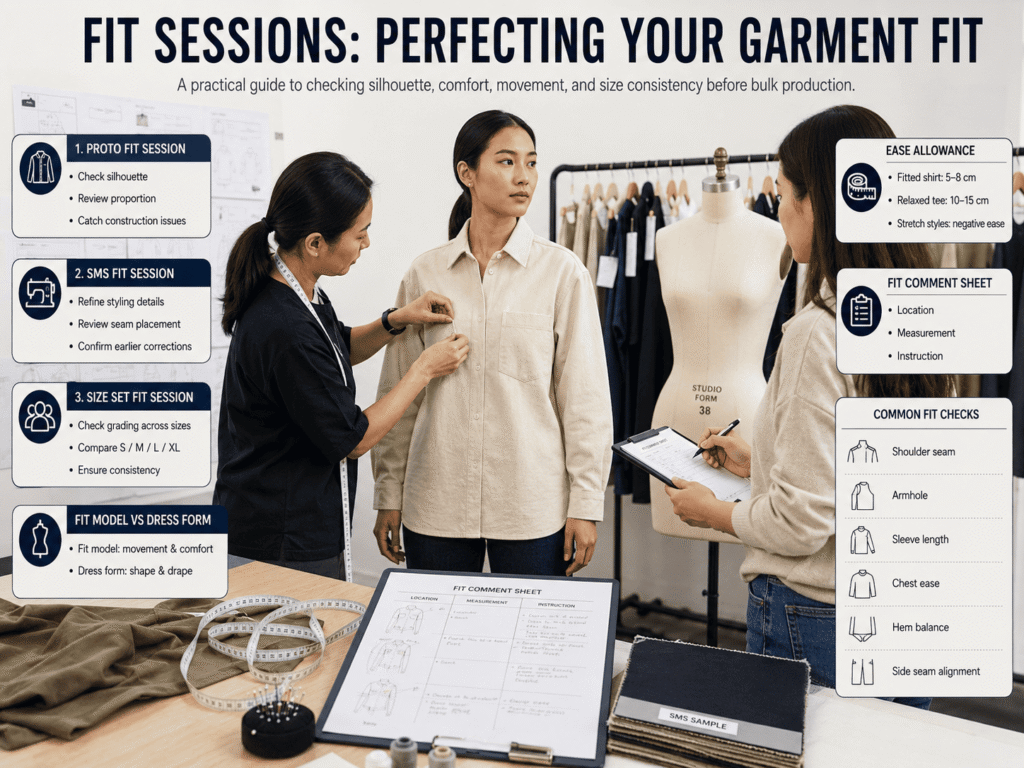
Poor fit is a bigger sustainability problem than most brands realise. Garments that don’t fit properly are cited as a major reason clothing gets discarded rather than worn, according to WRAP’s research into UK clothing lifecycles. Fit sessions exist to catch that problem before bulk production, not after a customer opens the box. This guide covers fit models versus dress forms, what to check at each fit stage, ease allowance, and how many sessions you actually need.
In this article:
- When to use a fit model versus a dress form
- What to assess at proto, SMS, and size set fit sessions
- Ease allowance guidance by garment type
- How to complete a fit comment sheet properly
- How many fit sessions most brands need before bulk production
- Common fit problems and their fixes
What Is a Garment Fit Session and Why Does It Matter?
A fit session is a structured check of how a sample garment fits, before it moves to the next production stage. It happens at multiple points — proto sample, salesman sample, and size set — not just once.
Skipping or rushing fit sessions is one of the most common causes of costly bulk production errors. A single missed fit issue at proto stage can multiply across every size in the range by the time bulk cutting starts.
Fit Model vs Dress Form — When to Use Each
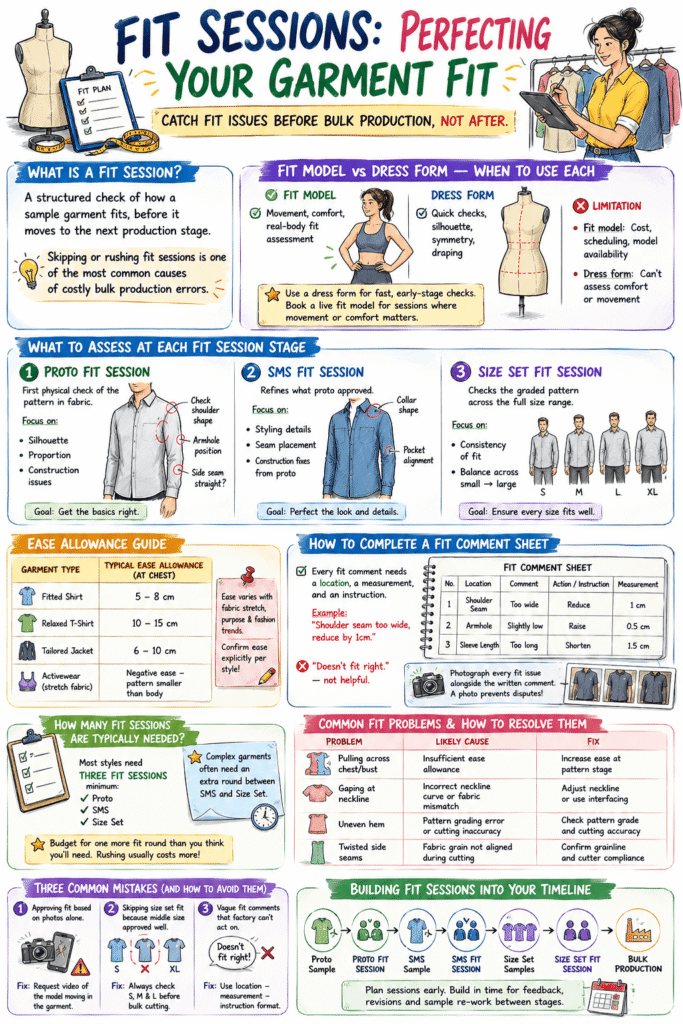
Both tools check fit, but they answer different questions.
| Tool | Best For | Limitation |
|---|---|---|
| Fit Model | Movement, comfort, real-body fit assessment | Cost and scheduling, model availability |
| Dress Form | Quick checks, silhouette, symmetry, draping | Can’t assess comfort or movement |
Use a dress form for fast, early-stage checks between formal fit sessions. Book a live fit model for any session where movement or comfort genuinely matters — activewear, tailoring, anything with a close fit.
What to Assess at Each Fit Session Stage
Different fit stages exist to catch different problems.
| Stage | Primary Focus |
|---|---|
| Proto Fit Session | Basic silhouette, proportion, construction issues |
| SMS Fit Session | Refined fit, styling details, final adjustments |
| Size Set Fit Session | Consistency of fit across the full size range |
Proto Fit Session
This is the first physical check of the pattern translated into fabric. Focus on silhouette and proportion, not fine detail — small issues get fixed later.
SMS Fit Session
The salesman sample fit session refines what proto approved. Check styling details, seam placement, and any construction fix requested after proto.
Size Set Fit Session
This session checks the graded pattern works consistently across the full size range. A garment that fits perfectly in a middle size can fail badly at the smallest or largest grade — this is the session that catches it.
Ease Allowance — How Much Is Right for Each Garment Type?
Ease allowance is the extra room built into a pattern beyond the body measurement itself.
| Garment Type | Typical Ease Allowance |
|---|---|
| Fitted Shirt | 5–8cm at chest |
| Relaxed T-Shirt | 10–15cm at chest |
| Tailored Jacket | 6–10cm at chest |
| Activewear (stretch fabric) | Negative ease — pattern smaller than body |
Ease allowance varies with fabric stretch, garment purpose, and current styling trends. Brands sourcing patterns through Silk Routes’ clothing manufacturing services should confirm ease allowance explicitly per style, since “standard ease” means different things across pattern cutters.
How to Complete a Fit Comment Sheet
“Every fit comment needs a location, a measurement, and an instruction — ‘too tight’ alone gives the factory nothing to act on.” — Silk Routes Manufacturing Team
Write comments as specific, actionable instructions. “Shoulder seam too wide, reduce by 1cm” works. “Doesn’t fit right” does not.
“Photograph every fit issue alongside the written comment — a photo prevents disputes about what was actually flagged.” — Silk Routes Manufacturing Team
Reference garment technologists — the professionals who typically lead fit sessions and write these comment sheets as part of their day-to-day role — recommend keeping one comment per line, numbered, so nothing gets missed during the next round.
How Many Fit Sessions Are Typically Needed?
Most styles need three fit sessions minimum: proto, SMS, and size set. Complex garments — tailoring, outerwear, anything with multiple closures — often need an extra round between SMS and size set.
“Budget for one more fit round than you think you’ll need. Rushing the schedule to save one session usually costs more in bulk-stage rework.” — Silk Routes Manufacturing Team
Simple basics with a proven, previously-used pattern can sometimes skip proto and go straight to SMS. New patterns, new fabrics, or new factories should never skip a stage.
Common Fit Problems and How to Resolve Them
| Problem | Likely Cause | Fix |
|---|---|---|
| Pulling across chest/bust | Insufficient ease allowance | Increase ease at pattern stage |
| Gaping at neckline | Incorrect neckline curve or fabric weight mismatch | Adjust neckline pattern or stabilise with interfacing |
| Uneven hem | Pattern grading error or cutting inaccuracy | Check pattern grade and cutting table accuracy |
| Twisted side seams | Fabric grain not aligned during cutting | Confirm grainline markings and cutter compliance |
Mistake 1: Approving fit based on photos alone. Why it happens: remote sourcing makes in-person fit sessions harder to schedule. Fix: request video of the model moving in the garment, not just static photos, for any fit-critical style.
Mistake 2: Skipping size set fit because the middle size approved well. Why it happens: brands assume grading is mechanical and won’t introduce new fit issues. Fix: always check at least the smallest, middle, and largest size before bulk cutting.
Mistake 3: Vague fit comments that the factory can’t act on. Why it happens: comments get written quickly under time pressure. Fix: use the location-measurement-instruction format every time, no exceptions.
Building Fit Sessions Into Your Production Timeline
Fit sessions work best when they’re scheduled into the production calendar from the start, not squeezed in reactively when a sample looks wrong. This same checkpoint discipline runs through the complete tech pack to production process, where fit review sits alongside sampling and QC as a planned production stage rather than an afterthought.
Read more about Silk Routes and how fit sessions fit into our wider production approach.
FAQ
Can a brand skip a fit model entirely and only use a dress form?
Yes, for early-stage or lower-risk styles, though this carries some fit risk for anything requiring movement assessment. Activewear, tailoring, and anything with a close body fit should use a live fit model at least once before bulk approval.
How long does a single fit session typically take?
A single fit session usually takes 30 to 60 minutes per style, depending on how many issues come up during the check. Complex garments with multiple fit points can take longer, especially if several adjustments need discussing on the spot.
What’s the difference between ease allowance and grading?
Ease allowance is the extra room built into a single pattern size beyond the body measurement. Grading is the separate process of scaling that same pattern up or down across a full size range.
Should fit comment sheets be shared with the factory directly?
Yes — fit comment sheets should go straight to the factory’s pattern or sample team, not stay internal to the brand. Delayed or filtered fit feedback is one of the most common causes of repeated fit errors across multiple sample rounds.
Does a graded pattern need re-checking every time it’s reused for a new season?
It’s good practice to re-check a reused graded pattern each season, particularly if the fabric or supplier has changed. Even a small fabric weight or stretch difference from a new fabric lot can shift how a previously-approved pattern actually fits.