
Contents
- 1.
- 2. Digital fabric printing finder
- 2.1. The Three Main Digital Fabric Printing Technologies
- 2.2. Which Digital Print Method Is Right for Your Fabric?
- 2.3. Cost of Digital Fabric Printing in the UK
- 2.4. MOQ and Lead Times for UK Digital Fabric Printers
- 2.5. Colour Accuracy and Gamut in Digital Fabric Printing
- 2.6. How to Prepare Artwork for Digital Fabric Printing
- 2.7. Common Digital Printing Mistakes
- 2.8. Getting Digital Printing Right in Your Tech Pack
- 2.9. FAQ
- 2.9.1. Is digital fabric printing more expensive than screen printing?
- 2.9.2. Can digital printing achieve an exact Pantone colour match?
- 2.9.3. Does digital printing work on natural fibre and synthetic blends?
- 2.9.4. How long does a typical digital fabric printing order take?
- 2.9.5. Is digital printing suitable for activewear?
The digital textile printing market has been through a genuinely difficult stretch, and industry recovery is now visible in real terms. Duncan Ferguson, Vice President of Commercial and Industrial Printing at Epson Europe, put it plainly at FESPA 2026: “the tide is turning” after what he called a very difficult few years for textile print. For UK clothing brands, that recovery means more capacity, more printer options, and increasingly competitive pricing on both reactive and pigment digital printing. This guide covers the three main digital printing technologies, cost, MOQ, colour accuracy, and how to prepare artwork correctly.
In this article:
- What digital fabric printing is and how it differs from screen printing
- The three main digital printing technologies and how each works
- Which method suits which fabric type
- Realistic cost, MOQ, and lead time expectations in the UK
- How to prepare artwork and manage colour accuracy correctly
What Is Digital Fabric Printing and How Is It Different From Screen Printing?
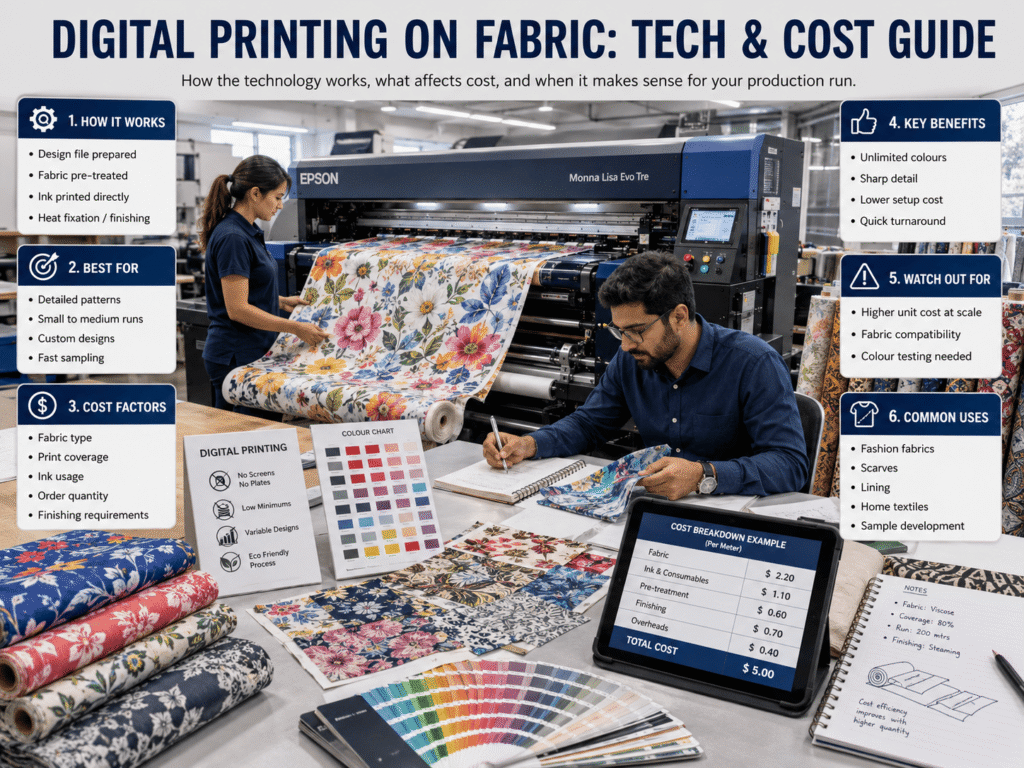
Digital fabric printing applies ink directly onto fabric using inkjet technology, with no screens, no per-colour setup cost, and no practical colour limit. Screen printing instead requires a physical screen per colour, making it more cost-effective at high volume but far less flexible for complex, multi-colour, or photographic designs.
| Factor | Digital Printing | Screen Printing |
|---|---|---|
| Setup Cost | None — file goes straight to print | Screen required per colour |
| Colour Limit | Unlimited, full gradient capability | Typically capped around 9 colours |
| Best At Volume | Low to mid volume, print-on-demand | High volume, simple designs |
Digital fabric printing finder
An interactive companion to "Digital Printing on Fabric" — pick your fabric to get a method recommendation, compare technologies, and run through the pre-print checklist.
Reactive inkjet
Chemically bonds with natural fibres like cotton and silk. Vibrant colour, but needs pre-treatment and steaming to fix.
Sublimation
Ink becomes gas under heat and bonds into polyester fibres directly. No hand-feel change, no cracking or peeling.
Pigment digital
Works across natural and synthetic fibres with no pre-treatment. The fastest-developing digital textile technology.
“The market for textiles has been very difficult over the last three years… but the tide is turning.”
The Three Main Digital Fabric Printing Technologies
Each digital printing technology works differently and suits different fibre types.
| Technology | Best Fabric | Key Trait |
|---|---|---|
| Reactive Inkjet | Cotton, silk, natural fibres | Vibrant, durable colour that bonds chemically with the fibre |
| Sublimation | Polyester, polyester blends | Ink becomes part of the fibre itself, no hand-feel change |
| Pigment Digital | Cotton, polyester, and blends | Works across almost any fibre, no pre-treatment needed |
Reactive Inkjet Printing
Reactive printing works through a chemical reaction between the ink and natural fibres, producing vibrant, durable colour, but it is limited to fabrics like cotton and silk. It typically requires a pre-treatment step and post-print steaming to fix the colour properly.
Sublimation Printing
Sublimation printing turns ink into a gas under heat, which then bonds directly into polyester fibres rather than sitting on the surface. This makes it especially well suited to activewear and other polyester-heavy garments, since the print doesn’t crack, peel, or add any noticeable hand-feel.
Pigment Digital Printing
Pigment printing has become one of the fastest-developing digital textile technologies, largely because pigment inks work across natural and synthetic fibres without the fabric-specific limitations reactive inks carry. Newer pigment ink formulations, developed by manufacturers including Kornit Digital, have largely overcome the stability and speed issues that once limited pigment printing compared with reactive dyes.
Which Digital Print Method Is Right for Your Fabric?
| Fabric | Recommended Method | Why |
|---|---|---|
| 100% Cotton | Reactive or pigment | Reactive gives the most vibrant result; pigment is faster and simpler |
| Polyester / poly-blend | Sublimation or pigment | Sublimation bonds directly into polyester fibre |
| Cotton-poly blends | Pigment | Works across mixed fibre content without fabric-specific limits |
| Silk | Reactive | Best colour vibrancy and hand-feel retention on delicate natural fibres |
Cost of Digital Fabric Printing in the UK
Digital printing cost is driven primarily by design complexity and fabric type rather than colour count, which is the opposite of screen printing’s cost structure.
| Cost Factor | Digital Printing | Screen Printing |
|---|---|---|
| Cost Driver | Fabric type, print length | Number of colours, then quantity |
| Cost at Low Volume | Lower — no setup cost | Higher — screen setup dominates |
| Cost at High Volume | Relatively flat per metre | Falls as screen cost amortises |
Because digital printing carries no per-colour setup cost, it’s typically the more cost-effective option at low-to-mid volume, particularly for multi-colour or photographic designs that would need a separate screen per colour under traditional printing.
MOQ and Lead Times for UK Digital Fabric Printers
Digital printing generally supports far lower minimum order quantities than screen printing, since there’s no screen investment to justify with volume.
| Factor | Typical Range |
|---|---|
| MOQ | Often as low as a single metre or single garment |
| Standard Lead Time | Days rather than weeks, for straightforward designs |
| Rush Options | Frequently available at UK-based digital print suppliers |
Brands sourcing production through Silk Routes’ clothing manufacturing services can request digital printing for smaller runs or sampling, without needing to commit to the higher volumes screen printing typically requires.
Colour Accuracy and Gamut in Digital Fabric Printing
Digital printing’s unlimited colour range is a genuine advantage, but colour accuracy still depends on proper colour management, not just the printer’s capability. Screen colour on a monitor rarely matches printed fabric exactly, so a physical colour proof should always be requested before bulk printing, particularly for brand-specific Pantone colours.
Ink certification also matters for skin-contact garments — inks with OEKO-TEX STANDARD 100 certification have been independently tested for substances that could be harmful to health, which is worth confirming with any digital print supplier before committing to bulk production.
How to Prepare Artwork for Digital Fabric Printing
Artwork resolution needs to be high enough for the final print size, not just screen resolution — a design that looks sharp on a laptop can pixelate badly once scaled to garment size. Repeat patterns need to be set up as a true seamless repeat before submission, since a poorly matched repeat becomes an obvious visible seam once printed and cut.
Fabric shrinkage during the printing and fixation process should also be factored into pattern sizing, particularly for reactive printing, which involves steaming as part of the fixing process.
Common Digital Printing Mistakes
Mistake 1: Submitting low-resolution artwork scaled up for print. Why it happens: artwork is designed at screen resolution without checking print-size requirements. Fix: confirm required resolution at final print dimensions before finalising artwork, not after a test print comes back pixelated.
Mistake 2: Choosing reactive printing for a polyester-heavy fabric. Why it happens: reactive printing’s vibrant colour result looks appealing without checking fibre compatibility. Fix: confirm fabric composition first, and use sublimation or pigment printing for polyester content.
Mistake 3: Skipping a physical colour proof before bulk printing. Why it happens: digital proofs on screen look accurate enough to approve. Fix: always request a physical printed proof on the actual fabric before approving bulk production.
Mistake 4: Not accounting for shrinkage from post-print fixation. Why it happens: pattern sizing is finalised before the printing and fixing process is factored in. Fix: ask your digital print supplier for their typical shrinkage allowance and build it into pattern sizing.
Getting Digital Printing Right in Your Tech Pack
Specifying the correct digital printing technology, ink certification, and shrinkage allowance in the tech pack avoids costly surprises once bulk fabric comes back from print. This same specification discipline runs through the complete tech pack to production process, where fabric decoration decisions are documented alongside every other production detail.
Read more about Silk Routes and how digital printing fits into our wider approach to fabric sourcing and decoration.
FAQ
Is digital fabric printing more expensive than screen printing?
It depends on volume and colour count — digital printing is often cheaper at low-to-mid volume and for multi-colour designs, while screen printing becomes more cost-effective at high volume with simple, low-colour designs. There’s no universal answer; it comes down to the specific order quantity and design complexity.
Can digital printing achieve an exact Pantone colour match?
It can get very close, but exact Pantone matching depends on the printer’s colour profile, ink set, and the fabric itself, which all affect final colour output. A physical proof on the actual fabric is the only reliable way to confirm an exact match before bulk production.
Does digital printing work on natural fibre and synthetic blends?
Yes, particularly with pigment printing, which works across natural and synthetic fibres without the fabric-specific restrictions that reactive and sublimation printing carry. This makes pigment printing a common default choice for blended fabrics.
How long does a typical digital fabric printing order take?
Lead times are often measured in days rather than weeks for straightforward designs, though this varies by supplier and order size. Complex, high-resolution designs or larger print runs can extend this, so it’s worth confirming lead time before finalising a production schedule.
Is digital printing suitable for activewear?
Yes, particularly sublimation printing on polyester-based activewear fabrics, since the ink bonds into the fibre rather than sitting on the surface. This avoids the cracking or peeling that can affect surface-applied decoration methods under repeated stretch and wash.