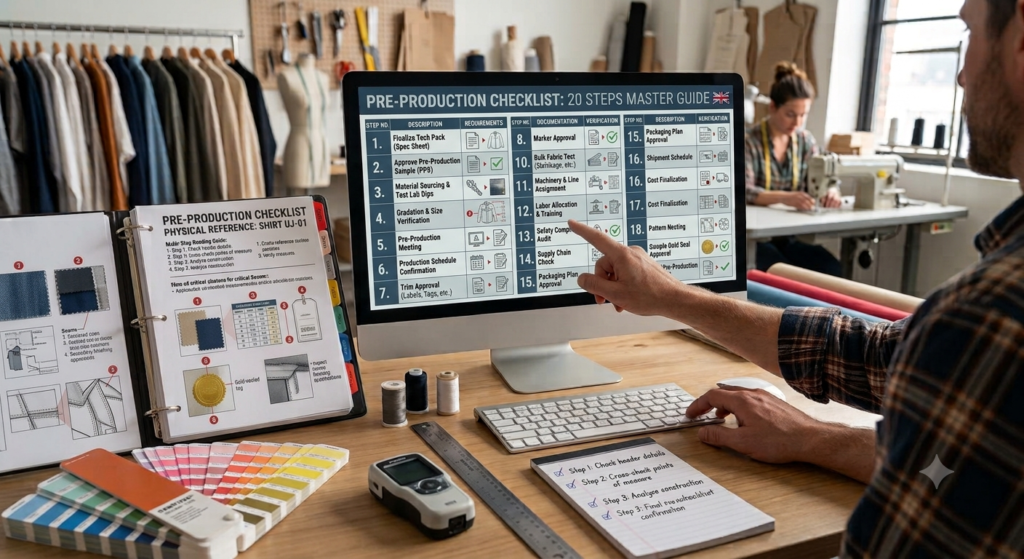
Every unchecked box before bulk production becomes a multiplied problem once cutting starts — a wrong trim on one sample is an inconvenience; the same wrong trim on 500 units is a costly reorder. Pre-production is the last point where a mistake is still cheap to fix.
This guide is a working pre-production checklist clothing manufacturing UK brands can run through before committing to a bulk order, covering every confirmation that actually matters. This sits at the final gate of the tech pack to production process, right before cutting begins.
In this article:
- Why pre-production is the last real chance to catch expensive mistakes
- The complete 20-step checklist, grouped by category
- How to run a pre-production meeting with your manufacturer
- What happens when brands skip pre-production steps
- Who’s actually responsible for each step
- FAQs on pre-production timing and sign-off
Contents
- 1. Why Pre-Production Is the Last Chance to Prevent Expensive Mistakes
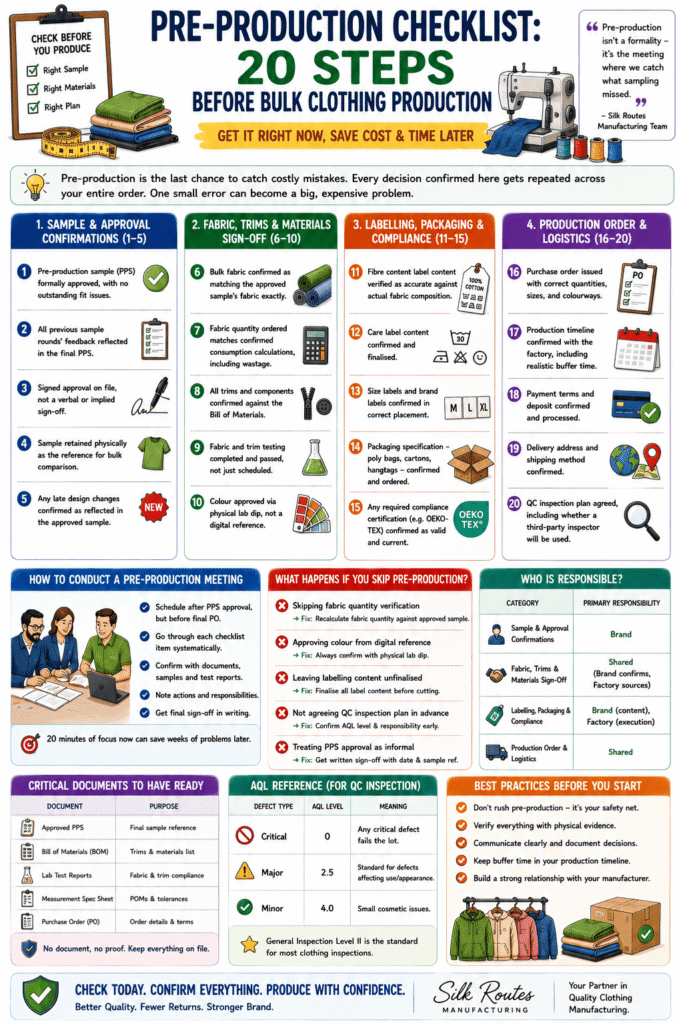
- 2. The Complete 20-Step Pre-Production Checklist
- 3. How to Conduct a Pre-Production Meeting With Your Manufacturer
- 4. What Happens If You Skip Pre-Production Steps
- 5. Who Is Responsible for Each Pre-Production Step
- 6. The Silk Routes Pre-Production Process
- 7. FAQ
Why Pre-Production Is the Last Chance to Prevent Expensive Mistakes
Every decision confirmed at pre-production gets locked in and repeated across the entire order — get one wrong, and it’s wrong hundreds of times over, not once. This is the point where a brand’s attention to detail either pays off or doesn’t.
“Pre-production isn’t a formality — it’s the meeting where we catch what sampling missed.” — Silk Routes Manufacturing Team
The Complete 20-Step Pre-Production Checklist
| Category | Steps |
|---|---|
| Sample & Approval Confirmations | Steps 1–5 |
| Fabric, Trims & Materials Sign-Off | Steps 6–10 |
| Labelling, Packaging & Compliance | Steps 11–15 |
| Production Order & Logistics | Steps 16–20 |
Steps 1–5: Sample and Approval Confirmations
- Pre-production sample (PPS) formally approved, with no outstanding fit issues.
- All previous sample rounds’ feedback reflected in the final PPS.
- Signed approval on file, not a verbal or implied sign-off.
- Sample retained physically as the reference for bulk comparison.
- Any late design changes confirmed as reflected in the approved sample.
Steps 6–10: Fabric, Trims, and Materials Sign-Off
- Bulk fabric confirmed as matching the approved sample’s fabric exactly.
- Fabric quantity ordered matches confirmed consumption calculations, including wastage.
- All trims and components confirmed against the Bill of Materials.
- Fabric and trim testing completed and passed, not just scheduled.
- Colour approved via physical lab dip, not a digital reference.
Steps 11–15: Labelling, Packaging, and Compliance
- Fibre content label content verified as accurate against actual fabric composition.
- Care label content confirmed and finalised.
- Size labels and brand labels confirmed in correct placement.
- Packaging specification — poly bags, cartons, hangtags — confirmed and ordered.
- Any required compliance certification (such as OEKO-TEX) confirmed as valid and current.
Steps 16–20: Production Order and Logistics Confirmation
- Purchase order issued with correct quantities, sizes, and colourways.
- Production timeline confirmed with the factory, including realistic buffer time.
- Payment terms and deposit confirmed and processed.
- Delivery address and shipping method confirmed.
- QC inspection plan agreed, including whether a third-party inspector will be used.
How to Conduct a Pre-Production Meeting With Your Manufacturer
“We run through every checklist item out loud with the brand before confirming the PO — it takes twenty minutes and saves weeks.” — Silk Routes Manufacturing Team
Schedule the meeting after the PPS is approved but before the purchase order is finalised, so any last confirmation can still be adjusted without delaying the timeline. Go through each category systematically rather than assuming items are covered because they were discussed earlier in the process.
If you’re preparing for your first bulk run, our clothing manufacturing services team runs this exact meeting with every client before production starts.
What Happens If You Skip Pre-Production Steps
Skipping fabric quantity verification. Ordering based on estimated rather than confirmed consumption often leads to a fabric shortfall mid-production. Fix: recalculate fabric quantity against the exact approved sample before ordering bulk fabric.
Approving colour from a digital reference instead of a lab dip. Screen colour doesn’t reliably represent dyed fabric, leading to a bulk dye lot that doesn’t match expectations. Fix: always confirm colour against a physical lab dip before bulk dyeing begins.
Leaving labelling content unfinalised until after cutting starts. A fibre content error caught after labels are printed means a costly relabelling exercise. Fix: finalise and verify all label content at the pre-production stage, not during or after cutting.
Not agreeing a QC inspection plan in advance. Without a pre-agreed plan, inspection expectations can differ between brand and factory once goods are ready to ship. Fix: confirm AQL level and inspection responsibility during the pre-production meeting, not at final inspection.
Treating the PPS approval as informal. A verbal “looks good” without a documented sign-off leaves no clear reference if a dispute arises later. Fix: get the sample approval in writing, referencing the specific sample and date.
Who Is Responsible for Each Pre-Production Step
| Category | Primary Responsibility |
|---|---|
| Sample & Approval Confirmations | Brand |
| Fabric, Trims & Materials Sign-Off | Shared — Brand confirms, Factory sources |
| Labelling, Packaging & Compliance | Brand (content), Factory (execution) |
| Production Order & Logistics | Brand (commercial terms), Factory (timeline) |
Most pre-production failures happen in the “shared” categories, where both sides assume the other has confirmed something. Naming a single owner for each step during the pre-production meeting closes that gap.
The Silk Routes Pre-Production Process
We treat pre-production as a formal checkpoint with a documented sign-off, not a casual final check before cutting. Every one of the 20 steps above gets confirmed explicitly, with responsibility assigned, before a purchase order is finalised.
You can read more about how we approach production accuracy on our about page.
FAQ
What is included in a pre-production checklist for clothing manufacturing?
A complete pre-production checklist covers sample approval, fabric and trim sign-off, labelling and packaging confirmation, and production order and logistics details. It’s typically organised into these four categories, with around 20 individual confirmation points in total.
When should a pre-production meeting happen?
A pre-production meeting should happen after the pre-production sample (PPS) is approved but before the purchase order is finalised. This timing allows any last-minute confirmation issues to be resolved without delaying the production timeline.
Who is responsible for pre-production sign-off?
Sample and design approvals are typically the brand’s responsibility, while fabric sourcing and production logistics are usually shared between the brand and the factory. Assigning a clear owner to each checklist item during the pre-production meeting prevents items falling through gaps.
What happens if pre-production steps are skipped?
Skipping pre-production steps like fabric quantity verification or colour confirmation often leads to costly problems once bulk production is underway, since any error gets repeated across the entire order. Catching issues at pre-production is significantly cheaper than correcting them after cutting has started.
How long does pre-production typically take?
Pre-production can often be completed within a single meeting once the PPS is approved, though confirming fabric orders, labelling content, and compliance certification may take longer depending on supplier lead times. Building in a few days of buffer for final confirmations is more realistic than expecting same-day sign-off on every item.