
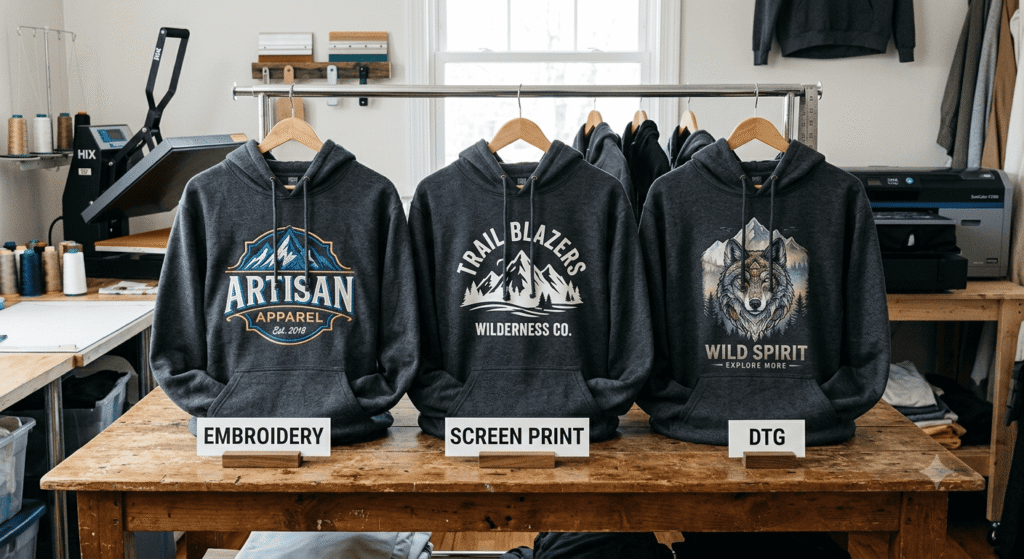
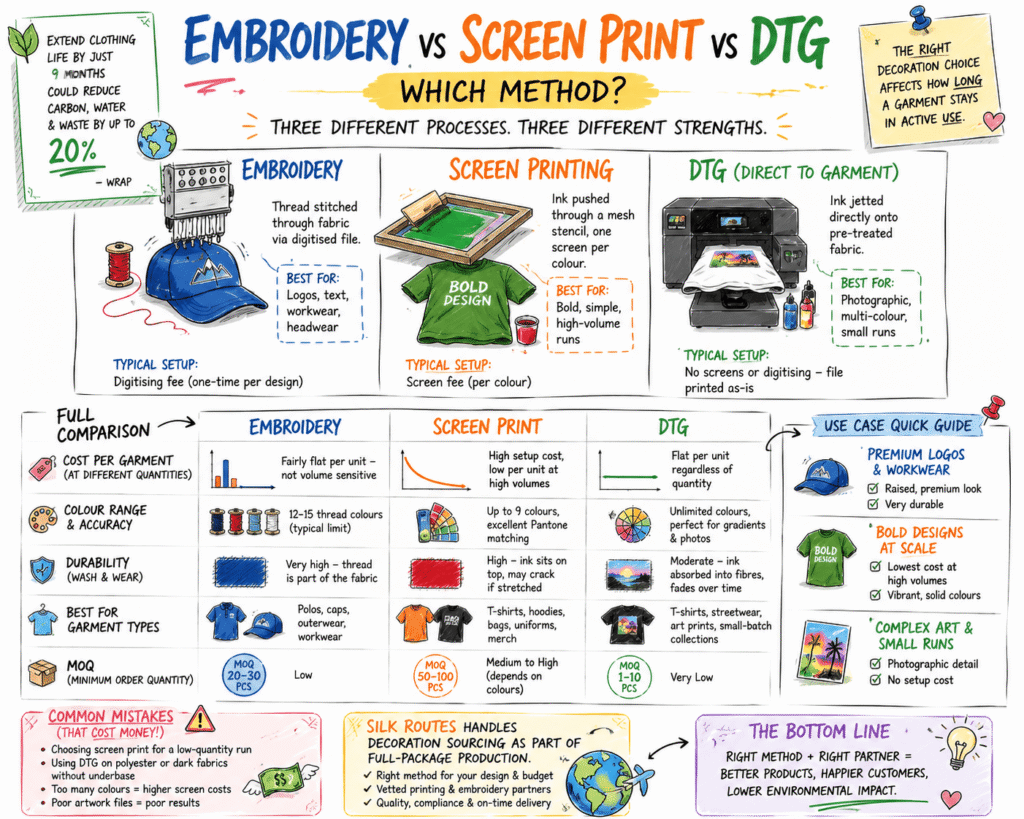
Embroidery, screen printing, and DTG dominate garment decoration for different reasons — thread stitched into fabric, ink pushed through a mesh screen, and ink jetted directly onto the surface each behave differently under wear and wash. WRAP’s clothing durability research shows that extending the average life of clothing by just nine months could reduce carbon, water, and waste footprints by up to 20%, which makes decoration choice more than a cosmetic decision — it affects how long a garment stays in active use. This guide breaks down cost, durability, colour range, and MOQ across all three methods so you can pick the right one for your garment type and order volume.
In this article:
- How embroidery, screen printing, and DTG each work, and where their costs sit
- A full side-by-side comparison across cost per unit, colour range, durability, and MOQ
- Which method suits which garment type — logos, workwear, streetwear, activewear
- Common decoration mistakes that cost brands money and rework
- How Silk Routes handles decoration sourcing as part of full-package production
Contents
- 1. The Three Main Clothing Decoration Methods — Overview
- 2. Embroidery — How It Works, Costs, and Best Use Cases
- 3. Screen Printing — How It Works, Costs, and Best Use Cases
- 4. DTG (Direct to Garment) — How It Works, Costs, and Best Use Cases
- 5. Full Comparison: Embroidery vs Screen Print vs DTG
- 6. Which Method Is Right for Your Garment Type?
- 7. Which Method Is Right for Your Order Volume?
- 8. Common Decoration Method Mistakes
- 9. The Silk Routes Approach to Garment Decoration
- 10. FAQ
- 10.1. Can you combine embroidery and DTG or screen printing on the same garment?
- 10.2. Does embroidery work on stretch or activewear fabric?
- 10.3. How many wash cycles does a screen print typically survive before fading?
- 10.4. Is DTG suitable for dark or black garments?
- 10.5. What’s the minimum digitising cost for an embroidered logo?
The Three Main Clothing Decoration Methods — Overview
Each method applies design to fabric through a completely different mechanical process.
| Method | How It Applies | Best For | Typical Setup |
|---|---|---|---|
| Embroidery | Thread stitched through fabric via digitised file | Logos, text, workwear, headwear | Digitising fee (one-time per design) |
| Screen Printing | Ink pushed through a mesh stencil, one screen per colour | Bold, simple, high-volume runs | Screen fee (per colour) |
| DTG | Ink jetted directly onto pre-treated fabric | Photographic, multi-colour, small runs | No screens or digitising — file printed as-is |
Screen printing and embroidery both add a physical layer to the garment — ink sitting on top, or thread stitched through. DTG instead deposits ink into the fibres themselves, which changes how it wears over time.
Embroidery — How It Works, Costs, and Best Use Cases
Embroidery starts with digitising: converting an image into a stitch file an embroidery machine can read. This is a one-time cost per design, independent of order quantity. Because machine time — not ink or setup — drives the price, the cost per garment stays fairly flat whether you order 20 units or 2,000.
| Factor | Detail |
|---|---|
| Setup cost | Digitising fee, charged once per design |
| Cost driver | Stitch count and design size, not colour count |
| Colour limit | Practical limit around 12–15 thread colours per design |
| Fabric fit | Works on almost any fabric weight, though very lightweight fabric can pucker |
Embroidery is the method most associated with a premium finish — the raised, textured stitch reads as higher quality on polo shirts, caps, and outerwear than a flat print does.
Screen Printing — How It Works, Costs, and Best Use Cases
Screen printing requires one physical screen per colour in the design, each one hand-cut or exposed before a single garment is printed. That upfront cost is the reason screen printing rewards volume: once the screens exist, the marginal cost of printing another 500 units is low.
| Factor | Detail |
|---|---|
| Setup cost | One screen per colour, prepared before production starts |
| Cost driver | Number of colours, then quantity |
| Colour limit | Typically capped around 9 colours per design |
| Fabric fit | Best on cotton and cotton-blends; ink sits on top of the fibre |
Screen print facilities in the UK fall under COSHH regulations for handling printing inks and solvents — Silk Routes’ partner printers follow the HSE’s control guidance covering screen processes from stencil generation through ink mixing and screen reclamation, which matters if you’re auditing a decoration supplier’s health and safety practices before committing to a contract.
For brands producing their first small-batch collection through Silk Routes’ clothing manufacturing services, decoration method is one of several sourcing decisions worth locking in before bulk cut begins — it affects lead time as much as it affects unit cost.
DTG (Direct to Garment) — How It Works, Costs, and Best Use Cases
DTG printers work like a specialised inkjet printer for fabric — the design is jetted directly onto pre-treated cotton, with no screens and no digitising file required. That absence of setup cost makes DTG the cheapest entry point for a single sample or a run of 10 units, but the per-unit cost doesn’t fall much as volume climbs, since there’s no screen cost to amortise.
| Factor | Detail |
|---|---|
| Setup cost | None — file goes straight to the printer |
| Cost driver | Roughly flat per unit regardless of design complexity |
| Colour limit | Unlimited — full CMYK gradient printing |
| Fabric fit | Needs high cotton content; struggles on polyester and dark garments without an underbase layer |
DTG excels at photographic and multi-colour artwork that would need a separate screen for every colour under screen printing.
Full Comparison: Embroidery vs Screen Print vs DTG
Cost Per Garment at Different Quantities
At low volumes (under 50 units), DTG and embroidery are usually the cheapest because neither carries a screen-based setup charge. Once a run climbs past a few hundred units, screen printing’s flat per-colour setup cost gets spread across more garments, typically making it the lowest cost per unit for large, simple designs.
Colour Range and Accuracy
DTG has no practical colour limit and handles gradients and photographic detail that screen printing cannot reproduce economically. Screen printing gives the most accurate spot-colour and Pantone matching for brand-specific colours, since each ink is mixed and applied separately. Embroidery is constrained by thread colour count, so gradients and fine colour blending aren’t achievable.
Durability and Washability
Embroidery is generally the most durable of the three, since the thread is structurally stitched into the fabric rather than sitting on or in it. Screen printing with quality inks holds up well through repeated washing, though the print sits on the surface and can crack over very long-term wear on high-flex areas. DTG durability depends heavily on wash care — mainstream commercial guidance across multiple UK and US suppliers puts typical DTG print life in a comparable range to screen printing, though ink soaks into the fibre rather than coating it, giving a softer hand-feel that fades gradually rather than cracking.
MOQ Requirements
Embroidery and DTG both work at MOQ 1, since there’s no per-colour setup that needs volume to justify it. Screen printing typically has a stated minimum order size at most UK print suppliers, since one-off screen setup at low quantity makes the per-unit cost impractical.
Which Method Is Right for Your Garment Type?
| Garment Type | Recommended Method | Why |
|---|---|---|
| Polo shirts, caps, uniforms | Embroidery | Premium, durable finish that survives repeated commercial laundering |
| Event tees, band merch, bulk basics | Screen printing | Lowest cost at volume for simple, bold designs |
| Streetwear, photographic graphics | DTG | Full colour range with no per-colour cost penalty |
| Activewear, technical fabrics | Screen printing (water-based) or DTG | Embroidery can restrict stretch and add unwanted weight |
“Match the decoration method to how the garment will actually be worn and washed — not just to what looks best in a mockup.” — Silk Routes Manufacturing Team
Which Method Is Right for Your Order Volume?
| Order Volume | Best Value Method | Reasoning |
|---|---|---|
| 1–50 units | DTG or embroidery | No setup cost penalty at this scale |
| 50–500 units | Depends on colour count | Screen printing overtakes DTG once colour count is low and volume climbs |
| 500+ units | Screen printing (simple designs) or embroidery (logos) | Screen setup cost fully amortised; embroidery cost stays flat regardless |
“Startups often lock into one decoration method for every product, then wonder why unit economics don’t work at scale. Match the method to the specific SKU, not the brand as a whole.” — Silk Routes Manufacturing Team
Common Decoration Method Mistakes
Mistake 1: Choosing embroidery for a highly detailed, multi-gradient design. Why it happens: brands see embroidery as “premium” and default to it regardless of artwork. Fix: run the artwork through a digitising assessment first — if it needs more colours or finer detail than embroidery can reproduce, switch to DTG.
Mistake 2: Ordering screen printing below the supplier’s practical MOQ. Why it happens: brands don’t realise per-colour screen setup cost until the quote comes back. Fix: get a quote before committing to screen printing for runs under roughly 50–100 units — DTG is often cheaper at that scale.
Mistake 3: Printing DTG onto polyester or poly-blend fabric. Why it happens: DTG ink is formulated to bond with cotton fibres, and this limitation isn’t always flagged upfront. Fix: confirm fabric composition with the decorator before committing artwork — high-cotton blends (80%+) generally still work.
Mistake 4: Skipping a physical sample before the bulk run. Why it happens: brands approve a digital mockup and assume colour and placement will translate exactly. Fix: always request a strike-off or physical sample, since screen colour, thread colour, and fabric dye lot can all shift the final result slightly from the mockup.
The Silk Routes Approach to Garment Decoration
Silk Routes treats decoration method as part of the tech pack, not an afterthought bolted on after sampling. Every decoration recommendation is matched to the garment’s fabric, end use, and order volume before cut begins, using the same fabric and trim sourcing process outlined in the complete guide to tech pack to production. This avoids the common scenario of a brand approving artwork that later turns out to be technically unsuitable for their chosen method or fabric.
To see how decoration decisions fit into the wider production relationship, read more about Silk Routes.
FAQ
Can you combine embroidery and DTG or screen printing on the same garment?
Yes — a common combination is an embroidered chest logo paired with a DTG or screen-printed back graphic. Each decoration is applied and costed separately, so a garment using two methods carries two setup costs rather than one.
Does embroidery work on stretch or activewear fabric?
Embroidery can work on stretch fabric but requires backing material to stabilise the stitch area, which adds a small amount of stiffness across roughly a 2–3cm zone around the design. For activewear that needs to stretch freely across the chest, screen printing or DTG is usually the better choice.
How many wash cycles does a screen print typically survive before fading?
With quality plastisol or water-based ink and correct curing, screen prints typically survive over 50 domestic wash cycles before noticeable fading, though care instructions and wash temperature affect this range significantly.
Is DTG suitable for dark or black garments?
DTG can print on dark garments, but it requires a white ink underbase layer applied before the colour print, which adds a processing step and can very slightly affect the final texture on the printed area compared to light garments.
What’s the minimum digitising cost for an embroidered logo?
Digitising cost depends on design complexity, but as a general rule it’s a one-time fee per unique design — a single-colour text logo digitises faster and more cheaply than a multi-colour illustrated design with fine detail.